Fragrance Profiles Inspired by Mediterranean Coastal Destinations
Transform Mediterranean coastlines into layered home scents with the right diffuser technology.

Recreating a luxury hotel scent experience at home starts with a coherent fragrance profile. Mediterranean coastal destinations offer distinct combinations of citrus, florals, herbs, woods, and sea-air notes that homeowners can match to a room’s purpose. A programmable, waterless cold air diffuser then helps control the balance, making timing and intensity as important as the oil itself.
Why Mediterranean coastal destinations generate such recognizable scent identities
Citrus orchards, salt air, coastal scrub, sun-warmed stone, and wild florals give Mediterranean coastlines a shared sensory vocabulary. Their botanical, geological, and climatic conditions bring these materials together, but each place gives them a different emphasis. A lemon grove above a cove suggests a different composition from lavender hills behind a driftwood shore.
Fragrance translates that landscape into layers. Bergamot, lemon, blood orange, and grapefruit supply bright top notes, while lavender, rosemary, jasmine, neroli, and orange blossom form the heart. Amber, sandalwood, driftwood, and cedarwood provide the warmer base. Febreze’s 2026 Scent of the Year, Tranquil Cyprus Coves, uses citrus, nectarine, and sea breeze to “transport you to a sun-kissed Mediterranean island.”
How the fragrance grammar divides into distinct sub-profiles, each suited to different rooms and moods
Citrus Grove combines bergamot, lemon, neroli, and blood orange for an uplifting morning register. Coastal Fresh / Aquatic uses sea salt, marine accords, driftwood, and light woods for airy shared spaces and bathrooms. Herbal Sunlit brings lavender, rosemary, thyme, and sage into work or meditation spaces, while Warm Amber Coastal gives afternoon and evening rooms depth through amber, sandalwood, and warm woods. White Floral Marine blends jasmine, orange blossom, or neroli with aquatic notes for use in bedrooms and when entertaining.
These categories are a sorting tool. A blend can cross several of them, but its dominant register helps distinguish a kitchen scent at 7am from a bedroom scent at 10pm. With a smart cold-air diffuser such as those from Aura House, programmed intensity and timing can give a single Citrus Grove oil morning brightness and evening restraint. The composition stays the same while its presence in the room changes.
Santorini: the salt-kissed floral profile and how to recreate it at home
Santorini’s atmosphere rests on the contrast between volcanic stone, salt wind off the Aegean, and terrace blooms. Tiare flower and island palm make its fresh-floral scent feel exotic, while the marine notes keep it clean. This is White Floral Marine. Its appeal lies in the impression of flowers exposed to open air.
To translate that atmosphere at home, the defining relationship is between the floral notes and their aquatic counterweight. Open living spaces give the combination room to read as airy, while a bedroom brings out its romantic register. A waterless cold-air diffuser keeps that delicate balance free of added heat or water. Aura House offers programmable scheduling for this kind of controlled delivery, as one option for managing a floral-aquatic oil. In a smaller or enclosed room, short cycles matter because the floral side can intensify quickly, turning an inviting atmosphere into saturation.
Sorrento and the Amalfi Coast: the citrus-coastal profile that defines southern Italy's scent
The Amalfi Coast shifts the emphasis from terrace flowers to lemon groves and sea cliffs. Its grammar is crisp and citrus-led, with watery freshness suggesting the coves below. The Sorrento Breeze destination concept brings garden and sea together with cucumber flower, wild daisy, and bamboo waters. It illustrates an important distinction between reproducing a landscape’s dominant material and expressing its atmosphere through complementary notes.
Sicily offers a related but different accent. Tom Ford’s Taormina Orange layers sun-ripened orange with aromatic Mediterranean herbs, warm woods, and soft musks, giving the broader citrus profile a warmer foundation. Sorrento’s watery garden character should therefore not be treated as interchangeable with Sicily’s orange-and-herb register.
Profiles led by citrus work well in kitchens, home offices, and entryways in the morning and through the day. Their brightness brings an energizing character, while watery notes keep the composition from feeling heavy. Heat can flatten volatile citrus top notes, which makes heat-free delivery a good fit here. For these high-traffic spaces, the waterless cold-air approach used by Aura House is one way to preserve the crispness that makes the profile worth choosing.
The French Riviera and Nice: the herbal-lavender coastal profile and its grounding quality
Nice moves away from citrus groves toward the lavender grown in the hills behind the coast. White driftwood, ocean moss, and blue lavender form a destination concept that joins an earthy botanical note to the shore. The result is grounding rather than insistently energizing. It offers brightness with its feet on the ground, which explains its place in the Herbal Sunlit family.
The wider Côte d’Azur scent family also has room for a more complex blend. BDK Parfums’ Citrus Riviera opens with bright mandarin, Italian lemon, neroli, and fig, introduces orange blossom and jasmine, and grounds the whole with patchouli and vetiver. A lavender-dominant version is particularly adaptable, functioning as a focused daytime scent in a study or a softer evening presence in a bedroom. Lavender is generally considered lower-risk at diffused concentrations in households with dogs, but that does not make every lavender-containing blend unconditionally safe.
Monaco and the Italian Riviera: the clean-cotton and sea-air profile for understated luxury
Monaco and the broader Italian Riviera offer a quieter register built around warmth, laundered fabric, and sea air. The Sun-Drenched Cotton destination concept expresses it through clean cotton, creamy coconut, and soft white woods. Its reference points are cobblestone streets and outdoor lunches. Luxury here comes from restraint.
That restraint has a practical role in rooms where guests spend extended periods. A low-projection scent works well in dining rooms, open-plan living areas, and guest rooms because it sets a mood without drawing attention to itself. Yet a subtle blend is not necessarily an easy blend to deliver. Imprecise heat- or water-based diffusion can flatten its character or make its musk base too prominent. The Monaco profile needs close control over concentration so that the scent stays just strong enough to notice.
Dior's Eden-Roc and the pine-marine-citrus profile of the Cap d'Antibes coastline
The Cap d’Antibes coastline brings several Mediterranean scents together in one blend. The profile of a fragrance associated with a coastal hotel combines marine saltiness, luminous citrus, and the resinous pine character of the trees along the rocky shore. Rather than letting one botanical carry the destination, this grammar relies on a layered structure.
For a homeowner choosing a diffuser oil, this is a useful lesson in top, heart, and base notes. The lighter aquatic and citrus notes register first near the diffuser, the floral middle carries through the space, and the resinous base supplies background warmth. The base anchors the brighter opening. Heat-based delivery can upset that balance by making volatile top notes evaporate too fast, leaving the heavier notes to take over. Cold air diffusion matters here because the oil’s layered character, rather than just its strongest surviving note, is the point.
The fig-and-coastal-scrub profile: Sicily, Sardinia, and the vegetal Mediterranean interior
Moving inland from the open water reveals a less expected Mediterranean register. The coastal scrub of Sicily and Sardinia brings fig leaf, wild herbs, and the tannic character of plants growing in dry, mineral-rich soil beside the sea. This is greener and more vegetal than the region’s familiar citrus or aquatic profiles. It is also a reminder that a coastal fragrance need not smell primarily of water.
In a home library or study, that green character can support a grounding, nature-forward atmosphere. In a bathroom, it offers a herbal alternative to spa-style aquatics. The distinction is important because fig leaf’s vegetal bitterness is an acquired taste. Homeowners trying it should start with a short diffuser cycle to see whether the green-tannic scent works in the room. A programmable interval makes that trial manageable before any commitment to continuous diffusion.
Barcelona and the western Mediterranean: the warm-fruit coastal profile for evening atmosphere
Barcelona takes the scene from quiet coastal terraces to warm, humid air, tropical fruit, and nightlife outdoors. This western Mediterranean register is more festive than the pastoral accents of the Italian and French coasts. It sits closest to Warm Amber Coastal, with warmth and abundance taking precedence over herbal restraint. The mood is social without requiring the formality of a floral blend.
That makes warm-fruit profiles a good fit for evenings with guests in living rooms and dining rooms. They have a fuller scent than the quiet clean-cotton style, but there is a limit to how sweet they should be. In a warm, enclosed room, full-output diffusion can turn inviting fruit notes cloying. A timed cycle synchronized with the gathering keeps the fragrance in proportion to the occasion.
How do you make your house smell like a five-star hotel with a Mediterranean diffuser setup
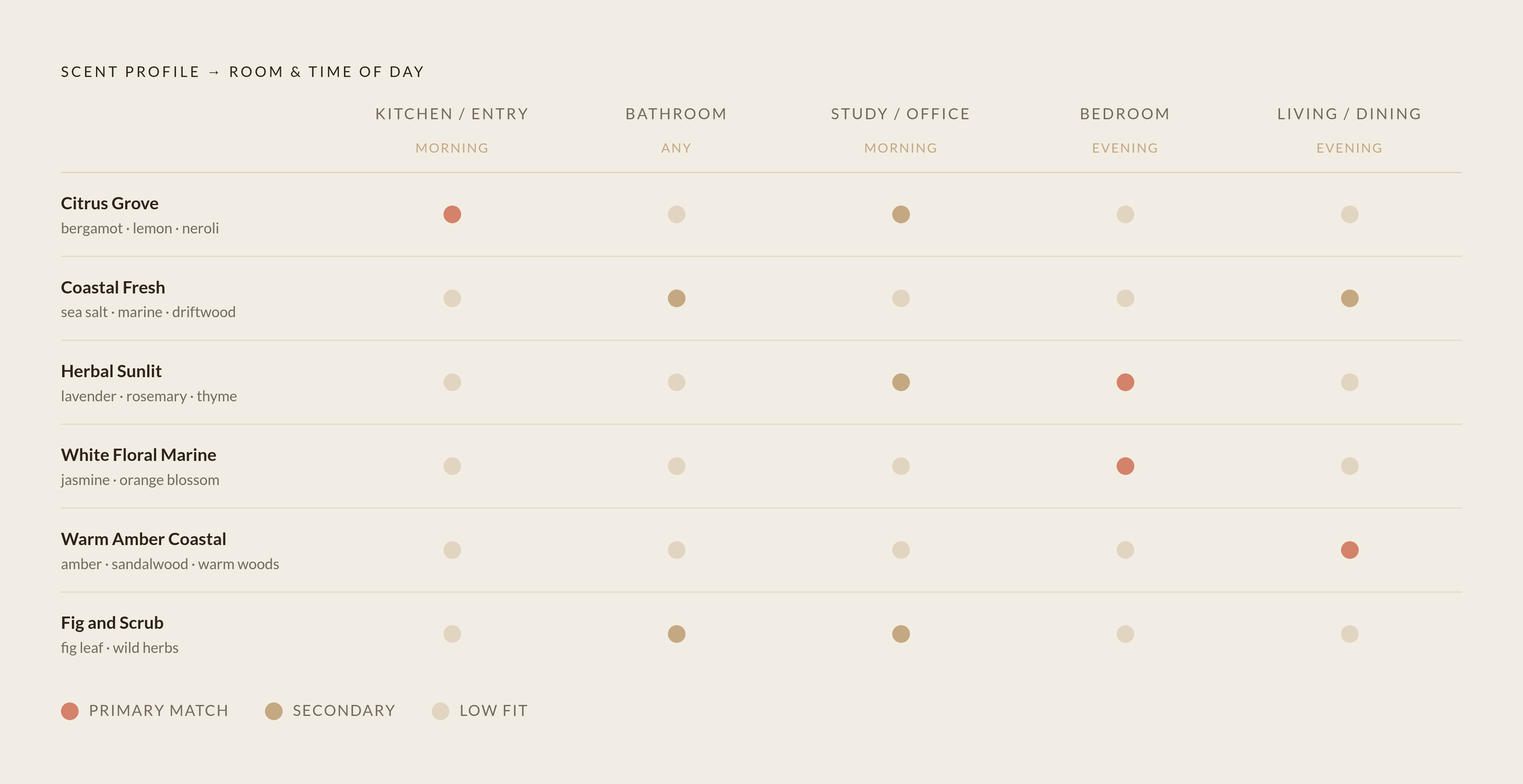
A home setup requires three linked decisions, namely the room’s purpose, the oil’s dominant notes, and the diffuser output appropriate to the space. Citrus Grove works well in entryways, kitchens, and home offices during the day, while Coastal Fresh / Aquatic works in bathrooms and open-plan living areas at low intensity. Herbal Sunlit works well in studies and in bedrooms in the evening, White Floral Marine suits bedrooms or guest rooms on timed cycles, and warmer amber or fruit profiles work well when entertaining. Fig and Scrub is a lower-intensity choice for libraries, reading rooms, and bathrooms.
Cold air diffusion avoids heat and water, preserving volatile citrus notes without diluting the floral middle or heating the woody base. Positioning the diffuser at mid-height and away from direct airflow gives the lighter notes a chance to develop across the space. For a large room, distribution and adjustable output control how widely and intensely the scent is delivered. Aura House’s smart cold air diffusers have schedules that can be set to suit each room, while its Aura Whole Home Diffuser can run on its own or connect to HVAC.
Set the schedule to suit how the room is used, with breaks between cycles for each profile. Citrus can accompany the first part of the morning, while lavender-coastal or floral-marine bedroom cycles can start shortly before sleep and continue at intervals. Aura House recommends a qualified HVAC installer for assistance with an HVAC setup.
Choosing and maintaining a fragrance oil for a Mediterranean-profile diffuser
The oil label should say what is in the chosen destination profile. An umbrella “fragrance” description cannot tell a homeowner whether bergamot and lemon notes come from those botanicals or from synthetic approximations. Transparent composition therefore matters when evaluating an oil’s character and consistency. Clean, vegan, cruelty-free formulations are criteria to look for, without treating those terms as proof of a wellness benefit. Aura House fragrance oils are one option formulated for transparency and compatibility with cold air diffusion.
Lavender and bergamot require attention to properly diffused concentrations in homes with dogs, and their presence does not establish the safety of an entire formula. Homeowners with cats should consult their vet and prioritize lower-intensity cycles. A destination name describes an atmosphere.
Once the oil is chosen, routine cleaning helps preserve the distinctions that made the choice worthwhile. Residue from an earlier blend can muddy bright citrus and make different destinations smell alike. Clean the diffuser when switching sub-profiles, especially when moving from resinous or amber-based oils to light citrus or aquatic blends. That small act of care gives the next composition a clean start and keeps the room faithful to its intended atmosphere.