Cat-Safe Home Fragrance Options for Scent Lovers
Cats lack the liver enzyme to clear fragrance compounds, making scent safety complicated.
Home fragrance is having a moment. The U.S. market alone was valued at $2.6 billion in 2025, and a good chunk of that spend is happening in living rooms and bedrooms where a cat is also, statistically speaking, asleep on the couch. This piece is about the collision of those two facts: what happens when scent lovers who also happen to be cat owners try to have both a good-smelling home and a cat that doesn't end up at the emergency vet. The short answer is that it's possible, but it depends on two things people rarely think about separately: which ingredients you're using, and how you're getting them into the air.
Why cats metabolize fragrance compounds differently than other pets
Cats are not small dogs, and they are definitely not small humans, no matter how much your cat seems to believe otherwise when she's sitting on your keyboard during a work call. The actual issue is enzymatic. Cats lack sufficient UDP-glucuronosyl transferase, a liver enzyme responsible for breaking down phenols and a handful of other compounds common in fragrance products. Dogs have it, and humans have it too. Cats mostly don't, and that gap doesn't shrink no matter how "gently" you introduce the compound.
This matters because it changes the entire risk calculation. In humans, we tend to think about fragrance exposure the way we think about spicy food: too much at once causes a problem, but small amounts are fine indefinitely. Cats don't get that luxury, since without the enzyme to clear certain compounds, those compounds build up in the liver over repeated exposure rather than getting flushed out. So it isn't strictly a "how much did she inhale in one sitting" problem; it's a "how many afternoons in a row was the diffuser running" problem. Chronic, low-grade exposure can be just as much of an issue as one big whiff.
Why does this matter for the rest of the article? Because it means the standard advice you'd give a dog owner (dilute it, keep the room ventilated, don't let him lick it) doesn't transfer cleanly to cats. A dog's liver is doing enzymatic heavy lifting that a cat's liver simply is not built for.
And exposure isn't limited to one pathway anyway. There are three, and cat owners tend to only think about the first one.
- Inhalation. Airborne particles from a diffuser, spray, or candle, breathed in over the course of an evening.
- Skin absorption. Oil residue settling on fur, which then gets absorbed through the skin.
- Ingestion. This is the one people miss. Cats groom themselves obsessively, several times a day, and whatever landed on their coat during the last diffusing session gets licked off during the next grooming session.
That third pathway is why diffuser users in particular need to pay attention. Nebulized particles don't just float around and dissipate; a portion of them settle on surfaces, including the cat. A cat sitting six feet from a running diffuser for an hour is going to end up with some of that mist on her fur, and she is, by nature, going to lick it off later. This isn't some rare edge case dreamed up by an overly cautious vet. It's just what cats do, constantly, as part of being cats.
Some cats carry more risk than others. Kittens under ten weeks, cats with asthma or heart disease, short-nosed breeds, and pregnant or elderly cats are flagged as higher-risk populations by veterinary sources including VCA and PetMD. If any of those describe your household, the margin for error shrinks considerably.
One myth worth killing early: "natural" doesn't mean safe. PetMD specifically flags this misconception, because essential oils, being plant-derived, sound inherently gentler than synthetic fragrance. They're not, and the reason is biological rather than semantic. Plants produce some of the most potent chemical compounds on earth, largely because plants can't run away from things that want to eat them, so they've evolved to be toxic instead. Cats didn't get the evolutionary memo that says "this plant compound is fine in small amounts," because for them, structurally, it often isn't.
Which specific fragrance ingredients are known to be harmful to cats
Here's the list that shows up again and again across veterinary literature, the one worth actually memorizing if you're a scent-and-cat household: tea tree (melaleuca), peppermint, eucalyptus, cinnamon, clove, pine, wintergreen, and some citrus oils. Jasmine essential oil gets a specific callout from Lola Hemp as well, which surprises people, since jasmine reads as a soft, unassuming floral note rather than something in the same danger tier as tea tree.
Heat makes this worse, not better. WebMD notes that heating essential oils actually produces more toxic compounds than the raw oil itself contains. That's a genuinely important detail, because it means an oil that presents relatively lower risk in a cold, unheated context can become considerably more hazardous the moment you put it near a flame or a heating element. Chemistry doesn't sit still just because you wanted a cozy evening.
So what does toxicity actually look like, in real time, in a real cat? VCA lists drooling, vomiting, lethargy, difficulty breathing, and pawing at the mouth as the tell-tale signs. In cats that already have asthma or heart disease, even fairly low concentrations, ones that wouldn't bother a healthy cat at all, can trigger acute respiratory distress or a coughing fit that doesn't quit. If you see any of that, this is not a "let's wait and see" situation. Call the ASPCA Animal Poison Control Center at 888-426-4435 or the Pet Poison Helpline at 855-764-7661, and save both numbers in your phone now, not later, because "later" is usually a bad time to be looking things up.
The ingredient list matters enormously. But it's only half the equation, and the half most articles stop at. How that ingredient gets into the air, whether it's heated, aerosolized, or just sitting passively in a reservoir, changes the actual risk your cat faces. That's where we're headed next.
How the delivery method changes the level of risk
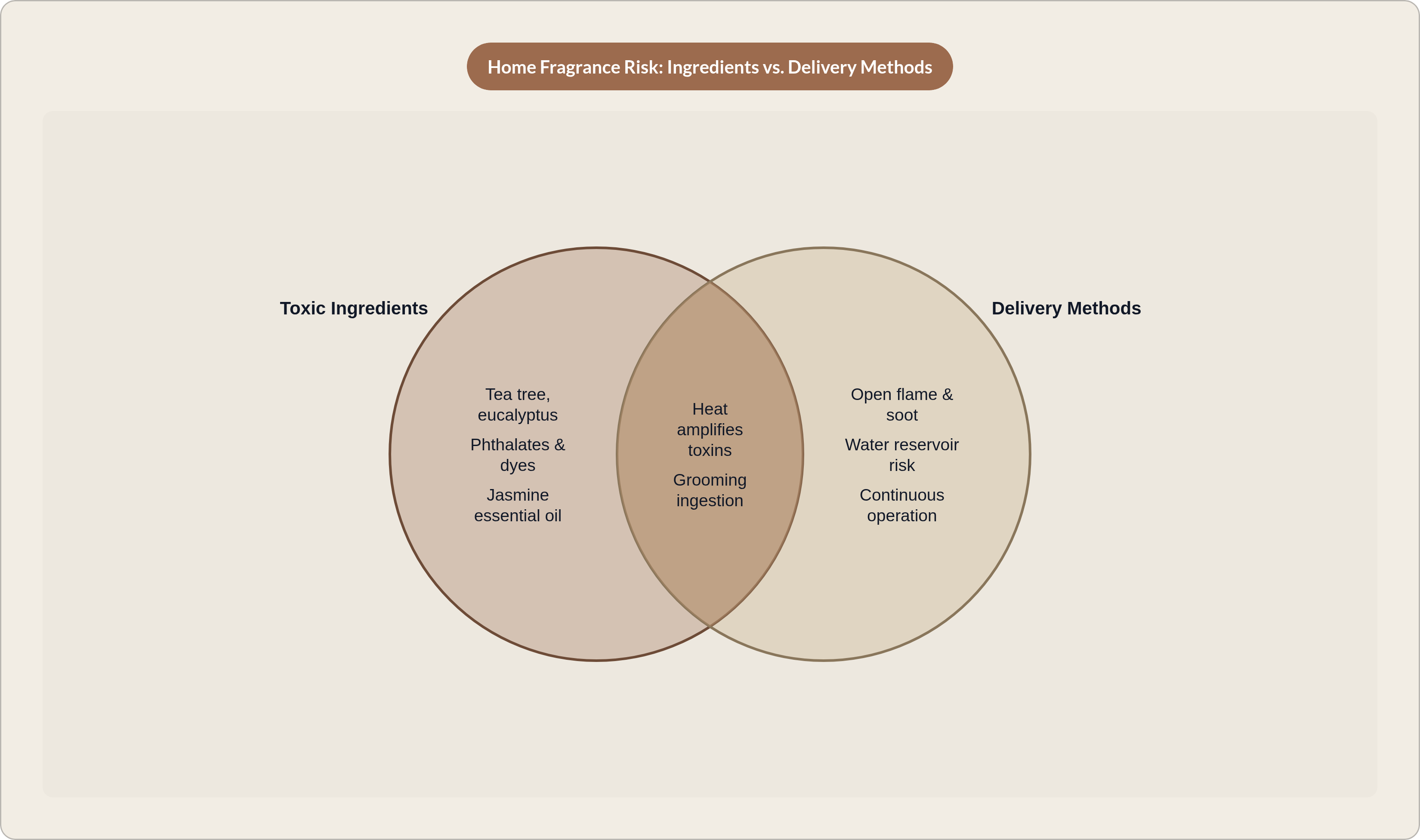
Think of risk as a simple multiplication problem: ingredient toxicity times exposure intensity. The ingredient is one variable. The delivery method is the other, and it's the one people consistently ignore, because we tend to fixate on labels and forget that a candle, a spray, and a diffuser are putting fundamentally different physical processes into motion.
Delivery method determines a handful of concrete things: how concentrated the airborne particles get, whether heat is altering the compound's chemistry as it's released, whether residue lands on the surfaces a cat naps on or grooms from, and whether the cat can physically get to the fragrance source and knock it over, lick it, or fall in it (cats have a talent for the third one).
Quick overview before we go format by format in the next several sections:
Candles bring an open flame, incomplete combustion, and soot into the mix, on top of whatever's in the wax. Ultrasonic diffusers use a water reservoir that dilutes the oil, but cats have been known to drink from standing water sources, reservoir included. Reed diffusers are passive and need no electricity, but the reservoir holds a high concentration of oil that a curious cat can access directly. Sprays and plug-ins split into a single burst versus continuous low-level release, with different exposure patterns for each. Cold-air nebulizing diffusers use no heat and no water, just a dry micro-particle mist, and that combination puts them at the lower-risk end of the spectrum, assuming the oil itself is clean.
Here's the principle to carry through the rest of this piece: no delivery method makes a toxic ingredient safe. Delivery method changes how much of a compound reaches your cat and by which route, but it doesn't detoxify anything, and a cold-air diffuser running jasmine oil is still running jasmine oil.
What makes candles the most layered risk for cat households
Candles get their own section because they stack risks in a way nothing else on this list does. Start with the boring, non-fragrance-related part: an open flame, a pool of hot wax, and a cat are not a great combination independent of what scent is involved. Cats jump on things, cats knock things over, and cats seem to possess an almost supernatural instinct for finding the one unstable surface in a room. A lit candle on a side table is a tipping hazard waiting for a slightly too-enthusiastic tail swipe.
Then there's the combustion chemistry, which is its own problem entirely. Paraffin wax, a petroleum byproduct, releases volatile organic compounds when burned. The EPA notes that indoor VOC concentrations can run up to 10 times higher than outdoor levels, and cats, unlike the humans who occasionally step outside for fresh air, spend nearly all their time indoors. There's no "let me go for a walk to clear my lungs" option for a housecat. Lower-quality candles compound this with synthetic fragrance additives and phthalates, both known respiratory irritants, and some imported candles still use metal-cored wicks, zinc or lead, despite bans on the practice in some regions.
None of this means candles are off the table entirely. It means the bar for what counts as an acceptable candle is higher than most people realize. Look for 100% soy, coconut, or beeswax, which burns cleaner and produces meaningfully less soot than paraffin. Look for a cotton or wood wick with no metal core, and look for fragrance free of phthalates, parabens, and synthetic dyes. One Fur All's Pet House Candles are a reasonable benchmark here: 100% natural soy wax, a lead-free cotton wick, non-toxic fragrance, a 60 to 70 hour burn time, and more than 30 scent options, which tells you clean formulation and actual scent variety aren't mutually exclusive.
Even with the cleanest candle available, a few management habits still matter. Burn it in a room with airflow, never somewhere your cat is shut in with no way out, and place it somewhere she genuinely cannot reach or topple. Limit burn time so you're not accumulating hours of airborne exposure over the course of a day. And give your cat the option to leave the room if she wants to; a closed door removing that option defeats most of the other precautions you just took.
The honest bottom line: a well-formulated candle is meaningfully safer than a cheap one, but the open flame and the combustion byproducts are baked into the format itself. No ingredient swap makes that go away entirely.
Where reed diffusers, room sprays, and plug-ins fall on the risk spectrum
These three formats don't behave like each other at all, so let's take them one at a time.
Reed diffusers skip the heat and the electricity, relying on passive evaporation through wooden reeds. That's a point in their favor: lower exposure intensity than a burning candle, no flame to worry about. But the liquid sitting in that glass reservoir is typically a fairly concentrated blend of fragrance or essential oil, and the main danger isn't the ambient air; it's a cat that decides to investigate the bottle directly, either by knocking it over or sticking her nose right up to it. Direct contact with the reservoir delivers a far higher dose than anything drifting through the air ever would. Placement solves most of this: high, stable surfaces, away from the paths your cat actually walks.
Room sprays are a different animal entirely, a single burst rather than a steady drip. A spray puts a lot of fine droplets into the air at once, and those droplets land quickly on furniture, fabric, and floor, the exact surfaces a cat lies on, walks across, and later grooms herself from. There's no lingering airborne exposure the way there is with a diffuser, but that immediate surface deposit is the actual concern. The fix is almost embarrassingly simple: spray, then keep the cat out of the room for a few minutes while things settle, then let her back in.
Plug-in warmers and wax melts run continuously and use low-level heat, which brings us back to that WebMD point about heated oils generating more toxic compounds than unheated ones. Add to that the fact that plug-ins in low outlets sit right at cat height, and wax melt warmers tend to sit on accessible surfaces rather than being tucked away. Continuous operation also means continuous low-level exposure, which can accumulate in a room without much airflow.
Ultrasonic water-based diffusers deserve a specific mention, because they're often marketed as the pet-friendly option. Water does dilute the oil concentration in the resulting mist, and people take that dilution as evidence of safety. But diluting a toxic compound doesn't make it non-toxic; it just makes the dose smaller per breath. Worse, the water reservoir itself is a hazard cats have direct access to, since cats will drink from more or less any standing water they find, including a bowl full of diluted essential oil. The mist still lands on fur and nearby surfaces too, so the grooming-ingestion pathway from earlier hasn't gone anywhere.
The through-line across all three formats: none of them are unmanageable, but all of them require the owner to actually pay attention. Set it and forget it doesn't really apply here.
Why cold-air diffusion sits at the lower-risk end of the delivery method spectrum
Cold-air diffusion works by using high-velocity air pressure to break fragrance oil into an extremely fine, dry micro-particle mist, with no heat involved, no water reservoir, and no flame. That sounds almost too simple to matter, but each of those absences removes a specific risk we've already covered.
No heat means the oil's chemistry stays exactly what it was in the bottle; nothing is being converted into a more toxic compound the way WebMD describes happening with heated essential oils. No flame means no combustion byproducts, no soot, no VOC generation from burning wax or wick. No water reservoir means there's nothing for a cat to drink or knock over as a liquid oil-water mixture, and no standing water sitting around to grow mold or bacteria in the device itself.
Coverage is another practical advantage. Cold-air units cover an area up to twice the size that ultrasonic diffusers manage, which sounds like a marketing detail until you realize what it actually means: you can hit the same scent intensity in a room while running the device at a lower operational concentration. Less oil in the air for the same perceived result.
Output is also more predictable. A cold-air diffuser's intensity stays consistent whether the reservoir is full or nearly empty, so you don't get the unpredictable spikes you sometimes see with other formats as they run low. Add smart scheduling into the mix, setting the device to run in intervals rather than continuously, and you cut total airborne concentration over the course of a session while giving the air time to clear between cycles. That matters quite a bit if your cat naps in that exact room most afternoons, which, statistically, she does.
Here's the caveat, and it's worth stating plainly rather than burying it: cold-air diffusion reduces exposure, it does not eliminate risk from a bad ingredient. The particles are still airborne, they still settle on fur, and grooming ingestion is still a live pathway. Running tea tree oil through a cold-air diffuser is safer than heating it, sure, but "safer than the worse option" is not the same thing as "safe."
Which is exactly why the oil you put into that diffuser is the piece that determines whether the whole setup actually works.
What to look for in fragrance oils when cats live in the home
Start with transparency, because it's the fastest filter you have. If a company won't tell you what's in the bottle beyond the word "fragrance," you have no way to evaluate it, and that opacity is itself the warning sign. A clean product doesn't need to hide behind a vague catch-all term.
Rule out the same list from earlier, regardless of which delivery format you're using: tea tree, peppermint, eucalyptus, cinnamon, clove, pine, wintergreen, citrus oils, and jasmine. Also rule out phthalates, the synthetic stabilizers linked to respiratory irritation, along with other synthetic VOC-generating additives and artificial dyes.
A genuinely lower-risk oil formulation reads clearly on the label: a published, legible ingredient list, none of the flagged essential oils above, no phthalates or parabens, and ideally a vegan, cruelty-free formulation, which tends to correlate with tighter manufacturing standards overall. None of that is a guarantee, exactly, but it's a reasonable proxy.
Concentration still matters even once you've cleared the ingredient hurdle. A diffuser with scheduling controls lets you run shorter, lower-intensity cycles instead of leaving it on full blast all day, which cuts your cumulative airborne load regardless of how clean the oil itself is. That kind of clarity is what makes a real cat-safety evaluation possible in the first place, rather than a guessing game based on how pleasant the label smells.
Worth repeating one more time, because it's the misconception that undoes most of the good work people do otherwise: natural origin is not a safety signal on its own. Plenty of scent lovers reach for essential oils specifically because they assume "plant-based" means "gentler," when for cats, it frequently means the opposite.
Practical setup choices that reduce fragrance exposure for cats regardless of format
Ventilation is the single rule that applies no matter which format you land on. Airflow dilutes whatever's in the air and gives compounds somewhere to go besides your cat's lungs, so cracking a window or running a fan while anything is diffusing, burning, or spraying cuts exposure meaningfully, at basically no cost.
Placement is the second lever, and it's oddly underused. High shelves, closed rooms your cat doesn't frequent, surfaces she can't reach or tip: all of these turn a moderate-risk product into a genuinely low-risk one just by controlling access. A reed diffuser on a low coffee table is a different risk profile than the same diffuser on a tall bookshelf, even though it's the exact same liquid inside.
Give your cat an exit. Whatever room you're fragrancing, she should be able to leave it if she wants to, not stuck behind a closed door with no say in the matter. Watch for the early symptoms VCA describes, drooling, lethargy, pawing at the mouth, rather than waiting for something dramatic, and when in doubt about a specific oil or product, the two poison control numbers from earlier are worth having saved, not googled in a panic at eleven at night.
None of this requires giving up fragrance in your home. It requires treating your cat's biology as a real constraint rather than an afterthought, and choosing formats and oils that respect the fact that her nose, and her liver, are simply not built the way yours is.