Hotel Lobby Scent Design and What It Reveals About Branding
Fragrance is infrastructure: how hotels engineer scent to shape brand identity and guest experience.
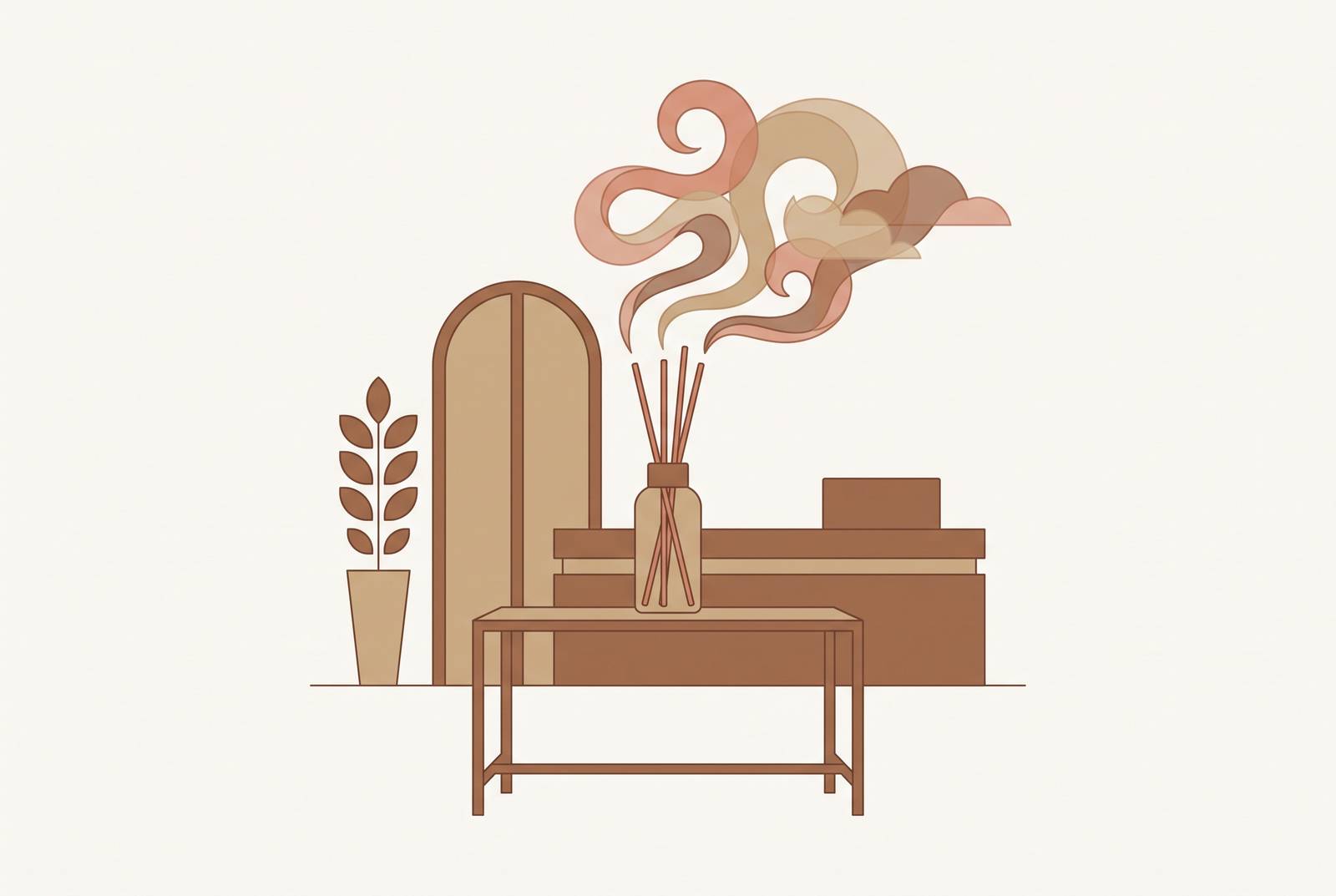
Hotel lobby scent design reveals that fragrance is brand infrastructure, built through simple composition, controlled diffusion, suitable materials, and repetition. At home, that means choosing one signature, matching cold-air delivery to the space, managing intensity, and paying as much attention to the oil as to the diffuser.
Why hotel lobbies are engineered to smell the way they do
In a hotel lobby, the scent may seem to belong to the room as naturally as its light or temperature. That impression is often the result of a commissioned fragrance, developed with perfumers and deployed as deliberately as the furniture specification. The guest encounters an atmosphere, but the hotel has designed an asset. Smell can stir a feeling before a guest is aware of it, so the fragrance can shape how the room feels without drawing attention to itself. The scent does not need to announce itself to do its work.
This makes fragrance different from a decorative flourish added after the important decisions are finished. Its purpose is to establish how the property feels from the moment of arrival. A composition that fits the setting supports the impression made by the architecture and service, while one that conflicts with them weakens it. The fragrance therefore needs to be pleasant and belong so completely that the guest experiences it as part of the place.
How a signature hotel scent is actually composed and why simplicity is the design choice
A hotel signature fragrance usually has two or three dominant notes, making it simpler than a personal perfume. That restraint answers a physical constraint, because nuance that works on a wrist may not survive the attenuation and dilution of large-volume air handling. The most robust notes remain apparent while finer distinctions disappear. A simpler composition gives the intended character a better chance of reaching the guest intact. It also has to remain comfortable from the first encounter through hours or days of exposure.
The governing brief is scent congruence, meaning that the fragrance fits the brand, the room, and the guest’s emotional state. Citrus-forward blends fit a lively, design-led brand, while warm woody notes with oud and amber fit a luxury hotel in a city. Westin’s White Tea signature, used at its properties around the world, has a different feel from W Hotels’ citrus-forward blends, though both brands have the same parent company. Singapore Airlines uses scent in the same way beyond buildings, with Stefan Floridian Waters, its own cabin fragrance, applied to flight attendants’ hot towels since the 1990s.
How diffusion is zoned, timed, and dosed across a property
Once the fragrance is composed, its delivery becomes an operational problem. Larger hotels divide a property into scent zones, with the arrival area establishing the first impression and corridors and lifts carrying a lighter thread. Destination spaces, including treatment rooms, dining areas, and VIP suites, may use a deeper or more immersive variation. An intensity that feels welcoming in a high-ceilinged lobby can feel excessive in a corridor, so dosing responds to both volume and dwell time.
Time matters for the same reason that space does. Programmable commercial systems connected to HVAC and footfall data can increase diffusion at peak times and reduce it during quiet hours. The output changes so that the guest’s experience need not. In large open-plan spaces, HVAC-connected systems can scent up to roughly 10,000 square feet from a single central air-handling point. That distribution avoids the contrast between overpowering pockets near a single-point diffuser and dead zones farther away.
Why the physical materials in the lobby are part of the scent system, not just its backdrop
The diffuser is only part of what holds that result together. Wool carpets, linen, raw wood, and other porous surfaces retain fragrance after active diffusion stops. They act as a scent battery, absorbing part of the fragrance and releasing it more slowly. This makes textile-rich interiors more than a visual or tactile choice. The room’s materials become a memory medium for the scent, linking the interior design brief to the fragrance brief.
That relationship also works against a poorly maintained space. New carpet adhesives, vinyl off-gassing, and damp surfaces create an olfactory baseline that applied fragrance cannot simply erase. Cleaning products contribute to that baseline too, so the signature is never operating in an empty sensory field. A lobby can end up smelling like its cleaning routine wearing perfume. The practical consequence is that materials, cleaning, and fragrance need to be considered together from the start. Adding a diffuser after every other decision has been made cannot deliver the full effect of an integrated design.
Why consistency across time and properties is the actual strategy, not the scent itself
The system’s purpose becomes clearest when it fails. A signature that is strong at noon, absent by evening, and different on the next visit communicates carelessness, however attractive each isolated encounter might be. The failure is not merely aesthetic, because the scent is supposed to make the property recognizable. A beautiful fragrance delivered unreliably is therefore less useful to the brand than a restrained one delivered consistently.
Repetition allows scent memory to compound across visits and properties. People can identify a scent after a year, while visual memory fades faster, which gives a stable fragrance a durable role in recognition. Hotels want returning guests to know the brand by its smell before they read its logo. This is why hotels protect signature formulas as intellectual property, mostly through trade secrets, since scent trademarks are rare and hard to get. The valuable asset is not just the formula in a bottle, but the familiar association built by delivering it repeatedly.
What cold-air diffusion technology contributes to delivering a consistent scent at scale
Cold-air diffusion addresses the gap between a fragrance as formulated and a fragrance as experienced across a large room. A specialized atomizer breaks the liquid into microscopic dry particles propelled by pressurized air. Because the process uses no heat, it preserves the aromatic compounds that give the composition its character. Using heat to spread scent can change its chemistry, while using water dilutes the fragrance.
Dry-mist delivery also addresses practical constraints around fine art, electronics, delicate fabrics, and polished surfaces, where residue would be a problem. Removing the water tank removes another liability, since standing water in ultrasonic diffusers can harbor pathogens without strict cleaning. A cold-air system avoids that particular water-related risk, though that does not settle every question about fragrance use. Connected to HVAC, it can distribute scent evenly through a large open-plan space.
How do you make your house smell like a five-star hotel all the time
The home version begins with the same constraints at a smaller scale. A diffuser sized for a small room will not serve an open-plan living area simply because its intensity is turned up. Conversely, excess power can make the space overwhelming. Coverage area, ceiling height, and airflow are better guides to choosing a diffuser than how strong a fragrance smells up close. For large rooms, cold-air diffusion spreads scent the way hotels do, while HVAC-connected models can cover more of a home.
Aura House specifies coverage of 2,500+ square feet for its HVAC-connected models, which apply dry-mist atomization at residential scale. That gives homeowners a way to spread scent as hotels do, though results will vary with the floor plan. Brands like Aura House also follow the same rules for formulation, designing oils that keep their character in rooms of different sizes and over long periods of use. The aim is a stable background presence. Technology and composition still have to work as a pair.
Within the home, zoning means a more noticeable arrival scent in entryways and living rooms, with a lighter presence in bedrooms and corridors. Smart scheduling provides the residential counterpart to hotel programming, and Aura House’s smart diffusers allow control over when and how intensely fragrance is delivered. Turning output up while people are home and down overnight can help control how much oil is used and limit olfactory fatigue. Natural textiles, linen, and unfinished wood can hold the scent after the diffuser stops running. Making a home smell consistent all the time does not require making its diffuser run at the same strength all the time.
What clean, non-toxic fragrance formulation means in this context and why it matters at home
A cold-air diffuser disperses the contents of its fragrance oil through a living space occupied by people and, in many homes, children and pets. Conventional formulations can contain volatile organic compounds and endocrine disruptors associated with respiratory irritation, headaches, and allergic reactions. An efficient diffuser does not filter those ingredients out. Cold-air delivery avoids combustion and standing water, but neither advantage establishes the safety of the oil itself.
In this context, a claim such as clean or non-toxic needs to refer to formulation. The relevant distinctions include the exclusion of phthalates, synthetic musks, and harsh chemical compounds, together with transparency about ingredients. The EPA’s Safer Choice certification checks products against a standard run by the EPA, which is different from how a brand describes its own products. Aura House describes its fragrance oils as clean, vegan, cruelty-free, transparent about ingredients, and safe around people and pets. Those terms describe different things, and vegan or cruelty-free status alone does not show whether an oil is safe to breathe. The home system has two co-equal parts, which are controlled delivery and a suitable formulation.
What homeowners can take from hotel scent design as a practical framework
The practical sequence starts before the fragrance is chosen. Ventilation, clean textiles, and managed moisture establish the baseline, because no diffuser can make damp or off-gassing cease to matter. Once that base is addressed, choose one signature that fits the home and remains comfortable as a background presence. Give the oil’s formulation the same attention as the machine that will disperse it. Then match the diffuser to the room’s coverage needs, ceiling height, and airflow rather than expecting a small unit to stretch across an open floor plan.
With that fit established, let the arrival area carry the clearest expression of the signature, with a lighter thread through quieter rooms. Wool, linen, cedar, and unfinished wood can serve as slow-release materials, extending fragrance beyond the diffuser’s active cycle. Scheduling can then keep scent in the air while people are in the rooms and turn output down when the rooms are empty.
A rotating museum of fragrance products may offer variety, but it cannot build the same association as one signature used across months and seasons. The most transferable luxury is therefore consistency, which turns a pleasant smell into the familiar character of a place.