Intentional Gifts for Friends Who Prioritize Wellness
Cold-air diffusion with clean oils beats conventional fragrance for wellness homes.

Wellness-minded gift-giving has a math problem: most fragrance products sold as gifts do the opposite of what a wellness-focused home actually needs. This piece works through what makes a gift genuinely intentional for someone who treats their home as a health decision rather than a design choice, and it lands on cold-air diffusion paired with clean fragrance oils as the category that checks every box. Functional fragrance, scent marketed specifically for sleep, focus, stress relief, or energy, grew 23% year-over-year across North America and Western Europe in 2025. That number says something simple: "smells nice" has quietly become "serves a purpose," and most gifts on shelves right now haven't caught up. The sections below make the case for why, and which choices inside that case actually matter versus which ones are just packaging.
Why conventional fragrance products fail the wellness test
Start with the plain fact most shoppers never learn: the home fragrance industry has no federal safety standards and no ingredient transparency requirement. A company can put a candle or a spray on a shelf without disclosing a single compound inside it. Nobody polices that gap, so nobody closes it.
Phthalates hide behind that gap, linked to hormone disruption and reproductive health concerns. Synthetic musks sit next to them, flagged as suspected allergens and endocrine disruptors. VOCs, including benzene and formaldehyde, and aerosol propellants carry their own separate damage. None of it shows up on a label that just says "fragrance": that single word is legally allowed to cover a mixture of dozens of undisclosed compounds, so the risk stays invisible to anyone reading only the label.
The air quality math makes this worse before it gets better. Indoor air in a modern, sealed home can run 2 to 5 times more polluted than outdoor air, because insulation and weatherproofing trap VOCs and particulates instead of letting them escape. A conventional fragrance product doesn't sit neutral inside that environment. It adds to a load that's already stacked against the room.
Terms like "parfum," "aroma," "natural fragrance," and "luxury scenting" can all sit on a label while synthetic compounds hide underneath. Skimming a label for the top note description tells a buyer almost nothing useful. Going all-natural doesn't solve it either. Interiormedicine.com notes that even natural terpenes found in essential oils and plant-derived fragrance can react with indoor ozone to form secondary nanoparticle pollution, so "natural" by itself isn't a sufficient standard. Delivery method carries just as much weight as ingredient sourcing, a thread this piece picks back up a few sections down.
None of this argues against giving fragrance as a gift. It argues against giving a careless one when a considered one costs about the same.
What "clean fragrance" means and how to read a label
Not everything natural is safe, and that's the detail most "clean beauty" marketing conveniently skips. Certain essential oils cause skin sensitization or phototoxicity at specific concentrations, while some synthetic compounds that have gone through rigorous safety testing turn out to be measurably safer than their natural counterparts. Clean fragrance is a transparency argument."
A legitimate clean formulation discloses its full ingredient list instead of hiding everything behind the word "fragrance." That disclosure is the tell: if a brand won't say what's in the bottle, the silence is the answer.
Greenwashingindex.com names a few certifications actually worth knowing, including EPA Safer Choice and IFRA compliance, and Sephora Clean is another. For candles, recandlecompany.com and interiormedicine.com point to 100% soy or beeswax, a 100% cotton or wood wick, phthalate-free fragrance, and no synthetic dyes.
Interiormedicine.com evaluates the fragrance itself, the carrier material it's suspended in, and the throw method that gets it into the air together, as three factors that all require attention. A gift that only gets one of the three right is a third of the way to clean, no matter how good the marketing copy sounds. Most "clean" candles on shelves right now nail the wax and skip the throw method entirely, which is a little like building a car with a great engine and no wheels.
Scent as a daily wellness ritual rather than an occasion product
Home fragrance used to be a finishing touch, added after the furniture was arranged and the art was hung. That's no longer how people think about it. Scent has gone experiential and purposeful: mood-setting, atmosphere, ritual, and emotional comfort now count as core parts of how a home functions, not decoration layered on top of it.
Picture how that plays out across an actual day. A morning diffuser cycle sharpens focus before work starts. A midday shift clears mental clutter. An evening ritual signals the day is winding down. These are small olfactory cues, but they do real structural work, the same way a morning coffee ritual or an evening skincare routine gives shape to hours that would otherwise blur together.
Ellecadeaux.com emphasizes that room-by-room thinking matters too. Living spaces do well with welcoming, layered scents. Bedrooms want calming, intimate notes. Work areas need something energizing that doesn't tip into overwhelming, and bathrooms lean fresh, spa-adjacent. Spraying one all-purpose scent everywhere misses the point of room-specific intentionality, and it's the single most common mistake in this whole category. If a gift comes with one bottle and instructions to "use it anywhere," it was built for convenience, not for the room it's supposedly meant to serve.
Functional scent tends to fall into three families worth knowing by name. Unwind blends run lavender, oakmoss, chamomile, sage, hinoki. Focus and clarity blends lean on eucalyptus leaf, green tea, mint, lemon verbena. Warm grounding blends use cedar, amber, vetiver, tonka. The current era of home fragrance is increasingly framed around one word: intentionality. People want scent that supports wellness, connects to memory, elevates a space, and reflects who they are, all at once.
A fragrance product built for that kind of daily, structured use sits in a completely different category from one that makes a room smell good for an hour and then evaporates, literally and figuratively.
Why delivery method is the deciding factor in how well scent works
So the oil is clean. Does that settle it? Not even close, and this is where most gift-givers stop paying attention right when it matters most. How the scent gets into the air changes almost everything about the experience and the safety profile.
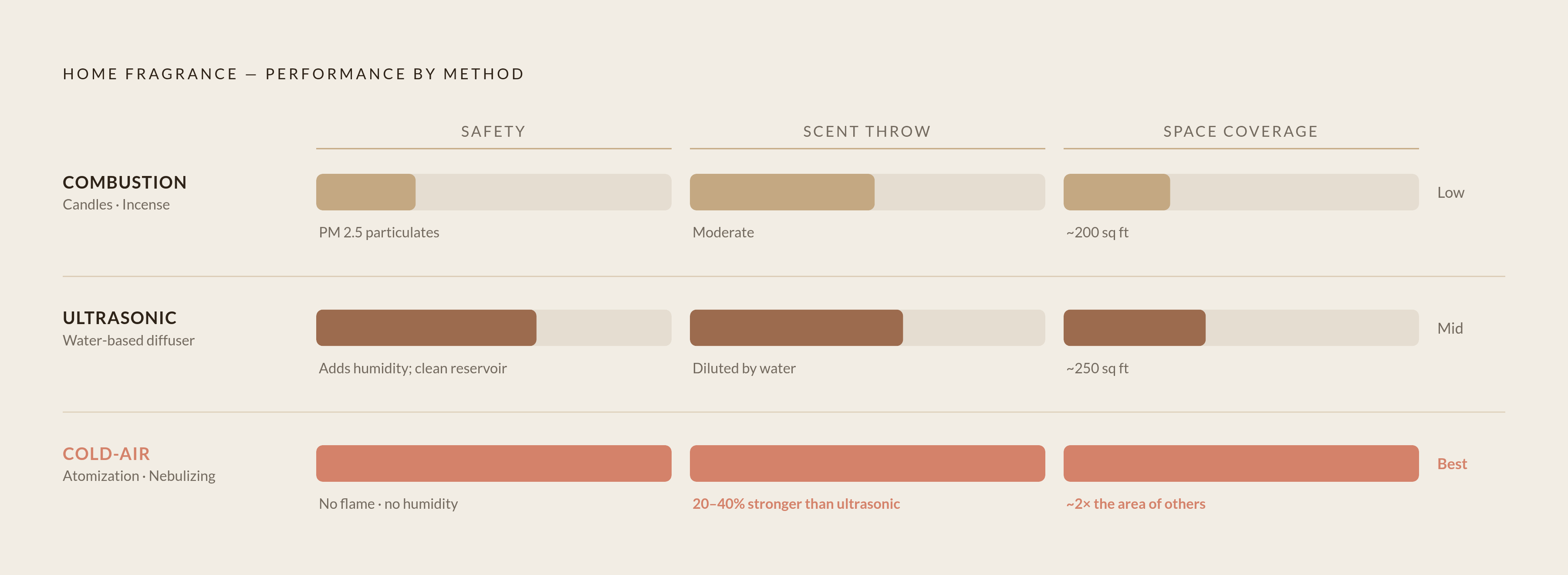
Three delivery methods dominate the category: combustion (candles, incense), water-based ultrasonic diffusion, and cold-air atomization. Each comes with distinct trade-offs on safety, scent accuracy, and how much space it can actually cover.
Combustion runs into a hard physical limit. Burning a candle releases PM 2.5 particulate matter into indoor air, regardless of how clean the wax or the fragrance oil is. Even a best-in-class clean candle cannot fully eliminate this byproduct, because combustion is combustion. It's chemistry, and chemistry doesn't negotiate.
Water-based ultrasonic diffusers avoid the flame but trade it for other problems. They dilute the fragrance oil with water, which caps how strong the scent throw can get. They add humidity to a room, which matters if hardwood floors, electronics, or artwork sit nearby. And the water reservoir needs regular attention to stay clean.
Cold-air diffusion works on a different principle: air pressure atomizes undiluted fragrance oil into ultra-fine particles, without heat and without water. Heat degrades scent in specific, measurable ways: citrus notes turn bitter, florals go flat, and base notes like musk or amber get muted into background noise. Cold air skips that degradation entirely, preserving the top, middle, and base notes the way the perfumer actually formulated them, as aromacountry.com explains.
The numbers back this up, and they're not subtle. Research finds that nebulizing (cold-air) technology delivers a 20-40% stronger scent throw compared to ultrasonic diffusers, and cold-air units can cover spaces roughly twice the size a typical candle, reed diffuser, plug-in, or ultrasonic unit can handle. No added humidity means no water reservoir to keep clean, removing that maintenance burden entirely, a relevant detail for households that keep close watch on indoor air quality. For those households, dampness, mold, and mineral scaling risks turn the choice between delivery methods into a health consideration rather than a simple preference.
Combustion is the method to avoid buying as a gift for anyone who already thinks about their home this way. It's the most common gift, and it's the weakest option on the list.
What a cold-air diffuser does inside a home and why that makes it a considered gift
Scent.ly reports that premium 2026 models come standard with app control, adjustable intensity, and voice assistant compatibility through Alexa and Google Home. That means the recipient sets a morning clarity cycle and an evening wind-down cycle once, and then never thinks about the device again. It runs on schedule, the way a thermostat does, minus the argument about who touched the settings.
Scheduling isn't just convenience. It keeps the diffuser from running continuously when no one is home to benefit from it, making each cycle feel deliberate rather than ambient. Cycling the diffuser on and off keeps the fragrance perceptible instead of fading into sensory wallpaper.
Consider the hotel lobby effect, because most people have felt it without ever naming it. Walking into a well-run luxury hotel means walking into a scent that's consistent, immersive, and somehow makes the whole space feel more considered than it probably is architecturally. That's usually a cold-air diffusion system running behind the scenes, quietly doing more work than the flower arrangements get credit for. A premium home unit recreates that exact effect, an experience most people associate with travel and rarely think to build into their own house.
For the person doing the buying, that's the whole pitch in one line. This isn't a product the recipient opens, uses once, and shelves next to the guest towels. It becomes part of a daily sensory routine, which separates an intentional gift from a decorative one sitting in a box marked "someday."
Choosing the right diffuser and oils when buying for someone else
Room size comes first, and it's not optional. Match the diffuser's rated coverage to the room it'll actually live in. Scent.ly's pricing tiers place a personal unit at $50 to $150, suited to a bedroom or a home office. A mid-range unit, $150 to $400, handles a main living space. Commercial-grade systems, priced anywhere from $1,500 to $5,000 and up, are built for retail and hospitality use, and buying one as a residential gift is overkill in the most literal sense of the word.
Layout matters alongside square footage. Placement relative to where people actually spend time shapes how well coverage translates from a spec sheet into a real room.
Operating characteristics beyond coverage area are worth reviewing before purchase, especially for a bedroom or meditation space where the environment itself is part of the benefit.
Oil compatibility is the detail most gift-givers miss entirely, and it's the one that ruins the gift fastest. Not every fragrance oil works in a cold-air diffuser. Generic essential oils, the kind sold for standard aromatherapy diffusers, can clog the atomizer mechanism in a nebulizing unit. The gift needs oils formulated specifically for cold-air use, not whatever's already sitting in a kitchen cabinet next to the olive oil.
For a wellness-focused recipient, the oil standard should match the diffuser standard: full ingredient disclosure, phthalate-free formulation, vegan and cruelty-free certification, and no synthetic musks or endocrine disruptors hiding under a generic "fragrance" label. A starter set spanning two or three scent families, say a grounding blend, a clarity blend, and a calming blend, gives someone immediate range without dumping an entire catalog on them at once. A starter set keeps a gift in active rotation long after the wrapping paper is gone. For a buyer who genuinely doesn't know someone's scent preferences, pairing the diffuser with a fragrance sampler lets the recipient build their own scent identity over time, which fits a group known for having strong, specific opinions about what belongs in their own home.
Pet and family safety as a non-negotiable for wellness households
Wellness-minded homes frequently include pets or kids, and that turns ingredient transparency from a nice-to-have into a hard requirement. It sits inside the buying decision itself, not next to it.
That indoor air quality figure from earlier, 2 to 5 times worse than outdoor air in sealed homes, hits harder in households with pets and small children. They spend far more time low to the ground and in smaller, less ventilated rooms than adults typically do. VOCs are a documented respiratory concern in enclosed spaces, and a home with a dog that naps on the floor all day is exactly that kind of enclosed space, at exactly nose height for the animal living in it.
Cold-air diffusion paired with clean, waterless oils sidesteps three risk factors at once: no combustion byproducts, no added humidity, no open flame anywhere near a curious cat or a toddler learning to reach things. Each matters on its own, and together they add up to a meaningfully different risk profile than a candle burning on a side table.
Oil selection needs its own scrutiny here, and this is where a well-meaning gift can go sideways fast. Pet-safe formulations specifically avoid certain essential oils: certain essential oils carry known risks for cats and dogs. Checking the label directly, rather than trusting a brand's general reputation, is the only way to be sure. Intensity control on a smart diffuser helps too. An owner can dial concentration down in rooms where a pet rests most of the day, instead of running the unit at full output around the clock regardless of who's actually breathing it in.
When a gift-giver can say, honestly, that a product is safe for every living creature in the house, that's not a small claim. It signals the gift accounted for the recipient's whole life.
Scent as a way to bring travel and memory into a home
Marie Claire's fragrance trend coverage shows fragrance has gotten hyper-focused on one thing: bottling memory. That's a real shift, because it moves scent out of "pleasant background detail" and into something closer to a keepsake.
Cherry Cheng, founder of Jouissance, put it directly in stylist.co.uk's 2026 fragrance trends feature: perfumers and brand founders are "deepening a narrative approach, creating immersive, multi-layered scents that resonate culturally and emotionally," building what amounts to "wearable stories that evoke memory, place, and identity." "Wearable" becomes "livable," and that description fits home diffusion just as well as it fits a bottle of perfume on a vanity.
Practically, that means destination-inspired scent collections: tropical notes that pull up a beach resort, citrus and neroli suggesting a Mediterranean coastline, cedar and earthy woods that summon a mountain cabin. Scent memory runs through one of the more direct pathways to emotional recall the senses offer, more direct than sight or sound in a lot of documented cases. A diffuser cycling a familiar travel-linked fragrance doesn't just recreate a smell. It recreates a state of mind, which is a strange amount of power to hand over to a small glass bottle.
For a wellness-focused recipient, that's not a minor bonus feature. Their home fragrance practice was already about mood management, and this extends it into memory and identity, bigger and more personal territory than mood alone. Pairing a diffuser with a destination-inspired oil collection and a short note explaining the idea behind each scent stops the gift from reading as a device purchase. It becomes something closer to a layered, considered story, the kind that doesn't get returned in January.
Putting it together: the criteria a cold-air diffuser and clean oils satisfy
Go back to the standard this piece opened with. Does the gift earn its keep in daily use, or does it only look good under wrapping paper? Does it fit how the person actually lives, not how a gift catalog imagines they live? Does it reflect what they already value?
Measured against that standard, the case for cold-air diffusion and clean oils holds up on every point, while combustion fails at least two of them. On safety, cold-air diffusion is waterless, flameless, and free of combustion byproducts, with clean formulations that pass for adults, kids, and pets alike. On daily utility: smart scheduling runs it as part of a morning or evening routine without asking for ongoing effort. On scent quality: cold-air atomization preserves the full molecular structure of the fragrance, so what the recipient smells actually matches what the perfumer formulated. On room fit: coverage scales to the space and intensity adjusts, so one unit serves an actual living room instead of just a corner of it. On values alignment: full ingredient transparency, clean formulation standards, vegan and cruelty-free options where they matter to the recipient. On emotional resonance: destination-inspired or mood-specific oils add a personal layer that goes past pure function.
That's a long list to satisfy with a single gift, and the market is already voting with its wallet on it. Grand View Research reports that the global aroma diffuser market, valued at $2.24 billion in 2023, is projected to reach $5.76 billion by 2032, a compound annual growth rate of 11.2%. That growth curve is evidence of a category getting rebuilt around exactly the standard this piece has walked through, criterion by criterion, and a candle, however nicely scented, was never going to clear that bar.