How Travelers Can Recreate a Favorite Destination Scent at Home
Smell triggers memory faster than photos—here's how to bottle that feeling at home.

Photos show what a place looked like. They can't get across the humid citrus air of a Mediterranean courtyard at 7 a.m., or the mineral chill off a coastline before the fog burns away. Scent does that, through a shortcut no other souvenir has access to: smell routes straight into the limbic system, the brain's emotional and memory center, in a way sight and sound don't. This piece walks through how to pin down the actual scent notes of a place you've visited and rebuild that atmosphere at home, using roughly the same playbook hotels have run for decades.
A 2026 peer-reviewed perspective published in PMC pushes past the tired "smell triggers memory" line and argues something sharper: smell and emotion are, in the researchers' own words, "fundamentally equivalent." Olfactory experience doesn't just accompany emotion, the two are grounded in the same neurobiological structures, not merely linked by sentiment. That's a bold claim, and it explains why one note, salt air, diesel and espresso, wet stone, can drop someone back into a full sensory scene faster than an entire photo album can. So why has nobody taught travelers to use this on purpose? The gap was never that destination scent is hard to describe. Nobody ever asked travelers to notice it in the first place, and that's a much easier problem to fix.
How destinations build a signature scent
Hotels solved this problem long before home diffusion caught up. Properties have worked with perfumers for years to build proprietary scents that make a lobby recognizable the second you walk through the door, blindfolded, jet-lagged, or otherwise, and that recognition is the entire point.
The Maker is a fragrance and lifestyle brand started by Lev Glazman and Alina Roytberg, the same pair behind the Fresh beauty brand, and it grew directly out of a hotel property in the Hudson Valley. Every candle and scent in the line traces back to a travel fantasy the founders built into the hotel experience itself, Marie Claire reports. Rosewood took the same idea to a larger scale: the luxury hotel chain developed its own signature fragrance, Bois Cachemire, with L'OBJET, so walking into any Rosewood property anywhere in the world delivers the same olfactory handshake.
Hotel groups treat fragrance as a design element on the same tier as lighting or music. That logic is migrating out of hospitality and into private homes, waxlyrical.com reports: instead of rotating scents by season, more people are settling on one signature fragrance per space, which is really just the hotel-lobby trick run on a living room. Milamariescents.com's market notes show that home scent machines have moved well past novelty status. Homeowners now shop for real coverage and reliability the way they'd shop for any other home system, not for a gimmick that smells nice for a week before getting shoved in a drawer.
Most people chase a feeling instead of identifying ingredients. Hotels never leave scent to chance. Treating it as guesswork at home is the mistake worth dropping first, before any diffuser or fragrance oil enters the picture.
Identifying the actual scent notes of a destination you've visited
Most people don't remember a destination as a list of ingredients. They remember it as mood, a blur, something closer to a feeling than a formula. The actual job is translation: breaking that blur into parts you can shop for.
Start with the obvious question. What was the dominant note? Salt air, wet earth, warm wood, spice, tropical flowers, rain on hot stone? That's the top note, the first thing that hits and usually the first thing to fade. The base note is the deeper layer that lingers once the initial impression is gone, and most travel memories are actually built from both, layered on top of each other. A single candle labeled "beach" so often falls flat because it captures only one of those layers and calls it a day.
A few patterns appear repeatedly across destination categories. Coastal spots tend to combine coconut, sea salt, citrus, mineral notes, and tropical flowers as a recognizable category signature. Happywax.com names a 2026 trend called "Salty Florals," pairing delicate floral notes against a sharp, mineral coastal base, described as airy and more sophisticated than a straightforward beach scent (the source pairs its Coastal Tide and Lilac Petals products as an example). Mediterranean and green-living destinations lean on olive leaf, sage, rosemary, aloe, and green stems as their characteristic note palette. Luxury hotel and spa environments run on white tea, bergamot, sandalwood, amber, musk, jasmine, and light woods as a category signature, while resort and tropical properties lean on sandalwood and musk combined with coconut and tropical florals as their defining register.
None of this is guesswork on the industry's part. Marie Claire's 2026 coverage quotes fragrance insiders predicting that "favorite foods or favorite places are going to be big moments for fragrance in 2026," meaning perfume houses are already building entire product lines around the exact exercise described here.
So do the homework the way a perfumer would. Pull up photos or video from the trip, let them trigger the sensory recall instead of trying to summon it cold, and write down three to five descriptors before shopping for a single fragrance oil. Salt, citrus, warm stone. Green herb, aloe, faint smoke. The list doesn't need to read like poetry. It needs to be specific enough to match against a label.
Why the diffusion method matters as much as the fragrance itself
Getting the scent profile right is half the job. Delivering it into a room without wrecking it along the way is harder, and most people skip past it.
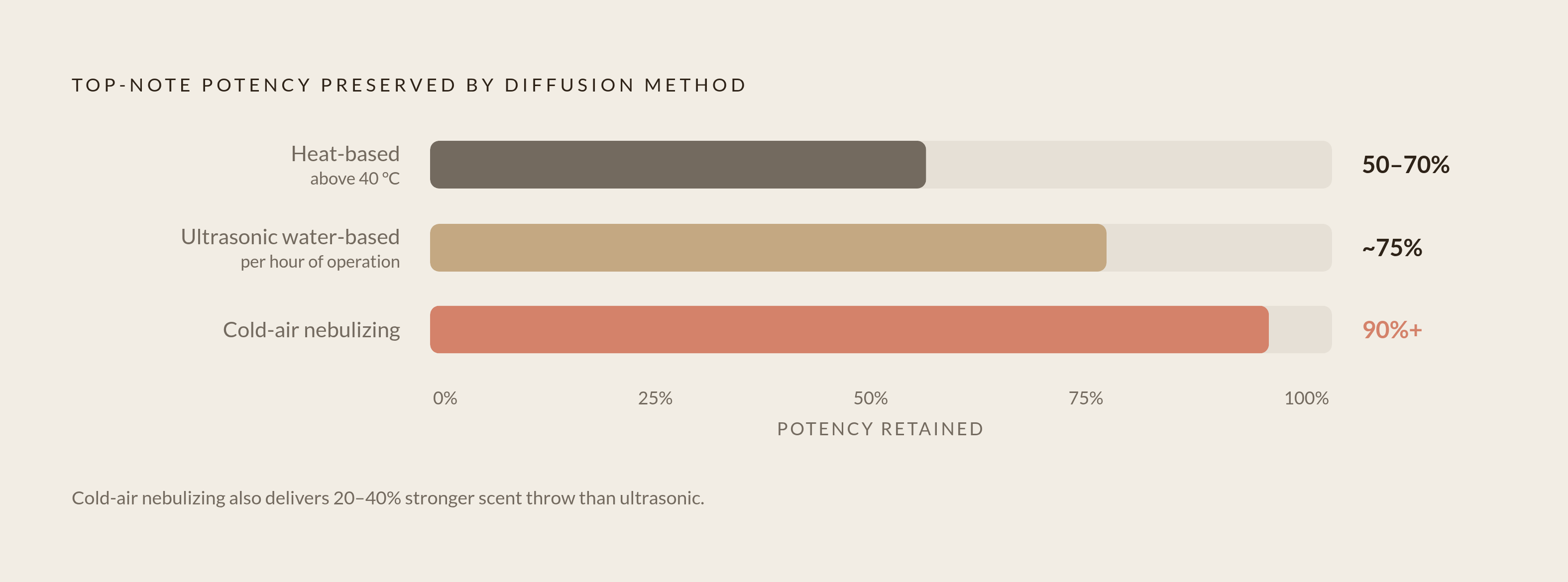
Heat is the first way this goes wrong. Volatile top notes, the sea salt, the citrus, the green herbs that make up the most place-specific part of any scent profile, break down under heat. Available figures put the loss at 30 to 50 percent of potency once temperatures climb above 40°C, a range well within reach of a standard heat-based diffuser or warmer, erasing half the thing that made the memory recognizable. That's half the thing that made the memory recognizable, gone before it ever reaches the room. That's half the thing that made the memory recognizable, gone before it ever reaches the room.
Water-based ultrasonic diffusers fail differently. They dilute the fragrance oil in water before pushing it into the air, so what reaches the room is a watered-down cousin of the scent a perfumer actually designed. Available figures show ultrasonic methods can lose up to 25 percent of top-note potency per hour of operation. Run one overnight and do the math on what's left by morning.
Cold-air nebulizing technology skips both failure modes. It atomizes pure fragrance oil directly into a dry, ultra-fine mist, nano-particle scale, without adding heat or water to the mix. Available figures on this technology put preservation above 90 percent of a fragrance's original integrity, with a scent throw 20 to 40 percent stronger than ultrasonic diffusion, and no dilution or thermal breakdown to account for.
For destination recreation, this gap decides the whole project. A coastal scent that loses its citrus and mineral top notes in a water-based diffuser doesn't become a weaker version of the coast. The coast disappears entirely, and what's left, mostly base notes, could belong to almost anywhere on earth. Cold-air units also tend to cover roughly twice the square footage of a candle, reed diffuser, plug-in, or ultrasonic unit, which matters once the goal shifts from perfuming a corner to filling an open living room.
Matching diffuser size and placement to the room you want to transform
Underpowering the space is the single most common mistake in home scenting, and it's an easy one to make, since coverage specs get skimmed rather than actually read.
A device built for a bedroom won't recreate a hotel lobby's atmosphere in an open-plan living area. Iscent.com's specs rate a flagship-tier diffuser like the Ensō for roughly 1,000 square feet, a useful benchmark. Measure the actual room, not the whole house, and match the device rating against that number instead of assuming bigger units automatically cover everything.
For larger homes, or for anyone rebuilding a destination scent across several connected rooms, HVAC-compatible diffusers solve something clustering small units can't. Instead of scattering devices room to room, one system pushes fragrance through the existing air ducts. Milamariescents.com's trend data shows this has become a real shift for homes with open floor plans or high ceilings, where a single point-source diffuser can't reach every corner evenly no matter how strong it is.
Placement matters almost as much as the unit itself. Put the diffuser near natural airflow, doorways, return air vents, so scent actually travels through the room instead of pooling near the machine. Skip placing it directly under an HVAC vent, since the airflow will blow the mist straight down before it disperses. Central placement works fine for a square room; for anything long, narrow, or L-shaped, a second unit or full HVAC integration beats a single central device every time.
Intensity control deserves the same attention. Internal intensity settings, available on leading cold-air systems, let a homeowner dial output up or down through the full cycle instead of committing to one fixed strength. Scent.ly's product survey shows app control and scheduling are widely available on premium 2026 models, so the diffuser runs during the exact hours the memory calls for, morning coffee, evening wind-down, without soaking the room the rest of the day. Hotels don't run scenting systems at full blast around the clock either. They calibrate to the room, so fragrance reads as atmosphere instead of announcing itself like an air freshener in a rental car.
Choosing and evaluating a cold-air diffuser for destination scent recreation
The category has grown fast enough that picking a diffuser is now a real research question. Scent.ly's market figures show the global aroma diffuser market was valued at $2.24 billion in 2023 and project it to reach $5.76 billion by 2032, a growth rate of 11.2 percent a year, with cold-air technology named as the premium segment driving that expansion.
Coverage rating against the actual room size matters most, since getting that wrong undermines everything downstream of it. After that, confirm the device uses genuine nebulizing technology (no water, no heat) rather than an ultrasonic unit marketed with similar-sounding language, since the terms get blurred in product copy more often than they should. Oil compatibility matters too: not every cold-air device handles every oil viscosity, so check that a unit is rated for the specific fragrance oils planned for use. Smart features, app control, scheduling, adjustable intensity, are standard on premium 2026 models according to scent.ly, and safety certifications (IFRA-compliant oils, UL-listed hardware, CARB-compliant formulations, also according to scent.ly) should be confirmed rather than taken on faith. Design and noise level round it out. A device running daily in a living room needs to fade into the background, not hum louder than the television.
Pricing spans a wide range. Scent.ly's figures put personal units at $50 to $150, mid-range home and office units at $150 to $400, and commercial-grade systems at $1,500 to $5,000 and up. Scent.ly's 2026 market roundup names Scently, Aera, and Hotel Scents among the brands leading the space, each built around a different use case, from tech-forward app control to luxury ambiance. Brand loyalty isn't the deciding factor here, whatever the marketing implies. What decides it is whether the hardware preserves scent integrity, because destination recreation fails at the hardware level long before the fragrance oil gets a chance to prove anything.
What to look for in the fragrance oil itself
Say the diffuser is dialed in perfectly. The oil can still sink the whole project, and it happens at a chemical level most people never think to check.
"Fragrance" as a label term does a lot of quiet work it shouldn't get away with. Disclosure rules for air fresheners and fragrance products have long allowed companies to bundle numerous undisclosed chemicals under that single word. Some low-quality synthetic fragrances can contain many unlisted compounds, some associated with hormone disruption, respiratory irritation, or allergic response. Phthalates deserve specific mention: they're used to stretch how long a fragrance lasts, they're documented endocrine disruptors per trulyfreehome.com, and their presence is also a tell about formula quality. A brand leaning on phthalates to extend scent longevity is usually papering over a weak base formula that can't hold up on its own.
Treating "natural" as a stand-in for "safe" is a mistake that trips people up constantly. Some essential oils cause skin sensitization or phototoxicity, and some well-studied synthetic compounds are actually safer than their plant-derived counterparts, the sourced material shows. The real standard is transparency, regardless of which side of the natural-versus-synthetic line an ingredient lands on.
A trustworthy label shows full ingredient disclosure instead of "fragrance" standing in as a catch-all. A trustworthy label also shows IFRA compliance, which isn't an ironclad safety guarantee but beats an uncertified synthetic blend by a wide margin. It stays free of phthalates, parabens, sulfates, glycols, and petrochemicals, and where available, EWG Verified or EPA Safer Choice certification adds one more layer of confirmation on top of that.
Terpenes, even the natural ones found in citrus and pine-forward oils, can react with indoor ozone to form secondary nanoparticle pollution. Ventilation and moderate intensity settings cut that risk considerably. For destination recreation specifically, the payoff of a clean, well-formulated oil is straightforward: it holds its top-note structure longer, so the coastal citrus or Mediterranean herb note that actually defines the memory stays present through the whole diffusion session instead of burning off in the first twenty minutes.
Building a destination-inspired scent ritual that becomes part of daily home life
None of this is about replaying a vacation on command, like some kind of scent-based time machine. It's about folding a place's atmosphere into the actual rhythm of a home, morning and evening, room by room, season by season.
Marie Claire's 2026 fragrance coverage states that 2026 fragrance trends are hyper-focused on bottling memory, with categories not traditionally tied to perfume, favorite places chief among them, expected to be major moments in the industry this year. Christophe Laudamiel, Master Perfumer at Osmo, adds a useful wrinkle in beautymatter.com's 2026 coverage: seasonal scent trends are losing relevance altogether, driven by global travel, social media, climate shifts, and the blurring of home and vacation life through remote work. A Mediterranean herb blend or a coastal salt note doesn't have to stay boxed into summer anymore. It can anchor a room year-round, the same way a hotel's signature scent doesn't change with the calendar just because the seasons do.
The ritual itself doesn't need to be complicated. Pick one destination scent per room instead of rotating constantly, mirroring the same signature-scent logic hotels have leaned on for years, since repetition is what actually builds the association. Use scheduling features to run the diffuser during the hours that match the memory: a Mediterranean herb profile for morning coffee, a warmer sandalwood or amber resort note for evening wind-down. Adjust intensity with the seasons, lighter when windows are open in warm months, a little richer once the house seals up for winter.
Repetition drives all of it. Smell builds new associations the same way any memory does, through steady exposure over time rather than one dramatic encounter. A destination scent diffused daily stops being a souvenir of a single trip. It becomes a property of the room itself.