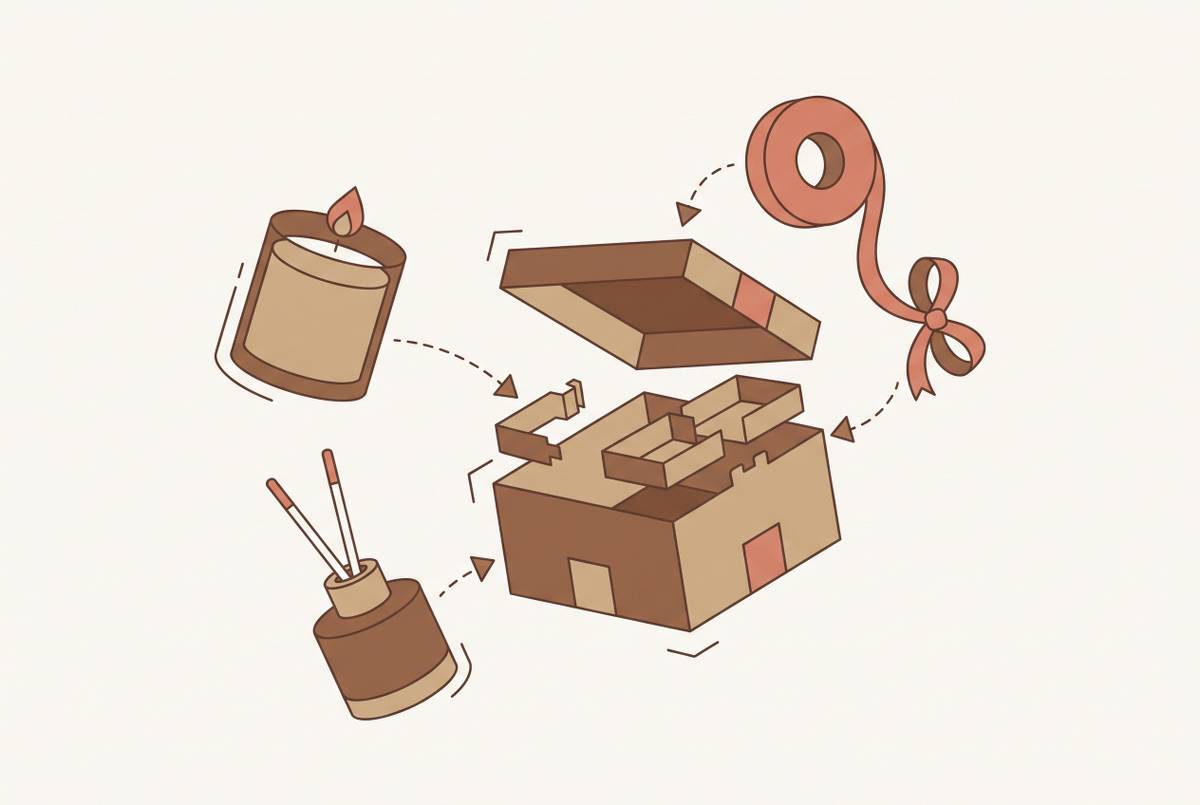
Corporate Gifting With Home Fragrance Products
Home fragrance gifts deliver daily value and stronger ROI than traditional corporate presents.

That shift is not just aesthetic preference. Sendoso's research found that 83% of recipients felt more connected to the company after receiving a corporate gift. The return on a well-chosen gift is measurable rather than a warm, fuzzy assumption someone in marketing made up.
Sustainability plays into this too, in a way that might surprise anyone who assumes B2B purchasing runs on spreadsheets alone. A majority of Gen Z consumers perceive experiences and consumables, home fragrance included, as more sustainable than physical products, according to Eventbrite's research, and that perception now influences gifting decisions even in B2B contexts.
Home fragrance, as a category, is at an unusually productive intersection: luxury, wellness, home living, and personalized gifting are four of the fastest-growing gift segments right now, and fragrance touches all four at once. That is not a coincidence so much as a convergence, one that touches luxury, wellness, home living, and personalized gifting all at once. Most gift categories pick a lane. Fragrance apparently forgot to.
What separates a diffuser from a coffee mug or a branded notebook is how often it gets used. It is that one gets used once and forgotten in a drawer, and the other releases a small, repeated sensory signal every single day it runs. That structural difference, a gift that keeps delivering value on a recurring basis instead of a single unboxing moment, is the thread the rest of this piece follows. The average corporate gift budget of $75–$150 per recipient (Coresight Research, 2025) comfortably accommodates a quality home fragrance product or entry-level smart diffuser. According to PPAI, food and beverage gifts rank as the second most popular corporate gift category after apparel/drinkware, placing fragrance squarely in this lane.
What Makes a Home Fragrance Gift Feel Premium Versus Forgettable
Not every candle, diffuser, or reed bundle registers as a premium gift, even within the same price bracket. Format, presentation, and how long the thing stays useful all factor into whether a recipient files the gift under "thoughtful" or under "we had a budget to spend."
Scented candles remain the most recognizable format in the category and the largest revenue segment of the home fragrance market overall. Everyone has received a candle, so a candle has to work harder to read as considered rather than default. None of this makes candles a poor choice. They are a legitimate, well-loved format. But familiarity has a ceiling, and a corporate gifting program aiming for a premium impression runs into that ceiling fast.
Reed diffusers solve a different problem. They are flame-free, close to maintenance-free, and suited to a desk or an executive office where nobody wants to think about a wick. Passive diffusion happens continuously without anyone touching the thing, which is a real advantage for a gift that needs to function in a professional setting.
A smart home scent diffuser occupies a different tier entirely, and this is where the premium signal really lands. It reads as considered and technology-forward, designed for daily use rather than a one-time occasion, which changes the entire message the gift sends. Perceived value climbs further when a product pairs sophisticated design with obvious function: the giver clearly thought about both how the thing looks on a shelf and what it actually does every day. Personalization compounds this. Curated fragrance selections or a custom scent, paired with the right device, close the gap between "gift" and "brand experience" in a way a generic item cannot. Add branded packaging or a custom scent name, and the object stops feeling like inventory and starts feeling like it was made with a specific person in mind.
Why a cold-air diffuser delivers more ongoing value than other home fragrance formats
The technical case for cold-air diffusion is not complicated, and it is worth understanding because it explains the format's actual advantage rather than just asserting one. Cold-air diffusion atomizes undiluted fragrance oil into ultra-fine, dry particles without heat and without water. The aromatic profile that reaches the room is the same one the perfumer formulated, not a version altered by temperature.
That distinction matters more than it sounds. Heat-based methods, wax melts and plug-in warmers among them, can cause volatile top notes to lose 30 to 50 percent of their potency once temperatures climb above 40°C. A heated device is not just diffusing scent, it is cooking part of it off before it ever reaches a nose. Whatever citrus or green top note the fragrance house designed gets thinned out, and what is left leans heavier on base notes than intended. A cold-air system skips that chemistry problem by never applying heat in the first place, which is why the scent throw from these units tends to be stronger and more consistent from room to room. No dilution, no combustion, no accidental reformulation.
Coverage is the part a gift recipient actually experiences, and it is worth translating into plain terms for anyone who has to justify the purchase internally. Smart cold-air systems built for residential use are engineered to service a meaningful area from one unit, which covers a living room, an open-plan space, or a home office without needing a second device. Layer on standard smart features, app control, scheduling, intensity adjustment, and voice assistant compatibility, and the device essentially manages itself. The recipient does not need to remember to relight anything or replace a warmer plate; the gift just keeps working.
Safety rounds out the case. No open flame and no standing water reservoir means fewer worries around children, pets, or a room with limited airflow. And because the hardware is refillable rather than disposable, the recipient keeps returning to the same device and, by extension, the same brand ecosystem every time a refill is needed, unlike a candle that burns down and disappears from the relationship.
Matching a Diffuser Gift to the Recipient's Space and Situation
Room size is the first filter, and it is a simple one. A personal or desktop unit fits an executive home office. A mid-range residential unit handles an open living area. Picking the wrong size in either direction, too small for the space or too large for a modest room, undercuts the whole experience, no matter how good the fragrance oil is.
Pricing maps cleanly to use case here, which makes budgeting easier than it sounds.
A few questions help narrow the decision further, and none of them require a fragrance background to answer. Does the recipient live in an open-plan home, or are they scenting one specific room? Is this going into a home office where noise matters more than usual?
Aesthetics affect how a gift is perceived, even when procurement teams overlook that factor. And for programs gifting at volume, this is good news: consistent SKU selection simplifies the whole purchasing process while still feeling personal, provided the chosen model performs reliably across the typical household profile of the recipient base. Pricing tiers map to use case: personal units typically start in the $50–$150 range, mid-range home and office units run $150–$400, and commercial-grade systems reach $1,500–$5,000+, making the latter appropriate for enterprise-scale deployments rather than individual gifts. For most corporate gifting budgets of $75–$150 per recipient, a quality personal cold-air diffuser with an included fragrance oil is the realistic and appropriate tier.
Choosing fragrance oils that work for a broad and unknown recipient audience
Buying fragrance for a stranger is a fundamentally different exercise than buying it for yourself, and corporate gifting programs run into this constantly. The giver has no idea what the recipient's nose likes, whether anyone in the house has a sensitivity, or whether there is a dog that reacts badly to certain oils. That uncertainty is the whole problem this section exists to solve.
The safest move is defaulting to scent families that rarely polarize: clean linen, warm woods, soft citrus, light botanicals. Nobody loves cedarwood the way they love their personal signature scent, but almost nobody actively dislikes it either, which is exactly the point when the goal is broad acceptability over a striking personal statement.
Ingredient quality is not a nice-to-have here, it is close to table stakes. A majority of consumers say they prefer home fragrance products made with natural or organic ingredients, according to Nielsen's research. Clean formulation now functions as an expectation rather than a bonus feature. Oils should be free of phthalates and parabens; paraben-free and phthalate-free formulations already represent a large share of new product launches tracked by the Fragrance Foundation in 2025, so a clean-ingredient oil is no longer a niche differentiator so much as a baseline a giver needs to clear.
The downside risk here is real and specific. A corporate gift that irritates someone's skin, triggers a respiratory sensitivity, or makes a household pet miserable does not just fail to delight, it actively creates a negative association with the company that sent it. IFRA-compliant oils and clean formulations meaningfully reduce that risk for recipients with kids or pets in the house, which matters more in a gifting context than a personal purchase, since the giver will never know the recipient's home circumstances in advance.
Functional fragrance offers a useful middle path between safe and meaningful. Scents positioned around sleep, focus, or stress relief grew 23% year-over-year across North America and Western Europe in 2025, and a wellness-adjacent oil, lavender, eucalyptus, cedarwood, adds intentionality that a purely decorative scent does not. It tells the recipient the gift was chosen with their actual day in mind. Where budget allows, pairing the diffuser with two or three oil options rather than a single fixed scent lets the recipient pick their own lane, which lowers mismatch risk and, somewhat counterintuitively, makes the gift feel more generous even though the unit cost barely changes.
Clean Formulation and Sustainability Credentials in Gifting at Scale
Gifting at scale turns ingredient choices into a statement about the company doing the gifting, whether that company intended to make one or not. Choose a diffuser and oil with a transparent, clean ingredient list, and the choice quietly signals that the same standard applies elsewhere in the business. Choose otherwise, and that gets noticed too, just in the opposite direction.
The workforce receiving these gifts skews toward caring about this. A significant share of consumers under 35 say sustainability influences their home fragrance purchasing decisions, per Mintel's research, and that is a significant share of the employees, clients, and partners on the other end of a corporate gifting list. Refillable systems help here in a very literal sense: the diffuser hardware sticks around and only the oil gets replaced, which is inherently lower-waste than a single-use gift format, and sales of refillable home fragrance systems have grown sharply since 2022 according to Euromonitor International's data.
Regulatory pressure is tightening too, not loosening. California's Toxic-Free Cosmetics Act, AB 2762, reflects a broader legislative push toward ingredient disclosure, and companies gifting non-compliant products at volume face real reputational exposure as transparency norms harden across the industry. Before committing to a bulk order, IFRA-compliant oils and UL-listed devices are the baseline credentials worth confirming, not an optional upgrade. A gift that is demonstrably clean, vegan, cruelty-free, and refillable says more about a company's actual values than anything printed on the box.
And this is where the argument loops back to something said earlier: the brand impression from a diffuser does not land in the unboxing moment. It lands every day the device runs, quietly, in someone's living room or office, long after the gift note has been recycled.
Structuring a Corporate Fragrance Gifting Program That Scales Without Losing the Personal Quality
Everything above points toward one operational question: how does a procurement team actually run this at volume without it turning into an impersonal bulk order? Start with the budget, before touching a product catalog.
Lead time deserves more attention than it usually gets. Diffuser hardware ordered in volume needs a longer fulfillment window than a commodity item like a tote bag or a gift card, and a last-minute order tends to compromise either product quality or the packaging and customization options available. This gets especially tight in the fourth quarter: gift-purchased home fragrance accounts for a large share of all online home fragrance orders between October and December, per NRF's data, which makes Q4 the most competitive stretch of the year for inventory and customization slots. Planning ahead of that window, rather than during it, secures better outcomes on both fronts.
A program also needs to decide early whether it wants one unified gift across all recipients or a tiered structure, since client gifts, employee recognition, and executive acknowledgment often warrant different price points even within the same fragrance category. Branded packaging or a custom scent name, available through several diffuser and fragrance suppliers, gives even a single unified gift a distinct identity tied to the company sending it. A short care card helps too, covering setup, intensity adjustment, and which fragrance families pair well with the included oil. It is a small addition, but it meaningfully reduces the odds that a diffuser sits unused in a box because nobody got around to figuring out the app.
None of this is limited to the December scramble. Client onboarding, deal closings, work anniversaries, new-hire welcome kits, and event hospitality all create natural moments for a diffuser gift, and the format does not carry the seasonal ceiling that food gifts do. Gift-purchased home fragrance accounts for a large share of all online home fragrance orders between October and December, according to NRF, and the Q4 window is competitive, so brands that plan ahead secure better inventory and better customization options.
What ties all of this together, and what separates a diffuser from nearly every other item on a corporate gifting shortlist, is durability of impression rather than durability of the object itself. A candle burns down. A gift card gets spent and forgotten. A diffuser gets refilled, adjusted, scheduled through an app, and left running in a living room for years, releasing a small, recognizable trace of the company that sent it every single day it operates. That is a functional outcome. It is just what happens when a gift is built to be used rather than opened once and shelved. Setting a per-recipient budget before selecting a product tier, the $75–$150 corporate gifting average maps to a quality entry-level cold-air diffuser with one or two fragrance oils included.
Sources
- 40+ Gift-Giving Statistics for 2026: How Much Americans Spend, What They Buy & Why
- Home Fragrance Market 2026: 7 Trends Shaping Product Development · Aromiso
- Choosing Your Home Fragrance Electric Diffuser for 2026 – EVA MEMENTOS
- Best Cold Air Scent Diffusers 2026: Top Picks for Home, Office & Comme – Scently