What Happens to Your Living Room Scent When You Run an Ultrasonic Diffuser All Day
Continuous diffusion raises humidity, particles, and contaminants while scent fades.

An ultrasonic diffuser running all day changes more than your living room’s scent, adding moisture, particles and fragrance compounds while the scent itself becomes less consistent. For home use, cold-air diffusion avoids added humidity, water-reservoir contamination and heat-driven changes to oils, but still emits fragrance VOCs. With either approach, session length deserves as much attention as oil choice, and intermittent operation is a better fragrance strategy than an uninterrupted run.
What an ultrasonic diffuser actually does to the air in your room over the course of a day
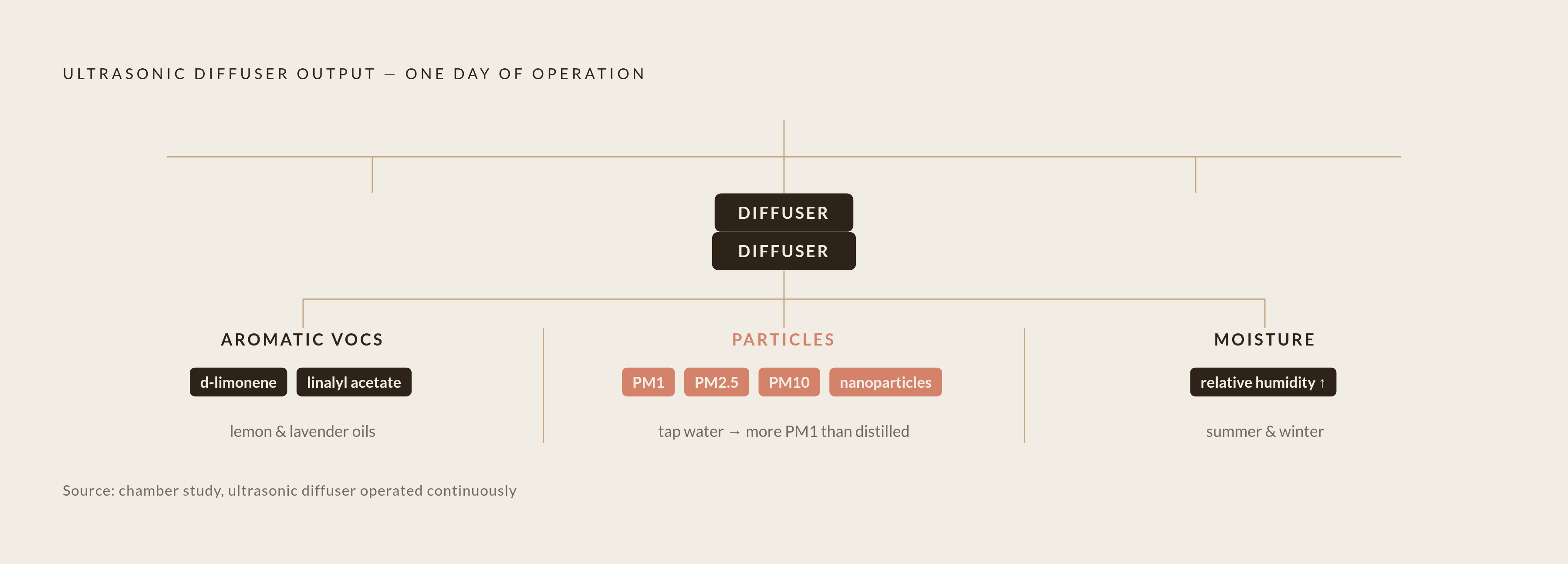
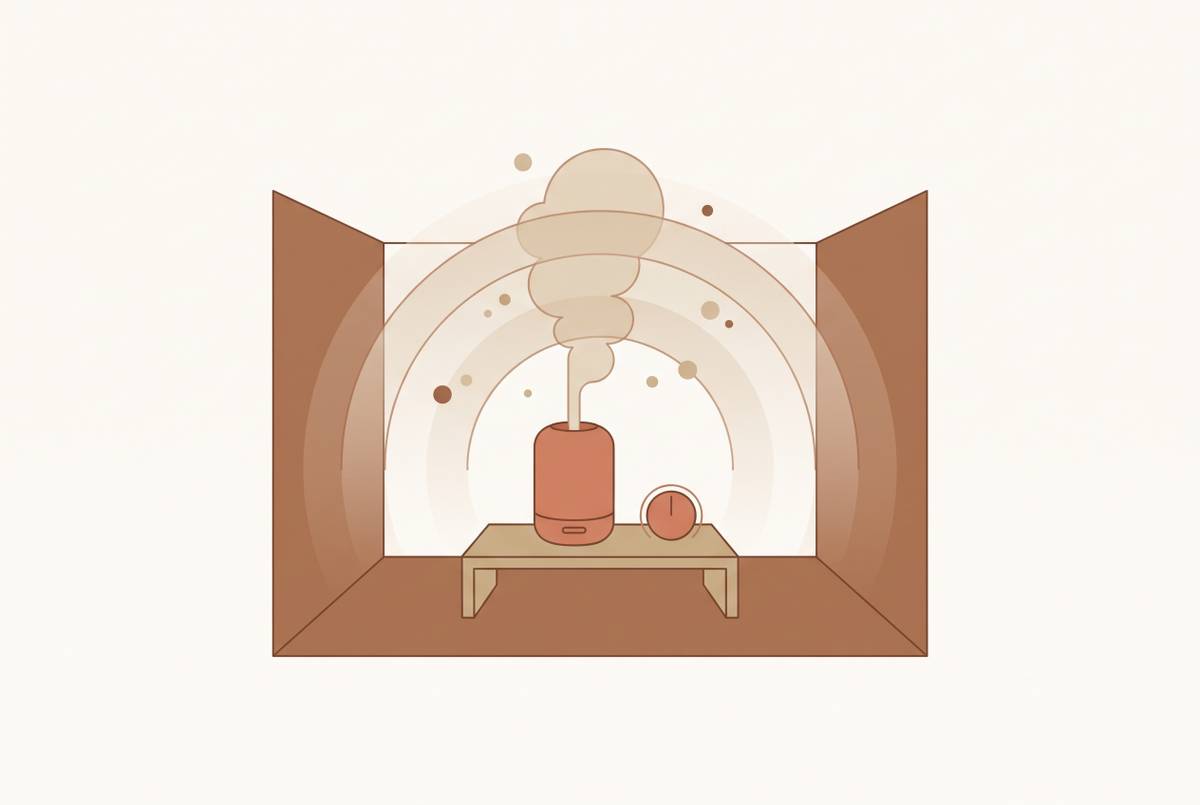
Inside an ultrasonic diffuser, a piezoelectric element vibrates at high frequency, breaking the water-and-oil mixture into a fine mist. That mist delivers the fragrance to the room. It also disperses material dissolved or suspended in the water, so the device is doing more than releasing a smell. Its outputs include aromatic volatile organic compounds, or VOCs, fine and ultrafine particles, and moisture that contributes water vapor as droplets evaporate.
Schwartz-Narbonne et al. (2021) identified d-limonene and linalyl acetate as the most abundant VOCs from ultrasonically diffused lemon and lavender oils, respectively. Rimdjonoka et al. (2024) measured increases in PM1, PM2.5 and PM10 during experiments using tap water or water with essential oils, as well as increased nanoparticle concentrations. The fill water changes this starting point, with tap water producing more PM1 than distilled water.
How humidity builds in the room and why it matters more in some seasons and homes than others
In a closed or poorly ventilated living room, continuous moisture output can raise relative humidity over the day. The Rimdjonoka study recorded rising humidity during both summer and winter experiments, although the size of the change differed between seasons. Temperature changes were recorded too. The significance of the humidity effect depends on the room’s starting conditions.
A room that is already humid has less room for additional moisture before conditions become favorable to dust mites and mold. That makes moisture buildup from all-day use a particular concern in coastal homes, basements and poorly ventilated apartments. A pleasant smell and an increasingly damp room can coexist quite comfortably, even if the occupants would prefer otherwise.
The reservoir presents a related but separate moisture problem. Standing water in a dark, enclosed chamber provides conditions in which bacteria and mold can establish, making cleaning part of the same environmental picture. Cleaning the tank leaves the water vapor already added to the living room in the air.
What happens to the VOCs and particles once they leave the diffuser nozzle
The fragrance compounds leaving the nozzle are not necessarily the final substances present in the room. Terpene VOCs can react with ozone already in indoor air, generating secondary pollutants that include formaldehyde and nanoscale aerosol particles. These reactions can happen even when ozone levels are no higher than usual. Continuous diffusion keeps supplying compounds that can participate in those reactions, so duration changes more than the amount of original fragrance released.
Formaldehyde is a respiratory irritant, although a single short session is unlikely to produce harmful concentrations. Running the diffuser for a long time in a poorly ventilated room keeps adding to whatever is already there from pressed-wood furniture, cleaning products or gas appliances.
Particle size complicates the picture further because nanoparticles can bypass upper-airway defenses that trap coarser particles. Smaller does not automatically mean greater deposition deep in the lungs, however, and particles near 100 nanometers may be exhaled. The Rimdjonoka study reported that current indoor-air guidelines had no specific advice for the nanoparticle range it found. Without that advice, claims about safety or danger need to be precise.
How particle load from an all-day diffuser compares to other common fragrance sources
A diffuser’s clearest advantage over a candle is the absence of combustion. There is no flame producing soot or carbon monoxide. Those are genuine benefits, but they do not establish that the resulting air is free of particles. Ultrasonic diffusion creates an aerosol by a different route.
Measurements described in the brief place oil diffusers, candles and incense in the same broad order of magnitude for PM2.5, with incense peaking higher and candles lower than diffusers. That comparison challenges an assumption. It does not establish that every ultrasonic model emits the same amount, or that all three fragrance sources have identical health effects. A peak reading also cannot be treated as equivalent to a recommended average over a full day.
For all-day use, the important distinction is continued input. A short fragrance session and an uninterrupted run create different exposure patterns, even when the device and oil are unchanged. Diffusers avoid combustion byproducts, while their total particle contribution still depends on how they operate and for how long.
The microbial dimension of a reservoir that runs all day
When water remains in a dark, enclosed chamber, microbial growth can make its contents increasingly different from the clean water originally poured in. Ultrasonic atomization can then disperse that contamination with the mist.
The Rimdjonoka study commonly identified Aerococcus viridans and Micrococcus luteus. The researchers reported that the microorganisms identified were not pathogenic and presented no significant infection risk from the diffuser’s use. The study also identified four fungal species, with molds making up most fungal findings, which is relevant because molds can act as respiratory irritants and allergen sources for sensitive people.
The concern is therefore maintenance and cumulative irritant exposure. The study found no significant changes in bacterial concentrations initially, followed by a substantial rise after several days. Repeated operation without cleaning allows the reservoir’s condition, and potentially its aerosolized contents, to drift.
What all-day operation does to scent consistency and why the fragrance experience degrades over time
With Olfactory adaptation, a smell seems weaker within the first hour of breathing it in without a break. A visitor may notice a strongly scented room while the person who has spent the day there barely registers it.
That helps explain why an ultrasonic diffuser can seem ineffective even on high. A smell that seems weak gives no sure sign of how much fragrance is in the air or how evenly it has spread through the room. Running longer cannot compensate for adaptation. The nose is not an air-quality meter.
Meanwhile, the mixture itself is changing. Water and fragrance oil do not evaporate or atomize at identical rates, so the effective concentration and aromatic character can shift over a long session. Heat generated during operation can also subtly alter the oil, while ultrasonic mist production relies on vibration. By hour six, the fragrance may differ from hour one in both composition and perception, sometimes seeming flatter or muddier. More operating hours can therefore undermine the very experience they were intended to sustain.
Who is most affected by the compounds that accumulate in an all-day diffuser room
Infants and children under three have smaller respiratory tracts and breathe faster for their body mass. They also spend more time near floor level, where heavier particles settle. A background exposure for an adult can therefore represent a proportionally larger burden for a small child.
People with asthma or other respiratory conditions may be more sensitive to terpene VOCs and secondary aerosols. Natural origin does not remove that sensitivity. Persistent coughing, throat dryness, shortness of breath during diffusion, or a heavy or tight chest are reasons to reconsider concentration and duration rather than assume the fragrance is harmless because it comes from plants.
Cats face a separate risk because they cannot process phenols and certain other compounds in many popular oils well enough. Tea tree, eucalyptus, peppermint and citrus oils are among the relevant examples. Their more acute sense of smell also means a concentration that seems mild to a person may be intense to a cat. Continuous diffusion in a room the animal cannot leave is therefore a specific welfare concern.
Why intermittent use preserves both air quality and the scent experience better than continuous operation
The practical response is to run the diffuser in sessions, with gaps between them. That limits the hours during which moisture, VOCs and particles enter the room. A scent-free interval lets the nose reset, making the returning fragrance more noticeable without requiring an uninterrupted supply.
Shorter sessions reduce the time available for the oil-to-water ratio to drift and for thermal effects to alter the aroma. They can also reduce the hours a filled reservoir spends at operating temperature. Switching off is not a substitute for cleaning, however. Water left standing still needs to be dealt with before the next session.
Ventilation during and after use helps dilute pollutants, including products of ozone-terpene reactions. Opening a window or running an air exchange complements shorter sessions rather than making continuous operation inconsequential. There is no need to invent a universal minute-by-minute schedule to apply this principle. The mood and wellness benefits sought from fragrance remain available through intermittent use, while the return of a noticeable scent can make the experience more rewarding.
Cold air diffuser vs ultrasonic diffuser for home use
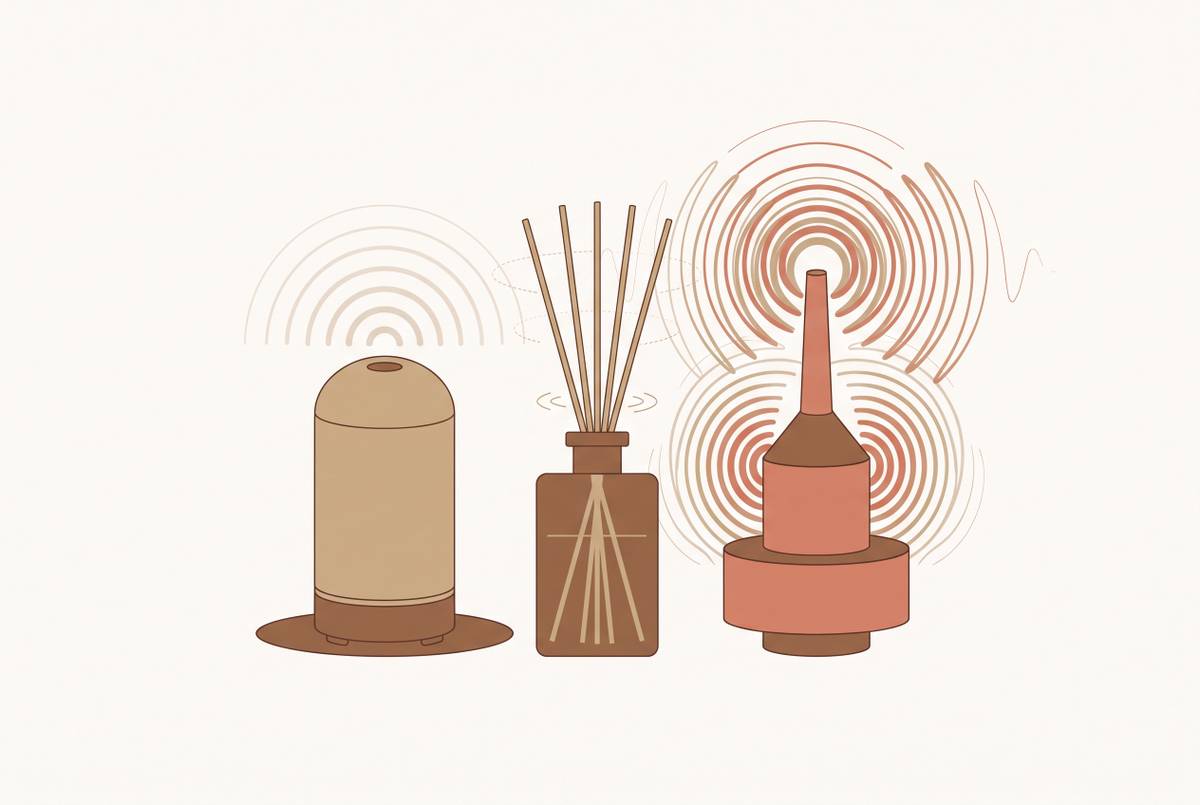
A cold-air diffuser uses pressurized air to atomize pure fragrance oil into a dry mist. This removes the water-based source of several problems. There is no added water vapor, no standing-water reservoir for microbial growth, and no warming element altering the oil. It also avoids the water-mineral aerosols that come from tap water in ultrasonic devices.
For a living room where added humidity is unwelcome, that is a structural advantage. For fragrance quality, removing dilution and heat also avoids the changes associated with those features of ultrasonic operation. iScent (2026) describes its cold-air approach as preserving a “True Note” profile. The company’s description of aromatic fidelity leaves open the possibility of chemical changes once scent is airborne.
Cold-air diffusion still releases VOCs because fragrance molecules are still being dispersed. Oil choice, intensity and session length remain relevant. Models with programmable on/off cycles can switch themselves on and off for intermittent use, but having that feature alone is no reason to run fragrance all the time.
What to do if you are running an ultrasonic diffuser and want to keep using it responsibly
For owners keeping an ultrasonic diffuser, the useful changes are straightforward. Use distilled or deionized water instead of tap water to cut down on particles from minerals in the water. The Rimdjonoka study specifically tested distilled water and found that PM1, PM2.5 and PM10 could remain within acceptable ranges over a 4-hour period. That finding does not extend to every particle size or every operating condition, and the study did not test deionized water.
Clean the reservoir before every refill and use, even if it has already had its weekly clean. Emptying and wiping it before adding clean water interrupts the conditions that develop across repeated sessions. Pair that maintenance with cycling on and off. Ventilate during or after diffusion, including briefly opening a window, to reduce the buildup of reaction products.
Choose oils with disclosed ingredients and formulations that follow IFRA standards. If the household includes infants, cats or people with respiratory conditions, limit the room and duration of use and consult the specific oil’s safety profile before use around pets. These choices address different parts of the process, from what enters the reservoir to what remains in the room.