Noise Levels Across Home Diffuser Types
Ultrasonic diffusers dominate the market, but noise levels vary wildly across types.
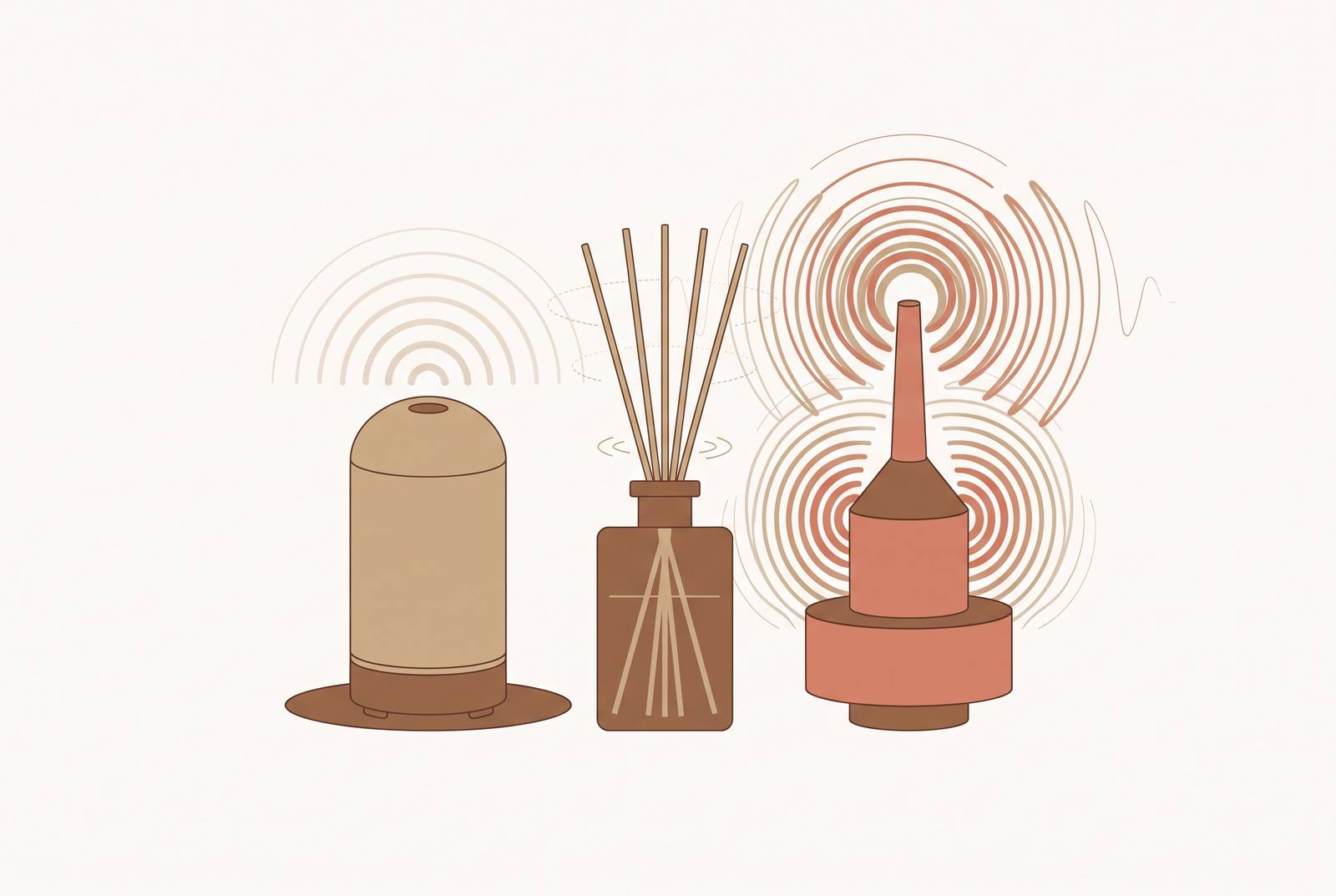
Fragrance diffusers got quiet, then loud, then quiet again, depending on which kind sits on the shelf. The category is worth $31.3 billion in 2025 and heading toward $61.5 billion by 2035, and yet the specs sheets buyers actually read fixate on coverage area, tank size, and design, almost never on decibels. That's strange, because noise is the one variable that decides whether a device can live six inches from someone's ear all night or gets banished to the living room by week two.
Ultrasonic diffusers hold more than 70% of the US market in 2025. Most people already own one type of noise profile and have never heard the alternatives side by side. This piece walks through what each diffuser type actually sounds like, mechanism by mechanism, so the decision happens before the purchase instead of after the third sleepless night.
Reed diffusers: no mechanical parts, no sound
Start with the easiest case. Reed diffusers have no electricity, no vibrating plate, no pump, nothing that spins or hums or clicks. The reeds sit in a vessel of scented oil, absorb it through capillary action, and release fragrance passively into the air. There's no motor to fail and, more relevantly here, no motor to listen to.
Scent projection is weaker than anything electric. Reeds work best somewhere the air doesn't move much and the room itself is compact. A reed diffuser asked to scent an open floor plan fails quietly, which is on-brand but not useful. There's also no scheduling and no intensity dial. It's set-and-forget, for better or worse, and whether that reads as a feature or a shortcoming depends entirely on how much control someone wants over their air.
Ultrasonic diffusers: near-silent operation with a water-related caveat
Ultrasonic units use high-frequency vibrations to break a water-and-oil mix into a fine mist. The vibrating plate at the bottom of the tank is the entire noise source, not a motor, not a fan.
The numbers back up the reputation. Homes & Gardens tested the ASAKUKI diffuser and measured it under 23 decibels, which the outlet classified as effectively silent. Industry guidance puts the bedroom-safe threshold at under 25 dB, so a unit like that clears the bar with room to spare. For scale, anything under 30 decibels sits quieter than normal human breathing, and most decent ultrasonic models land somewhere in that zone.
Water gurgles as the reservoir empties, especially near the end of a cycle, and the unit sputters and gurgles intermittently rather than humming along at a constant baseline. As the reservoir empties, especially near the end of a cycle, the unit sputters and gurgles intermittently rather than humming along at a constant baseline. In a dead-silent bedroom at 2 a.m., that gurgle can register louder than the rated decibel figure implies, precisely because it's unpredictable rather than steady. A steady hum, the ear tunes out. A random gurgle, it doesn't.
There's a maintenance wrinkle too. Water reservoirs need regular cleaning, since standing water is exactly the kind of environment mold and bacteria like, and whatever grows in there gets aerosolized right along with the fragrance. Anyone buying an ultrasonic unit specifically for cleaner air should treat the tank like a dish that needs washing, not a fill-and-forget reservoir.
Ultrasonic diffusers remain a strong pick for most living rooms, offices, and bedrooms where an occasional gurgle is tolerable. Anyone planning all-night use without a refill should check tank size before checking anything else.
Traditional nebulizing diffusers: the noisiest active type
Nebulizers skip water. Compressed air breaks pure essential oil into a fine particle spray, and that compression process is where the noise comes from: not a steady hum but a hiss or buzz that pulses with each spritz cycle. In a quiet room, that's the sound that turns heads.
Testing and reviews have noted that nebulizers can get genuinely noisy during those spritz bursts. The output is more concentrated too, since there's no water diluting the oil. That's why serious aromatherapy users tolerate the noise in the first place: undiluted oil means a stronger therapeutic dose per spritz. That's the trade being made here, noise for potency, and it's a fair trade in the right room.
Which rooms are wrong for it? Bedrooms, nurseries, home offices, anywhere quiet is the baseline condition. A nebulizer belongs in a larger space that already has some ambient noise to blend into, not a nursery where the spritz cycle could interrupt a nap that took forty-five minutes to induce.
Cold-air diffusers: a steady low hum, not a gurgle or a buzz
Cold-air diffusion runs on the Bernoulli principle: air accelerates over an oil reservoir, pressure drops, and the oil shears into ultra-fine droplets, somewhere around 1 to 3 microns, small enough to stay airborne for minutes. No heat, no water, just moving air and physics doing the atomizing.
The noise is in a defined band, 30 to 45 decibels according to aromaparadise.com, which the site compares to an aquarium pump or a refrigerator's hum. One named example, the INFINITY from Mila Marie Scents, runs under 35 dB according to the brand's own published figures, putting it below the roughly 40 dB hum most refrigerators produce and below the ambient noise floor of a typical occupied home.
What matters as much as the decibel number is the character of the sound. It's a low, steady mechanical hum, not sharp, not intermittent, nothing that yanks attention the way a nebulizer's hiss or an ultrasonic gurgle does. Many cold-air units also run on scheduled bursts rather than continuous output, so the pump is only audible during its actual operating window and silent the rest of the time.
Any diffuser that atomizes oil needs a pump, and a pump makes noise in a truly silent room. Marketing copy that calls a cold-air unit "completely silent" is overselling a mechanism that, by definition, moves air to break up oil.
One workaround erases the question. When the air pump for an HVAC-integrated cold-air system sits beside the air handler, tucked into a basement, garage, or utility closet, the mechanical noise stays in the mechanical room and the living space hears nothing. A single unit set up this way can cover 1,000 to 5,000 square feet, scenting a whole home from a closet nobody visits.
There's a scent-quality angle too, relevant to anyone weighing noise against fidelity: because the oil is never heated and never diluted with water, every top, middle, and base note reaches the air the way it left the bottle. Cold-air units also tend to show up in brushed aluminum, stone, or matte glass, materials chosen to complement a room rather than disappear into it.
Heat-based diffusers and wax warmers: silent operation, but at a cost to the oil
Heat-based diffusers and wax warmers use an electric heating element to warm fragrance material and release scent through evaporation. Most models have no pump, no vibrating plate, no fan, so the operational noise is close to zero. Nothing moves, so nothing to hear.
Some evaporative diffusers add a fan to speed up dispersal, and that fan is a genuine, audible departure from the silent baseline the category is known for. Heat-based does not automatically mean silent."
The bigger trade-off isn't acoustic at all, though, it's chemical. Heat changes the structure of essential oil compounds, which can degrade both the aromatic complexity and whatever therapeutic properties the oil started with. Heat can also alter the chemical composition of fragrance materials in ways that cooler diffusion methods avoid. The oil that goes in isn't quite the oil that comes out as scent.
That makes heat-based diffusion the right call when total silence outranks scent complexity, and the wrong call for anyone who cares more about how faithfully the fragrance translates into the room.
Candles: atmospheric crackle versus mechanical hum
Candles have no pump, no plate, no fan, so there's no mechanical noise to measure. Whatever sound comes off a candle, that faint crackle from the wick, is aesthetic rather than functional, and plenty of people count that crackle as a selling point rather than something to tolerate.
That's a genuinely different category of sound from anything mechanical. A candle's crackle is ambient and intermittent by nature; a diffuser's hum, on the rare occasions one exists, is steady and mechanical. Comparing them on the same decibel scale sort of misses the point, since one is incidental and the other is a design output.
Candles bring their own trade-offs unrelated to sound: open flame, soot, smoke. Diffusers remove all three of those risks and substitute, in some cases, a pump-based hum that a candle never had to begin with. Neither format wins outright on "quiet." They just make noise, or don't, for completely different reasons, and the right pick depends on what a given room can tolerate.
How surface, placement, and scheduling change what you hear
A diffuser's rated decibel level and what actually reaches someone's ear are two different numbers, and the gap between them usually comes down to placement, not the unit itself.
Hard surfaces amplify vibration. Setting any diffuser directly on tile, glass, or bare wood lets that surface transmit and even reflect the vibration, raising perceived volume well past what the spec sheet promised. The fix costs less than a coffee and takes ten seconds: a soft mat, a felt pad, even a folded coaster under the base absorbs the vibration before it becomes sound. Wall proximity matters the same way, since a hard vertical surface a few inches away reflects sound right back into the room; pulling a unit a bit further from the wall measurably changes what's audible.
Scheduling solves a different piece of the puzzle. Running a diffuser for an hour before bed and letting it shut off means the scent lingers in the room while the device itself sits silent by the time anyone's actually trying to sleep. Lower intensity settings help too, since most home diffusers get run at a higher output than the room actually needs, and reducing that setting eases pump effort and quiets the unit while, as a bonus, often improving how balanced the scent reads.
Bathrooms deserve a specific callout here. Hard tiled surfaces reflect sound readily, so a mat under the unit matters especially in a bathroom. And for a home office, scheduling diffuser cycles to run between calls rather than through them sidesteps that entirely, even with a near-silent device. If nobody's on a call when the pump kicks on, nobody notices the pump.
Matching noise tolerance to room and use case
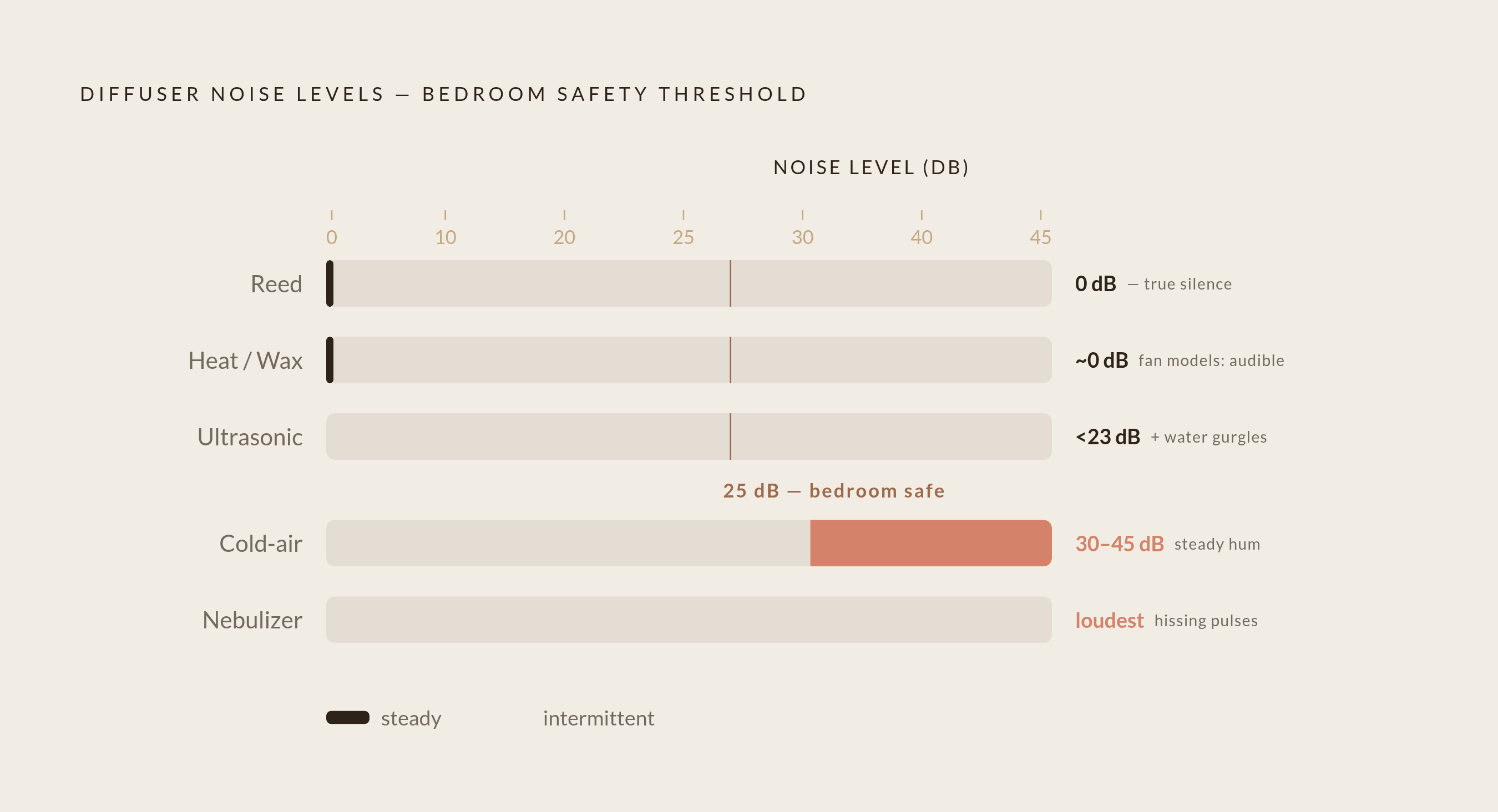
So which type goes where? Bedrooms and nurseries carry the highest noise sensitivity by a wide margin, and the cited benchmark for bedroom-safe operation sits under 25 dB. Ultrasonic models that hit that mark, or cold-air units run on a pre-sleep schedule, are the practical options here. For light sleepers specifically, HVAC-integrated cold-air diffusion settles the question outright, since the pump never sits in the bedroom to begin with.
Living rooms and open floor plans are the forgiving end of the spectrum. Conversation, cooking, a TV running in the background, all of it covers diffuser noise well enough that acoustic performance barely factors into the decision. Coverage area and run time affect the decision here, while decibels barely factor in.
Home offices sit in the middle. A steady mechanical hum is easier to work around than an intermittent spritz or gurgle, since the brain habituates to constant sound faster than to unpredictable bursts, and scheduling cycles around calls handles most of what's left. Bathrooms and hallways, being small and enclosed, are where reed diffusers genuinely shine, and if an electric unit gets used there instead, the surface underneath it matters more than which brand sits on top of it.
Cold-air and ultrasonic aren't simply louder or quieter than each other, they're different in kind. Cold-air produces a steady low hum; ultrasonic produces a softer baseline punctuated by intermittent water noise. Which one bothers a given person more is genuinely a matter of individual sensitivity, not a settled ranking. Premium cold-air systems designed for whole-home coverage are worth a look for buyers chasing scent fidelity and low maintenance alongside quiet operation.
The takeaway that actually travels past this article: match the type of noise, steady hum against intermittent gurgle against true silence, to the sensory demands of the room. Not just the decibel number printed on the box.
Sources
- The 6 Best Essential Oil Diffusers for Whole-Home Scenting in Fall and Winter
- The 10 Best Diffusers of 2025 – A Comprehensive Guide to Air Enhancement – wickfusion.com
- How Loud Is a Cold-Air Diffuser, Really?
- Best Essential Oil Diffuser for Home 2026 Picks
- Best Scent Diffuser for Home - 2026 Reviews
- aromaparadise.com