How to Test and Dial in Diffuser Power for Any Room You Own
Volume, airflow, and placement matter more than square footage alone.
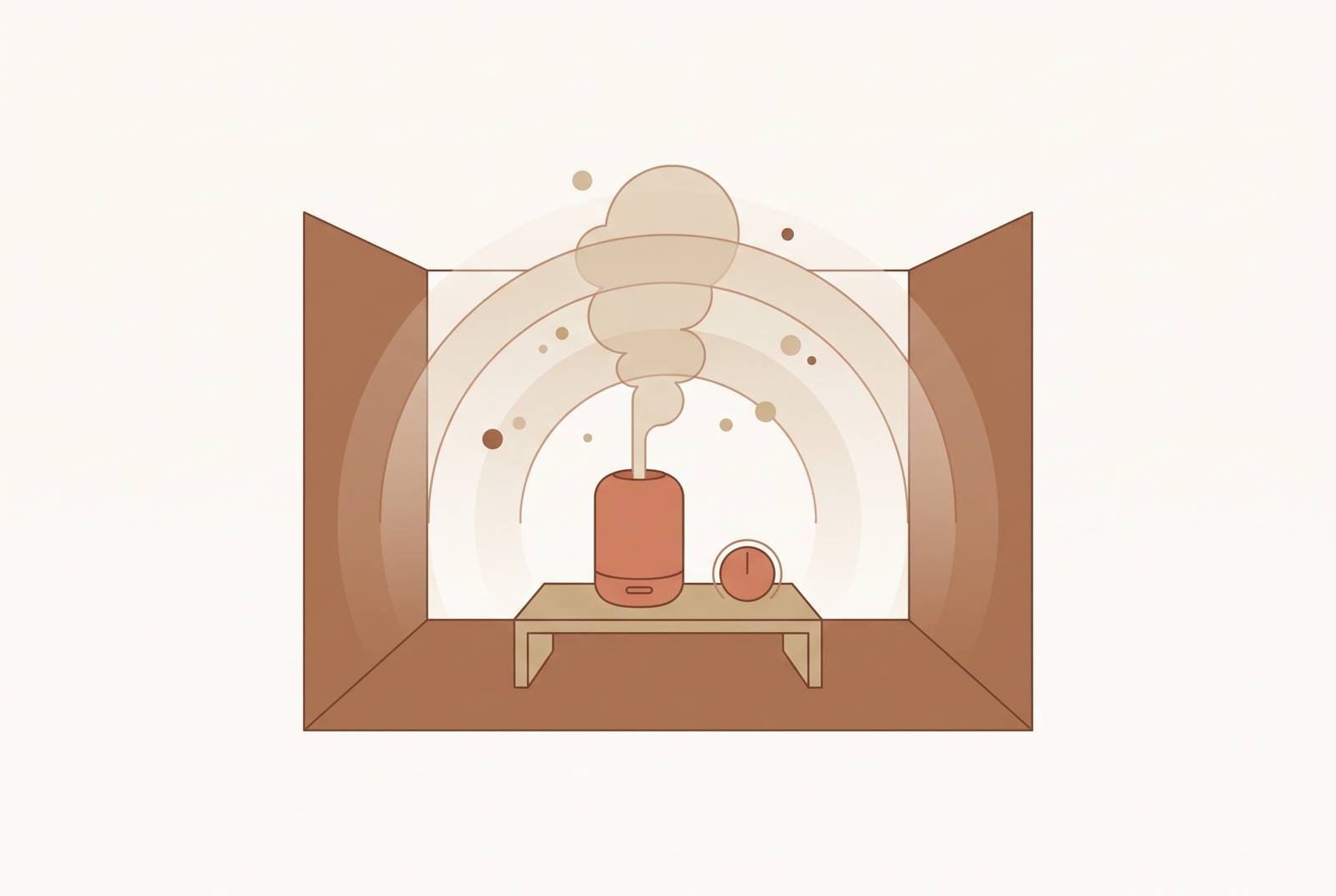
Matching diffuser size and power to room square footage starts with a coverage rating, but the right setting comes from testing room volume, airflow, layout, and output together. For a bedroom, an adjustable ultrasonic diffuser or compact cold-air unit is a reasonable starting point. Begin at low output, then assess scent at the room’s far edge before increasing it.
Why square footage alone fails as a sizing tool for diffusers
A diffuser’s coverage figure leaves out the height of the room it is supposed to fill. Cubic footage, worked out as length × width × height, tells you how much air is in the room. A vaulted living room therefore asks more of a diffuser than a lower-ceilinged room with the same floor area. The floor plan tells only half the story.
Tank capacity tells you how much oil or water the unit holds, which affects run time. Manufacturer ratings also need care because the industry has no shared testing standard for those figures. They express the maker’s design intent.
Can you simply buy the model rated for your room size and be done? That shortcut assumes something close to a sealed box with standard ceilings. Real rooms have doorways, ventilation, and furniture, so the rating is a sizing guide. The room gets the final vote.
The four variables that actually govern how scent fills a room
Start by checking volume, including any connected spaces. An open living, dining, and kitchen area is one scent zone, even if each part has a different use. Measuring only the living area understates the air the diffuser must fill. High ceilings enlarge that task without adding floor space.
Ceiling fans, open windows, HVAC vents, and frequently opened doors can make a room behave like a much larger space by reducing scent retention. Airflow is the hidden dial in the setup. A setting that works behind a closed door may fall short when that door stays open.
Layout determines where the fragrance can actually travel. A sofa in front of the outlet or a cabinet around the device blocks distribution, while many doorways let scent spread into adjacent rooms. High ceilings also let fragrance rise and disperse before it reaches breathing height, potentially requiring more output or higher placement.
Finally, check which controls the diffuser gives you. Mist intensity, interval timing, and continuous or intermittent operation are the levers available once the device is placed. Begin at the lowest usable output and increase gradually, because excess scent takes longer to correct than a faint result. These four checks work together.
How diffuser technology sets the limit on what an output setting can achieve
Controls cannot make up for a diffusion method that cannot reach far enough to fill your room. Ultrasonic diffusers use vibration to turn water and oil into mist and work well in small to medium rooms. They also add humidity. That can help in dry conditions, but it is less welcome in an already-humid space.
Nebulizing diffusers use air pressure to atomize pure oil without water or heat. They are the more powerful option for aromatherapy and cover larger spaces more effectively. Cold-air diffusion uses pressurized air to make a dry, micro-fine mist of fragrance. Its reach suits large or open-plan rooms particularly well.
Because cold-air diffusion avoids heat and water, it releases the oil’s full scent profile, including top, middle, and base notes, without those processes altering it. The dry mist lingers and travels farther than water-based mist. It adds no humidity and avoids hot-water or steam hazards. Those distinctions are useful in homes with children or pets, although they do not establish whether an oil itself is safe for them.
For initial sizing, ultrasonic units suit small rooms under roughly 150 sq ft. Medium rooms of roughly 150–400 sq ft need ultrasonic units with settings that can be changed or small cold-air models, while large and open-plan spaces of roughly 400–1,000 sq ft are a good fit for standalone nebulizing or cold-air devices. To cover a whole floor or home, HVAC-fed cold-air systems need to be rated for the full area they serve, and the ductwork already in place spreads the fragrance.
Placement decisions that determine whether a correctly-sized diffuser actually performs
Before testing output, give the mist an unobstructed route into the room. Central placement at mid-height, on a coffee table, side table, or shelf, helps fragrance disperse before meeting walls or furniture. In a larger room, position the diffuser near the main airflow path. Placement is part of calibration.
Natural airflow is helpful, but proximity to an HVAC supply vent can move fragrance out of the room before it disperses. Keep the device away from direct sunlight and heat sources, which accelerate oil evaporation and shorten effective run time. In hallways and entryways, favor the airflow route over a dead corner.
An open plan may also need more than one release point. Where a single device cannot reach distinct zones, two smaller, strategically placed diffusers often distribute scent more evenly than one oversized unit. Bedroom placement calls for a different restraint. Start farther from the bed at lower output, since concentrated fragrance near the pillow is harder to reduce than to increase.
The room-by-room testing sequence for calibrating output from a cold start
First, establish the room’s baseline before switching anything on. Measure length, width, and ceiling height, calculate cubic footage, and note open doorways or active ventilation that enlarge the effective scent zone. Compare the space with the technology tiers above, then position the diffuser where airflow is not blocked. This separates a sizing problem from a placement problem.
Second, run the diffuser at its lowest usable output. For a cold-air unit, use the lowest available output through its interval or mist-intensity controls. Choose one oil you know well and set a session length that gives the scent time to settle through the space before judging it. Record the oil name and setting after each session.
Third, assess the room’s far edge. Is fragrance detectable and comfortable at the point farthest from the diffuser? If so, the setting is in the right range. If it remains undetectable after a full session, increase output by one level and repeat. If the area near the device becomes heavy or sharp before fragrance reaches that edge, reduce output.
Fourth, test the conditions in which the room is actually used. An open window, running ceiling fan, or closed door can change the result, so compare those conditions when they change. Record any consistent pattern rather than treating each weak result as a demand for more power. A room that loses fragrance whenever the HVAC runs may need placement closer to the return-air path instead.
Fifth, use the timer or smart scheduling feature to save the setting that worked. Running during occupied hours and pausing when the room is empty conserves oil and limits olfactory fatigue. Intermittent operation is preferable to continuous output at the same volume because pauses help the scent register again when diffusion resumes. The method is a short sequence per room.
Room-specific adjustments that modify the baseline method
A bedroom’s closed door and lower activity encourage scent to accumulate. Begin below what seems necessary and allow time before increasing output, with a soft, lower-intensity oil as the starting choice. If pets sleep there, establish the oil’s safety before extended sessions, with extra caution for cats because of their reduced ability to metabolize certain oil compounds.
An open-plan living and kitchen zone works against retention. Extraction fans and stove heat create competing air currents, so output will generally need to be higher than in an enclosed room of similar floor area. Layout decides whether one unit is enough. A high-output cold-air diffuser near the main air path often outperforms two smaller units in a broadly connected space, while two release points suit distinct zones or a split layout.
A home office calls for steady, low-level background fragrance that does not distract during consistent occupancy. Citrus and clean herbal profiles tend to work well for that, but heavily spiced or high-intensity oils can build up in a closed room. The desk is the relevant assessment point here. A pleasant impression at the doorway is less useful than comfort where the occupant spends time.
Entryways and hallways lose scent through frequent door openings and movement. Intermittent scheduling compensates better than permanently high output, while placement along the route people take helps distribute fragrance into adjoining space. The target is moderate but clearly detectable scent. That differs from an office’s faint background because the entryway supplies the home’s first sensory impression.
A bathroom shifts the balance toward moisture control. Its small size and often-high humidity make a compact nebulizing or cold-air unit a better match than an ultrasonic model that adds water to the air. Start with very low output in this space. Enclosure and limited airflow can let fragrance build quickly enough to feel oppressive within a short session.
Fragrance oil choice as the final calibration variable
A heavier or more concentrated fragrance can overwhelm a room at the setting that suited a lighter one, while a light profile may need a modest increase. Oil choice is therefore part of calibration. The dial measures device output.
Light scents such as lavender, sandalwood, and soft florals suit small enclosed rooms where accumulation is fast. Heavier profiles, including cedarwood, amber, and woody blends, suit larger spaces where reach is needed. Base-heavy oud, dark woods, or spice at high output in a small room is likely to overshoot. Turn output down first, then consider a lighter oil if the scent is still too strong.
Use one oil at a time while establishing the room’s setting. Mixing during calibration makes it difficult to distinguish excessive output from the character of the blend. Once a reference oil works, blending is easier because the device’s setting has been worked out. A later oil change still deserves a brief test.
Choose clearly formulated fragrance oils suited to the specific cold-air device, because incompatible oils can damage the atomizer and make output inconsistent. Ingredient transparency helps households assess oils around children and animals. Vegan or cruelty-free labels tell households about things other than pet safety, so the oil-safety check is still needed.
Maintaining calibration over time and resetting a setting that drifts
A familiar scent can seem weaker even when the diffuser has not changed. Continuous exposure produces olfactory adaptation, which can create a false impression that the room needs more output. The response is intermittent sessions. Otherwise, a loss of sensitivity becomes a reason to overfill the room with fragrance.
Oil build-up can partially block the atomizer, reducing effective output at the same setting, so clean an active-use diffuser at least weekly. If a setting that used to work seems weak, clean the diffuser before changing it. For cold-air units, use only manufacturer-approved methods to protect the atomizer, particularly when incompatible oil residue may be involved.
The room itself can change as well. Winter heating lowers humidity and can increase scent throw, while open windows in summer let more air through and more scent out. A new pet, a new occupant, or a bedroom becoming an office can also change the appropriate intensity. Even a replacement oil of similar character warrants a brief retest because formulations differ in concentration and weight.
The reset need not repeat all the groundwork. Return to the second stage, run a session at the last known good setting, and assess the far edge. Most recalibrations need only one or two adjustments. Treating those small corrections as normal is what separates a diffuser that stays enjoyable from one abandoned because its original setting stopped working.