Bedroom Fragrance Setup for Better Sleep Quality
Lavender alone won't help you sleep, but the right scent blend can.
Start with the finding that probably cuts against what you've heard. A 2025 study published in Scientific Reports found that lavender alone did not produce a statistically significant sleep effect compared to a control condition, but a blended perfume did. If you've spent any time in the wellness space, that result lands strangely. Lavender is practically synonymous with sleep.
What the finding actually points toward is this: the mechanism has less to do with any single aromatic molecule and more to do with the brain's conditioned response to a scent it finds pleasurable and familiar. Personal preference and consistent use matter as much as botanical category. That surprised me when I first sat with it.
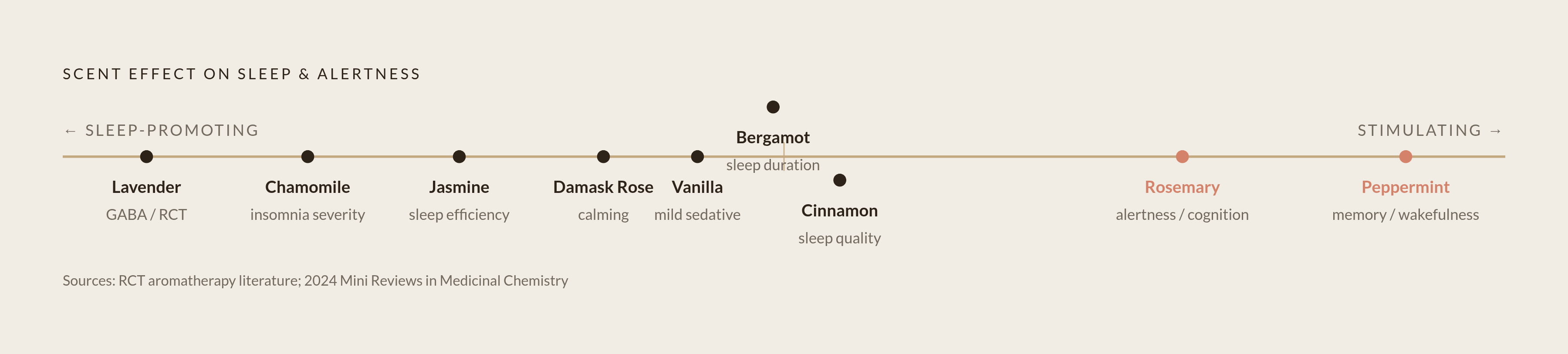
The botanical research still holds signal, though. Lavender has been tested across multiple randomized controlled trials; one study in 67 participants found improved sleep quality compared to a no-odor control, the effect linked to autonomic nervous system modulation and GABA pathways. A 2025 randomized controlled trial found that nightly chamomile inhalation over fifteen days reduced insomnia severity in young adults. Jasmine connects specifically to sleep efficiency and emotional stabilization, making it more relevant to staying asleep than to falling asleep. Damask rose showed calming properties and improved sleep quality even in high-stress clinical environments. Vanilla demonstrates a mild sedative effect, measurably reducing hyperactivity and startle responses. A 2024 review in Mini Reviews in Medicinal Chemistry covered evidence showing bergamot and cinnamon improved both sleep quality and duration.
The stimulant side is equally documented, and it's where I see people go wrong most often. Rosemary promotes alertness and cognitive activation. Peppermint enhances memory recall and wakefulness. Both are well-researched as performance-enhancing scents, which makes them exactly the wrong signals to send to a brain you're trying to move toward sleep. I've watched people diffuse peppermint at nine in the evening and wonder why they're still awake at midnight.
The Sleep Foundation's position is candid about the limits: there is no single consensus aromatherapy protocol for sleep. What works depends on the individual's specific sleep difficulty and their existing fragrance associations. The research gives you a well-supported set of candidates. It does not give you a universal answer, and that distinction matters when you're actually trying to use any of this.
Why delivery method shapes the outcome more than scent choice alone
The same fragrance oil, dispersed three different ways, can produce three meaningfully different experiences. Concentration, consistency, and scent fidelity all vary by method, and most bedroom fragrance decisions get made based entirely on what looked nice at the store.
Candles are the most common choice and a poor fit for sleeping environments. Open flame is the obvious concern, but combustion byproducts also enter the air, and heat alters the fragrance molecules themselves, changing what you're actually inhaling. They also burn out mid-night, which makes them useless as a timed behavioral cue.
Ultrasonic diffusers are common in wellness spaces, but the water-based mist introduces humidity into an already enclosed room. Water dilutes the oil, which reduces scent fidelity. A reservoir that isn't cleaned regularly becomes a mold risk in a space where you're breathing continuously for eight hours. Reed diffusers work passively and continuously, which sounds like a virtue until you realize there's no way to concentrate the scent for a targeted bedtime window. Pillow sprays are immediate and simple but dissipate in minutes, far too quickly to sustain any meaningful olfactory signal.
Cold-air diffusion addresses most of these constraints. It uses pressurized filtered air, no heat, no water, no combustion, to atomize fragrance oil into a dry, fine mist. The fragrance reaches the air intact, without thermal degradation, so what you smell corresponds to the actual formulation. More practically for sleep applications: timer and intensity controls let you program the diffuser to begin thirty to forty-five minutes before your target sleep time, run at consistent low output through the wind-down window, and shut off automatically. That programmability is what makes scent a repeatable behavioral cue rather than ambient background noise. Without it, you're just making the room smell nice.
What "clean fragrance" means in a room where you spend eight hours breathing
The exposure calculation in a bedroom is different from any other room in the house. A diffuser running while you cook dinner operates in a space you'll occupy for an hour, with kitchen activity dispersing the air. A bedroom diffuser runs while you're still, in an enclosed space, for eight hours. Most people haven't thought through that difference, and it's not a small one.
The labeling problem compounds it. In the U.S., the word "fragrance" on a product label can legally represent hundreds of individual synthetic ingredients drawn from a pool of over 5,000 fragrance chemicals, none of which require individual disclosure. The International Fragrance Association has identified over 3,000 fragrance ingredients currently in use; among them are documented carcinogens, reproductive toxins including phthalates, and common allergens.
Phthalates come up most consistently in the literature because they act as endocrine disruptors, interfering with hormone signaling. Formaldehyde, benzene, synthetic musks, and parabens are the other categories worth specifically excluding from a bedroom diffuser oil. These aren't theoretical trace concerns in an outdoor setting; they're compounds with documented biological activity in a room where nightly exposure is measured in hours.
One distinction worth keeping straight: "unscented" is not the same as "fragrance-free." Unscented products frequently contain masking fragrances designed to neutralize odor, which introduces chemical exposure without any olfactory signal to show for it. Fragrance-free means none added.
Third-party certification is the most practical test for a consumer who doesn't have access to full ingredient disclosure. IFRA certification indicates evaluation against safety and sustainability standards. Sephora Clean certification requires disclosure and exclusion of a specific list of problematic ingredients, a higher bar than unregulated "natural" or "botanical" claims, which mean essentially nothing enforceable.
Not every synthetic ingredient is harmful. The safe-synthetics category exists, and some lab-created aromatic molecules are specifically engineered for reduced allergenic potential. But "safe synthetics" is unregulated, which means the only practical proxy a buyer has is certification and full ingredient transparency. For a bedroom diffuser oil, Sephora Clean certification and formulation without phthalates and the ingredient categories above matter specifically because the exposure window makes ingredient quality a primary concern rather than a secondary one.
Fragrance safety when pets or children share the bedroom
Pets and young children present a distinct set of considerations, not because fragrance is uniquely dangerous around them, but because their physiological processing differs from an adult's in ways that change the safety calculation in directions that are easy to underestimate.
Cats are the clearest case. Their livers lack specific enzyme pathways required to metabolize certain compounds found in essential oils. Compounds that an adult human processes and clears without incident accumulate to toxic concentrations in a cat at relatively low airborne exposures. Veterinary toxicology literature documents this consistently, and it isn't a marginal edge case. A diffuser running overnight in an enclosed space with a cat carries real risk if the formulation hasn't been evaluated for this.
Dogs metabolize aromatics differently from humans as well. Tea tree, concentrated cinnamon oil, and certain citrus compounds are documented as problematic; early exposure symptoms, lethargy, subtle shifts in breathing, drooling, are easy to miss and attribute to other causes. Young children's respiratory systems are smaller and more sensitive to airborne concentrations that an adult won't consciously register. The clean-formulation principles that apply for adults apply here, amplified.
The practical filters come down to a few decisions. Avoid undiluted essential oils in any space where pets are confined overnight; blended formulations diffused at low concentration are different from single-note oils at full strength. Cold-air diffusion at low intensity produces lower airborne concentration than heat-based methods, which is a real advantage when other occupants can't self-regulate their exposure. Maintain partial ventilation even when the diffuser is running. Choose formulations from brands that explicitly address family and pet safety in their standards, because vague "natural" language tells you nothing useful about what's actually in the bottle.
How to select a sleep scent that will actually work for you
The clinical research gives you a validated set of candidates. It doesn't tell you which one your brain will respond to, because your brain is already running a set of associations built over years that no controlled trial accounted for.
A scent you've already linked to relaxation or safety, a childhood memory, a place that felt calm, a person whose home smelled a certain way, will activate those associations before any pharmacological mechanism has time to operate. That's not a reason to discard the research; it's a reason to use it as a starting framework and filter it through personal resonance. The two are not competing.
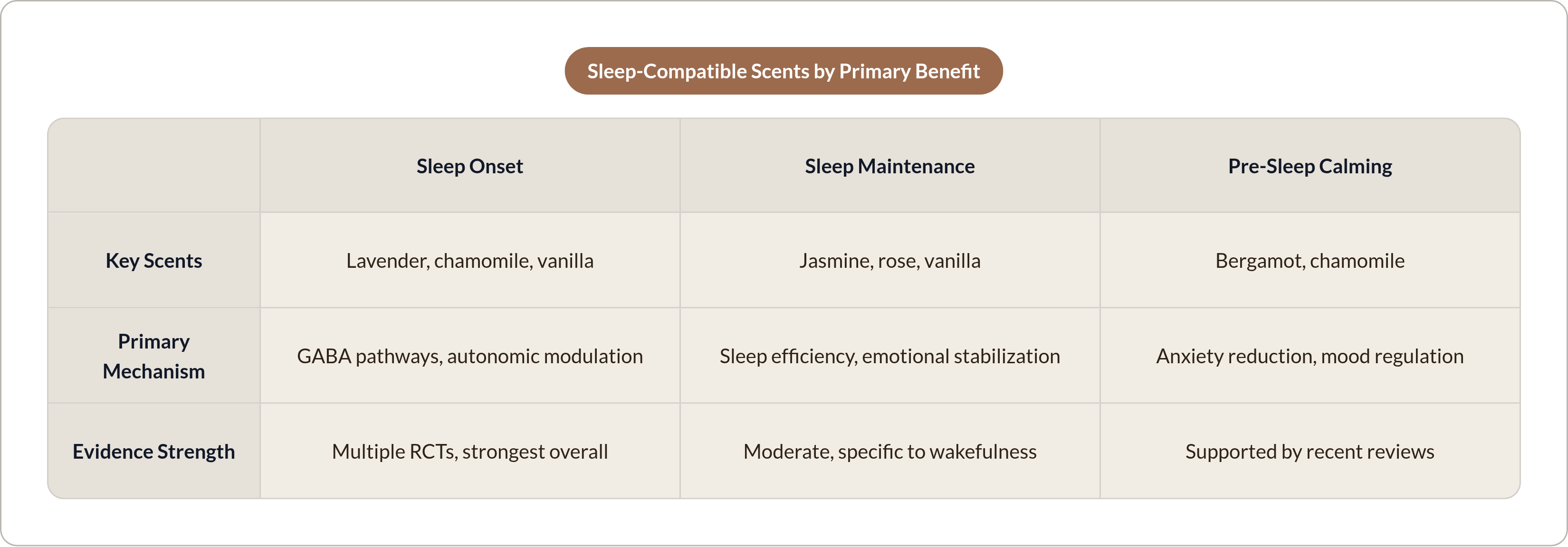
The documented set maps roughly like this. For sleep onset, lavender, chamomile, and vanilla have the strongest evidence. For sleep maintenance, staying asleep and reducing mid-night restlessness, jasmine, rose, and vanilla are most relevant. For general calming in the lead-up to sleep, bergamot and chamomile have the clearest support.
Blends are worth taking seriously. The 2025 Scientific Reports finding that a blended perfume outperformed lavender alone suggests that aromatic complexity engages the brain's reward and association systems more effectively than any single note. A 2025 meta-analysis of over seventy studies found that women reported greater emotional relief from floral and sweet scent profiles, while men reported stronger calming effects from woody and musky profiles. Personal preference is not a subjective nicety layered over objective data. It's a legitimate variable in the outcome.
The practical selection approach: pick one scent from the documented set that overlaps with an existing positive association. Use it exclusively in the bedroom for two to three weeks. Avoid using it during high-energy or stress-heavy contexts; if you diffuse your wind-down lavender oil in your home office during a difficult afternoon, you've diluted the association. The brain's conditioning depends on the scent remaining a sleep-specific signal. Specificity is what makes the cue reliable over time.
Building the timing ritual around the body's wind-down signals
Sleep onset is not an event. It's a gradient that begins one to two hours before the moment you actually fall asleep, driven by falling core body temperature, rising melatonin, and a progressive slowing of cognitive activity. Most people treat the transition to sleep as something that happens when they lie down and close their eyes. The biology suggests that's already the back half of the process.
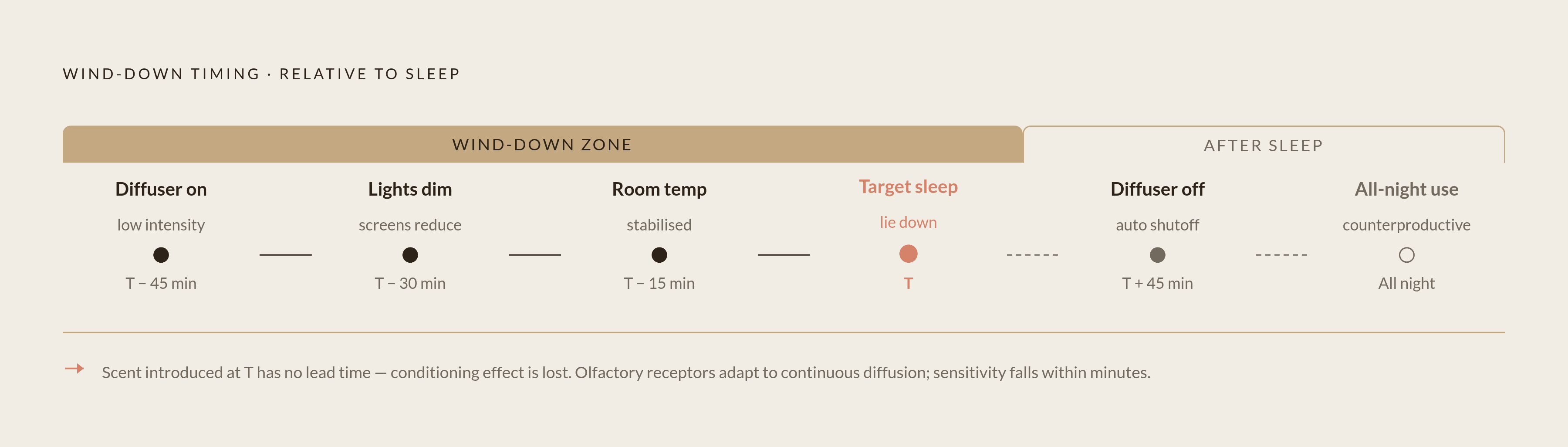
This is where timing matters in a way that isn't intuitive. A scent introduced thirty to sixty minutes before your target sleep time has time to accumulate in the air and for the olfactory signal to register as part of the transition sequence. Scent introduced at the moment you lie down is arriving after the process has already started, and it can't do the conditioning work because it isn't consistently preceding the behavioral shift.
Pairing scent with other consistent wind-down behaviors compounds the effect. Dimmed lights, reduced screen exposure, a stable room temperature: the body reads these as converging signals that the transition is underway. Scent works most powerfully as one signal within a coherent multi-sensory cluster, not as a standalone intervention.
The conditioning mechanism is straightforward. The brain learns to read the scent as a transition cue through repetition. That's why rotating fragrances based on mood undercuts the whole system; the brain can't build a reliable "sleep is coming" association with a signal that isn't consistently present at the same point in the nightly sequence. I've seen people spend a lot of money on diffuser oils they rotate through like a playlist, and then conclude that aromatherapy doesn't work. The rotating was the problem.
For a cold-air diffuser, program it to begin thirty to forty-five minutes before target sleep time, set it at low intensity, and configure an automatic shutoff after the wind-down window closes. Continuous all-night diffusion is unnecessary, and it works against you; olfactory receptors adapt to sustained stimuli and reduce sensitivity over time, meaning a scent that runs all night registers less and less strongly as a cue. A defined window, repeated nightly, is more effective than continuous background presence.
One finding from a 2024 meta-analysis on lavender and older adults is worth noting: non-inhaled forms applied consistently over short intervention windows, under four weeks, showed particularly significant effects. The implication for anyone starting a new sleep-scent routine is that measurable change emerges in a compressed timeframe when the practice is consistent. Two to four weeks of deliberate, same-scent, same-timing use is enough to begin evaluating whether the approach is working.
Putting the setup together as a repeatable nightly practice
What the research and the practical framework converge on is this: a sleep-fragrance routine works not because of any single element, but because the elements reinforce each other, and because the brain, given enough consistent repetition, begins to treat the sequence itself as the signal.
The complete setup, reduced to its components:
Start with a cold-air diffuser sized for the bedroom. Quiet operation, timer control, adjustable intensity, no heat or water. The room is small; commercial-grade output works against you here.
Choose one fragrance oil from the documented sleep-compatible set: lavender-based, chamomile, jasmine, vanilla, rose, bergamot, or a blend combining two or more of these. Weight your selection toward whatever carries existing positive resonance; the association you already carry accelerates the conditioning.
Verify the formulation. Phthalate-free is the baseline. Free of synthetic musks, formaldehyde, and parabens. Third-party certified, Sephora Clean or equivalent, where possible. This matters more in the bedroom than anywhere else in the house because the exposure window is the longest in your daily routine.
Program the diffuser to begin thirty to forty-five minutes before your target sleep time, at low intensity, with automatic shutoff after the wind-down window. Keep the room partially ventilated so the scent stays at a concentration that reads as pleasant rather than accumulating into something that competes with sleep.
Use the same scent, the same timing, every night for at least two to three weeks before evaluating. Resist the impulse to adjust before the conditioning has had time to develop.
If sharing the space with pets or children, confirm non-toxic formulation, start at the lowest intensity setting, and maintain ventilation throughout.
What changes over time is subtle but real. The diffuser turning on becomes a signal in itself. The scent shifts from something you notice to something ambient, and that shift is the goal; it means the scent is operating at the level of nervous system regulation rather than conscious perception. That's where it needs to be to influence the transition to sleep. You're training a biological system to recognize a cue. Creating a pleasant smell before bed is a side effect, not the mechanism.