Layering Fragrance With Texture and Light in a Living Room
Light, texture, and scent work as one system to shape how a room actually smells.
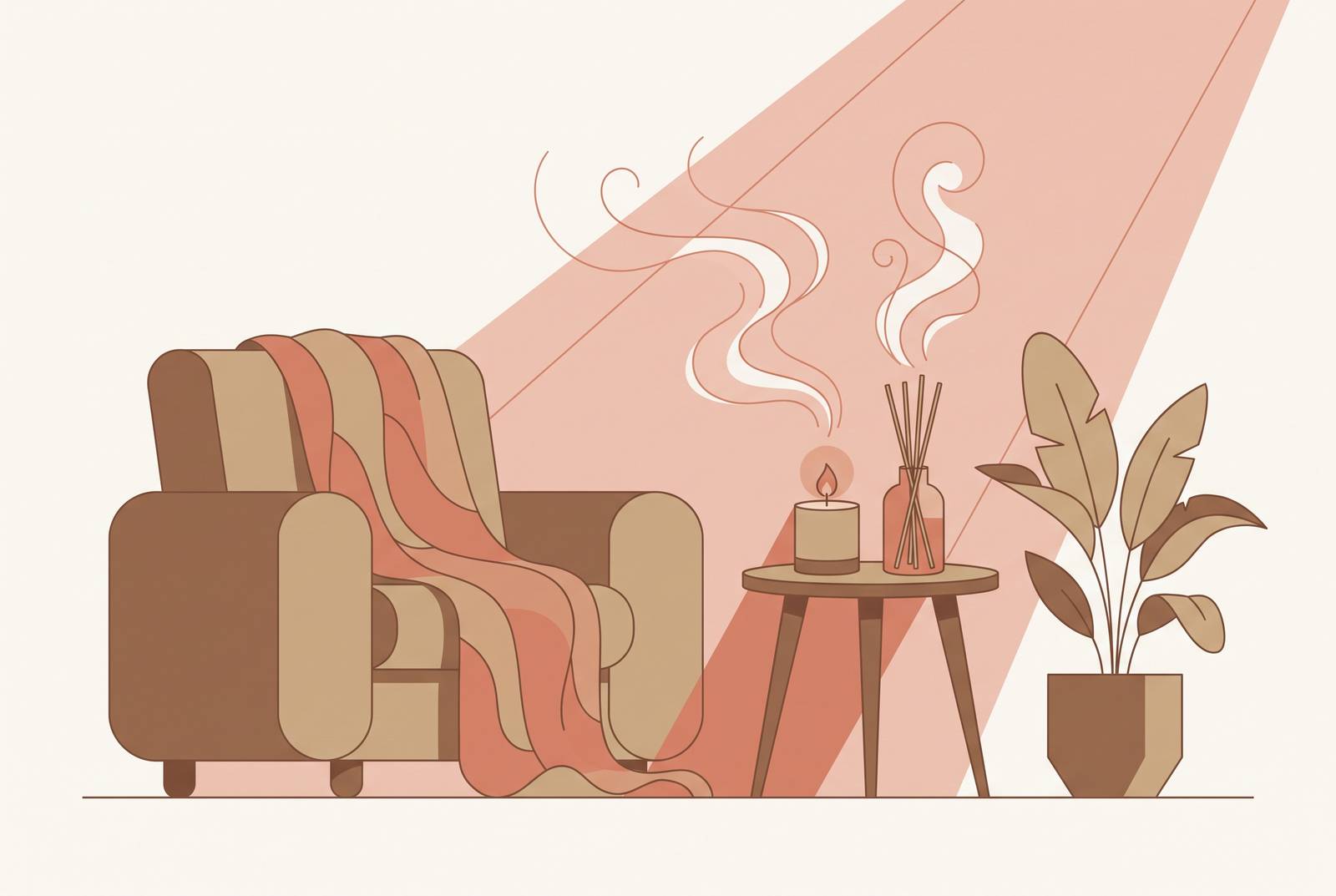
A living room's fragrance experience is a composite, built from light, texture, and scent all at once, not a single product performing in a vacuum. Most homeowners shop for one of these at a time, picking a diffuser oil the way they'd pick a throw pillow, but the room doesn't experience them separately. It registers them together, the same way a song isn't just melody or just rhythm but both arriving in the ear at once.
Anyone who has noticed that a favorite scent felt perfect in one room and strangely off in another has already brushed up against this. The oil didn't change. The bottle is identical, the wick count the same, the diffuser running the exact settings it ran last time. What changed is the room doing the receiving, and that's the thread this piece pulls on: light, texture, and fragrance acting as one system rather than three separate line items on a decorating checklist. Two living rooms running the same oil from the same device can produce two entirely different impressions, because the room is doing as much work as the diffuser itself.
How light conditions change the way fragrance is perceived
Light reaches the brain's emotional circuitry before a person consciously clocks what they're smelling, so by the time a fragrance registers, the mood has already been partly set. Warm, low lamplight signals safety and slows a person down, and in that state, a grounding or woody scent reads as cozy. Under bright, cool overhead light, the kind that says "stay alert, there's a task at hand," that same woody or amber fragrance can suddenly feel wrong, almost stale, while something green or citrus-forward fits the room's energy far better.
Daylight complicates this further because it never holds still. A fragrance calibrated for the flat, cool light of midday can feel different by five o'clock, once the sun has dropped low and the light in the room has gone warm and amber on its own. That's an argument for scheduling a diffuser to shift intensity across the day rather than locking it to one setting from breakfast to bedtime: lighter and fresher while the light is cool and bright, fuller and warmer as the light softens toward evening.
Direction matters as much as color temperature. A room lit low, by table lamps or floor lamps pooling light near where people sit, keeps attention close to the body, and scent concentrates in that same intimate radius. A room lit from above spreads attention outward across the whole space, and the same fragrance at the same intensity can feel thinner simply because there's more room, visually, for the nose to account for.
Surface textures and fragrance
Texture decides what happens to a fragrance molecule once it leaves the diffuser. Soft, porous materials, upholstered sofas, area rugs, curtains, woven throws, absorb diffused particles and let them go slowly, acting like a sponge that keeps releasing scent well after the diffuser has cycled off. Hard, smooth surfaces work the opposite way: glass, polished stone, lacquered wood, plaster, give fragrance nothing to grip, so it sits briefly on the surface and then clears out fast. A room heavy on synthetic, non-porous finishes lets scent disperse quickly simply because there's nowhere for it to settle and linger.
That difference has a direct, practical consequence for anyone running a diffuser. A living room full of soft furnishings can run at moderate intensity and still hold scent for hours, because the couch and the rug are doing the job of extending it. A living room built around stone floors and glass and little else needs the diffuser to work harder, and the same setting that feels generous in a plush room can feel almost absent in a sparse one. Placement follows from this logic too: in a heavily upholstered room, a diffuser set centrally at moderate intensity tends to outperform one pushed into a corner and cranked up, because the furnishings carry the scent outward on their own. In a hard-surface room, placing the diffuser near a natural air path, an HVAC return, a hallway that gets foot traffic, does more good than raw intensity, because without soft material to hold the fragrance, movement through the space is what spreads it.
Layering changes the picture at different heights. A rug over hardwood, curtains hung in front of a glass wall, a throw draped over a leather sofa: each of these creates a small gradient where the air at sitting height carries more retained scent than the air near the ceiling. That factors into where a diffuser actually sits, beyond just how strong it's set.
Cold-air diffusion as the right delivery method for a room where light and texture are already doing work
Once light and texture are understood as active, shifting variables rather than fixed backdrop, the delivery method for scent needs to hold steady against that shifting backdrop without adding its own distortion on top. Cold-air diffusion breaks fragrance oil into fine particles using a stream of cool air, with no heat and no water involved, so the compound that leaves the device is chemically the same one that went into the bottle. Warming an oil during dispersion breaks down its more delicate aromatic compounds and alters the chemical structure of what reaches the room, so the scent a person smells is no longer quite the scent that was formulated.
Water-based ultrasonic diffusers introduce a different wrinkle, diluting the oil and adding moisture to the air, which can interact with soft furnishings and, depending on humidity, change how scent molecules travel and settle. Cold-air diffusion skips that variable by running dry. The particles it produces are fine enough to stay airborne longer, letting them travel further into a mixed-texture room and reach soft surfaces gradually, dispersing concentrated scent across the space over time.
Consider an open flame for comparison, since a candle is often the mental default for home fragrance. A flame brings its own light, its own flicker and movement, and its own combustion byproducts, including fine particulate matter (PM 2.5), all of which land on top of whatever the room's light and texture are already doing, and none of which the homeowner can dial back independently. Cold-air diffusion keeps scent as the only variable being adjusted, which is what allows the scheduling logic from the light section to actually work: lower intensity while daylight is bright and cool, higher intensity as evening light warms, run without worrying that the delivery method itself is quietly changing the scent or adding smoke and soot to a room that's already doing enough sensory work on its own.
Matching fragrance character to the room's light and texture profile
Once delivery is settled, the next question is which fragrance actually suits the room, and that choice should follow from the room's light and texture, not from whichever bottle looked nicest on a shelf. A room that's already warm in its lighting and dense with soft furnishings, think a sofa piled with cushions, a rug underfoot, heavy curtains, is carrying plenty of sensory weight before any fragrance enters the picture. That kind of room tends to do better with something clean and moderately complex: sandalwood, white tea, neroli, a soft musk, or amber, all of which add warmth without piling onto a room that's already full.
Flip the profile: cool overhead light, hard floors, minimal soft furnishing, and the room has little sensory anchoring to begin with. That gives it room to carry a more distinctive fragrance, something woody, green, or lightly spiced, which can supply the warmth the furniture and walls aren't providing. The scent isn't competing with the room's fullness here, since there isn't much fullness to compete with; it's filling a gap instead.
Daylight itself should guide the choice across the day. Morning and early afternoon light is cooler and brighter, and fresher top notes, citrus, green, a light floral, feel coherent with that alertness. As the light shifts warmer toward evening, rounder, more resinous notes track with the same psychological shift the light is already prompting. Given that a living room usually serves two jobs, a gathering space by day and a wind-down space by night, running one fragrance at one fixed intensity around the clock rarely fits either job particularly well. And intensity itself needs to account for texture density alongside square footage: two identically sized rooms, one heavily upholstered and one mostly hard surface, will hold the same diffuser setting very differently, so the number on the dial means less than what it's interacting with.
Diffuser placement in a living room, guided by light and texture
Placement comes down to more than measuring a room's square footage. Light draws the eye and the body toward certain spots, texture decides where scent lingers once it arrives, and air moves through a room along its own quiet paths shaped by both. Warm zones near windows or lamps create slight convective movement that can carry particles toward cooler areas, so setting a diffuser in that natural current does some of the distribution work without forcing it.
Height matters too. A diffuser set at roughly seated nose level, a side table or a low shelf, puts fragrance in the breathing zone where people actually sit, rather than letting it drift up toward a high ceiling and thin out before anyone notices it. That's especially relevant in rooms with tall ceilings, where scent has more vertical space to climb through and dilute along the way.
Some spots work against a diffuser. Direct sun or a spot under strong overhead lighting can heat the oil reservoir unevenly, creating a zone where dispersion speeds up and the scent feels patchy. In a heavily textured room, a central placement at moderate intensity generally beats a high-intensity corner setup, since the furnishings are already doing distribution work from wherever the scent starts. In a hard-surface or open-plan room, a spot near a hallway entrance or an HVAC return puts the diffuser in the path of the room's natural air movement, which matters more there since there's no soft material to hold the scent in place. And where a living room opens straight into a kitchen or dining area, the diffuser belongs on the living room side of that threshold, away from the boundary, so the scent anchors its own zone there.
Choosing fragrance oils that are safe for the people and pets sharing the living room
None of the placement or scheduling logic matters if the oil itself is a question mark, and a lot of oils are exactly that. The home fragrance industry has no comprehensive federal rule requiring companies to disclose what's actually in a product labeled "fragrance." That single word can legally stand in for dozens of undisclosed chemicals, among them phthalates, which are known endocrine disruptors, and various VOCs tied to respiratory irritation. "Pet-safe" and "non-toxic" aren't regulated terms either, so a label carrying either phrase isn't a guarantee of anything in particular.
Full ingredient transparency, no phthalates, no parabens, no synthetic musks, and a carrier oil that doesn't introduce its own chemical baggage are what's worth checking instead. The fragrance compound, the carrier, and the delivery method all feed into a room's air quality together, so each one deserves a look rather than just the label on the front of the bottle.
Pets complicate the picture further, and not uniformly. Cats lack a liver enzyme that helps metabolize certain aromatic compounds, so they're more sensitive to many oils than dogs are. Birds sit at the far end of that scale, their respiratory systems vulnerable to airborne particulates in a way mammals' aren't. Several oils that show up constantly in home diffusers, tea tree, peppermint, eucalyptus, citrus, cinnamon, carry documented toxicity risks for pets and shouldn't be diffused in rooms where those animals spend real time. None of that means every oil is a hazard to every household; it means the evaluation has to account for which animals actually live there.
Cold-air diffusion earns a second mention here on safety grounds. No flame means no PM 2.5 drifting into the air, and no water in the mechanism means no added humidity to encourage mold growth. For a household with any respiratory sensitivity, that's as relevant as whatever's written on the oil's ingredient list. Vegan and cruelty-free formulation tends to track with the same companies doing careful ingredient sourcing, so the same attention that keeps a formula cruelty-free often keeps synthetic endocrine disruptors out of it too.
Treating scent, texture, and light as a single design decision when building or refreshing a living room
Everything above points to one working method: audit light, texture, and fragrance together, as a single decision. Start by noting the room's dominant light temperature and how much it shifts across a normal day. Then take stock of the balance between soft, porous surfaces and hard, reflective ones. Only after both of those are clear does it make sense to settle on diffuser placement, intensity, and fragrance character, because each of those choices depends on what the first two steps turned up.
That audit isn't a one-time exercise. New furniture, new curtains, a wall repainted a shade that reflects light differently, a swap from warm bulbs to cool ones: any of these resets the room's sensory profile, and a fragrance setup that worked before the change may read completely differently after it. Seasonal light shifts count too. Autumn and winter bring warmer, lower light; spring and summer bring cooler, higher light. Rotating fragrance character and adjusting intensity across those seasons isn't about tradition or habit, it's a response to the fact that the room's actual sensory conditions have moved. A diffuser capable of scheduling intensity by time of day gives a homeowner a practical way to track the room's light cycle automatically rather than remembering to adjust a dial every evening.
What all of this is building toward is a living room where a visitor couldn't cleanly separate the scent from the warmth of the lamp or the softness of the rug underfoot, because none of them were chosen in isolation. Light, texture, and fragrance end up pointing the same direction instead of working against each other, which is the entire difference between a room that happens to smell nice and one that was actually built to.