How Luxury Spas Use Scent to Create Destination Atmosphere
Luxury spas use scent to condition emotional responses and build lasting brand memory.
Smell is the only sense with a direct neural pathway to the limbic system. Every other sense routes through a relay station first. Scent doesn't. Odor molecules bind to receptors in the nasal passage, the signal travels to the olfactory bulb, and from there it goes straight to the amygdala and hippocampus, the structures responsible for emotional processing and memory formation. This is why a fragrance can shift your mood before you've consciously registered smelling anything. Faster than music. Faster than a visual cue.
The chemistry that follows is specific. Lavender elevates GABA activity, which reduces nervous system excitability. That's the neurological reality underneath its reputation as a calming agent: receptor pharmacology, not folklore. EEG research published in the International Journal of Neuroscience documented increased alpha-wave activity, the signature of relaxed wakefulness, in participants inhaling lavender. On the other end of the spectrum, a 2025 study found that diffusing rosemary and peppermint in office environments improved memory recall and alertness by 18 percent. Spas use the same mechanism, just pointed toward calm instead of activation.
Here's what doesn't get talked about enough: consistent exposure to the same aromatic environment, over weeks and months, reinforces the neural pathways that associate those compounds with a particular emotional state. Each time you return to a spa that runs the same signature scent, you're not just smelling something pleasant. You're being conditioned. The biology doesn't care about the address. The pathway functions the same in a treatment room and a bedroom. What changes is everything surrounding the scent itself.
I've worked around hospitality fragrance long enough to notice something that still catches me off guard: you can walk into a lobby and know before you see the front desk whether the property understands what it's doing. Not because of the scent itself, necessarily, but because of what it does to you in the first thirty seconds. That's the olfactory system operating exactly as designed, and someone on the design team knowing enough to use it deliberately.
How spas map different scents to different zones and moments
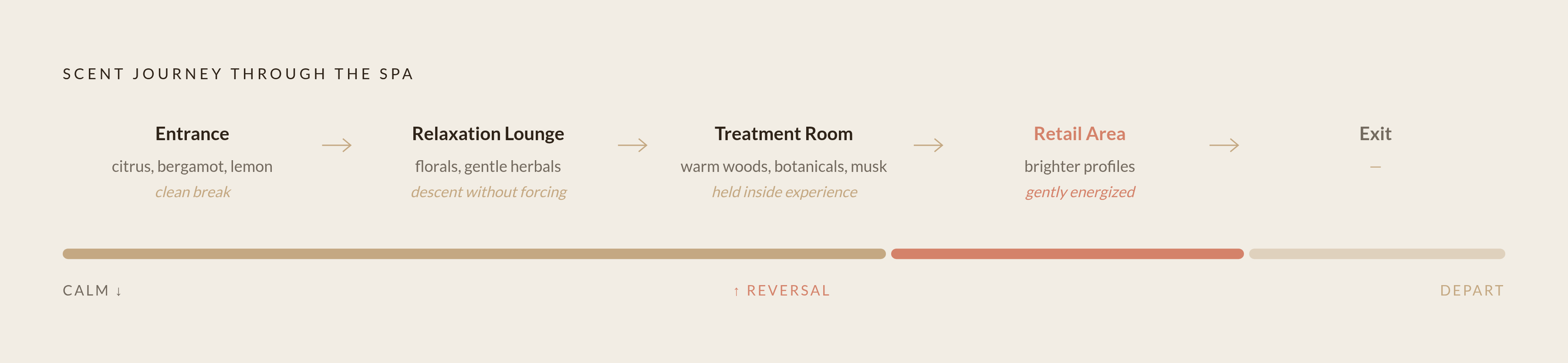
A sophisticated spa doesn't run one fragrance through the whole building. It uses a scent journey, calibrated to what each space needs to produce in the nervous system of the person moving through it.
Entrance areas run citrus-forward or herbal profiles: bergamot, lemon, fresh green notes. Uplifting without being aggressive. The implicit message is transition, a clean break from whatever came in through the door with you. Relaxation lounges shift softer, toward florals and gentle herbals, cuing the descent without forcing it. Treatment rooms go further: warm woods, dense botanicals, subtle musk. Scents that hold you inside an experience rather than redirecting you somewhere else.
Retail areas, and this one took me a while to sit with, often run brighter profiles. A notably sedated guest doesn't browse with the same curiosity as one who feels gently energized. Even the commercial logic turns out to have a neurological explanation. Which is either reassuring or a little unsettling, depending on how you look at it.
Spas also manage scent across time. Morning profiles differ from evening ones. Progressive properties shift diffuser settings after dark, reaching for warmer and more enveloping notes to accompany the wind-down hours, the same way lighting and temperature are adjusted by the hour. Some now offer scent menus, letting guests choose calming or invigorating blends before a treatment. A few incorporate locally sourced essential oils specific to the region, which is its own kind of placemaking.
The underlying principle in all of this isn't about which scent smells best in the abstract. It's about what emotional state a fragrance needs to produce in a specific context. That's a functional question before it's ever an aesthetic one.
The signature scent: how a single fragrance becomes a place's identity
Beyond the zone map, the most intentional hotels and spas develop one unifying fragrance that becomes inseparable from the property itself. The scent that arrives in memory before the visual does.
Hotel Costes in Paris commissioned perfumer Olivia Giacobetti to create "Brown," a composition of waxed wood, rum, mahogany, bitter orange peel, paprika, and oak moss. Cheval Blanc Randheli in the Maldives worked with Dior's François Demachy on "Island Chic," layering driftwood, cedar, tonka bean, rose, and cardamom into something that evokes open water and unhurried heat. The Fife Arms in the Scottish Highlands had master perfumer Julian Bedel visit Invercauld Estate during flowering season to develop "Alba," a blend of heather, pine, and peat smoke that could have originated nowhere else. St. Regis's "Caroline's Four Hundred" was created by Carlos Huber of Arquiste around exotic woods and American Beauty roses, built as a narrative evoking Caroline Astor's Gilded Age ballrooms.
None of these was chosen from a catalog. Each is authored. Rooted in a place or a story. Designed to function as olfactory autobiography for a property.
The emotional mechanism is the same one the neuroscience above describes, operating over a longer time horizon. A guest who has checked in several times, who has absorbed that signature fragrance in a relaxed and receptive state, will find that a single encounter with that scent months later can reconstruct the entire feeling of being there. Nostalgia as a designed outcome. That's not a soft amenity; it's a retention strategy built on how memory consolidation actually works.
That many of these hotel fragrances are now sold for home use tells you something. Guests want the experience to continue past checkout. The market, as it usually does, responded to what people were already doing on their own.
Why delivery method determines whether the effect actually lands
Most home attempts fall short not because the fragrance is wrong but because the delivery method undermines it. The gap between smelling something beautiful in a bottle and having it fill a room the way a spa does is almost entirely a mechanical problem.
Candles and plug-in warmers apply heat, and heat degrades fragrance chemistry. Delicate top notes evaporate first and fastest. The aromatic profile you experience in the first twenty minutes is not the one you experience two hours in, because the more volatile compounds have already dissipated. You also lose some of the therapeutic properties of the oil itself, since heat modifies the same molecular structures that produce the neurological effects worth caring about in the first place.
Cold-air diffusion works differently. High-velocity air breaks fragrance oil into ultra-fine dry particles without any thermal contact. The molecular structure of the oil stays intact, which means you experience the fragrance as it was actually blended: complex, full-bodied, with the layering behaving the way the perfumer intended across distance and over time. This is the method luxury hotels use for HVAC-integrated scenting, diffusing a signature fragrance through an entire property at consistent intensity with no surface contact, no flame, no heat, no moisture.
For home use, the practical advantages are real. Cold-air diffusion produces no combustion byproducts, raises no concerns for pets or people with respiratory sensitivities, and can run continuously without the intensity peaks and troughs of a candle's natural arc. It's programmable. You can calibrate by zone.
Some home diffusers are built around this same professional logic at a home scale, with fragrance oils formulated specifically for the technology. A delivery method this precise is worth pairing with oils whose purity justifies preserving their molecular integrity, which is the practical reason that pairing matters.
Choosing fragrance notes that do what you want them to do
The most common mistake in home fragrance isn't poor taste. It's choosing a scent based on how it smells in the bottle rather than what it will actually do in the space you're placing it in.
A functional orientation changes the selection process. Relaxation and sleep call for lavender, chamomile, sandalwood, warm musk: parasympathetic activators, the same register that treatment rooms use. Morning energy calls for citrus profiles, bergamot, lemon, grapefruit, peppermint, eucalyptus. These are entrance notes, performing the same activating function at home that they do in spa reception areas. Focus belongs to rosemary, cedarwood, and green tea, consistent with what the 2025 alertness research documented. Grounding and evening warmth come from vetiver, patchouli, amber, and oud. The narrative register, where hotel signature scents live, is built from florals, spice, and exotic woods.
Structural complexity matters too. A single-note fragrance behaves differently across a room, and across time, than a well-composed blend, because a blend's constituent elements diffuse at different rates. The aromatic profile evolves rather than sitting static. Spas use blends because they hold differently at fifteen feet than at three, differently after two hours than after twenty minutes. That layered behavior is part of what makes a scented environment feel immersive rather than simply perfumed.
On purity: if delivery method and neurological pathway are the active variables, then what you're delivering matters. Synthetic compounds and petrochemical carriers change what the olfactory receptors receive and, downstream, what the limbic system does with the signal. It's a reasonable thing to care about, particularly if the goal is to actually use the effect.
Building a home scent environment that works like a spa's
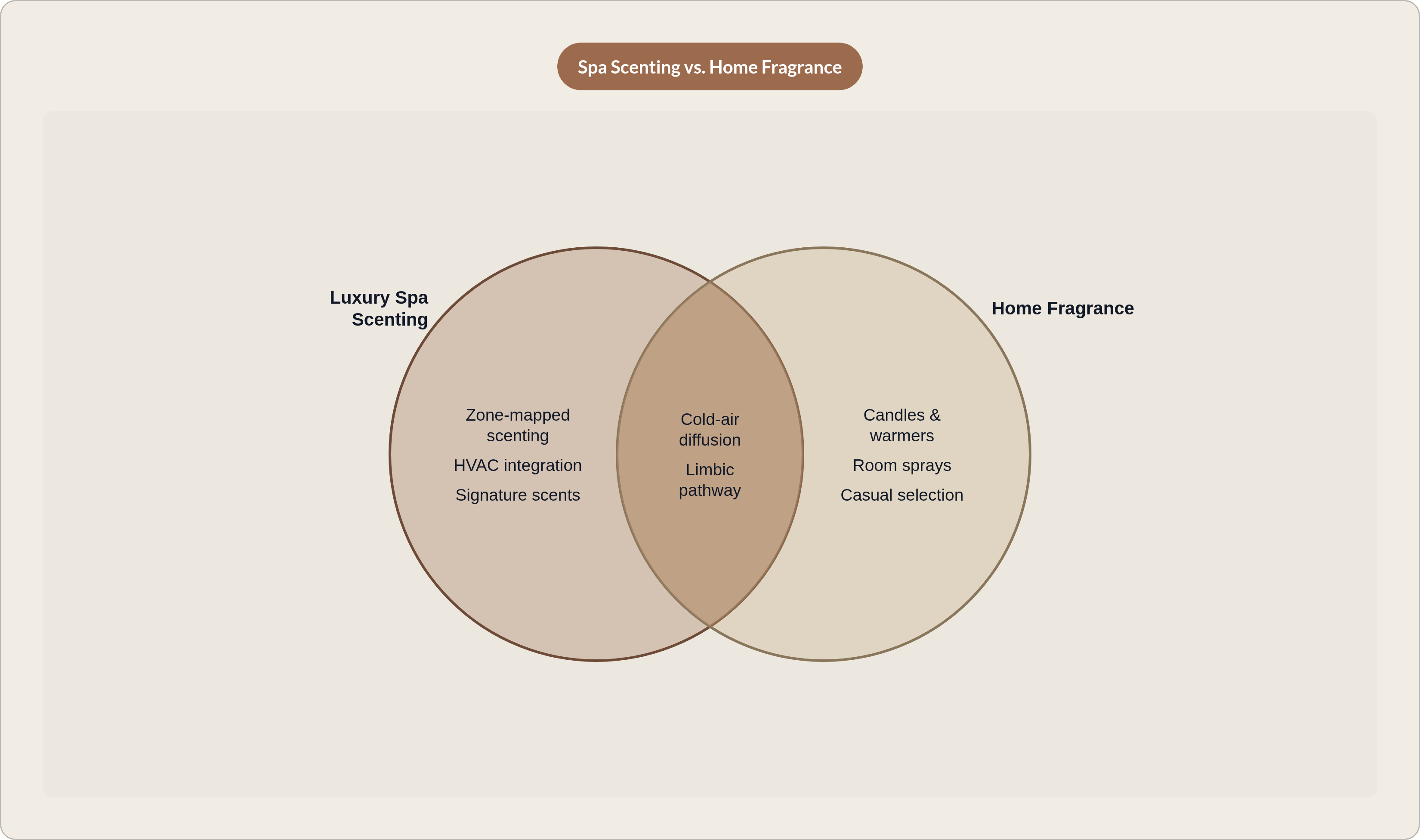
Four decisions separate a considered home scent environment from a room spray used without much thought.
The first is intentional zoning. Map your home the way a spa maps its floor plan. Entrance, living room, bedroom, bathroom, home office: each space has a function, and a fragrance can be chosen to serve that function rather than simply to smell pleasant everywhere in the same undifferentiated way. One scent throughout the whole home is the domestic equivalent of a spa that pipes the same fragrance through reception and treatment rooms simultaneously. It misses what zoning actually accomplishes.
The second is delivery integrity. Cold-air diffusion for primary living spaces where you want consistent, room-filling presence. Candles and room sprays have their place, for ritual, for portability, for moments where the act of lighting something is part of the point. But for the ambient, continuous scent environment that creates atmosphere rather than occasional accent, the method needs to preserve what you've selected.
The third is choosing for function before preference. Decide what the scent needs to do in a given zone at a given time of day, then find a blend you love within that register. This is how spas approach selection. It produces a more coherent result than starting from what smells appealing in isolation and working backward.
The fourth is building a signature. Choose one fragrance for your primary living space, use it consistently, and let it become the olfactory identity of your home. A scent doesn't need to reference an exotic destination to do what destination scents do; it needs to be specific, consistent, and chosen with intention. The emotional anchoring mechanism is identical at any scale.
Layering across time works at home exactly as it does in a spa. Program your diffuser to run a brighter profile in the morning and shift to something warmer in the evening. It doesn't require much effort, just having thought about it once, in advance, and then leaving it alone.
The clean formulation question is practical more than ideological. A non-toxic, pet-safe oil isn't only a cautious choice for sensitive households; it's what allows a diffuser to run continuously, at the intensity that actually builds atmosphere, without introducing a health calculation every time you turn it on. Some brands, such as Aura House, build their fragrance oils specifically around that standard for design-forward homes.
What luxury spas have understood, and applied systematically, is that scent is a controllable variable, as deliberate as lighting, as structural as acoustics. The science behind why it works is not proprietary. The methodology is learnable. And the olfactory pathway, as we started at the top, is entirely indifferent to whether you're in a resort or a living room.