Home Office Fragrance Setup for Focus and Boundaries
Scent creates a neurological context switch your commute used to provide.
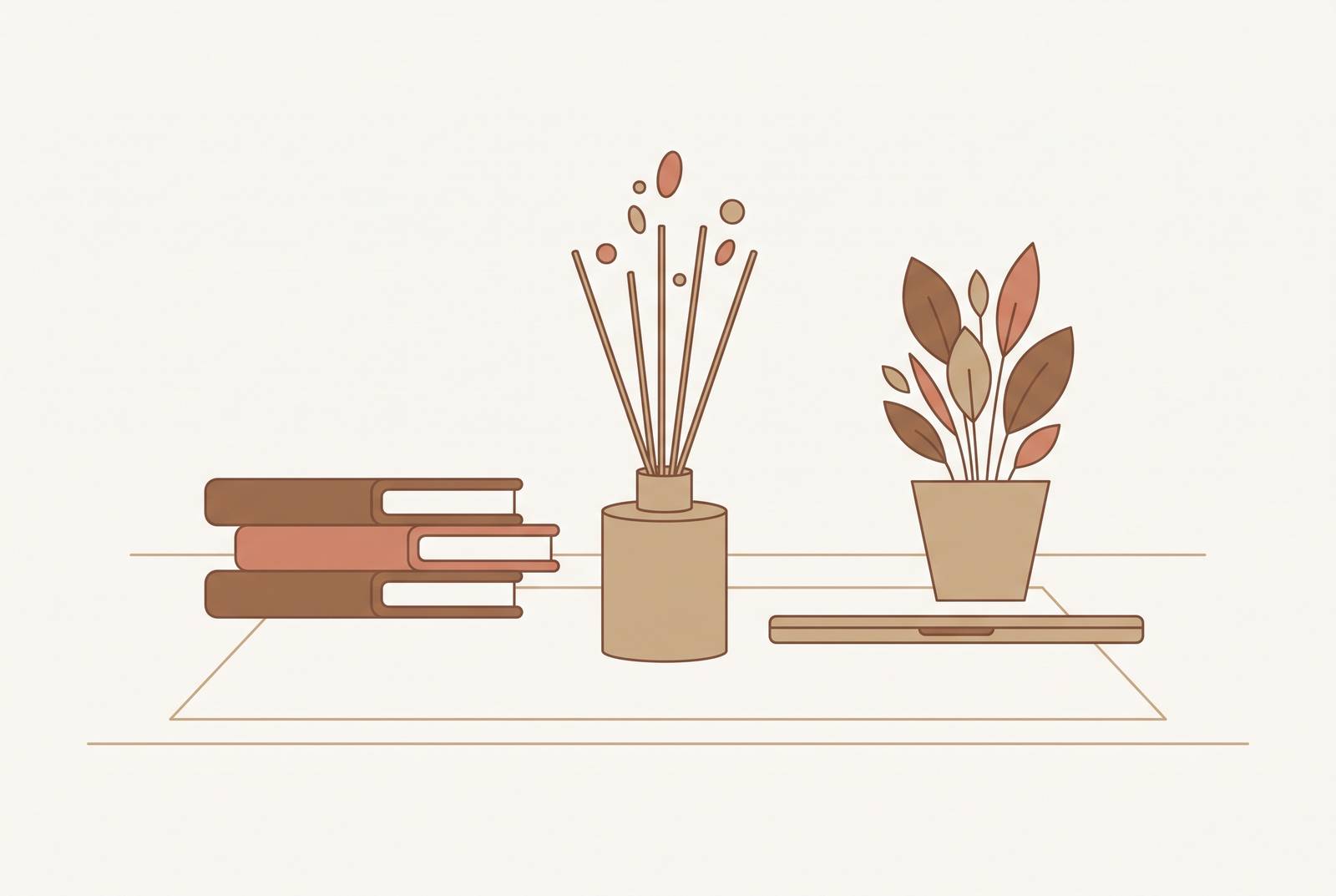
Something broke when the commute disappeared, and it wasn't just the forty-five minutes on the train. The home office erased the one mechanism that reliably told the brain to switch into work mode: a distinct sensory environment that belonged to work and nothing else. The commute, the office lobby, the elevator, the separate floor, none of these were really about distance. They were context cues, and the brain used them to shift cognitive gears the way a driver downshifts before a hill. At home, the kitchen table, the sofa, and the desk share the same light, the same sounds, the same smell of the same candle burning in the same room all day, so the brain never gets the signal that anything has changed. Oli & Home's analysis on this is precise: the office building did the work of signaling a context shift externally, and at home, without that external signal, the brain is left to manufacture the shift internally, alone, with no cue to grab onto. It's a neurological gap, the brain waiting for a signal the room never sends, and closing that gap is less about willpower and more about design, starting with the layer of the room most people never think to design at all: the air itself.
How the olfactory system creates context signals faster than any other sense
To understand why scent is the fix, it helps to look at what makes smell different from every other sense feeding the brain. Sight, sound, and touch all route through the thalamus first, which acts as a relay station, sorting incoming signals before passing them along for interpretation. Smell skips that step. Aera's home office guide and Oli & Home both describe the same wiring: olfactory signals bypass the thalamic relay and go directly to the limbic system, the part of the brain responsible for emotion, memory, and motivation. It means a scent can shift emotional and motivational state before conscious attention even gets involved, acting on cognitive mode before a person has consciously decided to respond to it. A visual cue, like a tidy desk, asks the brain to notice and interpret it. A scent cue doesn't ask permission. That speed is what makes scent usable as more than ambiance. It functions as a programmable signal, one that can be deployed on purpose to trigger a specific mental state, the same way a conditioned cue can be trained to summon a specific response before the triggering event ever arrives. The rest of this piece is about how to actually build that trigger.
Using the same scent consistently until the brain treats it as a focus trigger
The molecule itself isn't doing the heavy lifting. What matters is what the brain learns to associate with it over time, which puts consistency ahead of scent selection in importance, though scent selection still matters, as the next section gets into. Urban Automods, in a 2025 guide, states the mechanism directly: using the same scent daily can help the brain associate that fragrance with "work mode," improving concentration over time. This is classical conditioning, applied to a home office instead of a lab animal. Oli & Home frames the practical version of this ritual simply: light the candle before starting work, not after already sliding into it, so the scent arrives as the cue that precedes the cognitive shift rather than something that just happens to be in the room once the shift has already occurred. Scarlet & Grace makes the same argument in its home office focus scents guide, describing the act of lighting a candle or starting a diffuser at the start of the workday as a sensory cue that tells the brain it's time to transition into work mode, comparing it to the ritual of putting on work clothes or making a morning coffee. The conditioning works in both directions. Switching to a different scent at the end of the day tells the brain the work mode is closing, and the boundary holds at both ends. That implies something concrete about setup: the system needs two distinct scents, not one, a work scent and a rest scent, used consistently and never allowed to blur into each other. Everything from here forward, the scent families, the room placement, the scheduling, exists to make that two-scent conditioning loop reliable enough that the brain stops needing to think about it.
Which scents support which kinds of cognitive work
Not every task wants the same scent, and picking the wrong one for the wrong moment can work against the system. Rosemary has the strongest evidence behind it for memory and sustained attention, with studies out of Northumbria University among those linking it to measurable gains in both. Scarlet & Grace recommends it for complex projects, brainstorming, strategy planning, writing reports, and problem-solving, while Oli & Home describes it as grounded rather than sparky, better suited to long, detail-heavy stretches of work than short bursts of creative energy. Peppermint sits at the other end of the energy spectrum. Scarlet & Grace recommends it specifically for the afternoon slump, for detail-oriented tasks, and for data analysis, and Oli & Home calls it the "wake up your brain" note, the one to reach for when the page in front of someone has started to blur. Eucalyptus does similar work through a different mechanism: Oli & Home pairs it with mint as one of the most reliable focus notes available, and Scarlet & Grace recommends it for midday resets and for clearing mental clutter.
A rough pairing framework follows from these distinctions. Morning work, creative tasks, and short bursts respond well to citrus notes like lemon, bergamot, or grapefruit. Long analytical or writing sessions favor rosemary or sandalwood. The afternoon reset, the post-lunch fog that hits almost everyone around 2pm, calls for peppermint or eucalyptus. And the end-of-day transition belongs to lavender or chamomile, deliberately switched in to signal that work mode is closing for the day.
That last point is where the system shows its logic most clearly. Lavender is one of the most popular calming scents sold for home use, which makes it tempting to burn all day as a general stress reducer. But a calming scent used during working hours is fighting the exact cognitive state the system is trying to build. If the goal is alertness and sustained attention, and lavender's job is to relax and sedate, using it at 10am undermines the very output it's meant to support later. Lavender's value in this system comes entirely from timing. It belongs after hours precisely because of what it does, and that is the clearest demonstration that this is a decision framework built around what each scent family actually does to cognitive state.
Scent shortlists for households with cats or dogs
A complication the scent-pairing framework above glosses over: several of the most commonly recommended focus scents, peppermint, eucalyptus, and citrus among them, appear on veterinary toxic-to-cats lists. A home office shared with a cat can't just adopt the pairing framework wholesale. Cats have a sense of smell far more sensitive than a human's, which makes concentrated fragrance compounds, the kind released by candles and diffusers, a bigger physiological event for them than for the person at the desk. It means building the system from a different starting point. Cedarwood paired with frankincense offers an earthy, grounding profile suited to deep work, and frankincense with chamomile gives a more balanced, subtle option for lighter tasks. Both avoid the citrus and mint compounds that show up on toxicity lists for cats.
Dog households have more room to maneuver but still need to check the list before lighting anything. Lavender and chamomile are vet-approved as safe for dogs, which conveniently overlaps with the end-of-day scents already recommended above. Cedarwood needs a closer look: specific varieties, such as Atlas or Virginia cedarwood, carry lower risk, but the Merck Veterinary Manual flags cedarwood generally as capable of causing seizures in dogs, so checking the specific variety before buying matters, not just the name on the label. Tea tree, eucalyptus, and citrus are documented risks for dogs as well, overlapping with several of the daytime scents in the general pairing framework.
The hardware matters as much as the scent choice here. Cold-air diffusers, which disperse fragrance without heat, eliminate three hazards at once for households with pets: hot water, steam, and aerosol dispersal, all of which pose different risks depending on the animal and the room. The system holds together for pet households. It just draws from cedarwood and frankincense rather than citrus and peppermint, with the same conditioned-association logic from earlier applying exactly as it would in a pet-free home.
Why the delivery method determines whether the system works
All of the scent science and all of the conditioning logic depends on one practical requirement: the delivery method has to be consistent, controllable, and sustained, because a conditioning system built on an unreliable signal will condition the brain to nothing in particular. That rules out more formats than it might seem to at first.
Consistency of output matters because the brain's association between a scent and a cognitive state depends on that scent showing up the same way, at roughly the same intensity, every time. A candle that surges in fragrance once the wax pools and then fades as it burns down isn't sending a steady signal, and an inconsistent signal is a weak one. Programmable timing matters for a related reason. A work-rest boundary system works best with a device that can be scheduled to start and stop at the moments that define the boundary itself, rather than one that depends on someone remembering to light it at 9am and blow it out at 5. And intensity control matters because, as Aera's guide points out, strong fragrance competes for attention during deep work. A lower, steadier presence does more for sustained focus than a loud one, which calls for a device with an actual dial.
Room sprays have a place in this system, just not as the main tool. An afternoon peppermint spray works well as an on-demand micro-reset exactly when the 2pm fog hits, but a spray is episodic by nature, a single event rather than a sustained presence, and conditioning depends on sustained presence.
Cold-air diffusion fits the requirements more directly. The technology atomizes fragrance oil into a dry mist using high-pressure air, without heat, water, or flame involved anywhere in the process. That has a practical side benefit beyond pets: no water reservoir means no mold risk, no bacterial buildup, and no added humidity in a room where someone is likely to spend eight hours a day, every day, for as long as the home office arrangement lasts. The format matches what the conditioning system actually needs: steady, schedulable, low-drift, and safe enough to run all day without anyone, human or otherwise, having to think about it twice.
Sources
- Effects of home-sourced sensory disturbances on the work from home experience: A work-home boundary perspective - Jennifer Erickson, Ruth Kanfer, 2025
- Aromachology and Its Psychophysiological Impact: A Systematic Review of Essential Oil Inhalation on Mood, Cognition, and Emotional Well-Being
- Smell to boost your brain: Ambient fragrances enhance mental performance - ScienceDirect
- Experimental investigation on effects of odor types, concentrations, and release frequencies on cognitive performance - ScienceDirect
- Sensory design with scent: Exploring the impact of ambient smell on emotions and physiological responses in the office environment - ScienceDirect
- The smell of lavender is relaxing, science confirms
- Essential Oils and Pets: How to Use Aromatherapy Safely Around Your Furry Friends
- Essential Oils Safe for Dogs: 7 To Use and 12 To Avoid