Building a Home Office That Supports Focus and Calm
Optimize light, layout, and sensory cues to reduce cognitive drain and boost workplace focus.
The brain doesn't wait for you to sit down before it starts working. It's already scanning the room, reading signals about whether to be alert, relaxed, vigilant, or at ease. Your workspace either cooperates with that process or fights it.
The concept that explains this is cognitive load. Before you've opened a single document, your brain has already spent attentional resources processing the room around you: the cluttered desk, the inconsistent light, the chair that's slightly too low. You may not consciously register the drain, but the deficit is real, and it compounds across a full workday.
What makes this complicated is that sensory inputs arrive through distinct neural pathways. Visual, auditory, olfactory, and thermal information are processed differently, which means focus is a multi-channel problem. Fix one channel and leave the others unaddressed, and you've optimized a partial system. Biophilic design research makes this tangible: environments incorporating natural elements and organic forms show measurable improvements in both productivity and creative output. The conditions surrounding a person have quantifiable effects on how the brain performs.
That's where this gets interesting. Because if the environment can degrade performance quietly, without your awareness, it can presumably support performance the same way.
Light Is the Single Highest-Leverage Environmental Variable in the Home Office
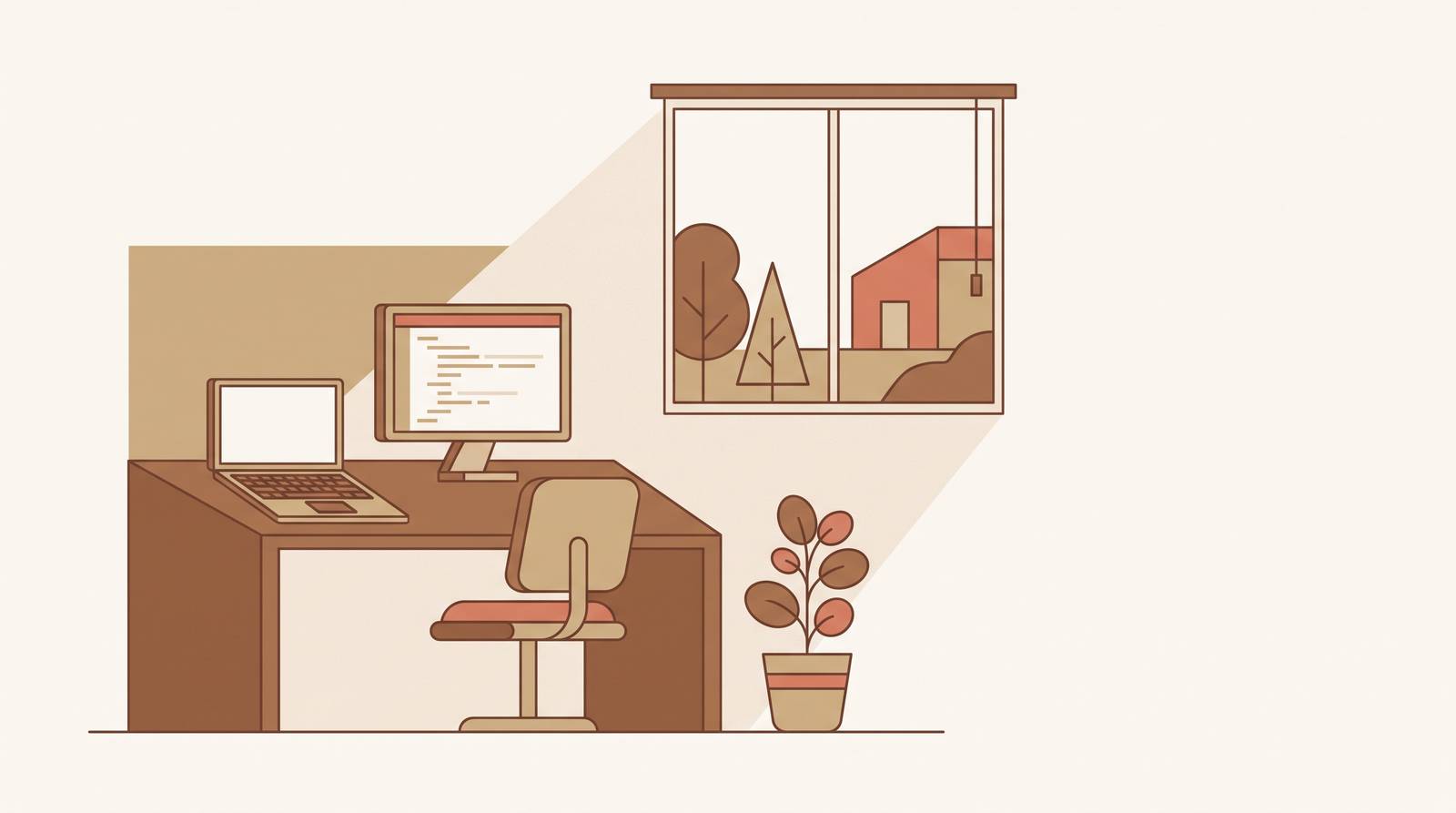
The single change that most consistently produces an immediate, visceral difference in a home office is moving the desk relative to the window. Not a new chair, not a monitor upgrade. Just repositioning relative to natural light. People describe it as finally being able to think. What they're experiencing is circadian alignment, because natural light governs alertness and energy across the entire workday in ways that no productivity system can replicate.
The direction of that light matters more than most people expect. A side-lit workstation reduces glare and the contrast fatigue that builds when you're staring at a screen against a bright background. North-facing light is diffuse and consistent, easier on the visual system across a full day. South-facing light is intense and variable: energizing at certain hours, fatiguing at others.
When natural light is limited, full-spectrum task lighting is the closest functional substitute. Color temperature tuning adds another layer: cooler, bluer light in the morning supports the brain's alertness peak; warmer light in the afternoon eases the transition out of deep work without the jarring quality of a sudden environmental shift.
The less visible problems are glare and flicker. Both force micro-adjustments in the visual system that the worker never consciously registers, but that accumulate into real fatigue by mid-afternoon. A monitor positioned against a bright window, a fixture cycling imperceptibly at 50Hz: silent attention drains, both of them.
If you're building out a home office from scratch, light is where you start, before furniture, before paint, before anything else.
Layout and Spatial Organization Reduce the Cognitive Tax of the Physical Environment
You don't need a dedicated room. You need a dedicated zone, and the boundary matters more than the square footage. Even a modest, clearly delineated area communicates something to the brain: this is where focused work happens. That signal isn't trivial. It functions as a spatial pre-task ritual, conditioning the nervous system before you've done anything else.
Visual clutter is the most consistently underestimated attention drain in a home office. Every visible object unrelated to the current task competes for attentional resources in a low-level, unconscious way. Minimizing what falls within the primary line of sight is a direct cognitive intervention, not organizational perfectionism.
Positioning the desk away from high-traffic household areas reduces ambient interruption. When a separate room is unavailable, physical separators, shelving, a folding screen, curtains, create the visual and psychological boundary that a closed door would otherwise provide. Something about having that edge, even a symbolic one, changes how the brain treats the space.
It's also worth considering a secondary zone within the workspace itself: a separate chair or corner intended for reading and open-ended thinking, distinct from the primary task station. Deep work and generative thinking are cognitively different modes, and having a physical location for each reinforces that rhythm. I'll admit I was skeptical of this until I tried it. The difference was quite striking.
Ergonomics belongs here too. A chair that forces compensatory posture, a monitor at the wrong height, a keyboard angle that produces wrist tension: all of these redirect attentional resources from the task to the body. Removing that neurological noise is part of what a good layout accomplishes.
Color in the Home Office Works on Mood Below the Threshold of Conscious Notice
Most people choose paint colors based on preference, the way they'd choose what to order when they're hungry. In a workspace, that impulse is worth slowing down, because color exerts a consistent influence on mood and arousal that operates almost entirely below the level of conscious awareness.
Cool blues and greens are associated with calm, sustained attention and reduced stress arousal. Warmer tones, terracottas, ambers, ochres, introduce psychological warmth and raise stimulation levels, which can be useful or counterproductive depending on what the work actually requires. Saturation is as important as hue: highly saturated, high-contrast schemes increase neural arousal, while muted, tonal palettes quiet the visual field without making the room feel sterile. A deep teal and a dusty sage produce very different cognitive effects despite both technically being "green."
White and grey are frequent defaults, chosen for perceived neutrality. Cold white in particular can produce a clinical flatness that works against psychological ease, a problem that warm whites and warm neutrals solve without sacrificing visual openness. A single wall, a set of textiles, a bookshelf is sufficient to introduce the psychological effect of a color without saturating the space.
Colors drawn from stone, moss, bark, and sky tend to feel restorative rather than activating. This connects to the biophilic design evidence: natural palettes signal safety to a nervous system that evolved in natural environments.
Why Scent Is the Most Direct Sensory Route to Mood and Cognitive State
Every sensory input routes through the thalamus before reaching the cortex, except one. Scent connects directly to the limbic system, the brain's seat of emotion and memory, bypassing the relay station that mediates all other sensory information. I remember learning this and sitting with it for a moment, because the implications are stranger than they first appear.
The practical consequence of that neurological shortcut is significant. Scent triggers emotional and physiological responses faster than visual or auditory input, and with considerably less conscious mediation. You don't process the smell and then feel calmer. The calm arrives first, and then, if you're paying attention, you notice the scent. The sequence is reversed from what we intuitively expect.
This same pathway explains why scent and memory are so tightly coupled. Specific smells reliably reactivate the emotional states associated with past experiences, a mechanism that can be applied deliberately rather than left to chance. Use the same scent consistently during focused work over time, and it begins to function as an associative cue. The brain learns that this smell precedes concentration, and it begins to prepare accordingly, before you've opened anything, before you've made a single decision.
The research on specific pairings is worth knowing. Citrus, peppermint, and eucalyptus are associated with alertness and energized attention, well-suited to morning sessions or tasks requiring speed and output. Rosemary appears consistently in study-context research as a support for concentration and memory retention. Basil is linked to relief from mental fatigue during extended cognitive effort. Frankincense has been used in contemplative environments for centuries, and contemporary research bears out what those traditions understood intuitively: it supports deep, sustained focus. Lavender, clary sage, and ylang-ylang are associated with reduced anxiety and ease of transition out of high-demand states.
Scent is also the most flexible variable in this entire toolkit. Unlike a chair or a light fixture, it can be changed in seconds, dialed up or down, and matched to the cognitive demand of the task at hand.
Building a Scent Ritual Around the Workday Rather Than Just the Room
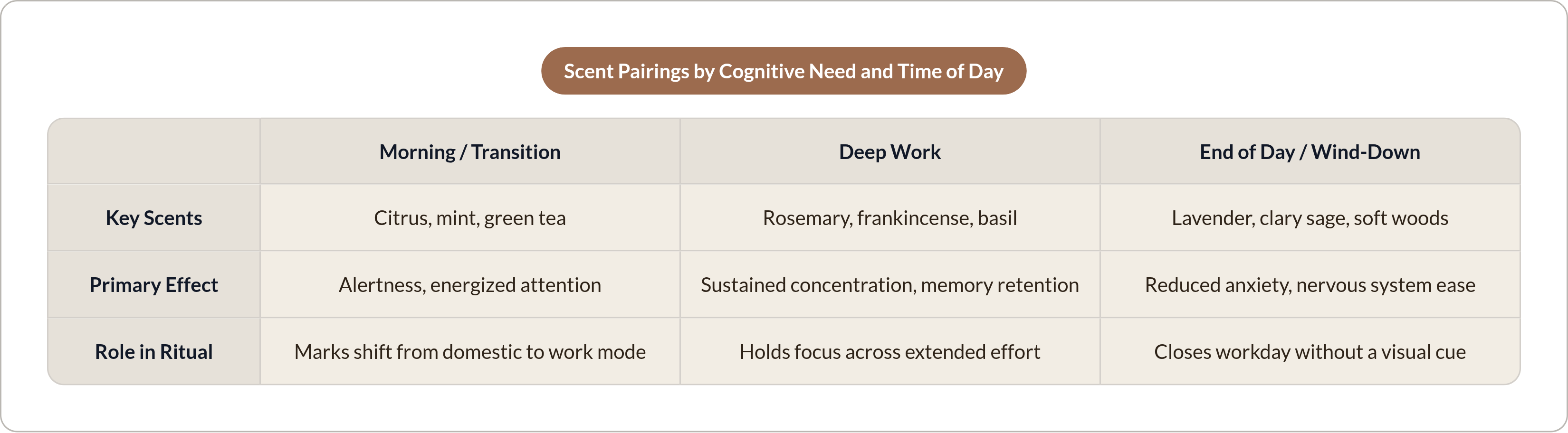
The common approach to scent in a home office is to diffuse something pleasant and leave it running. That works to a point, but it misses the more powerful application. Scent is most effective when it's intentional and varied across phases of the day, rather than ambient and constant.
A time-of-day structure is worth building deliberately. In the morning, as you move from a domestic mindset into focused work, a citrus, green tea, or mint scent marks the transition. It's the sensory equivalent of commuting through a threshold, giving the brain a clear signal that context has shifted. During deep work hours, rosemary, frankincense, or basil sustains concentration. In the mid-afternoon, a brief change of scent or a short pause in diffusion signals transition and prepares the nervous system for a second focus block. At the end of the workday, especially in a home office where the visual environment doesn't change when work ends, lavender, clary sage, or soft woods can close the day in a way that a calendar alarm simply cannot.
The ritual dimension matters. The act of choosing the oil, starting the diffuser, and setting an intention around it is itself a signal to the nervous system. It's comparable in function to brewing a specific tea before a particular kind of meeting, or putting on certain music to shift into a writing mode. The repetition is the point. The brain starts connecting the action to what follows, and over time that connection does some of the motivational work for you.
Luxury hotels and wellness spas have used exactly this logic to manage guest state for decades. The residential application is the same principle at a different scale, and there's something almost embarrassingly simple about realizing you can borrow it.
Why the Diffusion Method Shapes Whether the Scent Actually Delivers What It Promises
Not all diffusion methods are equivalent, and the differences matter more in a workspace context than they do elsewhere.
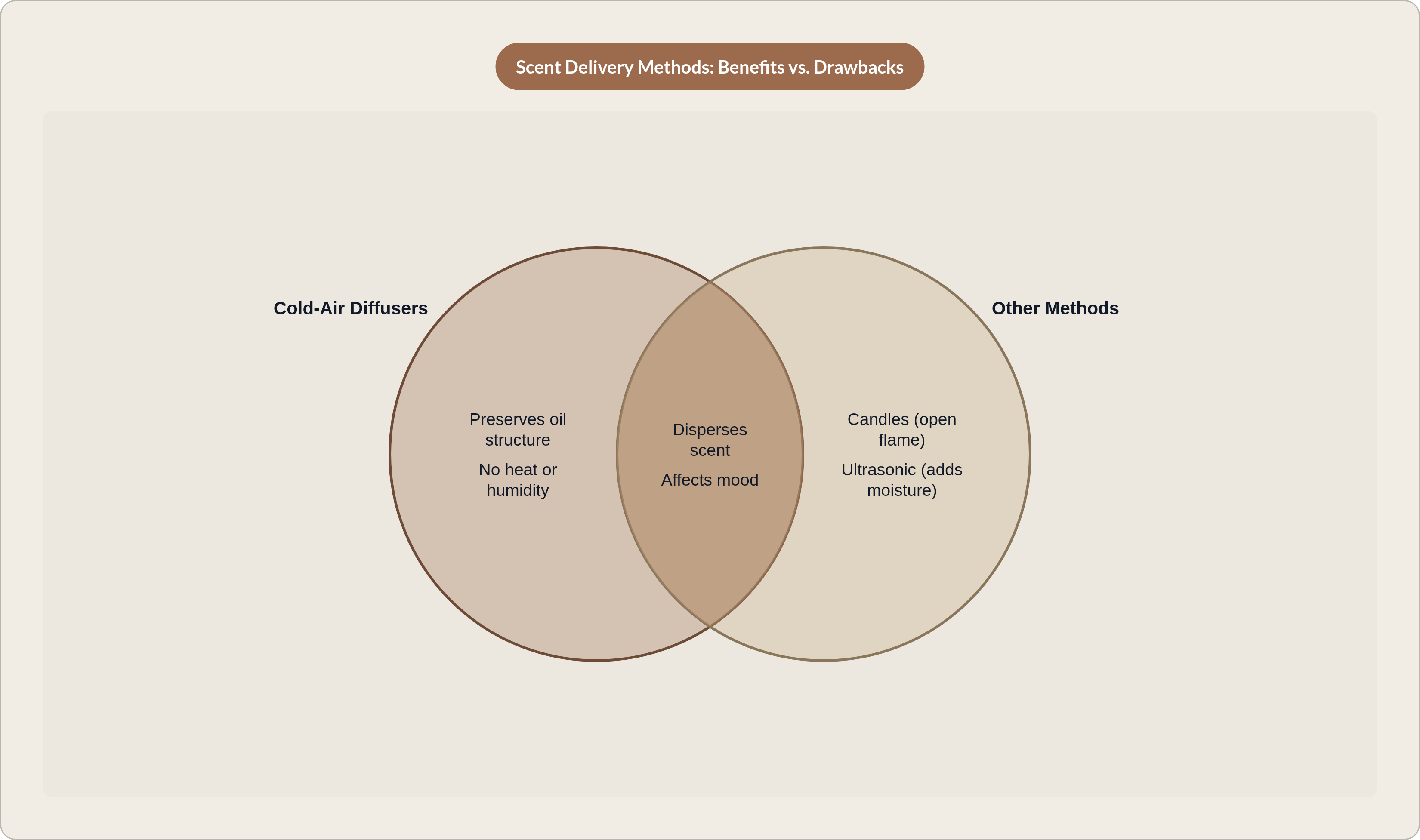
Candles introduce an open flame into a room where someone is working for eight hours. Beyond the safety consideration, heat alters the aromatic chemistry of fragrance oils, particularly citrus and floral top notes, which can turn bitter or flat when burned. What you smell from a candle is not precisely what the oil was formulated to deliver.
Ultrasonic, or water-based, diffusers dilute fragrance with water vapor, which reduces scent concentration and adds humidity to the room. In a home office with electronics, books, or finished wood surfaces, that added moisture warrants consideration. In a damp climate, it compounds an existing problem.
Reed diffusers and passive plug-in units are non-adjustable and have limited coverage range. They cannot be tuned to the task or time of day, which eliminates the primary advantage of using scent intentionally in the first place.
Cold-air diffusion, sometimes called nebulizing technology, works differently. It breaks fragrance oil into microscopic particles using a stream of cool air rather than heat or water, preserving the oil's molecular structure intact. The full aromatic profile, top, heart, and base notes, arrives as formulated. There is no humidity, no residue, no heat degradation. Coverage is substantially broader than passive methods. And for a focus environment, quiet operation matters: cold-air diffusers run nearly silently, which ultrasonic units often do not.
This is the standard method in high-end hotels, spas, and scent-branded retail environments. The technology is now available for residential use.
What "Clean Fragrance" Actually Means and Why It Matters in a Room Where You Spend Eight Hours a Day
The word "fragrance" on a product label is a legal placeholder for potentially dozens of undisclosed synthetic compounds. Manufacturers are required to disclose very little, which means a product's ingredient list can be almost entirely opaque even when it looks thorough.
In a workspace context, this matters more than it does for a candle you burn for an hour on a weekend. Several specific compounds are worth understanding. VOCs, volatile organic compounds, off-gas at room temperature and can irritate eyes, nasal passages, and lungs. In a sealed or minimally ventilated home office, accumulation across a full workday is a realistic concern. Phthalates, used as fixatives to extend scent longevity, are classified as endocrine disruptors. Synthetic musks are linked to respiratory irritation and accumulate in the body over time. Lilial, a common synthetic fragrance compound, was recently banned in the European Union for reproductive toxicity concerns and remains present in products sold in other markets.
Two label terms are frequently conflated and should be distinguished: "fragrance-free" means no scent ingredients were added; "unscented" can still contain masking chemicals that suppress odor while introducing their own compounds. They are not interchangeable.
What to look for: ingredient transparency, phthalate-free and paraben-free labeling, and certifications from bodies like IFRA, the International Fragrance Association, and Sephora Clean, which require disclosure and prohibit a defined list of harmful compounds. Fragrance oils carrying those certifications are formulated without the compounds described above and are appropriate for daily use in an enclosed space, including households with pets and children.
That raises a question worth sitting with: if the therapeutic effects of scent on focus and calm are real, does the delivery vehicle undermine them? It can. Clean formulation is the baseline condition for using scent in a functional, health-conscious way, and it is where the search for a daily-use fragrance oil should begin. Look for cold-air nebulizing diffusers paired with oils that carry Sephora Clean certification and are vegan and cruelty-free.
Putting the Sensory Layers Together into a Home Office That Actually Works
The practical sequence follows a logic of leverage. Start with light: maximize natural light, add full-spectrum task lighting where needed, and eliminate glare before addressing anything else. Then establish spatial boundaries, defining the work zone clearly, reducing visual clutter within the primary sightline, and separating the workspace from household traffic as much as the floor plan allows. Choose color deliberately: cool or natural tones for sustained attention, warm neutrals for psychological comfort, nothing high-saturation in the immediate task area. Finally, layer in scent as the most flexible and neurologically direct tool in the stack. Select fragrance by cognitive need, use a cold-air diffuser for clean and consistent delivery, and build a simple time-of-day ritual around it.
Each layer addresses a different source of cognitive friction. What's easy to miss is that the friction was there all along; you just weren't accounting for it as a variable.
A home office is not a room with a computer in it. It's the environment in which a person spends the productive hours of a workday, and the quality of that environment compounds across weeks and months. Most people experience a single well-considered change and wish they'd done it sooner. The sensory conditions aren't decoration. They shape the neurological conditions under which focus, creativity, and sustained effort either take hold or don't.