Entryway Scent Strategy for First Impressions
Entryway odors need cleaning first, then a cold-air diffuser to survive door traffic.
Most people treat entryway scenting like any other room: drop in a diffuser, pick something pleasant, done. I get it. But after years of thinking about how ambient fragrance actually performs across different residential spaces, the entryway keeps revealing itself as the one place where that casual approach consistently falls apart.
And the reasons are more specific than "it's a small space."
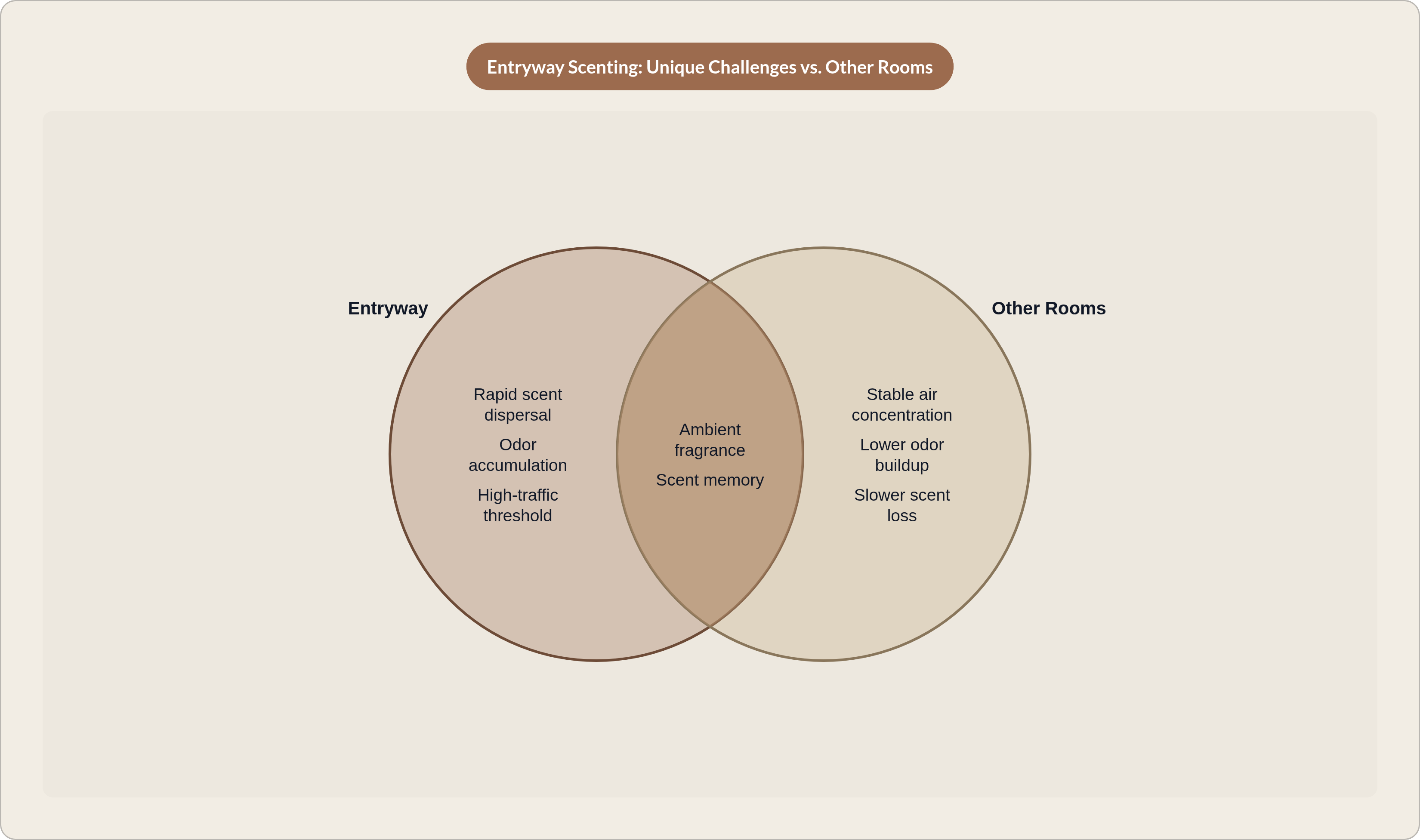
Start with what's literally accumulating at ground level. Wet shoes, damp coats, dog fur, umbrella drip working its way into a rubber mat. All of it settles into entry rugs and bench cushions and the dark interior of coat closets, building an odor baseline that no fragrance layered on top can resolve. The surfaces themselves have to be addressed first. What you're diffusing into the air above them is only as effective as what that air already carries.
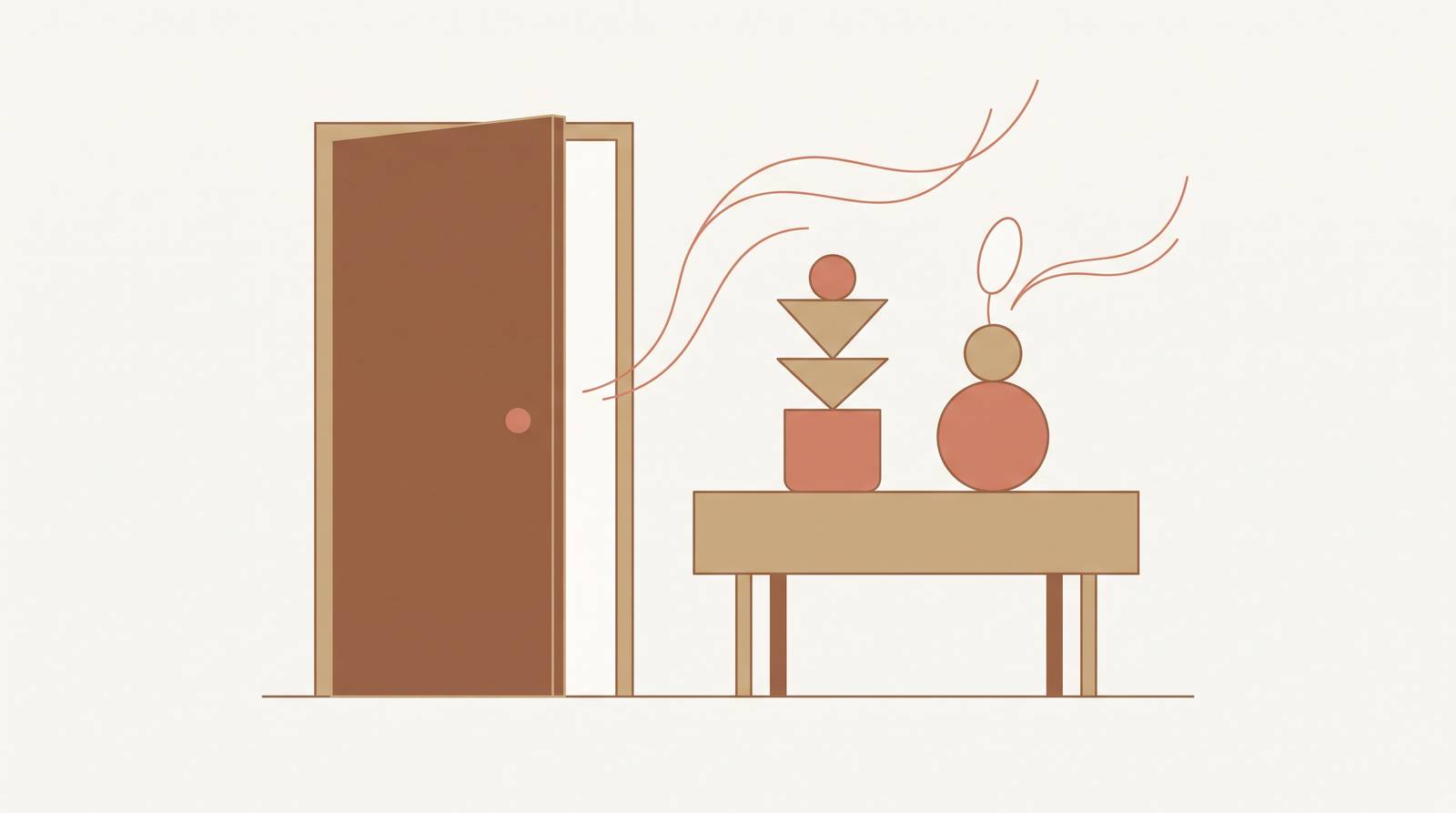
Then there's the airflow problem. Every time the front door opens, outside air pushes in and scatters whatever fragrance concentration you've spent hours building. People moving through quickly compound that dispersal. An entryway loses its scent faster than almost anywhere else in the home, which means the delivery method and placement strategy that work beautifully in a bedroom will barely register here.
So you have persistent odor accumulation below and rapid fragrance dispersal above, operating simultaneously in the same small space. No other room in the house asks you to solve both problems at once. A strategy borrowed from somewhere else doesn't just underperform; it misses the problem entirely.
How Scent Reaches You Before the Room Does
The version of this that lands most reliably is the simplest one: your nose finishes its assessment of a room before your eyes do.
The olfactory system connects to the brain's limbic region more directly than any other sense. Sight, sound, touch, all of them route through additional neurological processing before reaching the areas that govern emotion and memory. Scent takes a shorter path. That's why a particular fragrance can surface a memory with more immediacy and emotional weight than a photograph sometimes can, and why guests have already formed a feeling about your home before they've consciously noticed a single object in it.
In an entryway specifically, this plays out with unusual consequentiality. The scent someone encounters at your threshold becomes, over repeated visits, associated with your home itself. It triggers recognition before anything else in the space has registered. That association compounds. The fragrance becomes a kind of ambient signature, more persistent in memory than the arrangement of your furniture.
For the people who live there, this cuts the other way. Returning to a consistently scented entryway after a difficult day has a quality that's hard to replicate through visual design. The familiar fragrance signals a shift: outside to inside, public to private, whatever the day cost you to whatever the evening offers. It's a small sensory anchor, but that's precisely what's useful when you're depleted.
Consumer research from DSM-Firmenich found that 72% of people reported appreciating scent more in 2024 than in 2020, a shift shaped significantly by the pandemic period, when home environments became objects of sustained daily attention. The same research found 80% of fragrance users now view scent as essential for mood enhancement rather than merely decorative. The entryway is where that function lands with the most force: a single, high-velocity impression, made in seconds, impossible to undo once it forms.
Why Clean, Non-Toxic Fragrance Matters Most in a High-Traffic Threshold Space
The entryway is smaller and less ventilated than the main living areas of a home. That physical constraint has a practical consequence: the concentration of airborne compounds per square foot is higher. Whatever you're diffusing into that space, guests are breathing at an elevated dose relative to a larger room, whether they register it consciously or not.
Conventional air fresheners and plug-in products commonly contain phthalates, volatile organic compounds, and petrochemical derivatives. Research indicates roughly a third of the general population experiences some degree of sensitivity to synthetic fragrance compounds, ranging from mild irritation to more pronounced respiratory response. In a threshold space where guests have no practical option but to pass through, that's a real hospitality consideration. Nobody can quietly step back from your entryway the way they move away from a candle they find irritating.
Children and pets are lower to the ground, which positions them closer to the surfaces where heavier airborne particles settle. The entry rug and mat are precisely where this accumulation concentrates. When the scent delivery system introduces synthetic compounds, those surfaces become part of the problem you were trying to solve.
The marketing language in this category rewards skepticism. "Natural" and "eco-friendly" carry no regulatory weight. Specific exclusion lists, phthalate-free, paraben-free, sulfate-free, are more meaningful, but only when paired with transparent full-ingredient disclosure. Third-party certifications like MADE SAFE and EWG Verified involve genuine external accountability. Sephora Clean is a retailer-administered standard rather than an independent certification, but it applies defined formulation criteria that narrows the field considerably. The baseline question is simple: does this brand disclose its full ingredient list? If not, the absence of that transparency tells you something.
One thing worth knowing for anyone transitioning from conventional synthetic products: clean fragrance will initially read as subtler or less assertive. That perception reflects olfactory desensitization from prolonged synthetic exposure. Nasal receptors recalibrate over several weeks, after which the botanical complexity of a cleaner formulation becomes fully appreciable. The difference feels less like volume and more like clarity.
Cold-Air Diffusion as the Delivery Method Best Suited to Entryway Conditions
Given everything specific about the entryway, the delivery method matters more here than in any other room. Most of the common options are mismatched to the environment in ways that aren't immediately obvious.
Candles introduce combustion byproducts and present a safety concern in a high-traffic space near a frequently opened exterior door. Heat-based warmers alter fragrance compounds through thermal degradation, meaning what you smell is not what you chose. Ultrasonic diffusers add humidity through water vapor, which is counterproductive in a space already managing moisture from wet umbrellas and outdoor clothing.
Cold-air nebulizing diffusion works differently. A stream of cool air breaks fragrance oil into fine liquid droplets, no heat, no water carrier. The aromatic compounds arrive intact, unaltered by temperature, at a consistent concentration from the beginning of a diffusion cycle to the end. The output is dry and precisely adjustable.
That adjustability is the deciding factor in an entryway. The goal is a scent that registers as refined and intentional, not one that announces itself at volume before a guest has removed their coat. Cold-air diffusion with adjustable intensity controls and timer-based scheduling makes that calibration achievable. Smart integration options, timer scheduling and geolocation-triggered activation, allow the scent to settle and integrate before guests arrive rather than releasing as a concentrated burst the moment the door opens.
Among the brands commonly evaluated in this category, Aura360, Hotel Collection, and Mila Marie Scents each offer relevant options worth examining on their own merits.
Choosing the Right Scent Profile for an Entryway First Impression
The entryway scent has a specific, narrow job: welcome, not immersion. It should register as clean, warm, and inviting before a guest has formed a complete thought about the space. It should not compete with the fragrance profiles used deeper in the home, and it should not read as though it's masking something. Guests notice the difference between a space that smells pleasant and one that smells effortfully covered, even when they can't articulate what tipped them off.
Certain scent families perform well at the threshold. Light woods and soft musks, sandalwood, cedar, amber, are grounding without heaviness and read as elevated without ostentation. White tea and citrus profiles are clean, fresh, subtly green; they occupy the same register as a well-appointed hotel lobby, which is exactly the signal. Bergamot combined with soft florals lands as broadly welcoming, neither overtly gendered nor demanding, which makes it a reliable choice for households that entertain widely.
What to avoid: heavily sweet gourmand notes feel domestic in a way that can read as cloying at the threshold moment. Intense incense can overwhelm a smaller space with limited ventilation. Anything a guest consciously identifies as covering something else up should be reconsidered.
The luxury hotel lobby is still the most useful reference point for this problem. Those fragrance programs, white tea, bergamot, sandalwood, soft musk, warm woods, did not emerge from intuition. They emerged from iterative testing organized around a single question: what scent makes a person feel immediately welcome and subtly elevated the moment they cross the threshold? The consistency of these profiles across five-star properties globally is not coincidental.
One of the more compelling directions in contemporary home scenting is fragrance designed to evoke a place rather than describe itself by ingredient. Resort. Spa. Mountain lodge. That destination framing works particularly well in an entryway because it gives guests an immediate emotional orientation. They don't consciously smell "sandalwood and bergamot." They simply feel like they've arrived somewhere.
Where to Place the Diffuser and How to Time the Scent for Guests
Placement determines whether the diffuser functions as a threshold scent or simply as another room object.
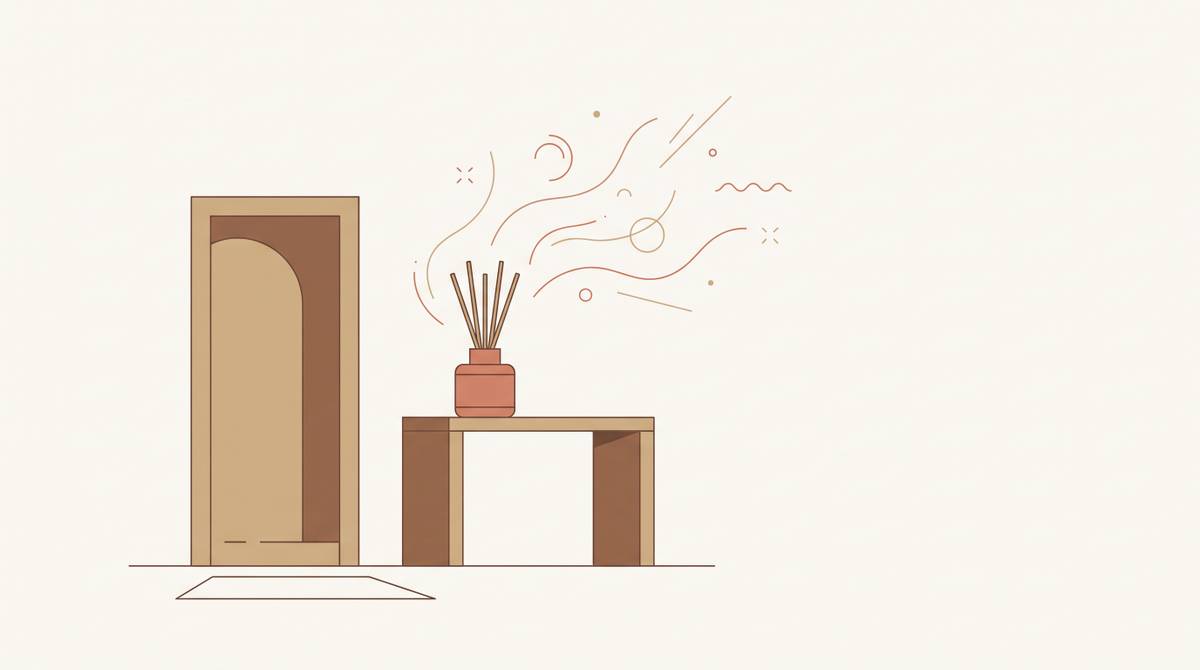
Position the diffuser near the entry point, but not directly behind the door. When the door opens, the airflow it generates pushes inward and slightly back, scattering whatever concentration you've built. A console table, shelf, or entryway furniture piece at mid-height is the practical target: scent disperses at breathing level, where it's most readily perceived, without concentrating at floor level.
In longer or L-shaped entries, the diffuser belongs at the natural pause point, where guests stop to remove shoes or look around, rather than as close to the door as possible. The door is a moment of transition; the pause is the moment of arrival. That is where the olfactory impression actually forms.
Keep the diffuser away from HVAC vents. Forced air will distribute the scent, but in a way that's difficult to control and typically dilutes it before it can register as a coherent impression.
Timing matters significantly when you're entertaining. Starting diffusion roughly an hour before guests arrive allows the scent to integrate naturally. A fragrance that's been running for an hour reads as ambient and settled; one that just activated meets visitors at the door as a concentrated presence, which is the opposite of what you're aiming for.
For daily household use, smart scheduling covers peak arrival windows without running the diffuser continuously. Beyond the oil consumption continuous operation requires, it risks olfactory fatigue in residents. Intensity should be calibrated lower in the entryway than in a dedicated relaxation space. Start below where you think you need to be and adjust upward over several days rather than overshooting immediately.
Revisit the calibration seasonally. In mild weather, when the door opens frequently and stays open longer, scent disperses faster. In winter, a closed entry retains fragrance more effectively. A strategy dialed in during October will need meaningful adjustment by April.
Maintaining a Consistent Entryway Scent Over Time
The signature scent effect, where a home becomes emotionally recognizable through a specific fragrance, develops only through consistency. It is not built in a week, and it's not rebuilt quickly after disruption. Irregular scent swaps and novelty-driven changes undermine the cumulative impression that makes the entryway fragrance worth establishing in the first place.
Practical maintenance for cold-air diffusers is straightforward but requires regularity. The atomizer should be cleaned on a consistent schedule; residue buildup degrades scent quality gradually, in a way that's easy to miss until the output has noticeably weakened. Monitor oil levels on a schedule rather than waiting until the scent disappears, because a nearly empty reservoir produces inconsistent output before it produces none. Keep a backup bottle of the entryway fragrance in stock. Running out and substituting something different while you wait for a reorder is the most common way the signature impression gets interrupted, and that interruption costs more than the extra bottle.
Source odor maintenance is equally ongoing. The entry rug, mat, and any soft furnishings near the door need regular attention. When the base is clean, the fragrance strategy compounds a positive impression. When the base deteriorates, the fragrance budget is spent on compensation.
When the time comes to evolve the scent, do it deliberately. A seasonal shift, something lighter in warmer months, something warmer and more enveloping as the weather cools, can feel intentional and refined rather than arbitrary. What undermines the effect is changing the scent because you're personally bored of it. Your boredom is not the relevant variable here.
There is something worth sitting with about a well-maintained entryway fragrance: when you stop consciously noticing it, that's not evidence it has stopped working. Olfactory adaptation is a normal neurological process; people in a space daily stop consciously perceiving its ambient scent. But the person crossing your threshold for the first time, or for the first time in months, is experiencing your home exactly the way you experienced it before it became familiar. The scent is still landing. It's still the first thing they feel about being there, before they've consciously registered anything else. Your nose has moved on. Theirs has not.