Entryway Scent Design to Set the Tone for a Home
Scent reaching your brain before conscious thought shapes how guests feel about your home.

Your entryway fragrance is shaping how guests feel about your home before they register a single conscious thought about it. The decision is being made by their nose.
Not metaphorically. Anatomically.
The olfactory system is structurally unlike every other sense. Visual and auditory signals travel through the thalamus, a kind of neurological relay station that processes and filters input before passing it upward to the cortex. Scent skips that entirely. Olfactory signals go directly to the limbic system, the brain's emotional and memory core, before conscious awareness has any chance to weigh in. By the time someone thinks "this place smells nice," the emotional imprint has already been made.
This is why lavender has documented associations with reduced anxiety. Why citrus elevates alertness. Why warm woody notes, cedar, sandalwood, amber, register as psychologically grounding in a way that feels almost preverbal. These are not placebo effects dressed up in scientific language. They are documented mechanisms, and they operate whether or not the person experiencing them is paying any attention.
The memory dimension compounds all of this considerably. A scent experienced repeatedly in the same environment gets encoded as the identity of that environment. The fragrance you diffuse in your entryway, month after month, will eventually become what "home" smells like in the memory of everyone who lives there. That is a significant design outcome for something most people buy without much deliberation.
There is also a behavioral priming effect that deserves attention. Arriving home to a scent your nervous system already associates with calm can begin the physiological unwinding process before you have even hung up your coat. The scent precedes the intention. For guests, the sequence is similar: their unconscious first verdict about your home, warm, sophisticated, welcoming or none of these, has already formed from the entryway before they have seen a single room.
Realtors figured out a version of this instinctively, which is why the industry cliché about baking cookies before a showing has persisted for decades. The cookies are not the point. The warm, yeasty, faintly sweet scent doing the work is priming a visiting buyer to feel something like domestic ease before a single room has been evaluated. It is folk science, but it is the right instinct. Its limitation is that it has no framework, no repeatability, and the logic almost never gets extended into actual design thinking.
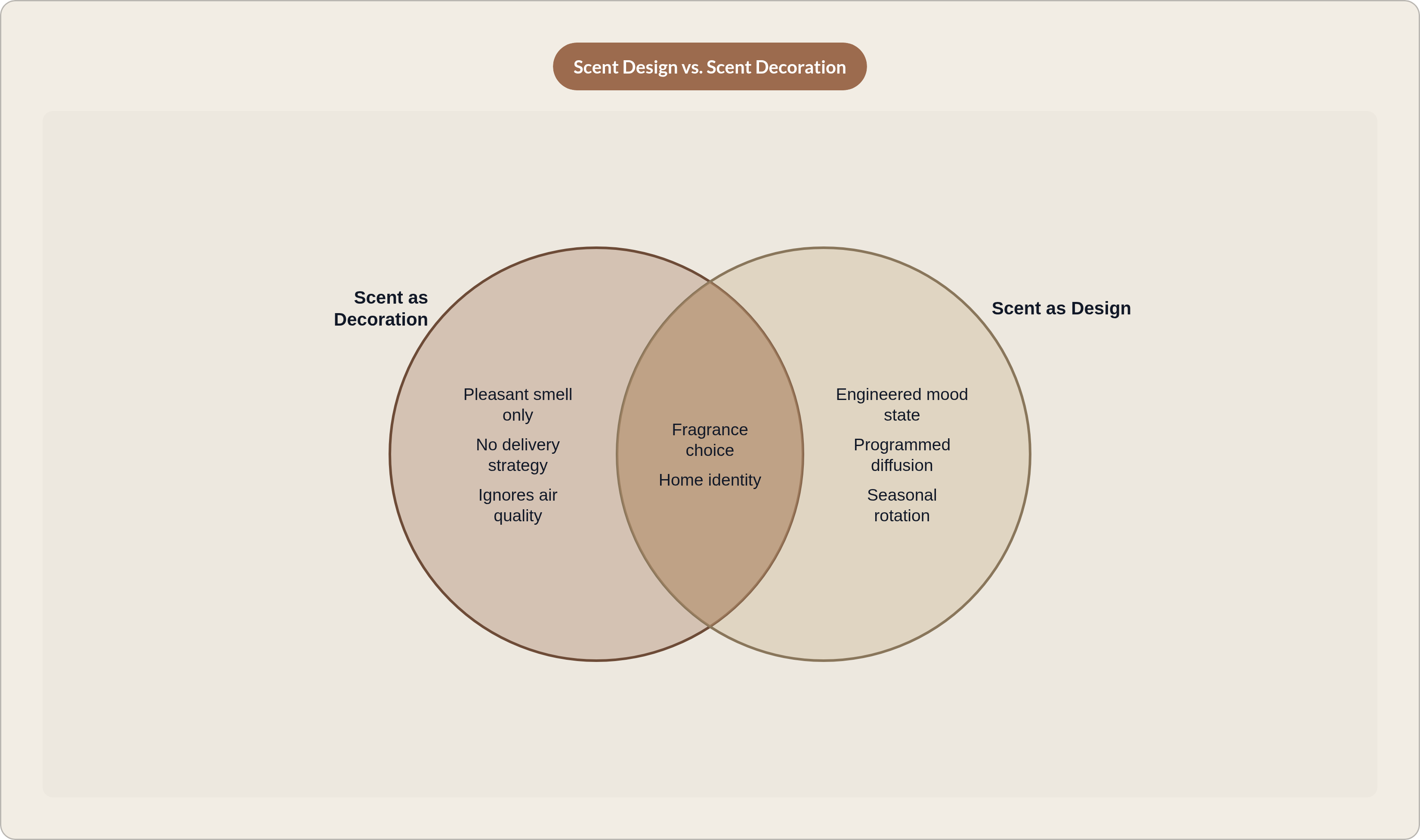
That is where this piece starts: with the premise that treating entryway fragrance as decoration, picking what smells pleasant, is a fundamentally different decision from treating it as design, choosing what emotional state to engineer. Once you accept that premise, three questions follow naturally. Which scents? How delivered? And how much?
Choosing a scent register for the entryway based on the mood it should create
The useful way to think about entryway scent is not by individual fragrance notes but by register: the emotional bandwidth the scent operates within. Three registers cover most residential situations, and learning to think in these terms changes how you shop.
The first is fresh and energizing. Citrus notes, lemon, grapefruit, orange, signal cleanliness and openness. They are uplifting in a way that reads as socially available, well-suited to households with a lot of daytime traffic, families with children, or any space where the entryway also functions as a bustling corridor. The risk with citrus is that it goes generic quickly if nothing grounds it. A citrus top note floating over nothing reads as air freshener. Give it something with body underneath.
The second register is warm and sophisticated. Spiced woods, amber, rich florals, notes with a quietly resinous undertone: these communicate depth and curation. They suggest a home that has been considered rather than assembled. This register works well in spaces where the aesthetic leans traditional, maximalist, or deliberately layered; somewhere the visual complexity needs a scent that can hold its own.
The third is what some designers call quiet luxury. Sandalwood, soft florals, cashmere-type musks. The entire point of this register is restraint. It does not project. It draws you in. It works especially well when the home's visual design is already doing significant work and the scent is meant to complement rather than compete.
One principle holds across all three: the entryway is a threshold, not a destination. The scent should invite rather than announce. Overpowering a small entry with fragrance does not read as generous or rich; it reads as effortful, and guests notice the effort in exactly the wrong way. Think of it the way you would background music in a very good restaurant, present and shaping the experience, invisible as a deliberate act.
A useful framing device, one I keep returning to, is to think in terms of place rather than notes. The scent of a specific environment, a forest lodge, a hotel lobby in a coastal city, a well-worn library, is already an emotional memory cue in most people's minds. Anchoring your selection to a place-memory gives the choice a narrative logic that pure personal preference often lacks.
If you are uncertain where to start, warm woods or soft florals read as broadly welcoming across a wide range of guests and sensibilities. Citrus is the stronger choice when the entryway doubles as a high-traffic corridor.
Building a layered scent that moves through the home without clashing
The entryway scent does not exist in isolation. It is the first movement of a longer piece, and if the rest of the home is playing different music in an incompatible key, the result is disorienting rather than designed.
The principle that resolves this is the signature scent: one foundational fragrance family chosen for the whole home, with each room carrying a variation rather than a departure. If your entryway is built around warm woods, the living room leans into the wood notes; the bedroom softens toward floral. They feel continuous because they share underlying DNA. Guests move through the home without ever consciously noticing the scent architecture, which is exactly the point.
For the entryway specifically, layering works best when it moves across three registers of persistence. The base layer is something steady and grounding: cedarwood, amber, or vanilla delivered through a diffuser on or near the console. It provides the consistent, low-level foundation that does not require your attention. The middle layer can come from natural elements, a small vase of fresh eucalyptus, a sprig of rosemary, something that adds a living, mildly vegetal note without requiring much maintenance. The top layer can rotate seasonally: lemon or clean herbs in spring and summer, cinnamon or clove when the temperature drops. That seasonal note is what keeps the base from going neurologically invisible through familiarity.
Room-to-room continuity comes from keeping one shared note between adjacent spaces. The entryway's cedarwood base reappears in the living room's candle. The bedroom runs a softer sandalwood variation that shares the same woody family without duplicating the entryway exactly. The home then has progression, a sense of moving through something intentional, rather than a sequence of disconnected product choices with no relationship to each other.
Running the same scent profile across formats, diffuser, room spray, linen mist, reinforces the signature further. The experience becomes cohesive without depending on any single delivery method.
Why diffusion method determines whether the entryway scent actually works
Most people spend considerable time choosing a fragrance and almost no time thinking about how it gets into the air. This is the part that most determines whether the whole setup actually functions.
Entryways present a specific diffusion challenge. They are typically small, high-traffic, and transitional. There is frequently a door opening to the outside, which introduces temperature swings and air pressure changes that overwhelm or evacuate a scent within minutes. What works in a bedroom does not necessarily work here.
Reed diffusers are steady and passive. They provide a consistent, low-intensity background note, which makes them useful as part of a layered setup but insufficient on their own as the primary driver of a first-impression experience. You cannot adjust them, schedule them, or turn them up when guests are arriving.
Spray formats are immediate and intuitive, which is why they command a significant share of the room fragrance market. The limitation is that the effect is short-lived, often a matter of minutes. More consequentially, as the next section addresses, the formulas in most spray products deserve serious scrutiny before you commit to using them in a small, frequently occupied space.
Cold-air diffusion is the method that solves the most problems for this application specifically. Rather than using heat or water vapor to disperse fragrance, cold-air technology converts fragrance oil into microscopic dry particles using air pressure alone. No heat means the scent profile is not altered in transit; what you smell is the oil as formulated, not a heat-modified version of it. Coverage is substantially greater than candles, reed diffusers, or ultrasonic units, which makes cold-air diffusion viable even when the entryway opens into a larger open-plan area. For this use case, the critical feature is programmability: high intensity during typical arrival windows, lower or off overnight when the space is empty.
The discretion factor matters more than most guides acknowledge. A well-designed cold-air diffuser fits inside a console drawer left slightly ajar, behind a decorative object, inside a storage bench with ventilation gaps. The hardware disappears. The scent presence does not.
What conventional entryway fragrance products are actually emitting
This is the section most fragrance content skips entirely, and it is probably the most consequential one if you are placing a product in the space every person in your household passes through multiple times a day.
Research into common fragranced consumer products has detected over a hundred different volatile organic compounds, or VOCs, across the category. A meaningful proportion of tested products emitted compounds classified as toxic or hazardous. Roughly a third emitted at least one hazardous air pollutant that regulators have identified as potentially carcinogenic. These are not fringe products from obscure brands; they include common household names sitting on shelves at major retailers.
The entryway amplifies this risk specifically because of its size. Smaller, often less-ventilated spaces concentrate airborne compounds faster than open rooms. A product that disperses harmlessly in a large living room reaches a more concentrated threshold in a 40-square-foot entry hall.
The labeling gap makes independent evaluation nearly impossible for most consumers. In the United States, a single word, "fragrance," can legally substitute for complete disclosure of hundreds of individual chemical compounds. Manufacturers have no legal obligation to itemize what that word contains. This is not a niche concern or a regulatory loophole being exploited by bad actors. It is standard industry practice.
The natural and non-toxic marketing claims do not resolve this. Products carrying those labels can and do emit VOCs, including compounds derived from essential oils that react with ambient ozone to generate secondary pollutants. The label is a positioning statement, not a safety guarantee.
The health consequences for sensitive individuals are real and documented. A substantial minority of people report physiological responses to fragranced products: migraine, respiratory symptoms, skin reactions. In a space used by children, pets, and guests with varying sensitivities, that is worth factoring into the product decision, not as alarmism, but as ordinary due diligence.
None of this is an argument against fragrance. It is an argument for knowing what is in the product before placing it at the entrance to your home.
What clean fragrance actually requires — and how to read a product honestly
A genuinely non-toxic fragrance product does a few specific things: it discloses every ingredient, it uses plant-derived or verifiably safe scent compounds, and it contains no phthalates, parabens, formaldehyde, synthetic musks, or undisclosed VOC-generating compounds. Those are the functional requirements. But how do you identify such a product when most labels are designed to reassure rather than reveal?
Start with the single biggest red flag: the word "fragrance" appearing as an ingredient. It is not an ingredient. It is a legal placeholder for an undisclosed mixture that can contain dozens or hundreds of individual compounds. A product that is genuinely clean will enumerate what is actually in the formula; it will not hide behind that word.
Third-party certification is the most reliable shortcut available right now, precisely because fragrance disclosure law has not kept pace with consumer awareness. Standards like EWG Verified and Sephora Clean require actual ingredient vetting. They exist because the label system does not. They are imperfect proxies, but they are substantially more reliable than taking a marketing claim at face value, which is essentially nothing.
Cold-air diffusion reinforces the clean story in a meaningful way. Because no combustion is involved, there is no soot, no carbon byproduct, and no secondary chemistry triggered by heat. The fragrance reaches the air as it was formulated, which means the cleanliness of the oil itself becomes the primary variable. A verified non-toxic oil in a cold-air diffuser is about as close to the current ideal as product technology allows, which is the space Aura House occupies, pairing waterless diffusers with fully disclosed, non-toxic fragrance oils designed for design-forward homes.
The market is visibly moving in this direction. Consumer demand for plant-based fragrance systems, refillable formats, and disclosed formulas has grown steadily as domestic chemical exposure becomes better understood.
Practical setup for an entryway that stays consistently fragrant without effort
Before any diffuser or fragrance product enters the equation, address what is already in the air. Shoes stored while still damp, coats that never fully dry between uses, bags with their own accumulated odor history. Fragrance layered over a persistent odor source does not mask it; it produces something more unpleasant than either element alone. Ventilation and drying time come before scent addition. This is the step people skip and then wonder why the setup doesn't work.
Placement matters more than most guides acknowledge. Position the diffuser at mid-height rather than on the floor. Scent particles disperse outward and downward from the point of emission, so a floor-level diffuser sends fragrance where noses are not. Avoid placing it directly beside an exterior door; the temperature differential and pressure changes from a frequently opened door disrupt diffusion consistency and accelerate oil consumption in ways that will frustrate you within weeks.
If concealment is a priority, it is achievable without compromise. A small cold-air diffuser fits inside a console table drawer left slightly ajar, inside a decorative basket, or inside a storage bench with ventilation gaps. The visual line of the space stays clean.
Program the diffuser rather than running it continuously. Most cold-air units allow timer and intensity scheduling. Running at higher intensity during peak arrival windows, the morning departure rush, the evening return, and lower or off overnight, preserves oil and prevents olfactory fatigue, the phenomenon by which a scent becomes neurologically invisible through constant exposure. The goal is for the scent to register as a fresh first impression on arrival, not to dissolve into background noise that nobody processes anymore.
Seasonal rotation extends the emotional utility of the whole setup. A scent loses its priming power once it has fully merged into the ambient environment; the brain stops processing it as a signal. Keeping the same foundational family but shifting the dominant note every few months reactivates that first-impression effect and keeps the space feeling considered rather than set-and-forgotten.
Maintain the signature across formats: a matching room spray for use before guests arrive, a scented sachet in the coat closet, all within the same scent family. The entryway scent should feel like the opening of a sentence the rest of the home completes.