Building a Fragrance Gift Set From Individual Components
Curated sets perform better as gifts than pre-packaged bundles.
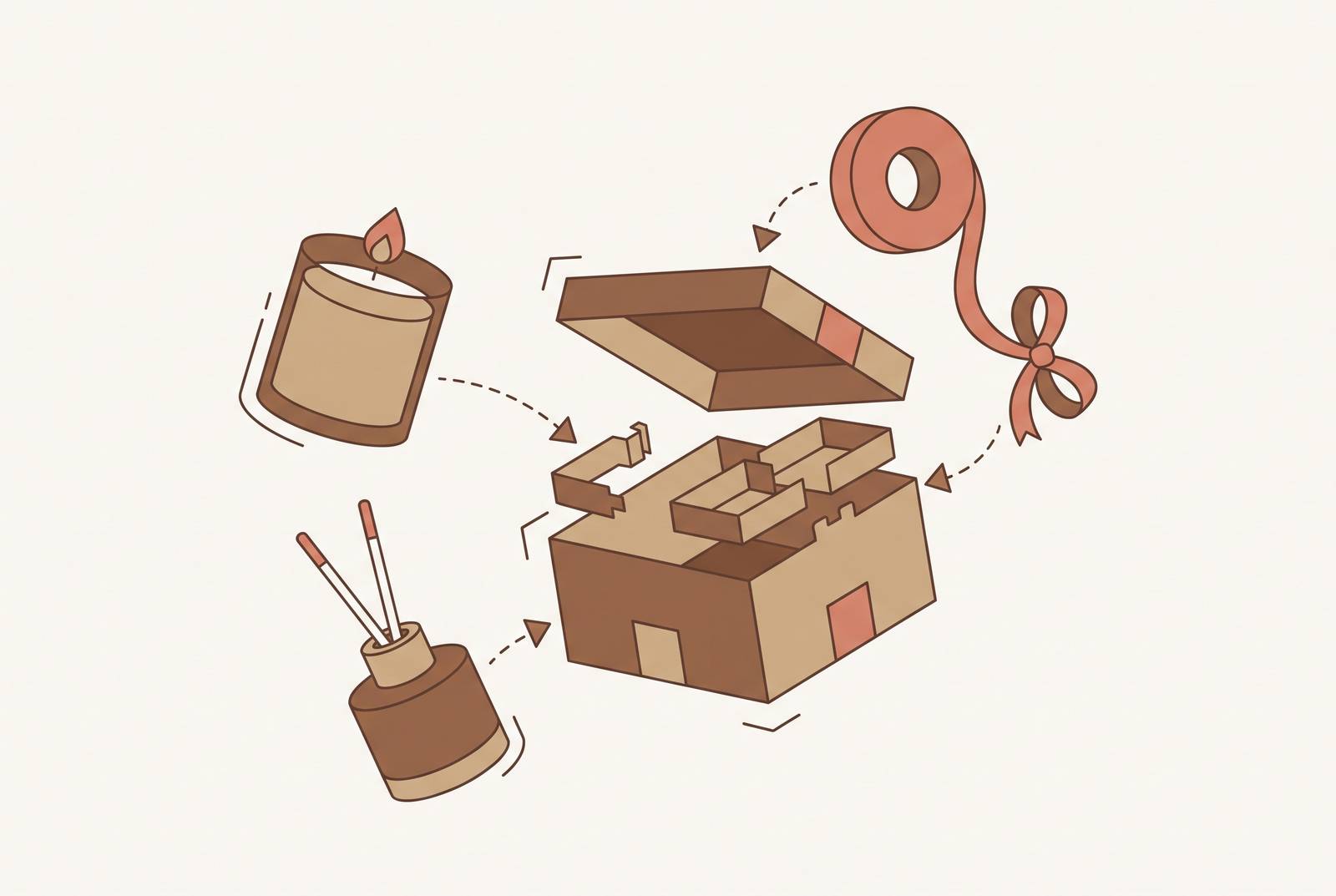
A fragrance gift set built from individual components, chosen deliberately rather than pulled off a shelf as a matched trio, is a fundamentally different object than the shrink-wrapped bundle sitting near the register. Building a Fragrance Gift Set From Individual Components.
Why a pre-packaged fragrance bundle is rarely the right gift
Bundles get built for the shelf, not for the living room. A box has to look good under store lighting and photograph well online, an incentive that has nothing to do with the three items inside actually complementing each other once they're sitting on someone's console table. The result, often enough, is a candle, a wax melt, and a room spray all competing to do the same job, none of them doing it particularly well, layered with a scent profile that reads as an afterthought rather than a decision.
Ask what the actual failure mode looks like. It's a diffuser too small for the room it lands in, or oils that don't suit a household with a toddler or a cat or a partner who gets migraines from synthetic musk. None of that is visible on the box. It appears only after the ribbon comes off, which is exactly the wrong time to discover a mismatch.
The stakes for getting this right have gone up, not down. Statista's 2025 fragrance industry analysis found that 80% of fragrance users now consider scent essential to mood, so a mismatched bundle is wasted potential on something the recipient already values highly. The alternative is to pick each piece for a reason and let the reasons build toward a set that functions as a system rather than three unrelated objects sharing a box. That's the premise the rest of this piece works from, section by section.
What a well-built fragrance gift set contains
Strip it down and a functional set has three layers, not one undifferentiated pile of "smell-good stuff". The diffuser anchors everything else by determining coverage and how faithfully the scent actually comes through. There are the fragrance oils themselves, the consumable layer that does the emotional work of shaping mood and atmosphere. A set of two to three oils with intentional contrast (one energizing, one grounding, one transitional) gives the recipient meaningful range without scent fatigue.
Each layer has its own criteria, and conflating them is precisely how a gift becomes clutter instead of a tool someone reaches for daily. A diffuser is not a candle with better branding; it's the foundational piece that decides if the rest of the set can perform at all. Get the order of operations right and the rest follows: settle on diffuser type first, since it constrains which oils will even work with it and what kind of coverage is realistic, then match oils to the room and the person, then round out with accessories that extend the thing's usefulness rather than just its footprint in the box.
Choosing the right diffuser type: cold-air, ultrasonic, reed, and heat-based compared
Cold-air, or nebulizing, diffusion uses air pressure to break undiluted fragrance oil into an extremely fine mist. No water goes in, no heat gets applied, nothing burns. Heat volatilizes the lighter top notes of a fragrance early, which leaves the heavier base notes unbalanced by the time anyone actually smells the thing, and this affects the perceived scent, while cold air sidesteps that problem by never introducing it in the first place.
The numbers back up why this format earns anchor status in a gift set. Cold-air units deliver 20 to 40% stronger scent throw than ultrasonic diffusers, largely because there's no water diluting the oil and no heat degrading it Scently iScent. That's a real living room and the hallway leading into it, not just a bathroom.
Ultrasonic diffusers work by a different mechanism entirely: they mix oil with water and use vibration to produce a mist. That dilutes the scent, introduces humidity into the room, and creates a maintenance problem, since a diffuser that isn't cleaned often enough becomes a small reservoir for mold. Reed diffusers skip electricity altogether. They're a good match for compact spaces like a powder room or an entryway or a reading nook, and eight to twelve high-quality rattan reeds will pull oil upward through capillary action more efficiently than the flimsy ones that come in drugstore kits, with a typical vessel lasting three to four months before it's spent. What reeds can't do is cover a large room; that's simply outside the format's physics.
Heat-based diffusers and candle warmers eliminate smoke (no flame means no soot), but thermal degradation is still thermal degradation. Warming an oil, even without an open flame, still shifts its aromatic profile away from what the perfumer intended. So for a gift set built around genuine daily use and real room coverage, cold-air diffusion is the strongest choice to build around; the other formats can supplement in a smaller space but shouldn't be asked to carry a whole home's worth of scent. And matching the diffuser's power to the actual room size isn't optional. A unit sized for a bedroom, gifted for an open-plan kitchen-living space, is going to underperform no matter how good the oils inside it are. Cold-air diffusers can cover spaces roughly twice the area of candles, reed diffusers, plug-ins, and ultrasonics, according to AromaTech. Smart premium models in 2026 offer app control, scheduling, intensity modulation, voice-assistant compatibility with Alexa and Google Home, and geolocation-triggered scenting. According to Scently, a single unit typically serves 800–1,200 square feet in residential applications. Personal units are priced at $50–$150, while mid-range home and office units range from $150–$400.
How to read a cold-air diffuser's specs before committing to it as the gift's centerpiece
Coverage rating is the first number to trust, matched to the recipient's actual room rather than the biggest number printed on the box. An open floor plan disperses scent differently than a narrow hallway-shaped room does, even at identical square footage, so a spec sheet is a starting point.
Oil compatibility deserves equal attention. Cold-air units atomize undiluted oil, which means the oils going into the gift need to be formulated specifically for that kind of use, not repurposed from a water-based ultrasonic blend. Buying the diffuser and the oils as an afterthought of each other is how a otherwise well-chosen gift stops working on day one.
Programmable intervals matter more than they sound like they would. Cycling the diffuser between active bursts and dormancy keeps the room's occupant from going nose-blind to a scent that's been running constantly (a phenomenon called olfactory adaptation), and it stretches the oil supply further in the process. Some 2026-era AI-learning models can suggest optimal fragrance rotations, and even basic scheduling reduces unnecessary oil consumption.
Noise level matters on the spec sheet, particularly if the gift is headed for a bedroom or a home office where a faint mechanical hum becomes a lot more noticeable at 11pm than it is at a store display. Maintenance design, meaning how easily the nozzle or atomizer actually comes apart and gets cleaned, decides if this thing still performs six months from now or if it's quietly clogged and forgotten by spring. Commercial-grade systems, cited at $1,500–$5,000 or more, exist but fall outside residential gifting scope, making mid-range home units at $150–$400 the most appropriate tier for a considered personal gift.
Selecting fragrance oils that work as a coherent set rather than a random assortment
Start from the recipient's actual day. A set built around distinct moments, morning focus, a midday reset, evening wind-down, does more for someone than three scents that all sit in the same vague "pleasant ambient" register. That's the difference between a gift that gets used and one that gets sniffed once and shelved.
The research on this is more specific than most gift-givers realize. For focus and alertness, eucalyptus, lemongrass, juniper, and neroli appear repeatedly in functional fragrance research. For relaxation and anxiety, lavender, chamomile, and sandalwood have real backing: a 2026 meta-analysis pooling 33 studies, 27 of them randomized controlled trials, found aromatherapy produced a meaningful reduction in both anxiety and pain. Lavender, chamomile, and sandalwood specifically show research backing for sleep and circadian support. For grounding, cedar, amber, vetiver, and tonka tend to do the job.
Consumer preference is shifting in a direction that matters if the goal is a gift that feels current rather than dated. Woody notes, sandalwood, cedar, oud, saw a 34% year-over-year jump in preference according to a home fragrance industry report, overtaking florals for the first time in a decade. Minimalist profiles, white tea, soft musk, bergamot, clean woods, light amber, read as elevated without dominating a room.
The practical rule: two to three oils, chosen with deliberate contrast, one energizing, one grounding, one transitional, gives someone real range without tipping into scent fatigue. And the pairing has to survive daily rotation in the same physical space; a heavy musk and a sharp citrus, diffused on alternating days in the same living room, will read as a clash rather than a wardrobe. None of this is a niche preference, either. A 14-country survey of 12,000 consumers by Scentmate, a dsm-firmenich initiative, found that half of respondents actively look for fragrances tied to a measurable wellness benefit. Building a gift set around function isn't a trend a gift-giver is chasing; it's already how people choose scent for themselves.
What "clean" and "non-toxic" mean when evaluating fragrance oils for a gift
"Non-toxic" printed on a label isn't a regulatory term. It only means something once a manufacturer names the ingredients it excludes and discloses the full formulation, not when the phrase shows up as a marketing flourish with no ingredient list behind it.
The screening list is fairly specific: phthalates, tied to hormone disruption and reproductive health concerns, parabens, formaldehyde donors, synthetic musks, and VOC-releasing carriers. The tricky part is that plenty of innocuous-sounding label language, "natural fragrance," "aroma," "parfum," "luxury scenting," even "fragrance oil" itself, can all be hiding undisclosed synthetic compounds behind them. None of those phrases confirm anything about what's actually in the bottle.
What does carry weight: EPA Safer Choice certification and IFRA compliance, both of which require actual disclosure rather than branding language, and the Sephora Clean standard, which prohibits more than fifty suspect ingredients as a voluntary bar that participating brands hold themselves to. Even natural terpenes found in fragrance oils can react with indoor ozone to form secondary nanoparticle pollution, so non-combustion delivery reduces risk substantially compared to burning a candle, but it doesn't erase it entirely. That's a point in favor of cracking a window occasionally rather than a case against diffusing fragrance. It's an argument for cracking a window occasionally and not running the unit around the clock.
For a household with pets, this distinction actually matters in a concrete way. Waterless cold-air diffusion of a properly formulated, clean oil is a genuinely different exposure profile than a burning candle or an aerosol spray, simply because there's no combustion byproduct and no propellant involved.
Accessories that make the gift set functional rather than decorative
An accessory earns its place in the box by serving either the device or the ritual around it. Anything that just adds visual bulk to the packaging is dead weight, however nice it looks arranged on tissue paper.
A cleaning kit sized to the specific diffuser model is arguably the single most useful add-on available, since routine cleaning is what keeps scent performance consistent and keeps the unit alive past its first year. A sampler of travel-size oils lets someone test a new scent family before committing to a full bottle, which extends the exploratory value of the whole gift rather than locking the recipient into one profile from day one. If the diffuser needs precise oil loading, a small measuring or dosing tool removes the guesswork and heads off over-diffusing before it becomes a habit. And a one-page placement guide, covering how room height, airflow, and distance from furniture change performance, turns "plug it in" into "set it up correctly," which is a bigger difference than it sounds like on paper.
Skip the generic reed diffuser vessel that duplicates a format the gift set already covers, skip decorative trays that add cost without adding function, and skip candles that quietly compete with the diffuser for the role of primary scent source. If a brand offers a subscription-style oil refill option, mention that too. It keeps the diffuser in active rotation months down the line instead of sitting empty on a shelf once the included oils run out.
Putting it together: how to assemble and present the set
The sequence matters as much as the individual choices. Start with the room itself, its size, its layout, whatever scent environment already exists there, before even looking at diffuser tiers. Choose the diffuser next, and confirm oil compatibility before a single bottle of fragrance gets purchased. From there, select two to three oils built around a mood arc, energizing, grounding, transitional, filtered through whoever's actually going to be breathing it, including pets, kids, or anyone with a sensitivity worth accounting for. Close with one or two functional accessories, no more than that, since piling on a third or fourth just re-creates the clutter this whole approach was meant to avoid.
Presentation is worth taking seriously as a functional step. A short note, handwritten or printed, explaining what each oil is meant to do and when to use it, turns three bottles and a machine into a ritual the recipient already knows how to start rather than a set of objects they have to reverse-engineer.
The category itself backs up why this effort is worth it. The global aroma diffuser market was valued at $2.24 billion in 2023 and is projected to hit $5.76 billion by 2032, growing at an 11.2% compound annual rate, which is a fairly clear signal that diffusion has moved from novelty appliance to something people treat as considered home technology. One major retailer's Q1 2026 loyalty data found 46% of fragrance customers classify the purchase as a "self-treat" buy, and a well-assembled gift set is aiming at that exact emotional register: something the recipient would choose for themselves but might not have assembled with this level of care Forbes. The point of building the set this way isn't to hand over "some nice-smelling things." It's to hand over everything needed to make one specific room feel like exactly what its owner wanted, without them having to figure out the diffuser math themselves.