Phthalate-Free Fragrance Oils Explained
Why phthalates in fragrance oils matter more than safety labels suggest.
Flip a candle over. Read the label. You'll probably find exactly one word where you expected a chemistry lesson: "fragrance." That's it. No breakdown. No list. Just that single word standing in for however many chemicals the brand decided to use.
That's not an accident. That's the system working as intended.
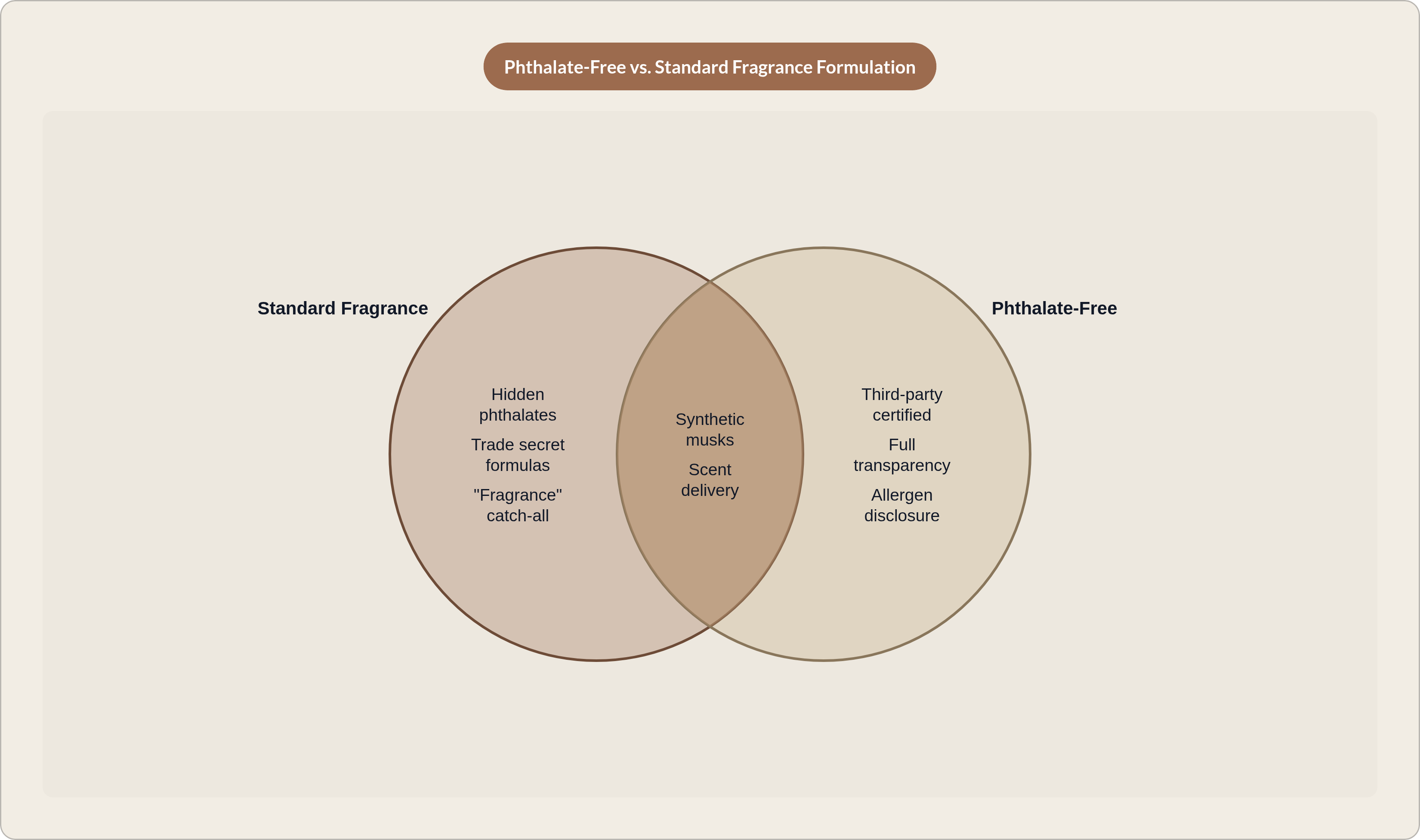
Fragrance formulas are protected as trade secrets under U.S. law. That protection is legitimate. A brand that spent years developing a signature scent has a real business interest in keeping the formula private. But the side effect is that "fragrance" or "parfum" can legally represent dozens of individual chemicals. Phthalates. Synthetic musks. Allergens. All of it, invisible on the label.
Why does this matter specifically for phthalates? Because phthalates aren't in there for scent. They're functional chemicals. Carriers, mostly. They help fragrance molecules bind to surfaces and skin and make the scent last longer. You can't smell them. They won't appear anywhere on the label. They're just in there doing a job you didn't know needed doing.
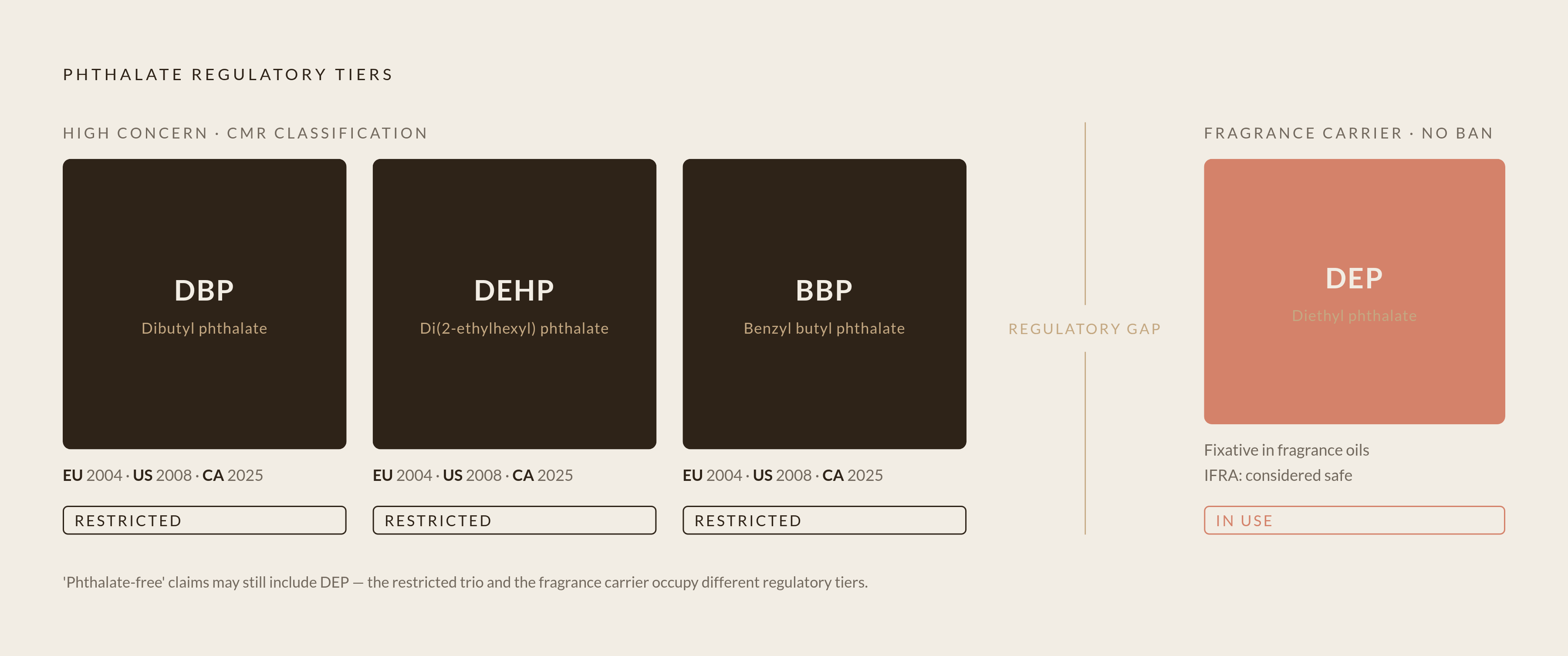
And here's where it gets more complicated: phthalates aren't one chemical. They're a large family. The high-concern members, DBP, DEHP, and BBP, have been classified in various regulatory frameworks as carcinogenic, mutagenic, or harmful to reproduction. The EU banned those from cosmetics in 2004. The U.S. followed with restrictions starting in 2008. California added more rules effective January 2025.
The phthalate most commonly found in fragrance oils is DEP, Diethyl Phthalate. IFRA, the fragrance industry's international standard-setting body, considers DEP safe for use in fragranced products. Different chemical. Different risk profile than the high-concern group.
So if the one most commonly used is considered safe, why does "phthalate-free" still matter as a label claim? That's the question this whole piece is really about.
What the Research Links Phthalate Exposure To, and Where the Science Is Still Unsettled
Phthalates as a class are well-established endocrine disruptors. That means they can interfere with hormone signaling. A 2025 review in Frontiers in Toxicology, pulling from 20 years of studies, found synthetic fragrance chemicals including phthalates associated with allergies, endocrine disruption, reproductive problems, and potential cancer risk. Separate research linked phthalate exposure to insulin resistance and cardiovascular disease.
But before you go throwing out every candle you own, the research asks you to pump the brakes.
A 2023 peer-reviewed study in Molecules found that at mean concentrations, phthalate esters in commercial fragrances were unlikely to produce non-carcinogenic health effects. Carcinogenic risk only appeared at maximum concentrations of DEHP specifically. Not the whole class. Not at typical use levels.
So what does that actually tell us? Risk is concentration-dependent. It is not uniform across the phthalate family. The evidence supports real concern. It does not support torching your candle collection.
The harder question is cumulative exposure. One scented candle. One body lotion. One laundry detergent. One air freshener. Used daily. In combination. That combination is harder to model and far less studied than any single product in isolation. This is where the precautionary logic for phthalate-free actually lives: not in a finding that DEP at normal fragrance concentrations harms you, but in the reasonable position that you'd rather not spend years being a one-person experiment with incomplete data.
It's also worth asking who's in the room. Children breathe more air relative to their body weight. Pregnant people have documented sensitivity to endocrine-disrupting compounds. Cats lack certain liver enzymes needed to metabolize specific aromatic compounds, and veterinary sources treat scented oils as a legitimate hazard category for felines. Who is being exposed matters as much as how much.
Why Household Use Raises Different Concerns Than Personal Fragrance
Perfume on skin is intermittent. It covers a small surface area. It largely off-gasses into open air.
A diffuser running in a closed room is something else entirely. Everyone present inhales it, for hours. Adults. Children. Pets.
"Is this safe to put on my wrist" is a genuinely different question than "is this safe to run in my living room for four hours while my toddler plays on the floor." That distinction is not philosophical. It's physiological.
Children spend more time at floor level, where heavier airborne particles tend to settle. They also breathe more air per unit of body weight than adults, which means a concentration that barely registers for you lands differently for a three-year-old. Cats can't process certain aromatic compounds the way humans can, and what smells pleasant to you can accumulate toxically in their system. Dogs have olfactory sensitivity that can translate into real respiratory distress at concentrations humans would never notice.
None of that makes home fragrance inherently dangerous. But it does mean the formulation standard you'd apply to a perfume is a floor, not a ceiling, for something you're diffusing into a shared living space for hours at a stretch. The exposure pathway is different. The stakes are different. The question you should be asking is different.
How Cold-Air Diffusion Interacts With Fragrance Chemistry — and Why It Matters for Clean-Fragrance Users
Here's something that doesn't come up often enough: how you disperse fragrance changes what you're actually inhaling.
Heat-based methods like candles, warmers, and heated diffusers apply high temperatures to vaporize oil. Heat can alter fragrance chemistry in that process. Some aromatic compounds break down or recombine under heat into forms that weren't present in the original oil. You're not necessarily inhaling what was in the bottle.
Cold-air diffusion works differently. A nebulizing atomizer breaks liquid oil into microscopic particles using cool compressed air. No heat. No water. No combustion. The aromatic compounds reach the air chemically intact.
That has a few practical consequences worth knowing:
- Scent fidelity. Top, mid, and base notes are all preserved. Citrus doesn't go bitter. Florals don't flatten. Woods arrive with actual depth.
- Coverage. Cold-air diffusers can cover roughly twice the square footage of ultrasonic diffusers or candles, meaning larger rooms get even distribution without requiring heavier oil concentration.
- Formulation integrity. If you chose a phthalate-free oil because you care what's in it, cold-air diffusion gets it into the air without adding a heat-transformation variable that changes what you're actually breathing.
That last point is the one worth sitting with. A clean oil delivered by a method that keeps it chemically intact is a coherent choice. A clean oil run through a heat source that alters its chemistry is a less coherent one. Most people make those two decisions separately, without realizing they're connected.
What "Phthalate-Free" Actually Signals on a Product Label — and What It Doesn't Guarantee on Its Own
Phthalate-free is a meaningful exclusion. Worth demanding. But it's not a comprehensive clean-formulation certification, and treating it like one is where people get tripped up.
A fragrance oil can be phthalate-free and still contain:
- Synthetic musks with their own regulatory scrutiny
- Undisclosed allergens sheltered under the "fragrance" umbrella
- Parabens or other preservative systems worth knowing about
So what does a stronger signal actually look like? Third-party certification. Sephora Clean, for example, requires a documented standard across the full formulation, not just one ingredient exclusion. Vegan and cruelty-free claims, when backed by actual certification rather than brand self-reporting, add another layer of verifiable standard.
The combination worth looking for is phthalate-free, plus full ingredient transparency, plus a third-party standard. Any one of those alone is a good sign. All three together means the brand has submitted its formulation to outside scrutiny rather than just writing its own rules and stamping "clean" on the front.
Treat "phthalate-free" as the first question you ask about a fragrance oil. Not the last.
How the Growing Preference for Phthalate-Free Fragrance Reflects a Broader Shift in How Consumers Use Scent at Home
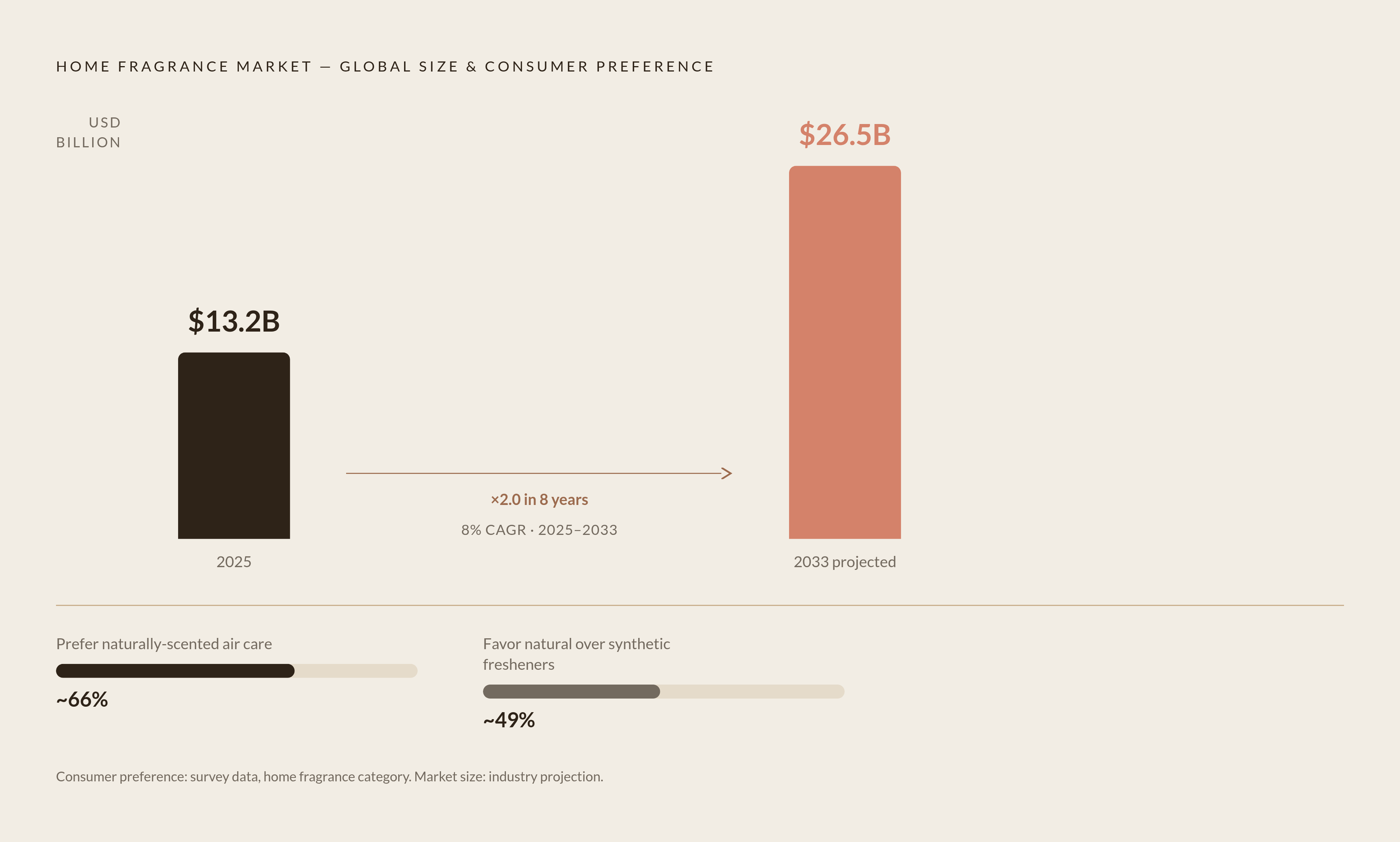
The global home fragrance market was valued at USD 13.2 billion in 2025 and is projected to reach USD 26.5 billion by 2033. That's not a niche category. That's a mainstream lifestyle segment with serious money and serious momentum behind it.
Within that growth, clean formulation is a named driver. Consumers are moving toward plant-based, essential-oil-based, and refillable systems. Regulatory pressure is reinforcing the same direction. EU REACH guidelines, U.S. CPSC restrictions, and state-level legislation are all tightening. The market and the regulators are, for once, heading the same way at the same time.
But there's something underneath the market story that's more interesting. About two-thirds of consumers prefer home air-care products that smell as natural as possible. Nearly half favor natural household fresheners over synthetic alternatives. That's not a niche preference. That's most people, which raises a reasonable question: why?
Part of it is surely about what people want to avoid. But a bigger part might be about what fragrance has become in the home context. It's not background noise anymore. People are using scent deliberately as a mood tool, a daily ritual, a practice they're building intention around.
That's not soft language. It has a physiological basis. Odor molecules signal directly to the limbic system, the brain's emotional and memory center, more directly than almost any other sensory input. Fragrance isn't passive. Your brain responds to it whether you're paying attention or not. When people understand that, they tend to hold what they're diffusing to a higher standard.
That shift in understanding is what's largely driving the clean fragrance movement. Not panic. Not trend-chasing. A more accurate picture of what fragrance actually does and what it means to fill your home with it every day. Brands that built their formulation standards around that understanding early are in a more defensible position now, partly because the question consumers are asking has genuinely changed.
The question used to be: does this smell good? Now it's: does this smell good, do I know what's in it, and is it something I'm comfortable with my kids and pets breathing for hours? That's a more demanding question. And "phthalate-free" is one of the first places a brand either answers it or doesn't.