VOC Emissions From Home Fragrance Products
Study of 25 fragranced products reveals toxic VOCs hiding in home scent staples.

There is something almost comically modern about the home fragrance industry. We have spent decades making our houses progressively more airtight in the name of energy efficiency, and then we fill those sealed spaces with products that emit dozens of volatile compounds into the air we breathe. The market for doing this has grown to billions of dollars globally, with scented candles as the dominant segment and diffusers closing the gap fast. Nobody, as far as I can tell, intended this to be ironic — but here we are, essentially pickling ourselves in pleasant smells and calling it self-care.
But it is worth taking the situation seriously for a moment, because the stakes are not hypothetical. A study by Steinemann, published in Atmospheric Environment, analyzed 25 common fragranced consumer products and identified 133 distinct VOCs across them, averaging 17 per product. Of those 133 compounds, 24 were classified as toxic or hazardous under U.S. federal law. That is not a fringe finding from an obscure journal. It is a peer-reviewed result, and it applies to the kind of products sitting on most people's bathroom shelves and living room tables right now.
The point is not that you should throw your candles away. The point is that delivery method, formulation, and usage behavior each play a measurable role in how much of what enters your air, and understanding those differences gives you an actual framework for choosing better. That is what this piece is trying to work through.
VOC Chemistry Starts Before You Light Anything
To understand VOCs, you need to understand one basic fact: most fragrance ingredients are volatile by design. That is the whole mechanism. Scent works because molecules vaporize, travel through air, and reach your olfactory receptors. Volatility is not a bug; it is the product.
The question, then, is not whether fragrance products emit VOCs. They all do. The question is which VOCs, at what concentrations, in what forms, and under what conditions.
Three variables interact to determine that outcome. Heat accelerates vaporization and can thermally degrade fragrance molecules, generating breakdown byproducts that were never present in the original formula. Combustion adds an entirely separate layer of chemical reactions on top of that, independent of the fragrance itself. Passive evaporation at room temperature is slower, lower-energy, and produces substantially less molecular breakdown.
A 2024 chamber study published by the American Chemical Society examined five fragranced personal care products and found they emitted over 200 VOCs, with emission factors ranging from 2 to 964 milligrams per gram. The variance within a single product category, under controlled conditions, tells you something important: formulation differences and delivery conditions interact in ways that produce dramatically different outcomes even when the category label is the same.
One family of compounds deserves particular attention: terpenes, with d-limonene being the most ubiquitous example. Terpenes are abundant in both synthetic and natural fragrance ingredients. When they react with ambient indoor ozone, they generate secondary pollutants, including fine particulate matter and formaldehyde. The compounds that enter your air are not always the ones the formula contains. Some of the most relevant ones are created by chemistry that happens in your room — think of it less like spraying perfume and more like starting a slow, invisible reaction you never agreed to run.
That is why the delivery mechanism is not a minor detail. It changes the chemistry.
Candles Do Two Things at Once, and That Is the Problem
Candles are the category most people know best, which makes them a useful starting point. They are also the format with the most emission variables, which makes them worth examining carefully.
When a candle burns, two distinct processes operate simultaneously. The combustion of the wax produces soot, ultrafine particles, and combustion byproducts that are entirely separate from whatever fragrance is in the formula. The fragrance itself is being vaporized under sustained high heat across the entire burn period, which accelerates release and can trigger thermal degradation of fragrance molecules, generating compounds that were not in the original oil.
Wax melts are often framed as a safer alternative, and in one specific sense they are: removing the open flame eliminates combustion particulates. But the electric warmer still applies heat to the formula continuously, meaning the thermal vaporization and potential degradation dynamics remain. The combustion pathway is gone; the heat pathway is not.
Projections for VOC emissions from fragranced products as a category suggest they will exceed two teragrams annually by 2050. Candles, as the largest segment, carry a disproportionate share of that trajectory. That is a macro-level statistic, but it reflects micro-level decisions made product by product, room by room.
The practical implication: candles and wax melts benefit more than any other format from open windows, shorter sessions, and intentional placement away from low-ventilation spaces. They are not categorically harmful, but they demand more behavioral management than most consumers currently apply.
The Plug-In Question Is More Complicated Than It Appears
Plug-in liquid electric diffusers use a low-level heating element to slowly vaporize a fragrance solution. No flame, lower temperatures than a candle, but still heat-assisted release.
A January 2025 study in Environmental Science: Advances (RSC Publishing) raised a methodological point that matters enormously for how we interpret prior research: most evaluation of these products has been conducted in small laboratory test chambers. Chamber studies generate gas-phase VOC concentrations that are substantially higher than what occurs in real homes. That gap is not trivial.
One real-home study cited within the RSC paper (Warburton et al., 2023) found that VOC increases from a single plug-in diffuser in an actual dwelling were difficult to detect above background levels. Ventilation and room positioning were the dominant variables.
But what if ventilation is degrading? That raises an important counterpoint: homes are becoming measurably less ventilated as building energy efficiency standards tighten. The gap between chamber-study conditions and real-home conditions is closing, not widening, over time. A finding that plug-ins are hard to detect in today's average home will not hold in tomorrow's more airtight one.
Honest summary: plug-ins carry lower emission risk than candles, but still rely on heat and often contain solvent carriers in the fragrance solution. Real-world impact is highly sensitive to a factor, ventilation, that has nothing to do with the product and everything to do with how you use your home.
Reed Diffusers: No Heat, but Read the Carrier Label
Reed diffusers have obvious appeal from an emissions standpoint. No heat, no electricity, no combustion. Fragrance oil wicks passively up porous reeds and evaporates at room temperature. The emission rate is inherently lower than any heat-assisted format.
But a June 2023 study in MDPI Atmosphere, using passive samplers in real bathroom conditions with bamboo reed diffusers, found something instructive. The dominant VOCs were not the aromatic fragrance ingredients. They were the carriers: ethanol and propylene glycol, with propylene glycol measurable at concentrations ranging from 273 to 528 parts per billion. The fragrance chemistry, in that study, was secondary to the solvent chemistry.
Room sprays share this dynamic in a different temporal pattern. Rather than sustained low-level release, sprays produce brief, high-concentration bursts in which propellant and carrier solvents contribute significantly to the momentary VOC load alongside the fragrance compounds.
Why does this matter? Because the intuitive assumption, that heat-free formats are automatically low-emission formats, obscures the formulation dimension entirely. What the fragrance is dissolved or suspended in can dominate what enters your air, regardless of whether anything is being heated. This applies across all formats, not just reed diffusers, but passive formats make the carrier chemistry particularly visible because combustion and thermal products are not there to compete with it.
Cold-Air Diffusion: A Different Category of Mechanism
Cold-air nebulizing diffusers work on a fundamentally different principle. Pressurized air, rather than heat, breaks fragrance oil into microscopic dry particles that are carried into the room. No heating element, no water reservoir, no carrier solvents.
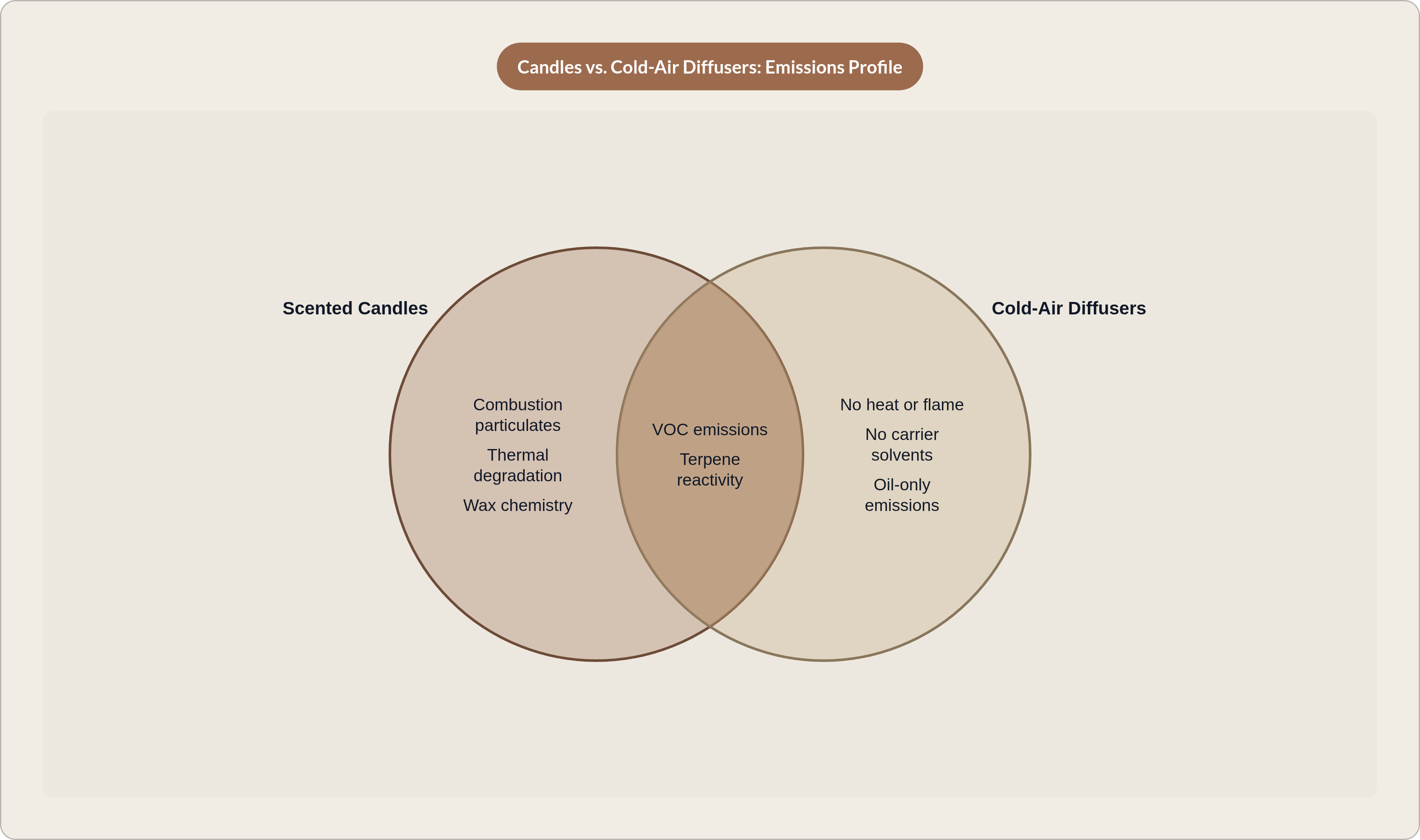
The implications cascade directly from that mechanism. No heat means no thermal degradation: the chemical composition of what enters your room air mirrors the composition of the oil in the reservoir. No carrier solvents means the propylene glycol concentrations that dominated the reed diffuser study above are absent entirely. No combustion means no particulate production from wax or wood burning.
The emission profile is, structurally, simpler. What comes out is primarily a function of what is in the oil, not of breakdown products, carrier chemistry, or combustion byproducts layered on top of it.
That simplicity shifts the controlling variable clearly onto oil formulation. Which is why ingredient transparency matters more in this format, not less. With a candle, combustion chemistry overwhelms the fragrance chemistry in the emissions profile. With cold-air diffusion, the oil is the story. Phthalate content, synthetic musks, undisclosed fragrance compounds, these carry more relative weight when they are not competing with combustion products for attention.
There is also a practical efficiency point. Cold-air diffusers cover equivalent or larger areas with less total product consumed than candle or reed formats. Less oil per unit of scented space means less total VOC load per session, all else equal.
The "Natural" Label Does Almost No Work Here
This section is, frankly, the one I feel most strongly about, because the labeling situation in home fragrance is genuinely indefensible.
Research has found that both conventional and "green" or "natural" fragranced products release hazardous compounds in comparable measure. The label does not predict the emission profile. This is not a cynical claim; it follows directly from the chemistry.
Consider: d-limonene, one of the most prevalent VOCs in fragranced products and one of the most reactive precursors to secondary indoor pollutants, is a terpene derived from citrus. It is as "natural" as it gets. Its botanical origin does not change its reactivity with ozone in your living room. Knock knock. Who's there? Natural ingredients. Natural ingredients who? Natural ingredients that are still reacting with your indoor air — the label never promised otherwise.
The regulatory structure makes this worse. Fragrance formulas are protected as trade secrets in the United States. The word "fragrance" on an ingredient label can legally represent hundreds of individual chemical compounds without any disclosure requirement. From Steinemann's 25-product study: of all 133 VOCs identified across those products, only one was listed on any product label. Only two appeared on any material safety data sheet. The transparency failure is not partial. It is essentially total.
Phthalate-free and paraben-free claims are meaningful within their specific scope, but they address particular chemical families, not VOC emissions broadly. Third-party certifications, including EWG Verified and IFRA compliance standards, offer more reliable signals than marketing language. But ingredient disclosure remains the necessary baseline. A "clean" product whose ingredient list begins and ends with "fragrance" is telling you almost nothing.
Ventilation Is Doing More Work Than the Product
Both the RSC 2025 study and the MDPI 2023 study identified ventilation as a primary determinant of real-world VOC concentration, in some conditions more determinative than product format itself. That is worth sitting with.
Lower air change rates correlate with significantly higher indoor concentrations of any emitted compound. The same product in a well-ventilated kitchen and a sealed bathroom produces exposure levels that are not even comparable. As energy efficiency standards push homes toward tighter envelopes, this effect becomes structurally more relevant over time, not less.
Why does this matter for the individual consumer? Because ventilation is one of the variables you actually control, independent of product choice. Opening a window during or after use, matching product intensity to room size rather than defaulting to maximum output, scheduling fragrance use for periods when windows can be cracked: these behavioral choices interact with product selection rather than being subordinate to it.
Diffuser scheduling features, specifically run/rest cycles rather than continuous operation, address the duration variable directly. Intermittent operation reduces total oil consumed per session, which reduces total VOC emitted per session. The math is simple. The habit is apparently underutilized.
It is also worth considering placement. Position near an HVAC return, a high-traffic air-movement zone, or a window affects dispersion and accumulation in ways that the product specification sheet will never address. The product is one variable in a system — and ventilation is the tide that raises or lowers all of them.
A Framework, Not a Verdict
One might argue that this entire analysis is overly complicated for what is, at bottom, a consumer decision about air freshener. That is fair. But the counterargument is that people make this decision daily, in spaces where they spend most of their time, without access to any meaningful information about the tradeoffs. A framework, even a rough one, is better than the current default of brand aesthetics and price point.
The framework has two independent axes.
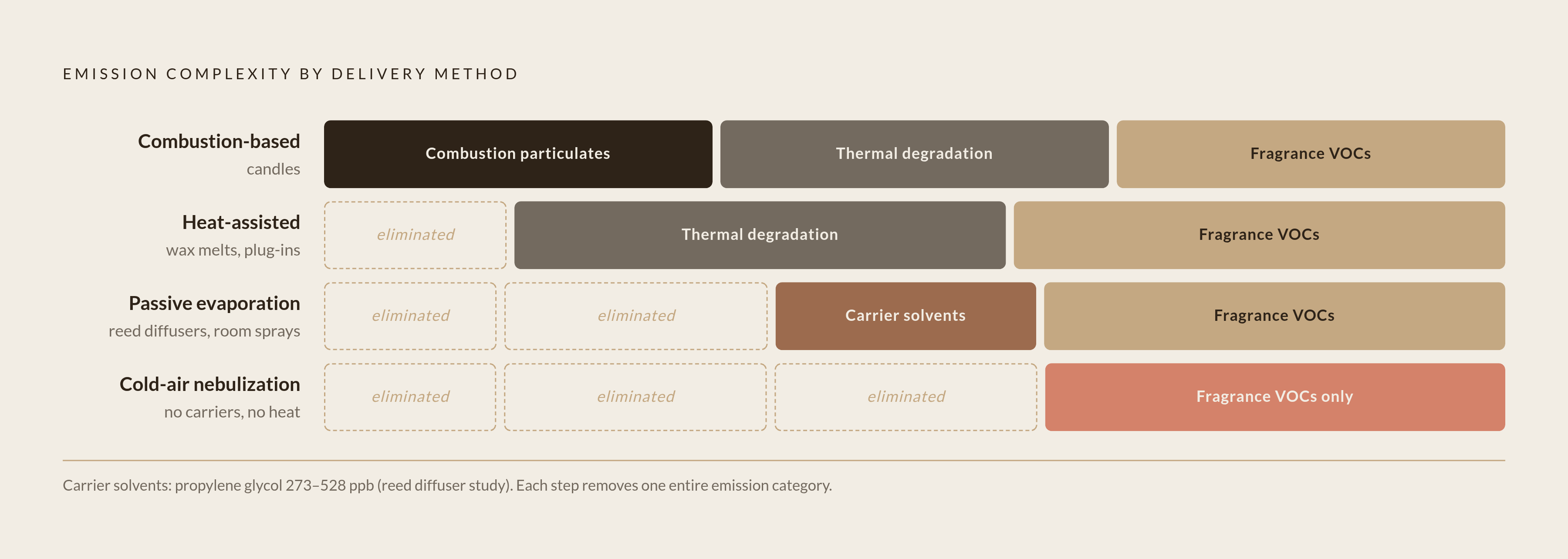
The first is delivery method. Along a spectrum from highest to lowest emission complexity: combustion-based (candles), heat-assisted (wax melts, plug-ins), passive evaporation with carrier solvents (reed diffusers, room sprays), and cold-air nebulization without carriers or heat. Each step down that spectrum reduces thermal degradation products, combustion particulates, and solvent carrier emissions. The tradeoffs and use patterns differ at each level.
The second axis is formulation: what is in the oil, wax, or solution, regardless of how it is delivered. Carrier solvents, phthalates, undisclosed fragrance compounds, and reactive terpenes each contribute to the emission profile independently of the delivery mechanism.
These axes interact but do not substitute for each other. A cold-air diffuser with a poorly formulated oil is not automatically preferable to a well-formulated candle used briefly with ventilation. And a candle made with thoughtfully disclosed ingredients is still subject to combustion chemistry that no formulation choice eliminates.
The practical read: prioritize delivery method first, because it determines the ceiling of emission complexity. Then evaluate formulation, because within a given delivery method it is the remaining controllable variable. Then manage behavior: room size, duration, ventilation, placement. None of these is sufficient alone. Together, they give you actual leverage.
The industry is not going to resolve the transparency problem on its own, and regulatory change on fragrance disclosure has moved at a pace that could generously be described as unhurried. In the meantime, the information exists to make more considered choices. That is not nothing.