Scent Routines for Work-From-Home Productivity
Scent can signal your brain when to focus, create, and recover without leaving your desk.
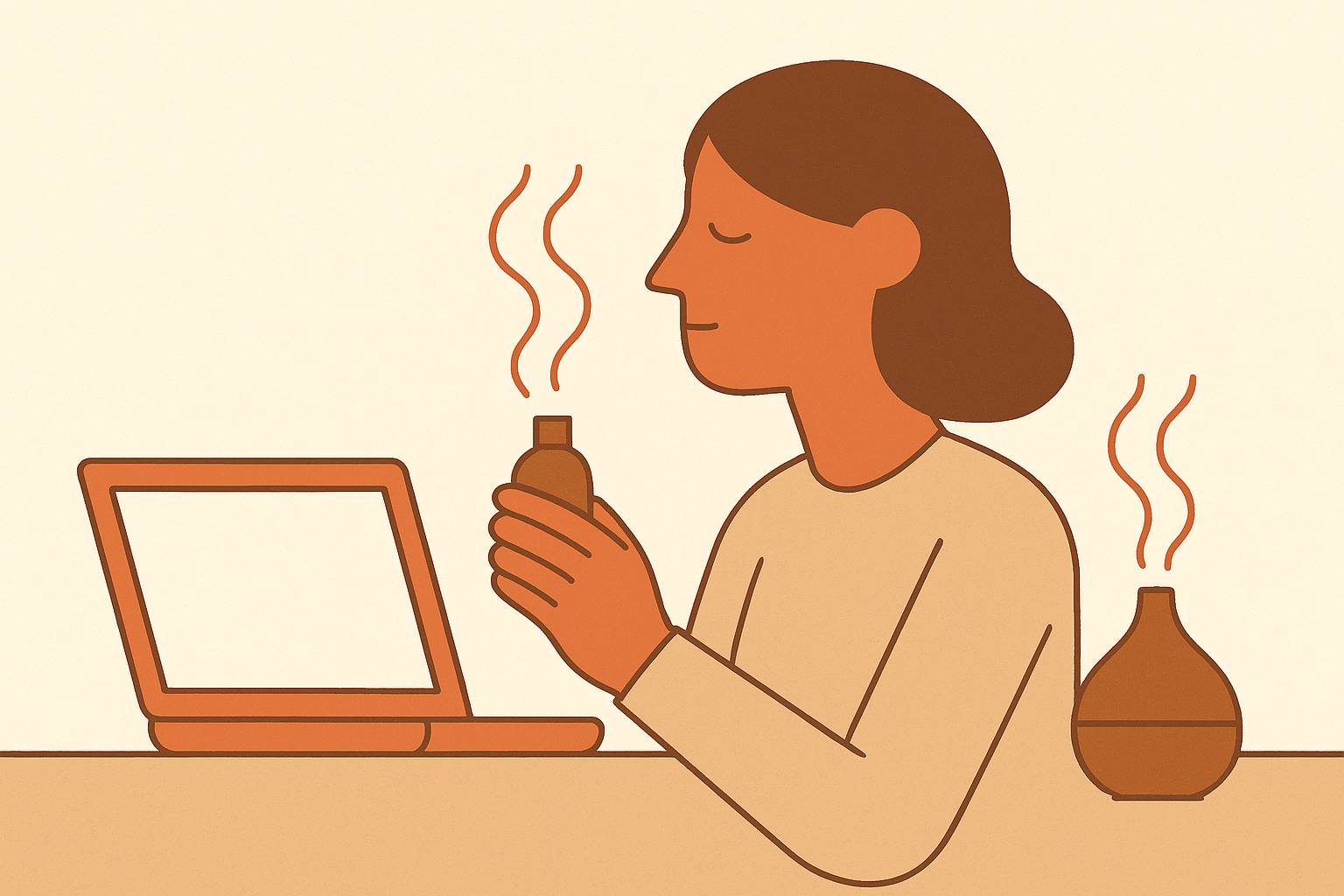
Anyone who's spent time in an office building knows the sequence without thinking about it: commute, badge in, sit down, conference room, out the door at 6, building releases you for the day. That's a chain of environmental cues telling your brain which mode to occupy, and brains lean on that structure more than we like to admit. They want to be told what's next, and that's less independence than the self-help industry would have you believe.
Working from home deletes almost all of it. Desk, couch, kitchen table blur into one undifferentiated smear of "the place where everything happens now." No commute and no lobby means no seam between getting ready to work and working, or between working and being done. People compensate badly, usually one of two ways. They work later because nothing ever tells them to stop, or they drift through the day in a low-grade fog because nothing marked the start of a real focus block either.
This isn't some fringe problem affecting a handful of independent contractors. Of the 2025 Fortune 100 Best Companies to Work For, 97 support remote or hybrid arrangements, so most people wrestling with this are doing it inside large, well-funded organizations, not scrappy startups improvising on folding tables. Calendar blocks, noise-canceling headphones, a second monitor: the usual fixes patch the workflow but do nothing for the sensory blankness of the room itself.
What's missing is an anchor, something that says "this moment is different from the last one" without you deciding it fresh every time. Light and sound can sort of do this, but they're competing with a screen that already owns your attention. Scent has less competition, since it runs in the background and gets processed by a part of the brain that doesn't wait for permission to react.
How the brain processes scent differently from every other sense
Here's the strange part, and it survives a closer look. Vision, sound, and touch all pass through the thalamus first, a relay station that sorts incoming signals before handing them to the parts of the brain that interpret them. Smell skips that step entirely, going straight into the limbic system, the seat of emotion, memory, and motivation, with nothing standing in between.
That's why a smell can drop you back into a room from fifteen years ago before you've consciously registered what you even smelled, while a sound or a sight from the same memory usually takes a beat to land. Research into olfaction suggests aromas improve cognition by interacting directly with brain chemistry, altering the chemistry itself rather than just making a room smell nicer.
That direct route also explains why scent pairs so well with conditioned association. Attach a smell to a mental state consistently enough, and the brain starts producing that state faster every time it meets the smell again. So which part is doing the actual work? Some inherent calming or energizing property baked into the molecule itself, or just the sheer repetition of pairing scent with state until the brain stops asking questions about it?
Both, probably, though repetition carries more of the load than people assume. A scent doesn't need some universal "focus" compound built in at the molecular level. It needs to show up at the same moment, day after day, until your brain stops filing it as background noise and starts reading it as an instruction.
Which scents support focus, which support creativity, and which support recovery
Not every scent does the same job. Lumping it all under "aromatherapy" flattens distinctions that are worth keeping separate, and that flattening is basically how you end up diffusing lavender before a brainstorm and wondering why the room goes sleepy.
For focus and alertness, rosemary and peppermint carry the strongest research behind them. A study in the International Journal of Environmental Research and Public Health found diffusing these two in office settings improved memory recall and alertness by 18 to 20%, with participants reporting less mental fatigue over long tasks. Lemon and citrus track close behind: a separate study diffusing rosemary and lemon together found an 18% improvement in test performance and concentration. Eucalyptus and green tea sit a notch below in intensity, lighter and more clarity-forward, better suited to a long stretch of desk work than to jolting yourself awake before a 9am call.
Creative work wants a different palette, and this is where people usually grab the wrong bottle off the shelf. They reach for the same sharp, high-stimulation scent they use to focus, when warmer, softer profiles do the job better here: light florals, lemon verbena, mild woods, the kind of thing that opens thinking up instead of narrowing it to a point. Grounding scents like cedar, vetiver, and amber are worth skipping during brainstorms specifically because they're built for winding down. Running them in a session meant to generate ideas works against the openness you're chasing.
Recovery gets its own category, and lavender carries the strongest evidence on the list by a wide margin. A randomized controlled trial in Frontiers in Psychology found lavender essential oil cut anxiety symptoms by 32%. Chamomile, oakmoss, and sage show up constantly in "unwind" fragrance families and pair naturally with an end-of-day ritual. Bergamot and ylang-ylang have turned up in clinical aromatherapy research tied to reduced depressive symptoms, useful for a post-meeting reset, or for the close of a long day when your inbox has finally stopped refreshing.
Roughly 80% of fragrance users say scent is essential to their mood, according to industry research. That's a belief people hold, not proof everyone responds to lavender or rosemary identically. Individual associations vary, sometimes for reasons as arbitrary as what a particular kitchen smelled like on a particular Sunday twenty years ago. Your own conditioned responses will end up mattering as much as any general map like the one above.
How to structure a scent routine around the actual shape of a workday
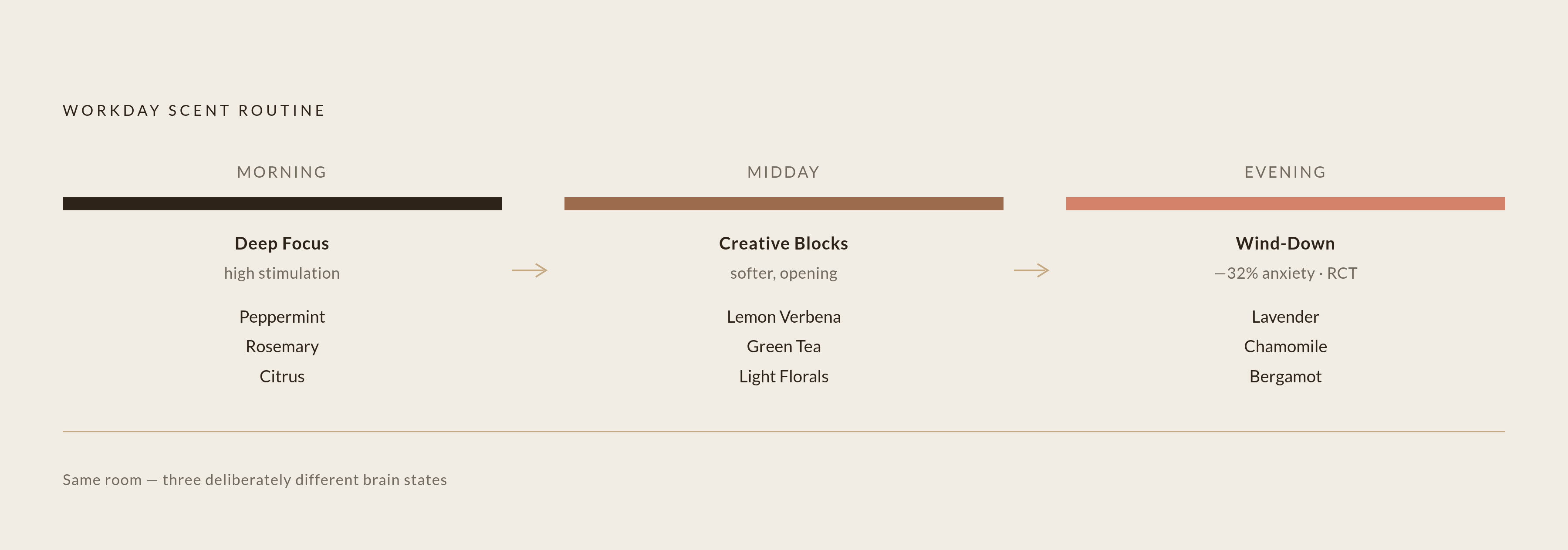
Strip a workday down and you get three phases most WFH people cycle through whether they've bothered naming them or not: deep focus, collaborative or creative output, recovery. Build the routine around that shape, not around the clock on the wall.
Morning ramp-up, the first 60 to 90 minutes, wants something high-stimulation: peppermint, rosemary, citrus. Treat it as the signal that home mode is over, standing in for a commute that no longer exists. During deep focus blocks, consistency beats variety every time. Run the same scent, because the conditioned association strengthens with repetition and gets diluted every time you swap it out because you got bored on a Tuesday.
Midday deserves its own small ritual. A brief diffuser-off window, or a lighter transitional scent like lemon verbena or green tea, works well heading into the afternoon. The contrast between scent-on and scent-off is itself part of the signal, right alongside whatever's actually in the bottle. Late afternoon, when creative work tends to cluster, calls for those softer profiles again: engaging, not overstimulating. At the actual end of the day, lavender, chamomile, or a bergamot blend switched on deliberately signals that work is closing, even though the door in question is just a laptop lid.
None of this works as a one-off. The whole routine runs on repetition, the same scent at the same moment day after day, which is what trains the automatic response described above. Smart scheduling on a cold air diffuser makes this far easier to sustain than manually spinning a dial four times a day; the timing runs on autopilot, and it survives the days you'd otherwise forget entirely.
Why the diffuser setup itself determines whether the scent effect is consistent or wasted
A good scent routine, badly diffused, wastes the oil and the intent behind it both. Concentration trips people up first: too little and there's no effect at all, too much and the scent becomes the very distraction you were trying to eliminate.
Room size solves most of this before it starts. A diffuser rated for a living room floods a small home office, and one rated for a closet does almost nothing in an open-plan space with twelve-foot ceilings. Match the unit's actual coverage rating to the room you sit in, not the square footage of the whole house.
Placement matters more than people expect. Set the diffuser at roughly breathing height, not on the floor, where scent has to fight gravity just to reach your face. Put it near an air current, an HVAC vent or a ceiling fan, so it circulates instead of pooling in one stagnant pocket, but not so close to the draft that it disperses before it builds any presence in the room. Keep it out of direct sun and away from heat, for the oil's sake and the device's, and steer clear of corners, where scent tends to sit and go stale rather than move.
The hardware matters as much as the placement. Cold air diffusion, which disperses fragrance oil without water vapor or heat, solves a few problems at once. Minimal moisture means less risk to electronics, documents, and hardwood surfaces. Minimal heat means the oil's chemical structure stays intact: citrus notes stay bright instead of turning sour, florals stay soft instead of going sharp, woods stay grounded instead of flattening out the way heat-diffused scents tend to over a long session. Nebulizing diffusers built this way also tend to run quietly, which matters more than you'd guess when you're on back-to-back calls for eight hours straight.
On intensity, aim for detectable, not attention-grabbing. If the scent is the first thing you notice when you sit down, the dial's turned up too far.
What to look for in the fragrance oil itself when the goal is cognitive performance
The diffuser is half the equation, and the oil is the other half; a poorly formulated one can quietly undercut everything the research above points toward.
A lot of what gets labeled simply "fragrance" or "parfum" on an ingredient list is shorthand for a mix that can include phthalates, volatile organic compounds, and other synthetic additives affecting indoor air quality without announcing themselves on the bottle. That matters more in a home office than almost anywhere else in the house, since you're sitting in that one room for the better part of eight hours. The EPA notes indoor VOC concentrations run two to five times higher than outdoor levels. Dumping a cheap fragrance source into an already closed, poorly ventilated room compounds a problem that was working against you before the diffuser ever turned on.
Look for transparent ingredient disclosure, minimal phthalates, minimal synthetic musks, and formulations built for continuous inhalation in an enclosed space rather than a quick spritz-and-leave. Vegan and cruelty-free labeling is worth a glance too, less for the label itself and more because that standard tends to travel alongside a more carefully controlled ingredient list generally.
Cold air diffusion adds one more wrinkle. It limits how much the process alters the oil's chemistry during use; minimal combustion, minimal heat, less there to mask a cheaply made oil or sand down its rough edges. What's in the bottle stays close to what ends up in the room. For a routine built on conditioned association, that consistency matters a great deal, since the whole mechanism depends on the scent smelling roughly the same on day 20 as it did on day one. A formulation that drifts or degrades quietly undoes the three weeks you spent building the habit.
Building the routine in practice: a starting framework for the first week
Week one is about calibration. Set up the three-phase pattern of focus, transition, and wind-down, then actually pay attention to what happens when you run it.
Start simple. Measure the home office, confirm the diffuser's coverage rating actually matches that footprint, and pick one focus scent and one wind-down scent distinct enough from each other that your brain clocks the switch immediately. Set intensity toward the low end at first, since turning a dial up later is easy, while clawing back a scent that's already overwhelmed the room is not. If the diffuser schedules, program start and stop times to match the actual workday and let the schedule remove the decision entirely. The routines that survive are the ones that don't ask you to remember anything at 8:47am.
Over the first few days, notice the difference, or the lack of one, between focus blocks with the scent running and without it. Notice whether the wind-down scent produces an actual mood shift or fades into the wallpaper by day three. If the scent seems to fade mid-session, check the airflow before assuming you need more oil; airflow problems get mistaken for concentration problems constantly. Dial down rather than up if the scent starts pulling your attention away from the task instead of toward it. The goal is presence in the room, kept subtle rather than performative.
And if the wind-down scent isn't landing the way lavender's research suggests it should, pair it with a second consistent action: closing the laptop, making tea, whatever fits your evening. That speeds the association along instead of waiting for the scent to carry the whole thing by itself.
Give it two to four weeks of real consistency and the routine starts reinforcing itself. The scent alone starts pulling your brain toward the associated state before the task has even started, the same way walking into a specific coffee shop puts you in "meeting mode" before you've ordered anything. A structured, intentional use of a diffuser, timed to the actual shape of a workday, is what makes the conditioned association reliable over time. Unglamorous conclusion, maybe, but that's usually how the useful ones land.