Morning Scent Rituals for Focus and Energy
Scent conditions your brain to focus faster than caffeine takes effect.
This piece is about building a morning scent ritual that actually does something for your focus and energy, rather than just making your kitchen smell like a candle store. The thesis is simple: fragrance works as a real cognitive tool only when it's the same scent, at the same intensity, delivered by a device that runs on a schedule, not a memory-dependent habit you'll abandon by Thursday.
Hybrid and remote work turned the morning commute into a morning routine you actually have to build yourself. When your kitchen table doubles as your desk, whatever is happening in that room, temperature, light, noise, and yes, smell, is now part of your cognitive environment. Research cited by dsm-firmenich and reported by Elle Cadeaux found that 72% of people appreciate scent more now than they did in 2020, which tells you this isn't a niche interest anymore. It's a broad, post-pandemic recognition that fragrance does something, not just that it smells nice.
How scent signals reach the brain fast enough to matter in the morning
Here's the anatomical quirk that makes this whole idea work: smell has a uniquely direct pathway to the limbic system, bypassing the lengthy relay chains that other senses travel. Sight, sound, touch, taste take longer, more indirect routes before the brain decides what to do with them. Scent arrives at the limbic system, the same neural neighborhood that handles emotion and memory. That's not a minor shortcut. It means the emotional and physiological response to a smell can happen before you've consciously registered what you're smelling.
Research published in the Public Health Policy Journal on aromatherapy backs this up: stimulating the limbic system through scent triggers neurotransmitter release and activates the autonomic nervous system, the part of your body running heart rate, alertness, and arousal without you lifting a finger. Peppermint and ylang-ylang in particular have been shown to increase activity in the amygdala, the region tied to emotional processing and arousal. So when someone says a smell "woke them up," that's not poetry. That's the amygdala doing its job.
Why does this matter for a 7 a.m. routine specifically? Because unlike caffeine, which requires time to metabolize before hitting peak effect, scent doesn't ask you to wait. The response is close to immediate. For a morning where every minute is already accounted for, that's not a small advantage; it's the whole reason this is worth doing at all.
And here's the part that sets up everything else in this article: the limbic system doesn't just handle emotion in the moment, it's also where conditioned responses get encoded. Same system, different job. That overlap is why scent becomes such an effective habit anchor, and it's the mechanism the rest of this piece leans on.
Which fragrances to use and when during a morning
Some might argue that any energizing scent will do the job, citrus is citrus, peppermint is peppermint, just pick one and go. But that treats fragrance like a single dial, loud or quiet, when it actually behaves more like a set of tools, each suited to a different task. Waking up and concentrating are not the same mental state, so the same scent won't serve both equally well.
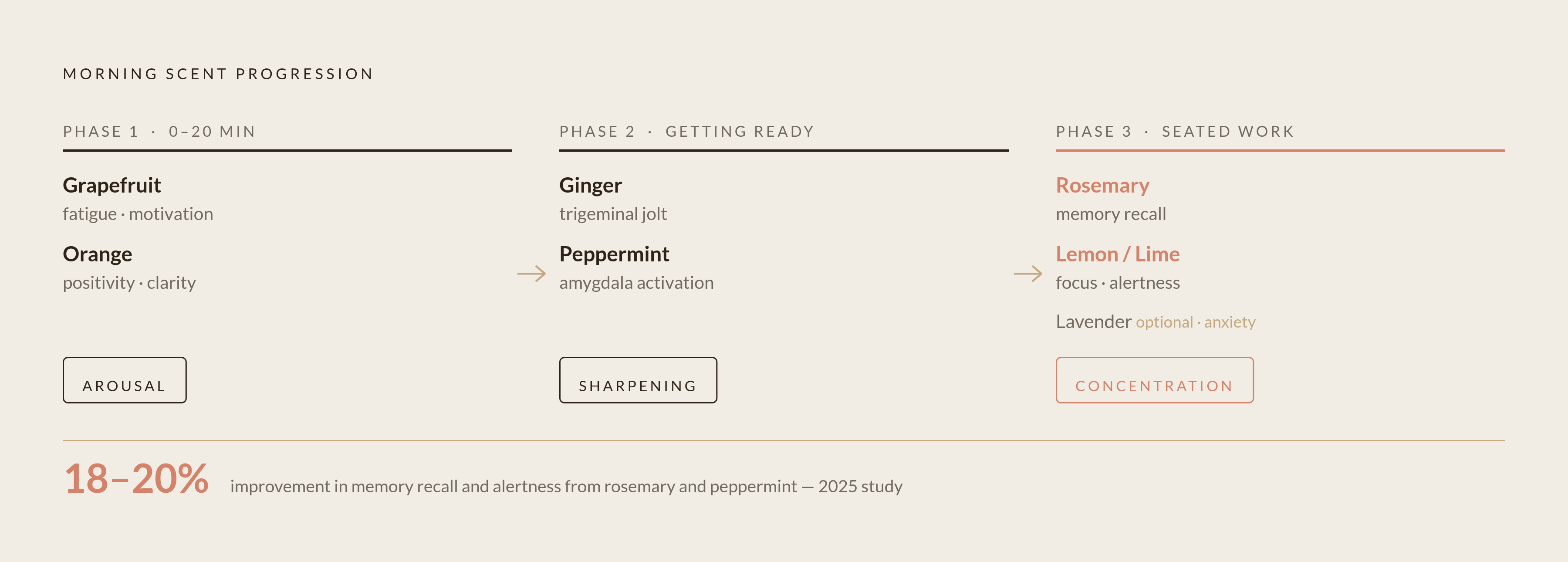
For the first 15 to 20 minutes after waking, the goal is arousal, not focus, and citrus does that job efficiently. Perfumer Elise Benat describes citrus as delivering a "sparkling freshness" that activates the brain quickly. Grapefruit specifically lifts fatigue and boosts motivation, while orange leans toward positivity and mental clarity. You're not trying to solve a spreadsheet problem at this stage. You're trying to convince your nervous system that morning has, in fact, begun.
The transition phase, whatever movement or preparation happens between waking and sitting down at a desk, calls for something sharper. Ginger has a trigeminal effect, meaning it doesn't just trigger olfactory receptors, it also stimulates the nerve that registers sharp physical sensation, the same nerve that reacts to spice in food. That gives ginger an almost physical jolt that citrus alone doesn't produce. Peppermint works alongside it, sharpening attention and, as mentioned above, activating the amygdala.
Then comes the actual work. Rosemary has research behind it specifically for memory and retention; a 2025 study in the International Journal of Environmental Research and Public Health found that diffusing rosemary and peppermint in office settings improved memory recall and alertness by 18 to 20%. Lemon supports clarity and alertness, lime sharpens focus further, and if anxiety or a racing mind interrupts concentration, lavender calms without dulling awareness the way a sedative might.
The scents change by phase, but the mapping itself needs to stay fixed day after day. Swap rosemary for lavender on a whim because you liked how it smelled at a friend's house, and you've reset the clock on the very association you're trying to build. That raises the obvious next question: how long does that association actually take to form, and what breaks it?
How a scent-focus association forms and why consistency is the whole game
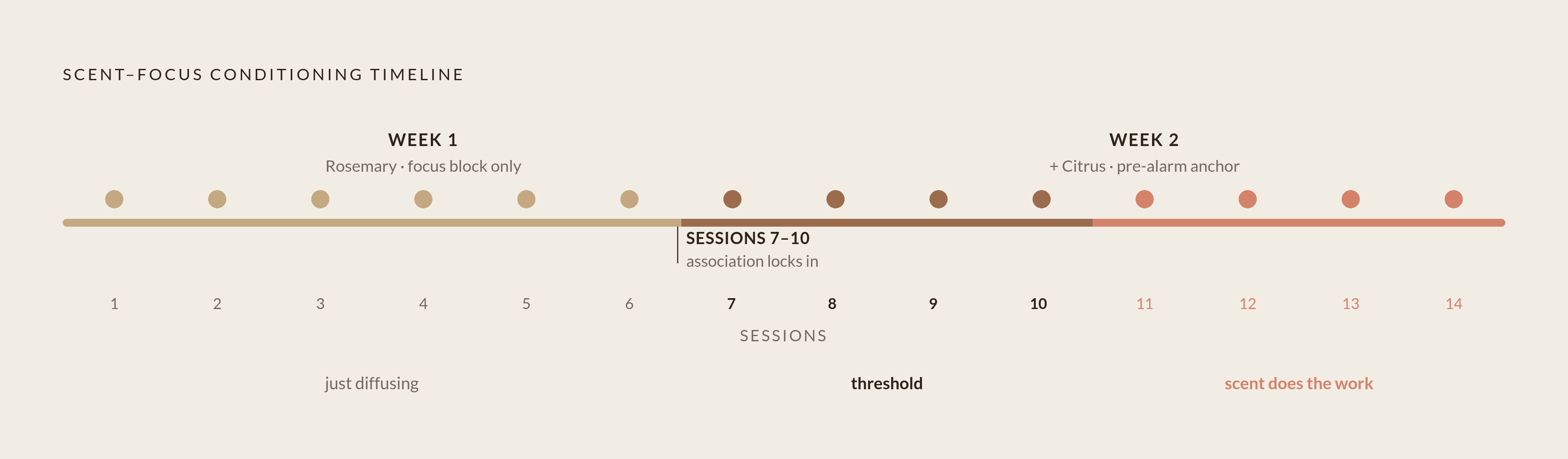
This is classic Pavlovian conditioning, applied to scent instead of a bell. The brain links a scent to a mental state through repetition, full stop. According to Mission Fragrances, it takes roughly 7 to 10 sessions for that scent-focus association to solidify. Not one morning. Not even three. Something closer to two weeks of consistent exposure before the smell itself starts functioning as a switch rather than just a nice background note.
Once that association sets, though, the payoff is real: the scent becomes a cognitive on-ramp, pulling you back into a focused state faster than starting cold. But this only works if the scent stays exclusive to that state. Diffuse your "focus" rosemary blend while binge-watching a show on Saturday night, and you've just told your brain that rosemary means "couch," which is the opposite of what you're going for. The rule is uncomfortable in its simplicity: the more narrowly a scent is tied to one activity, the stronger the cue becomes. Dilute it across contexts and you dilute the effect.
This isn't just a hunch dressed up as neuroscience. Research has cited a Japanese factory floor that introduced lemon scent into the air and reported a meaningful jump in productivity alongside fewer accidents. That's not a spa. That's an industrial floor, running heavy machinery, where scent conditioning moved real safety numbers. If it works there, it can likely survive your kitchen table.
Consistency, though, is where good intentions often falter, mostly because it depends on you remembering to do a small physical task every single morning before your brain is fully online. That is exactly the problem the next section addresses.
Why the delivery method determines whether the ritual actually works
Let's be honest about mornings: they are not a controlled laboratory environment. They are a scramble. So a ritual that depends on you manually lighting a candle, or shaking a spray bottle, or remembering to top off a reed diffuser, is a ritual that's going to get skipped the first week you oversleep by twelve minutes. Friction kills habits, and morning friction is especially costly because there's no slack in the schedule to absorb it.
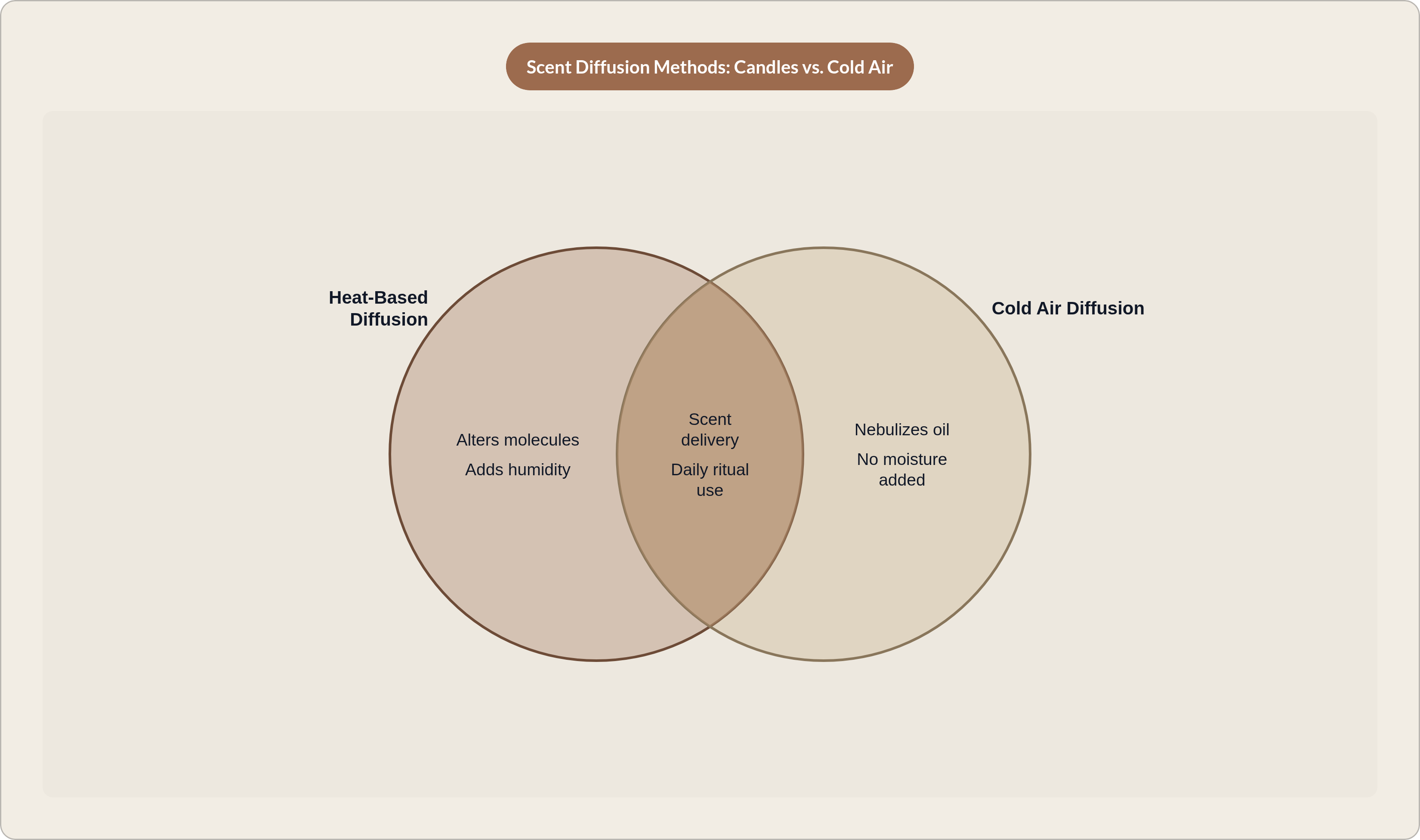
There's also a chemistry problem hiding under the convenience problem. Heat-based diffusion, candles, wax melts, anything involving combustion or a heating element, alters the fragrance molecules before they ever reach your nose. That means the "rosemary" you smell on Monday isn't chemically identical to the "rosemary" you smell on Thursday, which undercuts the whole premise of building a stable association. Water-based ultrasonic diffusers have their own issues: they dilute the oil with water, add humidity to the room, and research has found they release ultrafine particles into the air. None of that is disastrous, but none of it is precise either, and precision is the entire point here.
Cold air diffusion sidesteps most of this. It uses no heat, no water, no combustion, just a mechanical process that nebulizes the oil into extremely fine particles that stay suspended in the air longer and travel further than what you'd get from a candle or plug-in. Because nothing is being heated or diluted, the fragrance that reaches your nose is the fragrance as formulated, not a degraded stand-in for it. Cold air units also tend to cover meaningfully larger spaces than candles, reed diffusers, or ultrasonics, which matters if your "home office" is actually one corner of an open living room.
There's a quieter benefit too, for anyone with hardwood floors, electronics, or artwork nearby: no added moisture in the air. Small detail, but it adds up over months of daily use.
How to schedule a diffuser to match the phases of a morning
The best version of this ritual is the one where you don't have to think about it at all, which means the diffuser needs to start working before you do. Program it to activate 10 to 15 minutes before your alarm, running a citrus blend at low-to-medium intensity, and the scent is already in the air the moment you open your eyes. You're not fumbling for a device at 6:40 a.m. half asleep; the environment has already shifted before you're conscious enough to notice.
From there, the phases stack. During the active morning, movement, stretching, whatever your version of "getting ready" looks like, intensity increases slightly, and if your setup allows for scent-switching or a second unit, this is where ginger or peppermint takes over from citrus. Then, once you're seated and the actual work starts, the blend transitions again to rosemary or a lemon-forward oil, with intensity dialed back to moderate and steady rather than cranked up.
That intensity point deserves its own sentence, because it's counterintuitive: more fragrance is not better. Overpowering a room dulls the senses rather than sharpening them, which is exactly the opposite of what a "focus" scent is supposed to do. Scheduling also happens to save oil, since the diffuser runs only during the phases where it's doing something, not sitting there running at 2 p.m. for no reason.
Some cold-air diffusers build this scheduling and intensity control directly into the device, so each phase gets programmed once and then just runs. That's really the crux of the whole argument: when the same scent shows up at the same intensity at the same time, morning after morning, the conditioning effect compounds on its own. You stop having to try, which is the entire goal of a ritual in the first place.
Room setup and diffuser placement for a home office morning routine
A diffuser sized wrong for its room undoes a lot of the precision described above. Too small a unit in an open-plan space gives you weak, patchy scent that never quite reaches you; too large a unit in a small office produces an overwhelming concentration near your desk.
Placement matters almost as much as sizing. The device should sit at or slightly above desk height, inside what's sometimes called the breathing zone, rather than on the floor or tucked in a far corner where the scent has to travel across the whole room to reach you. Keep it away from direct HVAC airflow too; a vent will scatter the fragrance before it has a chance to concentrate anywhere near your face. In open layouts, central placement beats a corner, since corners quietly shrink the effective coverage area without you noticing until the scent just isn't there anymore.
If your morning spans two rooms, say a bedroom for the waking phase and a home office for the work phase, it's worth running a dedicated diffuser in each rather than hauling one device back and forth. And high ceilings or genuinely open floor plans need higher-output devices, since you're scenting a volume of air, not just a square footage number on a floor plan. Get the sizing and placement right once, and the scheduled phases from the last section arrive at the intended concentration without you fiddling with settings every other day.
Fragrance oil quality and what to look for when selecting oils for a morning ritual
Here's where it's worth slowing down, because this is the ingredient going into your lungs every single morning, potentially for years. According to reporting from the Environmental Working Group, synthetic fragrance formulations can contain a mixture of up to 3,500 chemicals, and a lot of that formulation isn't disclosed on the label at all. That's simply how fragrance regulation works in most places: "fragrance" can legally hide a lot.
There's a specific chemistry concern for daily diffuser use, too. Volatile organic compounds from synthetic fragrances can react with indoor ozone to form secondary pollutants, including formaldehyde, and that's a more relevant concern in a closed home office running a diffuser five mornings a week than it would be for the occasional scented candle.
So what should you actually look for? Transparent ingredient disclosure, first, since a brand willing to list what's in the bottle is telling you something about how confident it is in that formulation. Phthalate-free and paraben-free matters too, along with vegan and cruelty-free sourcing, and ideally something tested safe around both people and pets, since most home offices double as a dog's favorite nap spot. The EWG Verified standard is a useful shortcut here, because brands meeting it are required to disclose full ingredient lists and avoid known hazardous substances.
This loops back to the delivery mechanism from earlier: cold-air diffusion preserves the oil's molecular structure, so the scent your brain is being conditioned to associate with focus is the actual formulated fragrance, not some heat-altered variant of it. Quality oil and precise delivery aren't two separate concerns; they're the same concern, viewed from two angles.
Building the ritual in practice: a starting framework for the first two weeks
So, where does someone actually start? Given that the conditioning window sits around 7 to 10 sessions, two weeks of consistent morning use is enough to get the first association off the ground, assuming you don't skip half the mornings.
Week one, keep it simple: one scent, one phase. Pick a rosemary or lemon-forward oil, run the diffuser only during your focused work block, same time every morning, moderate intensity, no variation. Resist the urge to add the citrus waking phase right away; layering too much too soon just muddies which scent is doing what.
Week two, bring in the waking phase. Add a citrus blend on a pre-alarm schedule, and now you've got two distinct scents anchoring two distinct mental states, waking and working, each running on its own clock. The rule from earlier still applies without exception: don't let the work-phase scent bleed into evenings, weekends, or downtime, or you'll spend another two weeks rebuilding the association you just made.
A simple gut check tells you whether it's working: does the scent itself now feel like a cue to start working, before you've even opened your laptop? If the answer is yes, the association has taken hold, and you're free to expand from there, a third phase, a seasonal rotation, maybe a travel-sized diffuser so the ritual survives a week at a hotel. The whole setup costs a device, a bottle of oil, and a bit of patience up front. After that, it runs itself, which is really the only reason a habit like this survives past the second week of January.