Morning Scent Rituals That Support a Productivity Routine
Scent triggers focus faster than any other sense, neuroscience shows.
Fragrance stopped being decoration a while back. Statista's fragrance industry research puts it at 80% of users who now treat scent as essential to mood, and 72% say they appreciate scents more in 2024 than they did in 2020. The Global Wellness Summit has a name for this: "functional fragrance," scent chosen for what it does to your head as much as how it makes your living room smell. Morning is where that idea gets tested hardest. Whatever state your brain lands in around 7am tends to write the rough draft for everything that follows.
How scent signals reach the brain faster than almost any other stimulus
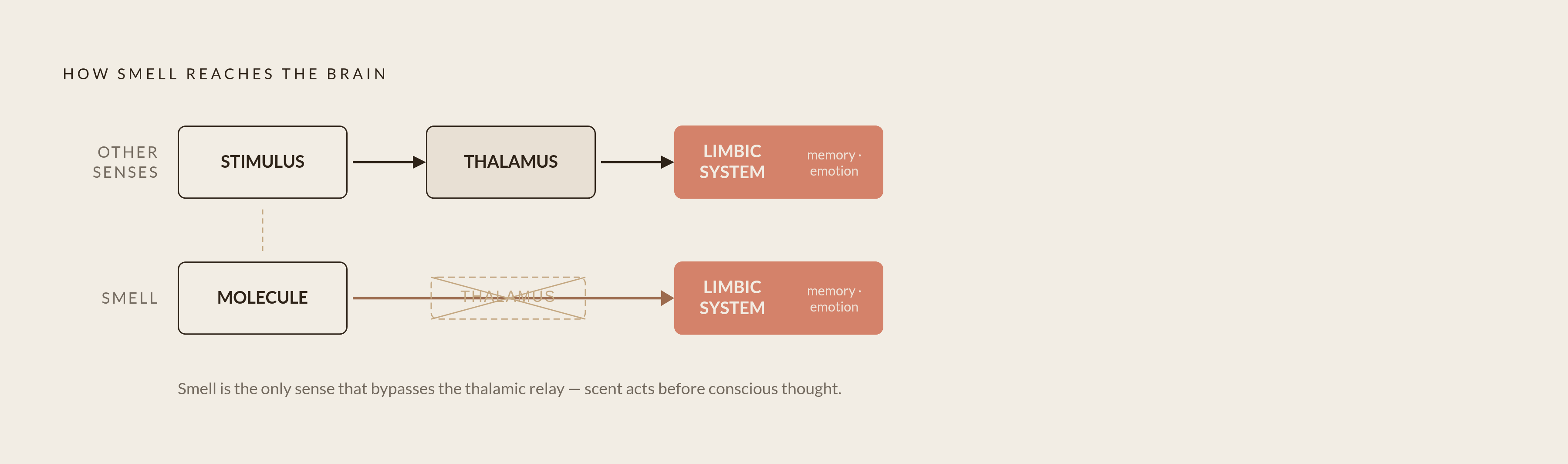
Every other sense makes a pit stop at the thalamus, the brain's sorting station, before the information gets passed along. Smell skips that step entirely. Olfactory signals go straight into the limbic system, the same territory that handles memory, emotion, and arousal, and they land there almost the instant a molecule hits your nasal receptors.
That's real neuroscience, grounded in documented research. Research on aromatherapy documents that essential oils act on the nasal-brain pathway in a way that bypasses the blood-brain barrier entirely, reaching the cerebral cortex, thalamus, and limbic system through inhalation alone; no digestion, no injection, no middleman. Research on odour and cognition lands on a practical point: odour environments shape cognitive efficiency both directly and through emotion. Translate that out of academic-speak and you get something like this: scent acts before your groggy Monday brain has voted on whether it's on board with the plan. Music needs your ears to parse rhythm. Light needs your eyes to register brightness and adjust your circadian signaling. Scent needs nothing from you at all.
What the research actually shows about scent and cognitive performance
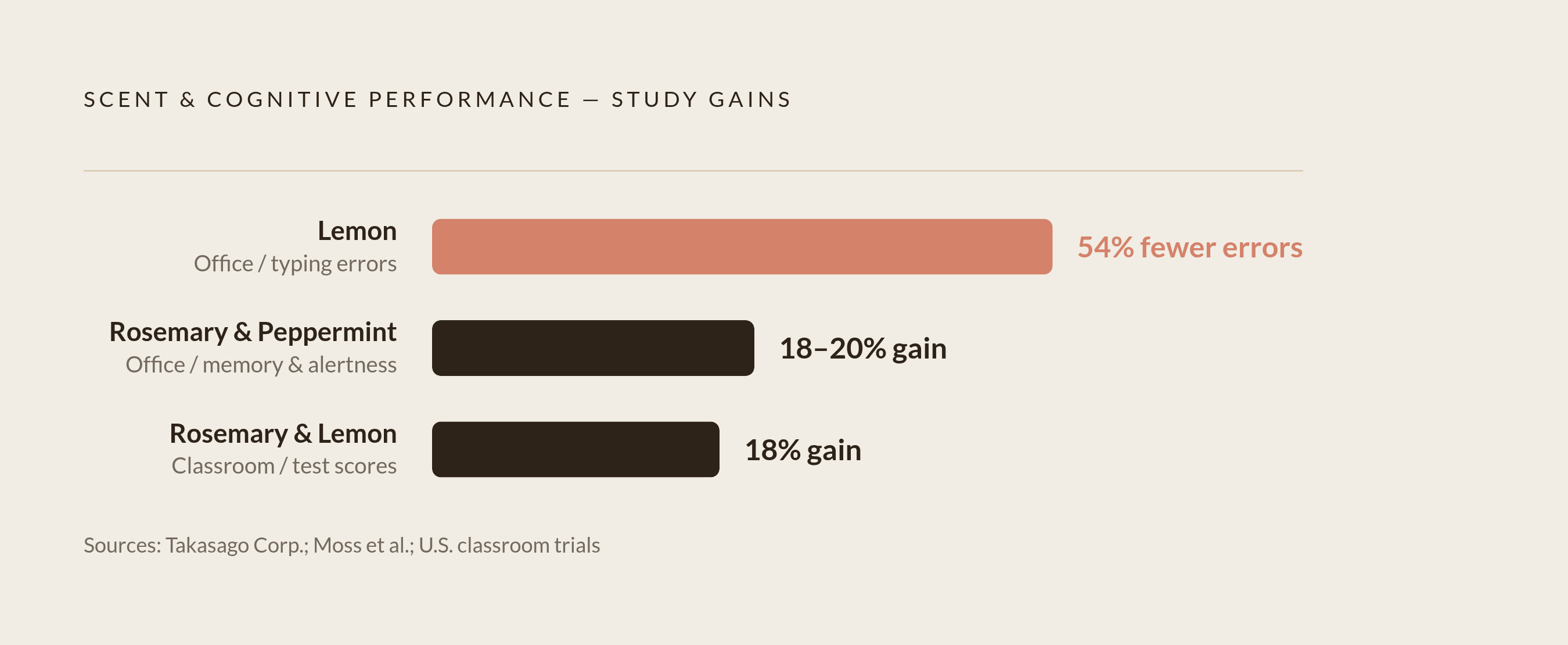
The headline number is hard to ignore. A study in the International Journal of Environmental Research and Public Health found that diffusing rosemary and peppermint in office settings improved memory recall and alertness by 18 to 20%, with participants reporting less mental fatigue over long tasks. Two cheap, unglamorous aromatics from the grocery store, moving a real number.
Lemon has its own file. A Takasago study found office workers made 54% fewer typing errors in a lemon-scented room, and a separate educational trial found rosemary and lemon diffused in U.S. high school classrooms produced an 18% bump in test performance and concentration. Even coffee aroma alone, no actual coffee involved, has been shown to raise physiological arousal and sharpen analytical reasoning.
What ties these together is dosage. The gains show up at low, steady exposure, well short of flooding a room until it smells overwhelming. So what's missing from the picture? Mostly the leap from lab to your actual kitchen counter. These studies happen in classrooms and offices with managed airflow and minimal competing smells, conditions your house does not share with a research lab. That's exactly why delivery method, which gets its own section further down, ends up mattering nearly as much as the fragrance itself.
The fragrances most consistently linked to alertness, clarity, and focus
Rosemary and peppermint are still the best-documented pair, on the strength of that 18 to 20% figure, and they're a reasonable default if you're starting your first ritual from zero. Lemon and other citrus notes carry the precision angle, useful for detail-heavy, analytical work and less useful for open-ended creative thinking, where you actually want your brain to wander a little.
Jasmine sits somewhere else entirely. Research links it to improved sleep efficiency and reduced nighttime wakefulness, which makes it a better match for mornings that start tense rather than mornings that start slow and foggy. Juniper splits the difference between the sharp aromatics and the calming ones: mental spaciousness without the nose-clearing jolt of peppermint or eucalyptus, for anyone who finds those a bit much before 8am. Vetiver is often described as going the opposite direction entirely, grounding instead of energizing, better suited to a long deep-focus stretch than a quick sprint through your inbox.
Coffee aroma deserves a mention too, mostly because it's the one fragrance most home offices already have sitting in a bag on the counter. None of these are interchangeable. The whole exercise is matching fragrance to the kind of cognitive work the morning actually demands, weighed against whatever smells nicest at the store that week.
How conditioned scent associations turn a fragrance into a mental trigger
The limbic system doesn't just react to scent in the moment; it files scent away alongside context, the same mechanism that makes a whiff of sunscreen drag you back to a specific summer you hadn't thought about in a decade. Pair a scent with a specific task, over and over, and the brain starts treating it as a cue: this smell means it's time to focus.
That's classical conditioning, plain and simple, pointed at a mental state instead of a bell and a dog. The practical rule follows directly. The scent you use for focused work on Monday has to be the scent you use for focused work on Tuesday, and every day after that. Swap it around too often and you dilute the exact association you're trying to build.
There's a flip side, though. Rotating scents between different activities, morning focus versus evening wind-down, actually strengthens the system, because each scent becomes its own distinct signal rather than a vague background presence your brain doesn't bother registering. The ritual itself becomes part of the cue too. The click of the diffuser switching on carries almost as much weight as the fragrance riding along with it.
Why intensity and timing undermine most people's attempts at scent rituals
More is not better here, and this is exactly where most scent rituals quietly fall apart. Once a fragrance is strong enough to demand conscious attention, it stops functioning as a background state-shifter and starts pulling focus as a distraction. Worse, olfactory adaptation happens fast: your brain habituates to a constant scent signal within minutes, so a diffuser running full blast all morning is actually less effective than a short, low-intensity session would be.
Timing makes it worse. A scent introduced before you sit down primes the brain for what's coming. A scent that's already saturating the room when you stumble out of bed half-asleep has far less anchoring power, since there's no clear "before" for it to signal against. Candles and room sprays fumble this in their own particular way: an initial burst, a fast fade, and, in the case of candles, combustion byproducts that have nothing to do with cognitive clarity and everything to do with soot on your ceiling.
Ask most people why their scent ritual fizzled and the honest answer is rarely about the fragrance itself. Usually they forgot to light it, oversaturated the room, or the smell faded before the actual ritual moment arrived. The fragrance chemistry tends to hold up fine. The habit around it is the weak link.
Why cold air diffusion delivers the most consistent and repeatable scent for a ritual
This is the mechanical fix for the timing and intensity mess above, and it comes down to how the fragrance actually gets into the air in the first place. Cold air diffusion atomizes fragrance oil into micro-particles without heat or water, which keeps the molecular structure of the scent compounds intact instead of cooking them before they ever reach your nose.
Without water, there's no dilution curve to fight: no hot burst at minute one followed by a fade twenty minutes later, just steady concentration from start to finish. Without heat, there's no combustion byproducts and no VOC risk from oil that's essentially simmering on low the entire session. A good waterless cold-air diffuser also runs at a genuinely low, steady output, a background presence that happens to be exactly the register this whole ritual depends on.
Coverage should scale with the room, not the other way around. Matching diffuser output to square footage is a five-minute calculation worth doing before you park the thing on a shelf and forget it exists. The oil matters just as much as the mechanism: clean, transparent, vegan formulations skip the synthetic VOCs that would undercut the exact clarity you're trying to build in the first place.
How a scheduled diffuser makes the ritual automatic rather than effortful
A ritual that needs a fresh decision every single morning is competing against inertia, grogginess, and whatever your phone is trying to tell you before your eyes are even open. That's a fight worth taking off your plate entirely.
Scheduling removes the decision. A cold air diffuser with a built-in timer means the scent shows up before you've had to remember anything at all, firing at the same time each day whether you're awake enough to care or not. A decent rule of thumb: schedule the session to start 5 to 10 minutes before your intended focus period, long enough to prime the room, not so early that the scent's already drifted off by the time you sit down. Intensity controls let you dial in the minimum level that still registers, enough to trigger the association without competing with your actual work for attention.
Scheduling also solves the habituation problem from a couple sections back, since a timed session ends before your nose goes numb to it, protecting both the effect and your oil supply. There's a bonus for anyone running a split schedule too. A 7am analytical block and a 9am creative block can each get their own scent and timing profile, reinforcing two separate mental states instead of one blurry one.
Where to place a diffuser to support a morning focus routine
Placement decides whether the same fragrance reads as too faint or too much, and it's the variable people think about least, right up until the ritual quietly stops working and nobody can figure out why. For a desk setup, put the diffuser at counter or desk height, on the same side of the room as the dominant airflow, ideally beside or behind the workstation rather than clear across the room where the scent has to travel through half your furniture first.
Skip the spot directly under a vent, next to a fan, or beside a window that's going to carry the scent outside before it reaches your actual breathing zone. If your ritual involves walking from bedroom to home office, the diffuser belongs in the office, keeping the scent tied to focus rather than to waking up or falling back asleep. Room size matters more than people expect, too. A diffuser sized for a small guest room won't register at all in an open-plan living space, so output needs to match square footage, not just wherever the device looks nicest sitting.
One more thing worth remembering: elevated placement, at desk height or slightly above, spreads those micro-particles more evenly than floor level does, especially in a room without much natural airflow to help things along.
Choosing a fragrance oil that is safe to diffuse every morning without accumulating risk
Daily inhalation at close range is a different standard than the occasional lit candle at a dinner party. It deserves to be treated like one. The Natural Resources Defense Council found phthalates in 86% of tested air fresheners, a number that lands differently once you're planning to breathe something in every morning for the next six months. Indoor VOC concentrations can run up to 10 times higher than outdoor levels, and a poorly formulated oil, diffused daily in a small home office, compounds that problem instead of diluting it away.
What separates a safe daily oil from a risky one comes down to disclosure. Look for full ingredient transparency, no vague catch-all "fragrance" hiding an undisclosed blend of who-knows-what, and formulations free of known endocrine disruptors. Vegan and cruelty-free labeling matters as an ethics checkbox in its own right, and it tends to correlate with something else. Brands willing to be upfront about animal testing tend to be upfront about chemical composition too, and those two habits tend to travel together.
If there's a cat, dog, or small kid in the room during your morning ritual, the bar climbs higher still, since some oils genuinely good for human focus are harmful to pets even at low concentrations. Point blank: you want a fragrance oil you could diffuse every morning indefinitely without slowly stacking up a chemical burden you never signed up for. That takes actually reading the label, checking the ingredient list line by line rather than trusting a clean font and the word "natural" printed somewhere on the packaging.
Building a morning scent ritual that holds up over weeks, not just the first few days
Week one is easy. Anyone can remember to hit a button for five straight days while the novelty's still fresh. Week three is the real test, the point where the ritual either goes automatic or quietly evaporates, and that's the week actually worth designing for.
Consistency beats variety early on. Resist the urge to rotate scents before the conditioned association has had time to set, which the conditioning section above puts at a few weeks of steady pairing. Once that anchor holds, a second scent for a different morning mode can get layered in without undoing the first. It deepens the ritual instead of resetting it to zero.
Scheduling handles the decision fatigue, clean oil handles the health question, and correct placement handles the inconsistency that kills most attempts before they get a fair shot. Each variable you remove is one less excuse for the whole thing to collapse around week two, which is coincidentally when a lot of other new habits quietly fall apart too. The signal to rotate scents should be habituation, not the calendar. If the fragrance stops registering consciously, that's your cue to cycle in something complementary for a week, not proof the whole idea failed.
This ritual gets stronger the longer it runs, gaining ground rather than wearing thin. Every morning the scent fires alongside real focused work, the brain shifts state faster and more reliably the next time that scent shows up. It doesn't ask for much either, a timer, a clean oil, a diffuser sitting where your nose actually is, and the rest just keeps compounding on its own.