Scents That Are Safe for Both Cats and Dogs
Cats and dogs metabolize scents differently, so identical diffusers create opposite outcomes.
My cat spent forty minutes rubbing her face against a diffuser last winter, which tells you nothing about diffusers and everything about cats. But it's the reason I started actually reading the backs of these bottles instead of just liking the smell and moving on. Dogs and cats process scent through different plumbing, and "pet-safe" isn't the clean label the industry wants it to be. Get the ingredients wrong, or the delivery method wrong, or the room setup wrong, and you're the one explaining to an emergency vet at 11pm why the living room smelled so nice an hour ago.
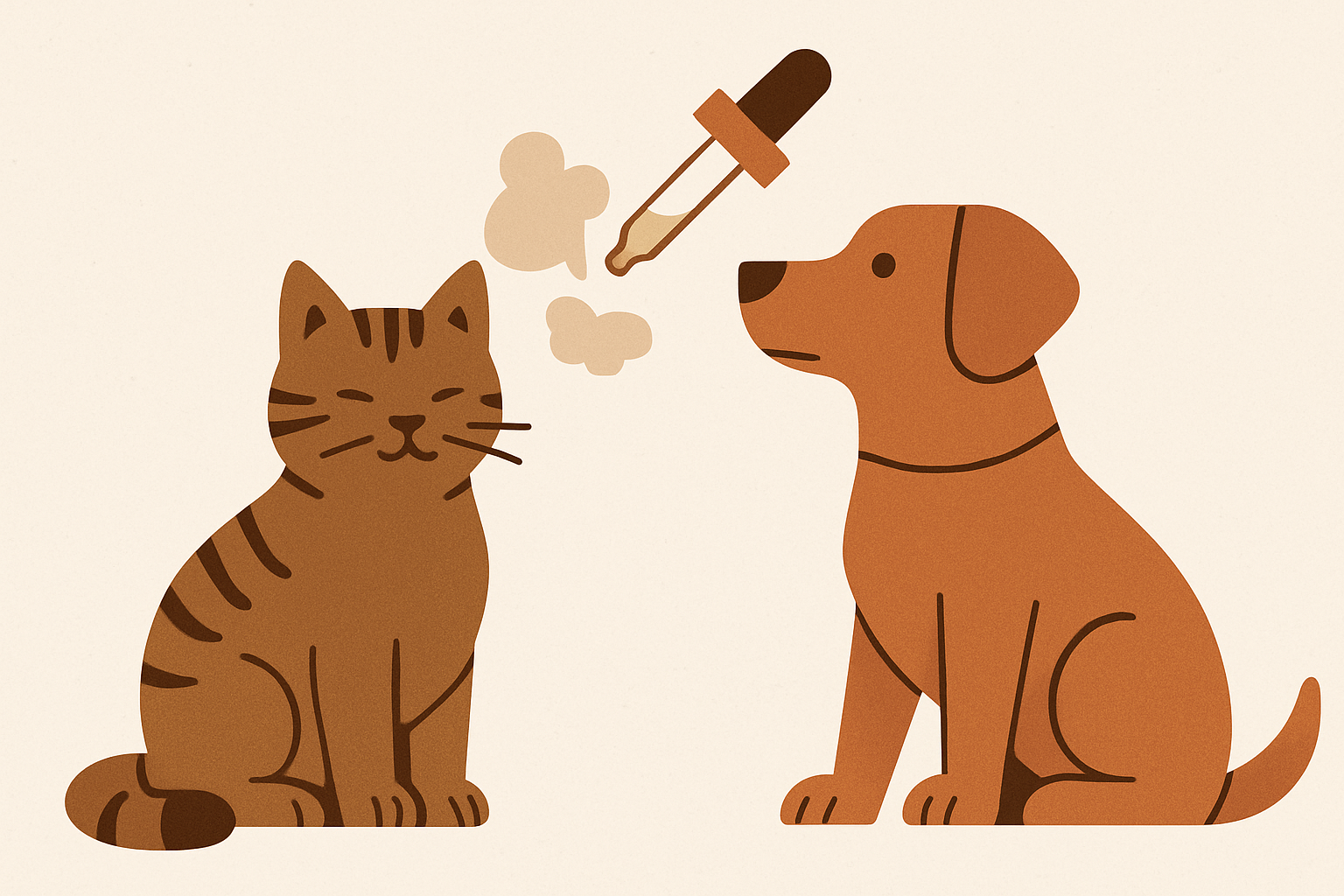
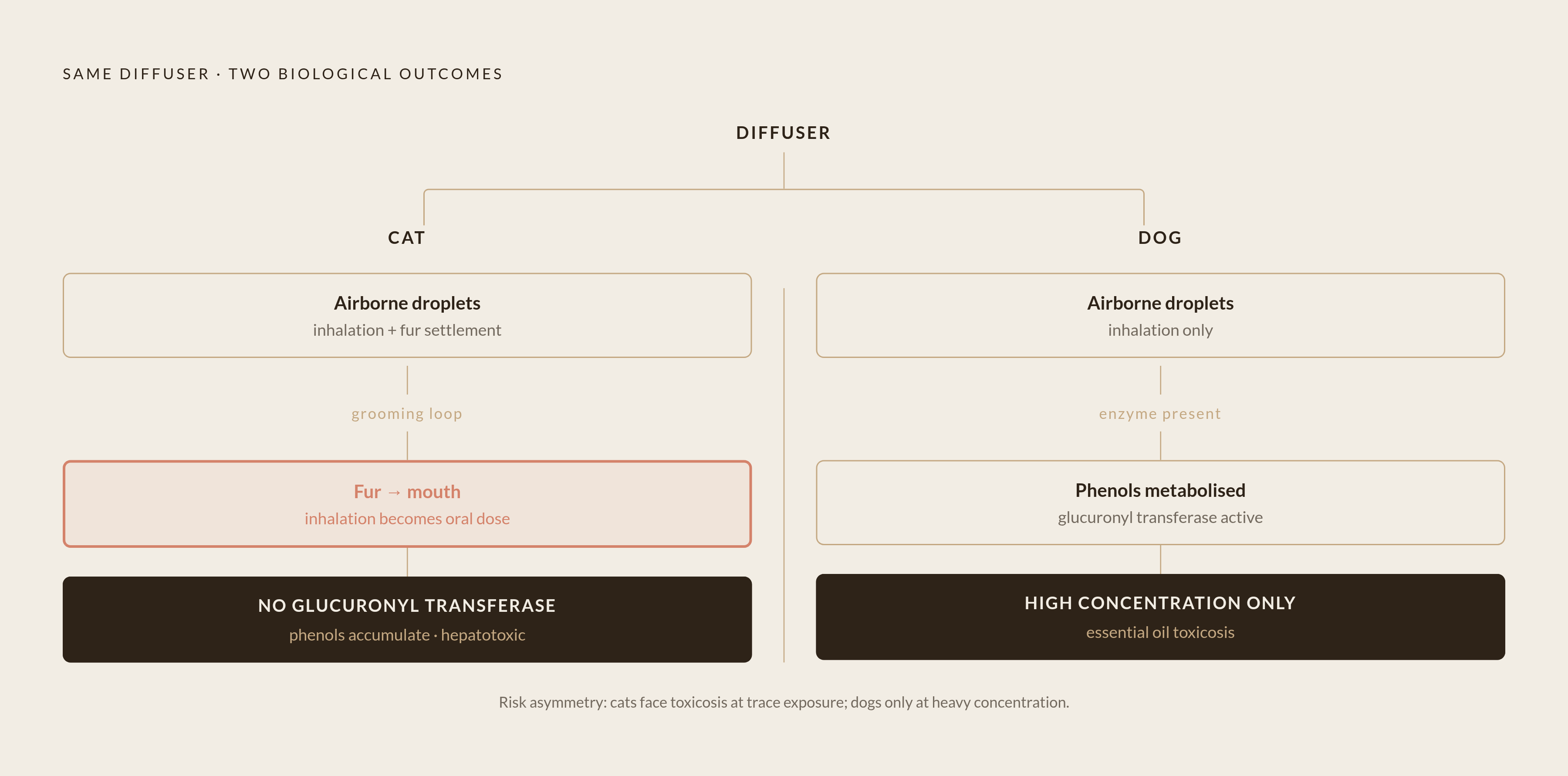
Dogs supposedly smell somewhere between 10,000 and 100,000 times better than we do, depending on which study you trust, and cats aren't far behind. Neither species reads the label on the oil bottle, so the burden sits entirely with the person holding it. There's a bigger issue than the nose, though: an enzyme called glucuronyl transferase, which cats don't produce in meaningful amounts. That enzyme is what breaks down phenols in dogs and in us. Take it away and a cat in a room with phenol-heavy oil just can't clear the compound, so identical air from an identical diffuser produces two totally different outcomes depending on which animal is breathing it.
Grooming complicates things further, and only for cats. Airborne droplets settle on fur, cats lick the fur clean, and now you've stacked ingestion on top of inhalation. Something that was mildly irritating to the nose becomes a direct oral dose an hour later at bath time. Dogs sidestep that particular trap since they've got the enzyme cats lack, though heavy concentrations can still cause essential oil toxicosis in dogs too. Two species, two different failure points, same living room, same diffuser.
Zoetis vets have noted that peer-reviewed research on essential oil safety in pets is thinner than you'd expect for a product category this common. So this piece walks through what does exist: which ingredients are outright poison, which ones are fine under specific conditions, how the diffuser itself changes the math, and what a genuinely clean fragrance oil looks like versus one just marketed that way.
Ingredients that are toxic to one or both species and must be kept out of the home entirely
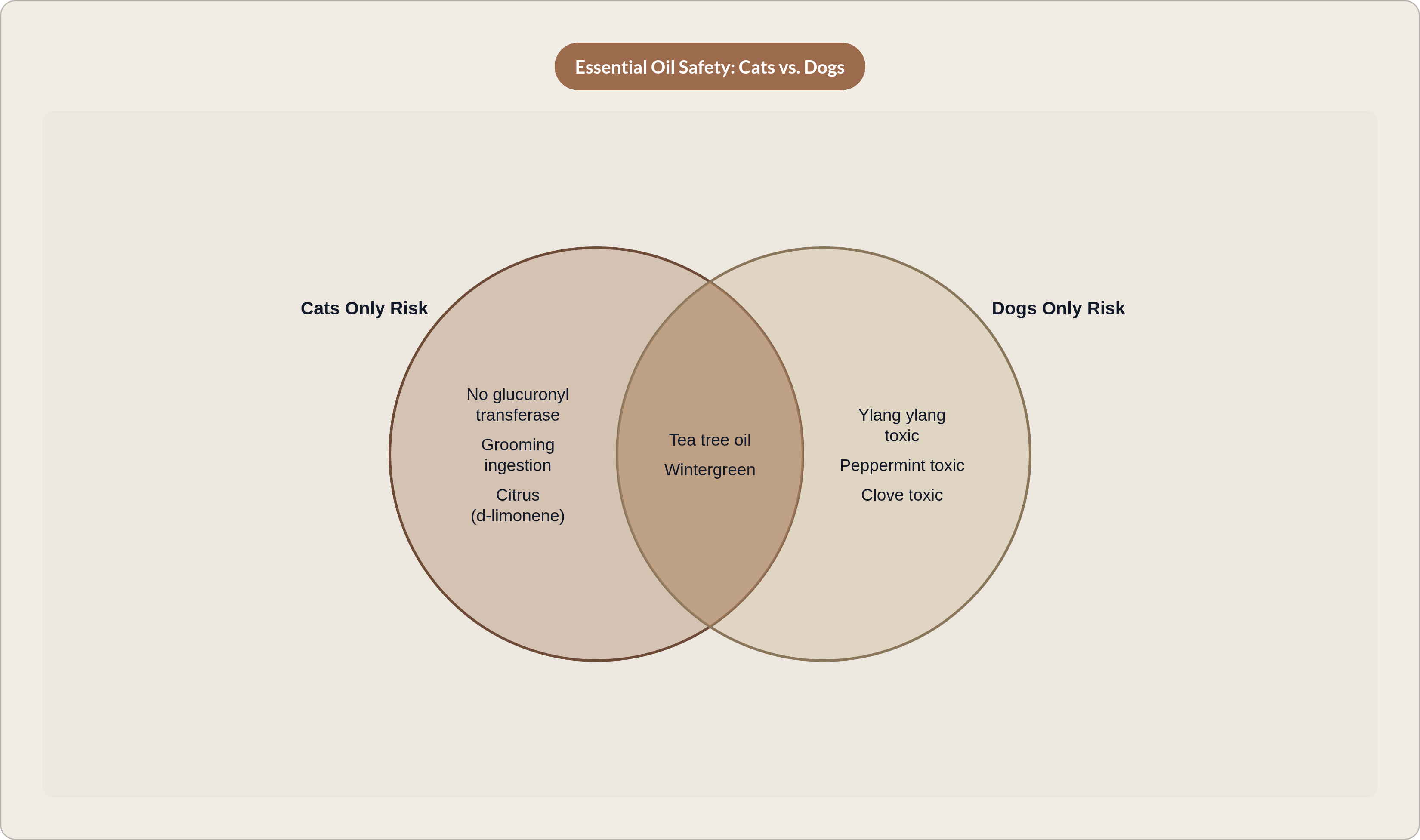
This isn't a call-your-vet-if-worried list. It's a keep-it-out-of-the-house list. Toxic to cats: wintergreen, sweet birch, citrus oils (specifically d-limonene), pine, ylang ylang, peppermint, cinnamon, pennyroyal, clove, eucalyptus, tea tree. Toxic to dogs: wintergreen, sweet birch, pine, cinnamon, pennyroyal, eucalyptus, tea tree. Notice how much overlap there is. Most of these aren't a one-species problem where the "hardier" animal gets a pass.
Tea tree, or melaleuca on an ingredient label, deserves its own paragraph because the data is specific and honestly a little grim. A ten-year study running from 2002 to 2012 found that 7 or 8 drops of concentrated tea tree oil caused drooling, lethargy, loss of motor control, and tremors in exposed animals. Seven or eight drops. That's the kind of splash most people wouldn't think twice about pouring into a diffuser reservoir, and it's exactly why every credible warning list in this space puts tea tree near the top.
Liquid potpourri is the sneaky one. It sits on shelves next to candles and room sprays, gets marketed like any other harmless home fragrance product, and carries a lot of the same toxic load as concentrated essential oil, minus the label that would make anyone pause. If tea tree oil wouldn't go within ten feet of your cat's favorite windowsill, a simmer pot of liquid potpourri has no business running in the same house.
Exposure happens three ways: inhalation, skin contact, and ingestion through grooming, and an animal can rack up more than one in a single evening. Symptoms track with dose. Mild cases show drooling, vomiting, skin irritation. Moderate cases bring ataxia (vets use the term for that wobbly, unsteady gait), plus low blood pressure, low heart rate, low body temperature. Severe cases go to tremors, seizures, respiratory distress, rear limb paralysis, or liver and kidney failure. If any of that shows up after a scented product's been running, call the ASPCA Animal Poison Control Center at 1-888-426-4435. Save the number now, before you need it at midnight with shaking hands.
Some oils just don't get to exist in a house with a dog or cat in it. Full stop, no negotiation.
Scents that both cats and dogs generally tolerate, and the conditions that make them safer
That heading is carrying a lot of weight on the word "generally." Dilution, ventilation, how long the session runs, and the particular animal's own sensitivities decide whether something on this list stays fine or turns into a Tuesday night emergency. Read it as a shorter, gentler menu that still needs supervision, a list that calls for caution rather than a green light to run full-strength oil in a sealed room and go to bed.
Lavender gets cited constantly for its calming effect during storms or car rides, though concentration is still doing most of the work behind that reputation. Chamomile is milder and often the safest pick for a house running both species at once. Frankincense grounds a room without overwhelming it, at least at low concentration. Cedarwood works for cats, but only heavily diluted and only for short windows, never left running all day while everyone's out at work. Ginger seems to ease nausea in dogs specifically through diffusion, not through direct skin contact or food. Myrrh is warm and resinous; cats should meet it only from a distance, while dogs tend to sit through short sessions without complaint.
A 2022 study in the journal Animals found dogs actively engaged with certain scents, blueberry, blackberry, mint, rose, lavender, and linalool among them, showing real interest rather than mere tolerance. That's preference, distinct from a mere absence of a bad reaction, and it only held at the right concentration.
For topical use, meaning a paw balm or a diluted spot on bedding, most sources land on 4 to 5 drops of essential oil per 10 ml of carrier oil, whether that's coconut, olive, or jojoba. That number applies to skin contact and shouldn't happen without a vet's sign-off first. The gentler tolerance described above is about diffused exposure from a few feet away, a different scenario from concentrated drops on fur or a closed bathroom.
One more wrinkle. A cat and dog sharing a house can respond to the exact same oil in opposite ways, even something off this friendlier list. Introduce anything new slowly, watch behavior over a few sessions, and don't assume the dog's calm nap means the cat's fine with it too.
How the method of diffusion changes the risk level for pets, regardless of which oil is used
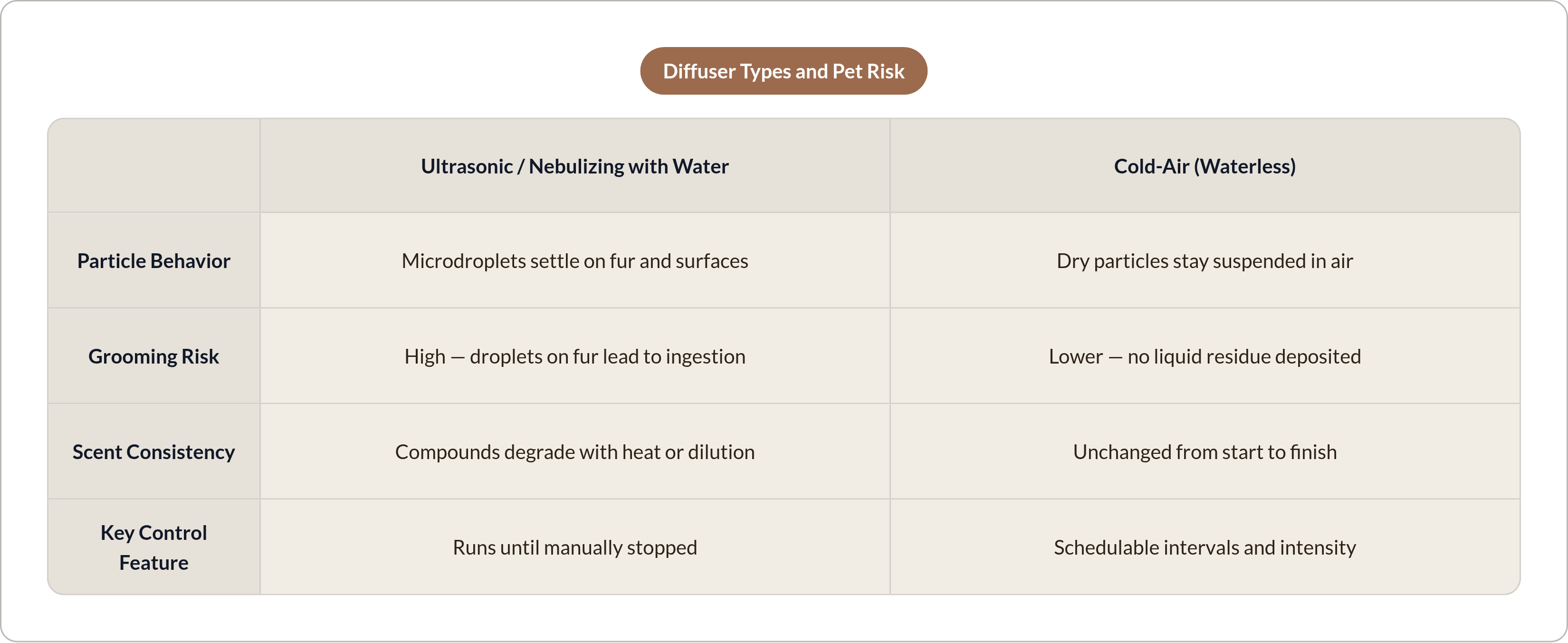
This is where careful oil selection goes to waste. Someone picks something genuinely safe, then runs it through equipment that undoes the whole decision in about twenty minutes. Ultrasonic diffusers and nebulizers that use water emit microdroplets that settle onto fur, and onto feathers if there's a bird in the house too. That's the grooming-ingestion problem from earlier, except now it's the appliance itself delivering the double exposure.
Run any diffuser too long in a small, closed-off room and you're looking at respiratory distress or aspiration pneumonia as real possibilities, regardless of what's in the tank. The room becomes the hazard right alongside the oil. VCA Animal Hospitals takes the strictest position out there, recommending owners skip scented oil diffusion altogether, even products marketed as pet-safe, on the logic that adverse reactions stay possible no matter what the label claims.
Fair position. But if diffusion is happening anyway, the technology matters enormously. Cold-air diffusion, meaning nebulizing without water or heat, works differently from the ultrasonic units most people picture. It breaks fragrance oil into dry, microscopic particles, roughly 0.1 to 5 microns, that stay suspended in the air rather than raining down onto fur or furniture. No water reservoir means no standing water growing bacteria in the corner of your living room, and no heat means the fragrance compounds aren't cooking the whole time they're being released. The scent at minute five is the same scent at minute thirty, not some degraded version of it.
A 2024 study on pet-safe aromatherapy devices found waterless diffusers releasing particles at or under 10 microns kept the oil's properties intact without overwhelming the animals in the room. The vets involved kept coming back to purity and control. Purity, because nothing's diluting or degrading along the way. Control, because the owner decides the runtime instead of a machine humming along until someone remembers to check on it three hours later.
Scheduling matters here too, meaning the ability to run a diffuser in set intervals instead of continuously. That hands the concentration decision back to a person, not an appliance left on autopilot. Cold-air diffusers work this way: waterless, heat-free, with scheduling controls that let you set duration and intensity for whichever room your cat or dog actually lives in. The 30-minute window that keeps showing up across veterinary sources isn't arbitrary; it fits naturally into a rotation, thirty minutes on, a stretch off, rather than running nonstop from breakfast until bedtime.
Room setup and placement decisions that protect pets even when using safer scents and diffuser technology
Every credible source agrees on one rule, and it's the one real households skip constantly: pets need a clear way out of any room with a diffuser going. An animal that can't leave can't self-regulate its own exposure, and that single fact separates a low-risk setup from a genuinely dangerous one. Oil purity and diffuser sophistication stop mattering much if the door's shut and the cat's stuck in there with nowhere to go.
Ventilation comes next on the list. Open windows, general airflow, even a door left ajar, all of it dilutes how concentrated the scent gets at breathing height and shortens how long any given particle lingers where a pet is actually inhaling it. Worth remembering: cats and small dogs live a lot closer to the floor than we do, so heavier particles tend to settle low, right around a cat's favorite nap spot or a small dog's crate. Where the diffuser sits relative to where the pet actually spends its day matters more than which oil is inside it.
A few habits worth building in. Skip confined spaces where a pet sleeps, eats, or hangs out for hours, a small bedroom that doubles as the cat's daytime hideout is a bad candidate no matter what's in the tank. Bigger rooms with higher ceilings disperse scent far better than a closet or cramped bathroom, so take the larger room when there's a choice. Keep diffusers away from bedding, water bowls, and food areas since those are spots pets return to over and over without thinking about it.
Room size and diffuser output need to be matched, too. A unit built for an open-plan living room, running full blast in a small closed bedroom, creates exactly the concentration spike that causes trouble, even with an oil that would've been perfectly fine in the bigger space.
Pets tell you when something's off, assuming anyone's watching for it. Leaving the room, sneezing more than usual, watery eyes, ears pinned back, general restlessness, these are worth taking seriously rather than shrugging off. When trying a new scent, start on the lowest setting in the biggest room in the house, and only bump it up after a few sessions of neutral or clearly positive behavior.
What to look for in the fragrance oil itself — ingredients, formulation standards, and what clean actually means
Good room setup and a decent diffuser can't save a fragrance oil that was badly formulated from the start. This part means actually reading the label instead of trusting the front of the bottle.
A few ingredients worth avoiding outright. Phthalates, synthetic stabilizers used to make scent last longer, have been tied to respiratory issues in pets. Benzene, an additive that smells sweet and shows up in some fragrance formulations, carries the same concern. Synthetic dyes and parabens add nothing to the actual scent, just chemical load with zero upside. Formaldehyde belongs on the list too, along with the slow-release preservatives that break down into it over time.
A genuinely clean label has a few specific markers. IFRA compliance means the product follows the International Fragrance Association's concentration limits, a real, verifiable standard rather than a phrase slapped on for effect. Explicit phthalate-free and paraben-free claims, paired with vegan and cruelty-free formulation, tend to line up with cleaner sourcing across the board, probably because a company careful about one detail is usually careful about the rest. Ingredient transparency matters just as much: you should be able to see what's actually in the bottle instead of "fragrance" doing all the hiding as a one-word catch-all.
The water question comes back around here, too. A cold-air system with no reservoir means the oil isn't sitting in a medium that can grow bacteria or react unpredictably with the rest of the formulation. Diffusion method and oil formulation end up reinforcing each other instead of working at cross purposes.
Some fragrance oils skip parabens, formaldehyde, synthetic dyes, and color additives and are formulated to IFRA standards, which is a useful, concrete example of what a clean label actually looks like on a real shelf. Before buying any oil for a house with pets in it, three questions handle most of the sorting: what's in it, what's deliberately left out, and whether the brand tells you both plainly or buries it in six-point font on the back.
None of this is complicated once it's laid out, it's just unforgiving of shortcuts. Safe scent in a house with a cat and dog under one roof comes down to the right ingredients, the right delivery method, and a little attention to where the diffuser actually sits, all three at once. Skip one and the other two can't cover for it. Biology, chemistry, and the physics of a diffused particle don't negotiate on this; they just do what they do once they leave the bottle and enter a room your pets never signed up to share.