Scent and Memory: Building Positive Associations at Home
Intentional scent exposure rewires memory pathways and mood, but only through consistent repetition.
Smell wired itself into memory before humans had words for either one — an anatomical fact. This piece is about what to actually do with it: using a diffuser to build associations that outlast whatever candle someone lit last Tuesday and forgot about by Thursday. The neuroscience comes first, then the mechanics, because knowing why cold air diffusion beats a scented candle only matters once the wiring underneath it makes sense.
Here's the structural quirk that makes smell different from everything else on the sensory menu. Sight, sound, and touch all route through the thalamus first, the brain's relay station, before getting forwarded along for processing. Smell skips that step. Olfactory signals connect directly to the amygdala and hippocampus, the brain's emotion and memory centers, with no layover in between, which is why a whiff of something floods a person with feeling before they've consciously clocked what they're even smelling.
This is where the Proust Effect comes in. It traces back to a Frenchman and a cookie, but it's also a documented phenomenon studied well beyond literature departments: smell-evoked memories skew disproportionately toward the first decade of life, while memories triggered by pictures or words tend to surface from early adulthood instead. The likely explanation ties back to how much brain development happens in childhood, right when foundational scent associations get laid down. Those smell-triggered memories don't just arrive with more detail, either; they carry a stronger emotional charge than memories pulled up by any other sense.
A 2023 study in Chemical Senses put numbers on where scent preference actually comes from: 65% early-life association, 25% cultural conditioning, 10% genetics. Translate that and the implication is hard to ignore. Most of what a smell "means" to someone got written before they could drive a car, which means the associations being built in a home right now are the ones most likely to stick around for decades, whether anyone's paying attention or not. The real question is whether anyone bothers to aim it.
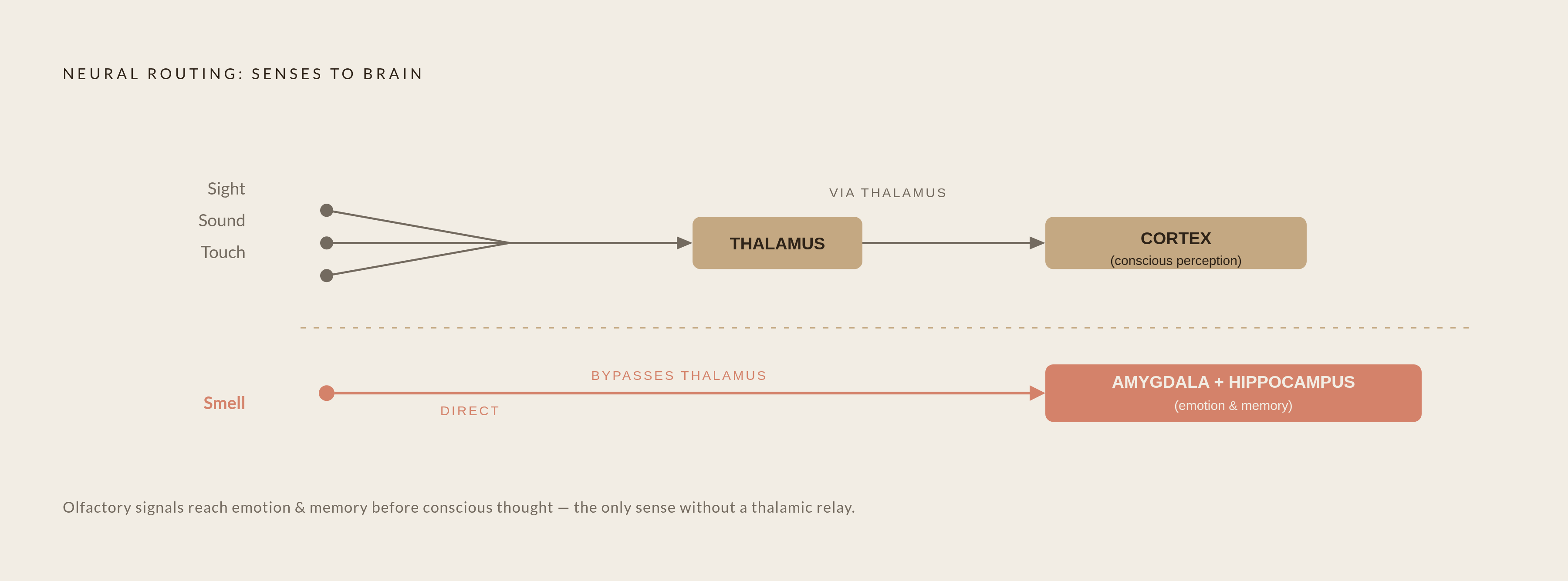
What the recent neuroscience says about deliberately strengthening scent-memory pathways
It can be aimed. There's a growing body of research showing the mechanism at work alongside the outcome, and it's more specific than "smells nice, feels nice."
A 2023 study out of UC Irvine, published in Frontiers in Neuroscience, had participants run scented diffusers for two hours a night over six months. The result was a 226% increase in cognitive capacity relative to a control group, a number large enough to demand a second look. What backed it up structurally was improvement in the uncinate fasciculus, the white matter pathway connecting the olfactory system to memory regions. Consistent scent exposure appears to have physically reinforced the wiring memory runs on, which researchers frame as infrastructure-level change rather than a temporary mood bump.
Separately, research published in the Journal of Cognitive Neuroscience found that brief odor cues have a lasting effect on both neural activity and memory performance, and that an odor-induced brain state shapes how events get encoded seconds after the smell hits. A scent present during a meaningful moment helps build the memory itself, in real time, while the memory is still being formed.
Then there's a 2024 study in JAMA Network Open, led by Kymberly Young at the University of Pittsburgh, which found that odor cues produced more detailed memory retrieval than word cues in adults with major depressive disorder, now being studied as a possible therapeutic pathway. If scent reaches memories that words can't, whatever's being built at home through a diffuser is doing more than most people give it credit for. Layer in the broader concept of "smell training," regular and varied scent exposure that recent research links to strengthened memory pathways and possibly slower cognitive decline, and the same pattern shows up across all three lines of research. Repetition, more than any single scent, is the mechanism doing the work.
How scent shapes mood room by room, and why the effect is predictable enough to use intentionally
Scent does something immediate to mood, and that runs through the limbic system: neurotransmitter release, activation of the autonomic nervous system, changes to heart rate and stress response. It's a physiological chain reaction, measurable on a monitor.
The effects are also more specific than the vaguely relaxing language a spa brochure leans on. A randomized controlled trial in Frontiers in Psychology found lavender essential oil reduced anxiety symptoms by 32% in patients waiting for minor surgery, with measurable drops in heart rate and blood pressure behind the number. A 2025 study in the International Journal of Environmental Research and Public Health found that diffusing rosemary and peppermint in office settings improved memory recall and alertness by 18 to 20%, with participants reporting less mental fatigue.
That's the backbone of what's now being called "functional fragrance," a framework that treats scent as having a job to do rather than just a pleasant smell to have. Lavender in the bedroom handles sleep onset. Peppermint or rosemary in the office supports focus. Warm, familiar scents in shared spaces build comfort, and grapefruit or rosemary in the morning deliver a jolt of alertness that doesn't involve caffeine. The mood effect and the memory effect compound over time: a scent that reliably calms a bedroom becomes, eventually, the scent that means "home" and "rest" everywhere else it's encountered.
Why consistency is the condition that makes intentional scent memory possible
Here's the catch, and it's the hinge the rest of this piece turns on: none of this works without repetition. A scent paired once with an experience is a coincidence. The same scent paired reliably, night after night, becomes a trigger, and the gap between those two outcomes is the entire argument.
Go back to the UC Irvine protocol: two hours every night, for six months, not two hours once and not two hours whenever someone remembered. The regularity produced the result, not the intensity of any single session. Light a candle occasionally, spritz a room spray when the thought crosses your mind, and the brain fails to register a pattern, because it needs a pattern to lock onto in the first place.
So what does "consistent" actually demand in a real house, with real people forgetting things constantly? Same scent, same space, same time or same activity, every time. A concentration that stays stable, not so strong the nose habituates and tunes it out within minutes, not so faint it never registers to begin with. Maybe most important, delivery that doesn't depend on a person remembering to do anything, since that's the part of the system most likely to fail.
And here's the position worth stating plainly: candles struggle with this particular job, no matter how good they smell in the store. They involve an open flame and a wax pool whose temperature drifts as it burns, so scent throw changes over the life of the candle, and someone still has to remember to blow it out before the house smells like smoke instead of lavender. Aerosol sprays spike and fade, a burst followed by nothing, working against the steady background presence memory formation actually wants. Water-based ultrasonic diffusers dilute the fragrance oil with water, so purity drifts with water level, and the mist can mess with humidity in smaller rooms. Heat-based diffusers cook the fragrance compounds, altering the scent profile the longer they run, so hour three smells nothing like hour one. Most people trying to build scent associations at home are using tools that make consistency almost structurally impossible.
How cold air diffusion delivers the consistency that memory formation requires
Cold air diffusion addresses this by removing the two variables that keep breaking everything else: water and heat. The mechanism uses pressurized air to atomize fragrance oil into a dry micro-mist, no water added, no flame involved. No water means no dilution, so what comes out of the diffuser matches what's in the bottle. No heat means the fragrance molecules don't degrade mid-diffusion, so the scent profile the brain encodes today is the same one it encoded last week.
Output on these units is controllable, too: intensity and duration set on purpose rather than left to a burn rate or an evaporation curve nobody's tracking. Pair that with scheduling and the consistency gap closes almost completely. A diffuser running on a timer delivers the identical scent, at the identical intensity, in the identical room, at the identical time, daily, with zero reliance on anyone's memory. That's a closer match to the UC Irvine study's timed, two-hour nightly protocol than any other fragrance delivery method on the market, which is precisely the point.
Sizing matters more than people expect, and this is where most home setups quietly go wrong. An undersized diffuser in a large room produces spotty, unreliable coverage. An oversized one in a small room oversaturates the space, and oversaturation triggers habituation, the exact thing that undermines the association being built to begin with. Fragrance intensity here is a dial to calibrate, not a lever to max out; the goal is a stable, low presence in the background of a room, not a burst that announces itself the second someone walks in. Placement matters too, relative to airflow, ceiling height, and where people actually enter the room, since the scent needs to be reliably present exactly where the memory-forming activity happens, not floating somewhere in the general vicinity of it.
The market has caught up to this logic, for what that's worth. The global aroma diffuser market was valued at $2.24 billion in 2023 and is projected to hit $5.76 billion by 2032, an 11.2% compound annual growth rate. That's a trajectory consistent with a home technology category settling in for the long haul.
Why the fragrance oil inside the diffuser needs to be as clean as the technology delivering it
None of the hardware matters if what's going into it is a question mark. Here's the part worth taking a firm stand on: most conventional air fresheners fail before the diffuser even turns on, and the labeling is a big part of why. Synthetic fragrance products can bury dozens of chemical compounds under the single catch-all word "fragrance" or "parfum"; the International Fragrance Association lists thousands of possible fragrance ingredients that could be hiding behind that word. Many synthetic fragrance formulations contain compounds that aren't individually disclosed on the label, leaving the full ingredient picture opaque to anyone reading the bottle. Aerosol sprays deliver a chemical payload into the air that raises its own set of questions for anyone planning repeated, long-term exposure. And "unscented" is a marketing term, not a chemistry one; masking agents can still be doing work behind that label, which means unscented is often just scented without disclosing it.
If the plan is repeated exposure over long stretches, and the UC Irvine protocol ran two hours a night for six months, ingredient transparency stops being a nice-to-have and becomes a health question. That's especially true in households with kids or pets, both of whom are smaller and closer to the ground, so their exposure to whatever's floating in the air is proportionally higher than an adult standing upright across the room.
So what should actually go into the diffuser? Plant-derived ingredients, full disclosure of what's in the bottle, no phthalates, no synthetic musks, formulations that are vegan and cruelty-free. Essential oils and botanical extracts also just perform better for this specific job: the scent profile is more stable and truer to the real plant than a synthetic stand-in, and that stability is exactly what memory encoding needs to work with. The clean-fragrance choice and the memory-building goal reinforce each other, because a pure, stable scent signal requires a pure, stable source to begin with.
A room-by-room approach to building scent associations that actually stick
One scent per room, tied to whatever that room is actually for, works best. Mixing scents or swapping them out frequently just confuses the signal the brain is trying to lock onto, which defeats the entire point of doing any of this in the first place.
Bedroom. The target state is rest, safety, the transition out of an active day into something calmer. Lavender has the strongest evidence behind it here, alongside chamomile and sandalwood. Run it on a schedule during the wind-down window before sleep, mirroring that nightly UC Irvine structure. Eventually the room itself starts to carry the association, and the scent can trigger the shift toward sleep before a person's even consciously aware they're winding down.
Home office or study. Focus, alertness, less fatigue by the third hour of the workday. Rosemary and peppermint are the evidence-backed choices, with that 18 to 20% bump in recall and alertness from the 2025 IJERHP study. Over time the scent becomes a cue that flips the brain into "work mode," genuinely useful for anyone whose office and living space sit under the same roof and need some kind of psychological border between them.
Living room or shared space. Warmth, welcome, the sense of belonging. Warm vanilla, citrus, soft woody blends: the nostalgia and comfort research here is well established. Over months, this becomes the scent guests and family members quietly file away as "this house," the one that means home itself rather than any particular room in it.
Entryway. Easy to skip, disproportionately important. Whatever scent greets someone the second they walk in sets the emotional tone for everything that follows. A consistent entryway scent is arguably the single most efficient anchor available for making "arriving home" register as a positive event, every time, before a person's even set down their bag.
Across all of it: match intensity to room size and resist turning it up looking for a bigger effect, since ambient presence, not announcement, is the goal. Overwhelm the room and the nose habituates fast, which quietly kills the whole project before it gets anywhere near the six-month mark that actually produces results.
How to start building a home scent practice without overcomplicating it
Start with one room and one scent. If there's only room in the budget or the routine for one, make it the bedroom; don't overthink that call. Sleep already runs on a nightly schedule, so the repetition the brain needs is already built into the calendar, and nobody has to remember to go to bed on purpose. Run the diffuser on a timer rather than whenever it crosses someone's mind, two hours before or during sleep being the window the research points to. Hold that same scent steady for several weeks minimum before even asking whether an association has taken hold. This is not a project with a 48-hour turnaround, and treating it like one is the fastest way to conclude, wrongly, that it doesn't work.
On the oil itself: clean formulation first, plant-derived, fully disclosed ingredients, no phthalates. Only after that clears does the scent get picked for the room's purpose rather than pure personal preference. If a particular smell already carries a positive charge from childhood, and recall that 65% of scent preference traces back to early-life association, it'll likely anchor faster than something chosen at random off a shelf.
Check the diffuser's coverage rating against the room's actual square footage before assuming it'll work. A unit rated for a space smaller than the room it's placed in will never deliver consistent coverage, no matter how disciplined the schedule is. Resist the urge to rotate scents in the early stages, too; variety feels appealing in the moment, but it's exactly the thing that dilutes the conditioning effect the whole practice depends on. Once the bedroom association is solid, and only then, move to a second room with a distinct scent of its own. One room at a time, one scent at a time. The brain isn't in a hurry about this, and there's no version of the process that rewards pretending otherwise.