Top Non-Toxic Candle Brands Worth Buying Right Now
Regulatory loopholes and hidden chemicals undermine most "non-toxic" candle claims.
A candle marked "non-toxic" has passed no test, met no federal standard, and answered to no regulator. That's the whole problem in one sentence, and it's worth sitting with before buying anything scented for the living room again. No legal definition of "non-toxic" exists for candles sold in the United States, the FDA does not pre-approve ordinary decorative or scented candles before they reach shelves, and the Consumer Product Safety Commission's one major intervention in this category was banning lead-core wicks back in 2003. So when a brand prints "non-toxic" on a label, it's making a claim it defined for itself, using criteria only it chose, and readers have no external checkpoint to hold it against unless the brand spells out what the term actually means.
Label-reading alone won't fix this, either. The Fair Packaging and Labeling Act grants fragrance formulas trade-secret protection, which lets a brand legally list "fragrance" as a single ingredient even though dozens of individual chemical compounds ride along underneath it, invisible to the shopper scanning the back of the jar. A handful of phrases show up constantly and deserve suspicion on sight: "fine fragrance," "natural parfum," "phthalate-free fragrance" (which can still describe a synthetic, petroleum-derived oil), "wax blend" (legally permitted to be almost entirely paraffin), and "lead-free wick" (a requirement since 2003, not a distinguishing feature of anything). None of these phrases are illegal to use. The rest of this piece builds a framework that skips the label and checks the wax, wick, and fragrance directly.
What conventional candles release into indoor air when burned
Start with what's actually happening in the wax pool once a wick is lit. Most mass-market candles are made from paraffin, a byproduct of petroleum refining, and burning paraffin releases benzene and toluene into the air of whatever room the candle is sitting in. Both are volatile organic compounds. Both are classified as known or probable carcinogens, and both act as nervous-system irritants with repeated exposure, which matters more for a candle burned nightly on a nightstand than for one lit twice a year at a dinner party.
Fragrance adds a second layer to the exposure, not a separate problem. Phthalates used to carry synthetic scent compounds get inhaled directly as the candle burns, and they've been linked to allergic reactions, headaches, and hormone disruption. So the two mechanisms, wax and fragrance, stack rather than compete for concern.
None of this argues for a fantasy of zero emissions, and the honest version of this argument has to admit its own limit. No burning candle releases nothing: even pure beeswax throws off some particulate matter and trace VOCs as it combusts. The goal a non-toxic candle can actually deliver is a meaningful reduction in known high-concern ingredients, not an emissions-free flame, and any brand implying otherwise is overselling physics.
Wax melts complicate the picture further, and not in the direction most people assume. A 2025 study conducted through the American Chemical Society found that terpenes in scent blends, including fully natural ones, can react with ordinary indoor ozone to form secondary nanoparticle pollution, so a melt with no open flame is not automatically the safer swap it's marketed as. Researchers behind the study called for more toxicology work before drawing firm conclusions, and that caution applies here too.
Ventilation does more real-world work than any wax or wick choice on its own. Burning anything indoors, candle or otherwise, sends up short bursts of fine particles that settle and linger in a closed room, and repeated exposure over months can aggravate allergies and breathing problems regardless of what's in the wax. Cracking a window while a candle burns costs nothing and helps regardless of brand.
Pet owners carry a version of this risk that's easy to miss. Cats and dogs have respiratory systems considerably more sensitive than a human's, and several essential oils marketed as natural and gentle, tea tree, many citrus oils, and eucalyptus among them, are documented as toxic to dogs, cats, and other household animals. A candle marketed as clean for humans isn't automatically clean for the golden retriever asleep next to the couch, a distinction that matters enough to shape which brands make the recommendations below.
If the chemistry above is concrete enough to name specific compounds and specific reactions, then the criteria for avoiding them should be just as concrete. That's the shift the next section makes.
The four criteria that separate a clean candle from a greenwashed one
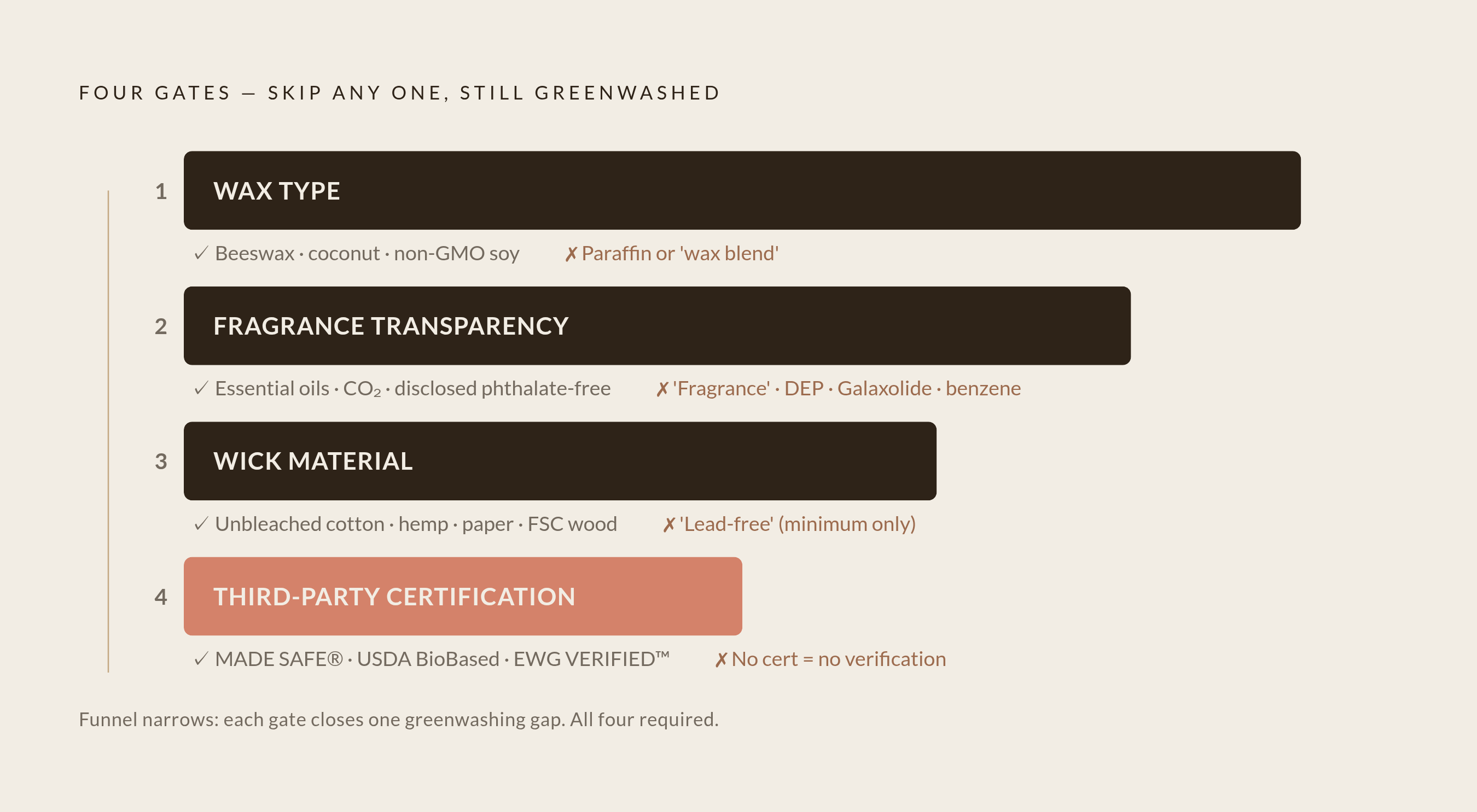
Four factors do the actual work of separating a clean candle from a well-marketed one: wax type, fragrance transparency, wick material, and third-party certification. Skipping any one of the four lets a brand still greenwash around the gap. Applying all four together leaves little room for vague language to hide in.
Wax type comes first because it's the easiest to fake with a euphemism. Any paraffin content disqualifies a candle from "non-toxic" territory, including paraffin hidden inside a "wax blend," and the reasonable default is to assume paraffin is present unless a brand confirms in writing that it isn't. Beeswax burns slowly, doesn't drip, and carries a faint natural honey scent; some sellers claim it releases negative ions that clear airborne allergens, a claim with no real scientific backing behind it, though sourcing it from small, ethical keepers does support bee populations. Coconut wax burns smooth and even, and some formulators consider it the most environmentally sound wax option available at scale. Soy wax is widely available and burns more slowly than paraffin; non-GMO, American-grown soy is preferable, but soy alone doesn't make a candle non-toxic, since the fragrance and wick riding along with it still have to clear their own bars. Cleaner waxes tend to burn slower than paraffin, so a candle that costs more upfront often delivers more hours of burn per ounce and less soot streaking the wall behind it.
Fragrance transparency is where most of the real toxicity hides, and it deserves the same scrutiny as the wax itself. The cleanest tier is pure essential oils, CO2 extracts, or naturally derived isolates, with the brand disclosing both origin and extraction method rather than just the word "natural". A workable second tier is a fully disclosed, phthalate-free synthetic fragrance oil that's been screened for high-concern chemicals, though "phthalate-free" alone, with no further detail volunteered, isn't enough to clear the bar on its own. Specific ingredients earn an automatic red flag whenever they appear on a label: diethyl phthalate (DEP), dibutyl phthalate (DBP), synthetic musks such as Galaxolide, Tonalide, and Cashmeran, parabens, benzene, toluene, formaldehyde, and any undisclosed "fragrance" or "parfum" standing in for a real ingredient list. Even fully natural essential oils can trigger allergic or asthmatic reactions in sensitive people, so "natural" describes an ingredient's origin, not a guarantee against irritation.
Orbasics.com and The New Knew identify the safest wick options as unbleached cotton, hemp, paper, or FSC-certified untreated wood. Lead-free wick" printed prominently on packaging is legally required since 2003 and functions as a greenwashing signal rather than a selling point, and "natural cotton wick" without the word "unbleached" attached likely went through a chemical processing step the label doesn't mention. Wood wicks, cherrywood especially, produce a genuine fireplace-like crackle as they burn and count as a legitimate clean choice when the wood is properly sourced.
Third-party certification is the closest thing to an external checkpoint in a category that otherwise runs on self-report. MADE SAFE® is the strongest signal available: it screens for thousands of individual toxic chemicals, was built as a certification spanning many consumer categories rather than candles specifically, didn't add candles to its scope until 2020, and remains rare precisely because its standard is hard to clear. USDA Certified BioBased is a legitimate secondary marker of ingredient origin, though it doesn't screen fragrance for toxicity on its own. EWG VERIFIED™ and Soil Association organic certification are credible supplementary certifications. A brand carrying no third-party certification at all isn't automatically disqualified, but the burden shifts entirely onto its own labeling and its willingness to answer direct questions in writing.
That last point turns into a genuinely useful shopping tool. The New Knew publishes a sample script of direct questions readers can send to a brand before buying: ask for the exact wax composition, ask whether the fragrance is essential oil, CO2 extract, or synthetic, ask for the wick material and whether it's bleached, and ask whether any third-party lab has verified the ingredient list. A brand confident in its own product answers directly. One that hedges, deflects, or stops responding has told a buyer everything they need to know.
The best non-toxic candle brands evaluated against those four criteria
Fontana Candle Co. earns the strongest overall mark for verified safety, and the certification does most of the talking: it was the first candle company to receive MADE SAFE® status, a screening standard covering hundreds of toxic chemicals across many consumer categories. The wax is beeswax blended with coconut oil, the scent comes from essential oils only, the wick is wooden, and the formulas carry no dyes or synthetic additives. Scent throw runs light to moderate rather than room-filling, best for households prioritizing safety over strong scent throw; seasonal and collaboration scents rotate regularly, including a Wildflower Honey release made with Beekeepers Naturals. Pricing wasn't confirmed at the time of this review and should be checked directly on the brand's site, along with the currency of a Labor Day promotion mentioned in past coverage.
Terralite takes the lead for strong natural scent throw paired with genuinely low-waste packaging. The wax is coconut, the wick has a hemp core, and the fragrance draws on wildcrafted and organic essential oils. Containers are amber glass made with a majority recycled content, and the brand also sells unglazed ceramic vessels designed to be returned to the earth rather than the recycling bin. Testing found scent throw among the strongest recorded for a fully natural essential oil candle, with standout scents including Woodlands, Desert Sage, Red Mandarin, Vanilla Lavender, Bourbon Cedar, and Lavender Lemonade; White Pumpkin runs as a fall-only seasonal addition to an otherwise consistent year-round core lineup. Founder Jessica Waters has pointed out publicly that phrases like "natural fragrance" and "phthalate-free fragrance" can still describe synthetic compounds, and Terralite's reliance on wildcrafted and organic oils is built specifically to sit above that ambiguity. Pricing and any current discount codes weren't confirmed at review time and are worth checking directly.
Slow North stands out for essential-oil candles that throw more scent than the category typically manages. Soy wax, natural essential oils, a cotton-and-paper wick, glass container, no dyes. Dr. Meg Christensen, a physician who runs the non-toxic home resource Interior Medicine, recommends the brand.
ELEMENT Candle Co. earns its spot on sensory experience and small-batch craft rather than certification volume. Made in Charleston, South Carolina, its small-batch soy candles use a cherrywood wick that snaps and crackles the way a real fireplace does, a detail that turns lighting a candle into something closer to a ritual than a chore.
Applewood Candle Co. takes the pet-safe category, and the founding story explains the formula choices directly. Founder Allison's golden retriever, Magnolia, developed persistent allergy symptoms eventually traced back to conventional home fragrance; removing it resolved the symptoms, and Allison built the company from that specific experience. The candles use a coconut-soy wax blend and phthalate-free fragrances, a formula shaped by one dog's reaction rather than an abstract wellness trend.
Companion Candles pairs with Applewood in the pet category but leans on veterinary verification rather than a founding anecdote. The formulation carries vet approval and excludes more than 250 chemicals commonly found in traditional candles, phthalates, parabens, and various carcinogens among them.
Peacesake Candles wins on value and burn time, the practical math that matters once the certifications and scent notes are accounted for. Soy wax grown without herbicides or pesticides, a cotton wick free of lead and zinc, handmade production, and notably more wax volume per candle than most natural competitors charge for at a comparable price point.
Hemlock Park is the most accessible option here, sold on Amazon and hand-poured in the Sierra Nevadas using plant-based coconut wax, packaged in recyclable amber glass with thinner cotton wicks that stretch out burn time. One honest caveat belongs here: at least one reviewing outlet removed Hemlock Park from its own vetted recommendation list over reliance on generic or undisclosed synthetic fragrances in some products, and separate reporting notes the brand uses both essential oils and fine fragrance oils depending on the specific candle. That's not a disqualification so much as a reason to check the ingredient list on each individual product page before buying, rather than assuming the whole catalog meets one standard.
Bluecorn Beeswax is the pick for anyone who wants little to no scent at all. Based in Colorado and operating for more than 30 years, the brand uses lightly filtered beeswax, and scented candles use pure essential oils, across a lineup that spans tea lights, tins, votives, and taper candles. It also offsets shipping emissions through carbon sequestration and funds a tree-planting program to counter its packaging footprint, and independent reviewers have named it a top pick specifically for sensitive noses, with orbasics.com recommending it as the best low-scent clean candle and naming it alongside Living Good Candle Co. for sensitive noses. The Filtery notes that price range and burn times vary by size and should be verified before buying. Organic Beauty Lover notes that price and burn times were not confirmed at review time and should be verified directly.
Candle Stork closes the list on ingredient transparency, and the founding detail matters here too. Founder Nettie developed symptoms from conventional candles tied to her own chemical sensitivities, and the response was a full-disclosure model in which every ingredient appears on the individual product page, the beeswax is sourced locally from Northern Michigan, and the scents come from essential oils. The catalog rotates through seasonal "chapters," an Autumn set including scents like "The Witch's Familiar" and "Ghost in the Garden," a Winter set with "Blanket of Snow" and "Milk & Cookies," alongside unscented pure beeswax tapers and tea lights for anyone who wants the ritual without any fragrance load at all. A discount code, THEFILTERY10, is available for shoppers checking out the seasonal chapters.
Fragrance transparency belongs in this same conversation even outside candles proper. The cleanest standard, pure essential oils, CO2 extracts, or naturally derived isolates with disclosed origin and extraction method, applies to diffuser brands making comparable claims. That openness is what turns label-reading from a guessing game into something a shopper can actually verify, in candles and in the home fragrance category around them, including cold-air diffuser brands like Aura House, which uses non-toxic, vegan fragrance oils formulated for design-forward homes.
Sources
- I Tried The Best Non Toxic Candles (here's What I Liked!) - Organic Beauty Lover
- 2026 Guide to Non Toxic Candles: the Best 13 Natural Candle Brands
- 9 Non-Toxic Beeswax Candles for a Natural Home Ambiance
- 2026's Best Safe, Nontoxic and Organic Candles | The New Knew
- Candle Safety Standards and Regulations in the US: An Overview
- What Does "Non-Toxic Candle" Actually Mean? A No-BS Guide – Candle Stork
- Product Profile: Candles | Made Safe – MADE SAFE a program of Nontoxic Certified