Reading Fragrance Notes in Home Diffuser Oils
Cold-air diffusers preserve fragrance notes heat destroys in the opening.

Most people assume fragrance notes are sequential, like they take turns, but they don't work that way.
All three layers exist in the formula at once. What shifts is evaporation rate. Lighter molecules move fast, heavier ones linger, and that gap in speed is what creates the sense that a scent is "developing." It was developing from the first second, and you're just catching different moments of it.
The three tiers, quickly:
Top notes. Lightest, most volatile, first impression. Citrus, aquatics, light herbs. Gone soonest.
Heart notes. The actual personality of the scent. Florals, spices, green notes. What a room smells like once things settle.
Base notes. Slowest to release, longest to stay. Woods, resins, musks, amber, vanilla.
Now here's where it gets interesting for diffuser users specifically. A diffuser isn't a candle wave or a single spray burst. It's sustained, low-intensity, and continuous, which means the note arc plays out differently than in any other format.
Top notes show up early and vividly during the first active cycle. Walk in after the diffuser has been running a while and you may catch only a trace of them. Heart notes are what you register after you've settled into a room. That scent you think of as "what this place smells like"? That's your middle note doing its job quietly. Base notes are what's still in the air hours after the unit has cycled off. Cedar, musk, sandalwood — a house having a signature. That's a base note working exactly as intended.
One thing that catches people off guard: carrier oil matters too. Plant-derived carriers like jojoba or fractionated coconut oil are the vehicle that lets fragrance disperse gradually. Blend too thick for your unit and every note tier underperforms, not because the formula is bad, but because it never properly atomized.
A fragrance described as "fresh and citrusy" may settle into something warm and resinous after an hour of diffusion. The notes aren't disappearing — they're shifting in proportion. That's the formula doing what it was built to do.
What heat does to the note structure — and why cold air preserves it
At some point, the hardware choice stops being a convenience question and becomes a fragrance quality question. This is that point.
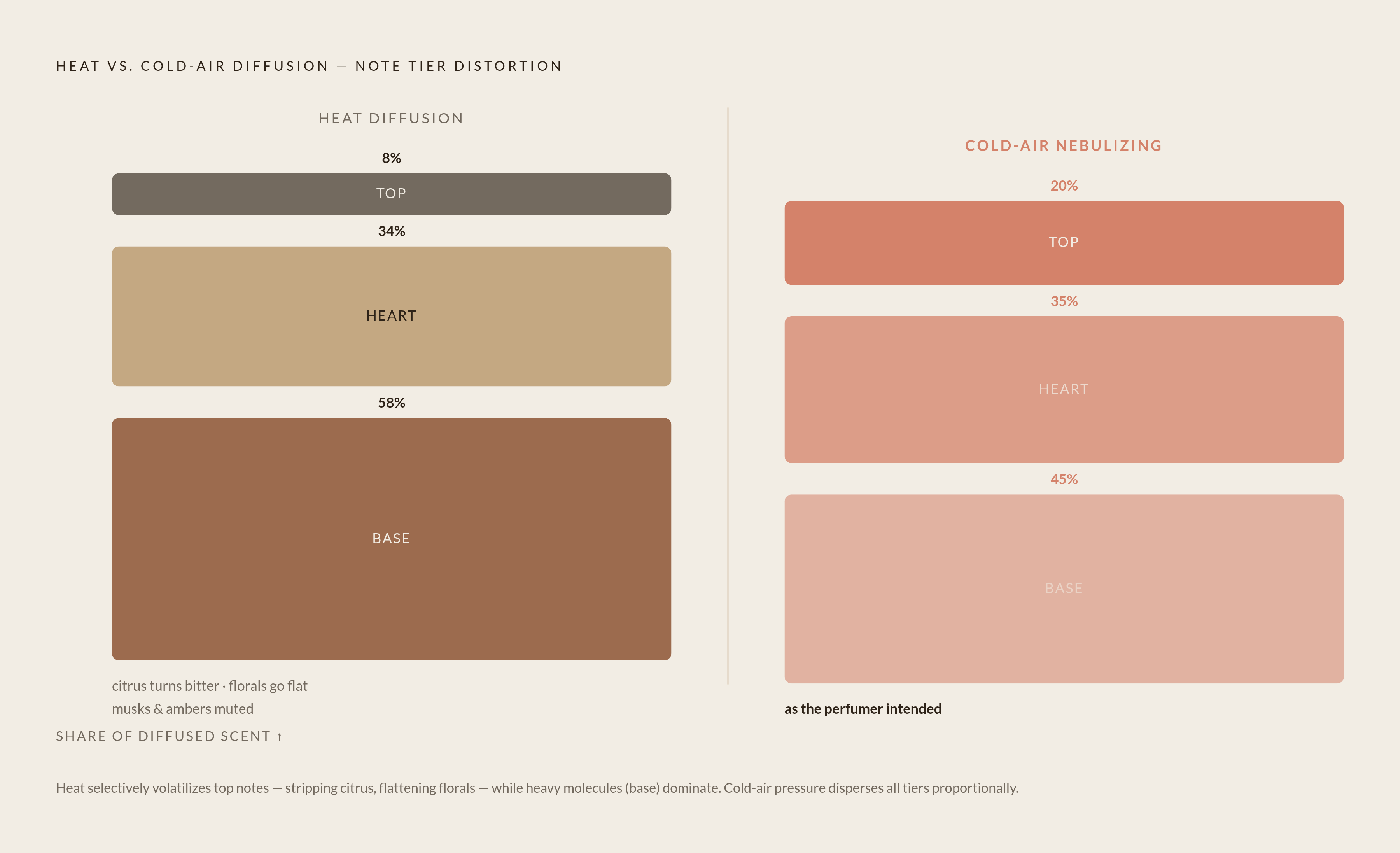
Heat-based diffusion applies thermal energy to the oil. That energy preferentially drives off the most volatile compounds first, which are, of course, your top notes. So before the scent even reaches your nose in its intended form, heat has already started editing the opening. And it compounds from there. Citrus can turn bitter under heat. Florals go flat. Musks and ambers get muted. You're not experiencing the formulation — you're experiencing what survived thermal processing.
Cold-air nebulizing diffusion uses pressurized air to break oil into microscopic particles. No heat means no selective volatilization. Top, middle, and base notes reach the air in roughly the same proportions as in the original formulation. For anyone who reads a note pyramid before buying, that's not a small distinction — that's the whole game.
The more complex the blend, the harder heat punishes it. A simple single-note scent may survive fine. A composition with deliberate top-note brightness, a rich floral heart, and a resinous base needs cold air to deliver the full arc. Heat flattens exactly what the perfumer worked hardest to build.
Ultrasonic diffusers solve the heat problem but introduce different ones. Water dilutes the oil's note balance, moisture creates mold risk over time, and concentration drifts from the first cycle to the last. Cold-air nebulizing systems are waterless, which keeps things consistent and cleaner.
Reading a fragrance note listing as a shopper
Most fragrance oil listings present notes in implied pyramid order, even when brands don't label them explicitly. First descriptors listed are generally top notes. Middle section is the heart. Closing descriptors are the base. A listing that reads "bergamot, jasmine, sandalwood" gives you no labels, but the order gives you the structure. Once you see that, any note listing becomes readable before you spend a dollar.
At the top, look for: citrus (bergamot, lemon, grapefruit, neroli), aquatics, light herbs (basil, mint, thyme), green notes.
In the heart, look for: florals (rose, jasmine, ylang-ylang), spice (cardamom, black pepper), warmer greens (clary sage, violet leaf).
At the base, look for: woods (cedar, sandalwood, hinoki), resins (frankincense, benzoin), musks, amber, vanilla, vetiver.
Here's a heuristic I keep coming back to. If you want a fragrance that stays bright and energizing throughout the day, confirm there are meaningful heart notes reinforcing that quality. A thin middle means the vitality fades the moment the top notes dissipate. The opening will feel alive, but the sustained experience will feel hollow.
If you want a scent that lingers after the diffuser cycles off, prioritize base note depth. Musks, woods, and resins are what stay detectable in fabric and air after diffusion pauses.
A quick example: "Bergamot / neroli / jasmine / vetiver / cedarwood" tells you bright citrus-floral opening, soft floral heart, earthy woody dry-down. That arc is predictable before you've bought anything.
Matching the note pyramid to a room and a purpose
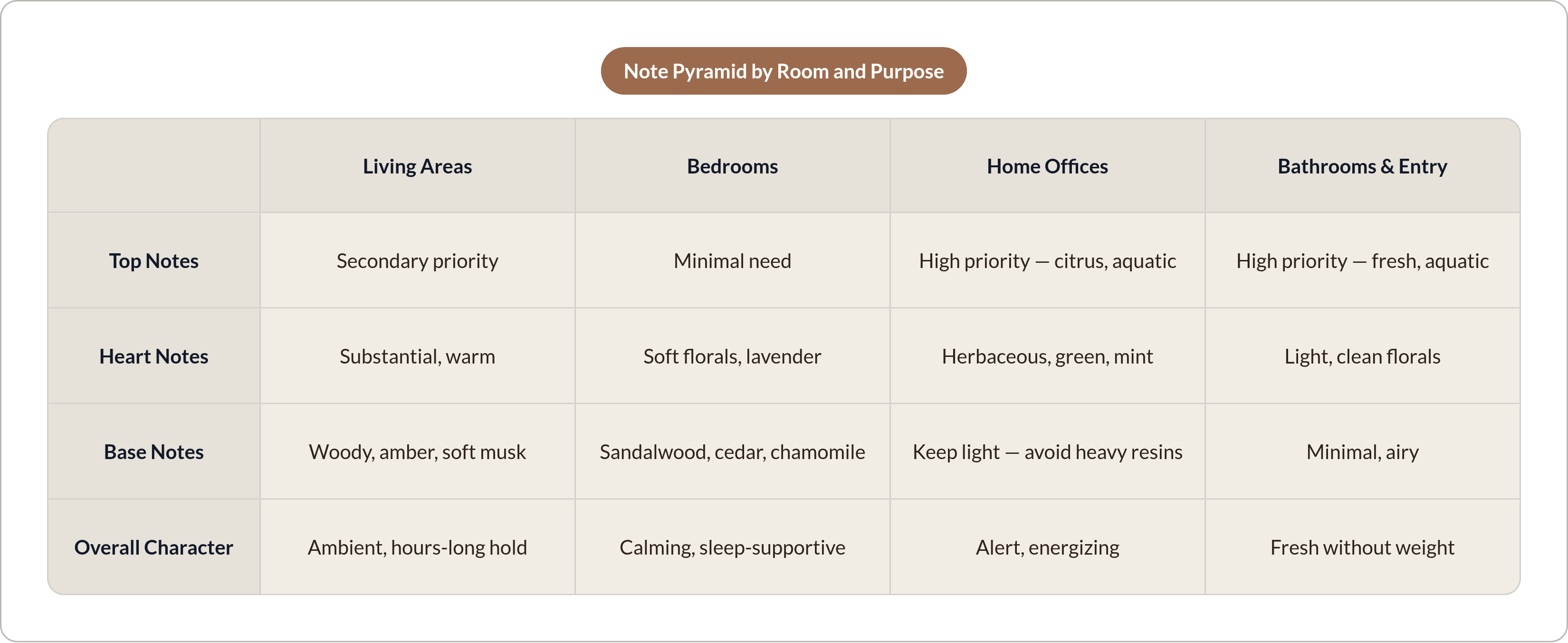
Different spaces make different demands on the note structure. This is where the pyramid stops being abstract and becomes a selection tool.
Living areas want a substantial heart and warm base. Woody, amber, or soft musk bases create ambient character that holds across hours without demanding attention.
Bedrooms are where base notes do the most work. You're often diffusing before sleep and during sleep. Sandalwood, cedar, lavender absolute (which behaves more as a heart and base note than a top note), and chamomile all work well here. A citrus-heavy blend without meaningful base depth will fade before it's done anything useful.
Home offices flip the priority. Top and heart notes matter most. Citrus tops and herbaceous or green heart notes like eucalyptus, mint, and green tea support alertness. A deep resinous amber that works beautifully in a living room can feel oppressive at a desk at 2 p.m. — a mistake I've made myself.
Bathrooms and entry spaces want fresh, aquatic or citrus-dominant compositions with lighter bases. Clean without weight.
Time-of-day logic mirrors room logic. Morning diffusion favors bright tops and energizing hearts. Evening favors warm hearts and deep bases. Some people keep two separate oils for this. Others adjust the diffusion schedule. Both approaches work, but both start from knowing what the note pyramid is designed to do.
How the essential-oil versus fragrance-oil distinction affects note reading
This one trips people up more than almost anything else, so it's worth slowing down for.
Essential oils are single-source plant extracts. Their note character is determined by the plant's natural chemistry. Bergamot is predominantly a top note. Lavender sits mostly in the heart and middle. That behavior is largely fixed. You're not reading a designer's intent when you look at essential oil notes — you're reading a botanical profile.
Fragrance oils are composed blends. They can include natural aroma materials, isolates, and synthetic aroma chemicals, and they can be engineered with essentially any note architecture the perfumer intends. A "sandalwood" note in a fragrance oil may be partly or largely synthetic aroma chemistry, not pure sandalwood essential oil. That's not automatically a problem, but it does mean the listed notes reflect formulation choices and perfumer intent, not a single botanical source.
But what if the formulation quality is poor? That's exactly where this distinction cuts. Because the integrity of the pyramid in a fragrance oil depends on formulation quality in a way that essential oil chemistry simply does not.
Two things worth checking:
Phthalates. Sometimes used as fixatives to extend base note persistence. They do the job, but they're undisclosed synthetics staying airborne in living spaces. Clean fragrance oils achieve base longevity through non-toxic fixatives and higher-quality aroma materials.
IFRA compliance. An IFRA statement confirms the formulation has been evaluated for safety at its use concentration. For oils diffused continuously in living spaces, that evaluation matters.
"Fragrance oil" in an ingredient list is not a red flag on its own. Pairing it with clean certification, IFRA compliance, or ingredient transparency is what confirms the note experience is both accurate and safe.
Why cold-air diffusion is the format best suited to complex, layered fragrances
The more sophisticated the note pyramid, the more the delivery method matters — that's just physics.
A single-note blend is forgiving. A composed fragrance with a deliberate top-note opening, a rich sustained heart, and a deep lingering base is not. Heat punishes complexity. Cold-air nebulizing diffusion uses air pressure alone, no heat, which means no selective volatilization. Every tier of the note pyramid is aerosolized in proportion to the original formulation. The scent you read on the label is the scent you experience in the room.
Coverage matters here too. Cold-air diffusers can service large spaces that candles, reed diffusers, and plug-ins simply cannot match. And programmable intervals, where the unit cycles between active diffusion and dormancy, solve a real perceptual problem. The nose adapts to constant scent and stops registering it. Programmed pulses mean the note pyramid is experienced in deliberate bursts rather than fading into habituated background. The oil also lasts longer, which is an underrated benefit nobody talks about until they're replacing bottles too fast.
No water means no dilution of note balance. No moisture reservoir means no mold risk, no mineral deposits, no bacterial colonization. The result is a cleaner system with consistent concentration, where every note tier performs as intended from the first cycle to the last.
For someone who has spent real time reading a note pyramid before buying, the alignment between formulation and delivery format is what makes a label worth trusting.
Putting note knowledge into practice when building a diffuser oil collection
A collection built around note literacy has structure. Rather than a random accumulation of things that smelled good in the cart, it becomes a set of oils whose profiles are chosen to serve specific rooms, times of day, and moods.
A practical checklist for evaluating any diffuser oil on a product page:
Identify top notes. Do they deliver the opening you want?
Identify heart notes. Do they sustain that character, or does the mid-scent shift somewhere you didn't anticipate?
Identify base notes. Will the dry-down suit the room and the mood it's meant to support?
Check for clean certification or IFRA compliance. Does the label confirm the note architecture is achieved without undisclosed synthetics?
Confirm diffuser compatibility. Cold-air and nebulizing systems require low-viscosity oils to atomize correctly. A mismatch here means every note tier underperforms regardless of how good the formula is.
It's also worth considering what note literacy opens up beyond personal use. A fragrance oil selected with real understanding of the note pyramid makes a more intentional gift. You can match the note profile to a recipient's space and routine, rather than just grabbing whatever has nice packaging.
Florals currently represent the largest share of the home fragrance market, and that dominance makes sense. Shoppers reach for familiar top-note territory because it's what they recognize from the first sniff. Note literacy opens the rest of the pyramid for consideration — the warmer, more grounded compositions, the complex blends that take a full hour to fully reveal themselves, the base-heavy scents that make a room feel like somewhere specific rather than somewhere that just got spritzed.
Knowing what a note list actually tells you means knowing, before the oil arrives, what kind of experience is waiting. That changes how every purchase after this one feels.