Vegan and Cruelty-Free Certifications in Home Fragrance
These two labels measure different things and a product can pass one while failing the other.
Most people shopping for ethical home fragrance assume "vegan" and "cruelty-free" mean the same thing, but they don't. One term describes what a formula contains, the other describes how it was developed, and a bottle can pass one test while failing the other completely.
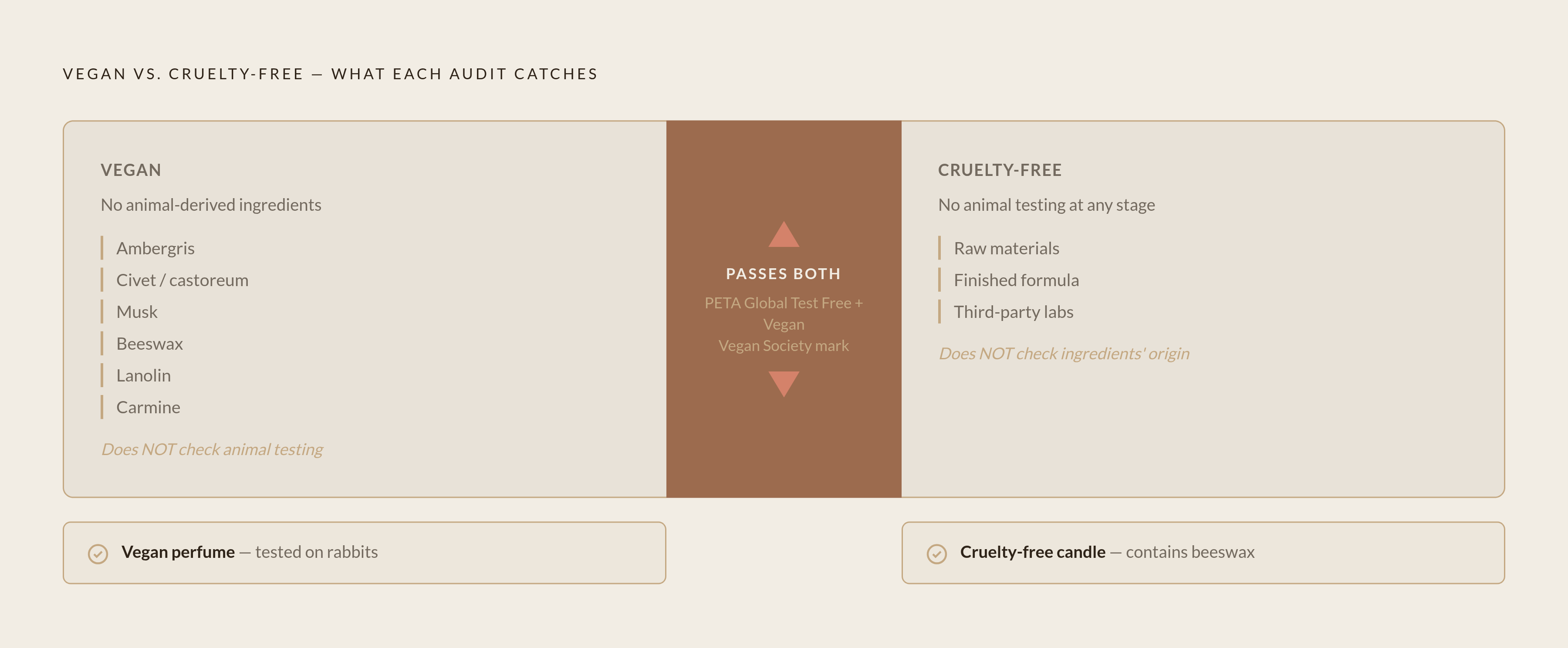
Cruelty-free means no animal testing happened at any stage of a product's life, not on the finished fragrance, not on the raw materials, not through any third-party lab the brand hired to do the testing for them. Vegan means something else entirely: no animal-derived ingredients in the formula at all. Neither claim implies the other. A cruelty-free candle can still contain beeswax or musk extracted from an animal gland. A vegan perfume, built entirely from plant and lab-made materials, can still have been tested on a rabbit's skin somewhere in its development chain if the brand or its supplier commissioned that test. Only a product that clears both bars at once qualifies as fully ethical by both standards, and buyers who check one label and assume the other is a coincidence are gambling on a coin flip that isn't wired to land the way they hope.
Fragrance has a longer, stranger relationship with animal ingredients than most other product categories, and the vegan half of this equation carries real weight in perfumery specifically. Ambergris, a waxy substance formed in the digestive tract of sperm whales, has been prized as a fixative in luxury perfumery for centuries. Civet, a glandular secretion taken from the perineal glands of civet cats, has been banned in EU cosmetics since 2009, though it remains in use in other markets. Castoreum, harvested from the castor sacs of beavers, appears in leather and amber accords, doing work that's historically been hard to replicate without it. Animal musk, once extracted from the glands of male musk deer, was largely displaced by synthetic alternatives after a 1979 CITES listing regulated and restricted the trade, though that listing never amounted to a universal ban, and trace use still turns up in vintage formulations. A vegan certification targets exactly this list. A cruelty-free certification doesn't touch it at all. That's the whole distinction in miniature: two labels, two separate audits, and a bottle that needs to pass both before anyone can call it fully clean on ethical grounds.
How the two main certification bodies verify these claims
Knowing what the labels mean in theory is one thing. Knowing what it takes for a brand to actually earn them is a separate matter, and that gap between a marketing claim and a verified one is where certification bodies come in. Independent certification bodies exist precisely to draw that line, and the two leading programs in this space don't use identical standards to draw it.
Leaping Bunny requires ongoing supplier monitoring and openness to independent audits, confirming that no animal testing occurs anywhere in a product's development, from raw ingredient sourcing through the finished formula. That's a cruelty-free certification specifically. It says nothing about whether the product contains honey, lanolin, or carmine, because that was never the question it was built to answer.
PETA's Beauty Without Bunnies program splits the difference by offering two separate tiers. The first, "Global Animal Test Free," confirms no animal testing by the brand or its suppliers. The second tier, "Global Animal Test Free and Vegan," adds a confirmation that no animal-derived ingredients appear anywhere in the formula, and this is the one tier that actually satisfies both definitions simultaneously. A product carrying only the first tier can still legally contain beeswax. The Vegan Society's logo and Certified Vegan mark certify both the absence of animal-derived ingredients and confirmation that the product and its ingredients were not tested on animals.
The China market complication. Brands selling in mainland China have historically faced mandatory animal testing requirements for imported cosmetics, and while those regulations relaxed for some categories starting in 2021, enforcement still varies by product type and jurisdiction. A brand can say, with total accuracy, "we do not test on animals," while its parent company sells products into mainland China under a regulatory regime that required exactly that kind of testing for a different product line. The brand-level statement is true. It's also incomplete, and the incompleteness lives one corporate layer up from where the label is printed.
Estée Lauder Companies, L'Oréal Group, and LVMH all operate in mainland China and have all drawn sustained scrutiny from PETA on this exact point. Estée Lauder Companies has partnered with Cruelty Free International to work toward ending animal testing globally, which is worth registering as a real step rather than a footnote. Most of these parent conglomerates have not received PETA's Beauty Without Bunnies certification at the corporate level, though PETA certifies individual brands rather than entire conglomerates, so some subsidiaries under a non-certified parent, NYX and Urban Decay under L'Oréal among them, do hold individual brand certification even while the parent company does not. That's not a contradiction so much as how the certification system is scoped: brand by brand, not boardroom by boardroom.
For a buyer standing in front of a shelf or scrolling a product page, the practical filter is simpler than all of that corporate structure suggests. A brand carrying third-party certification, Leaping Bunny, PETA, or the Vegan Society, has been externally audited by an organization with no financial stake in the answer. A brand offering only a self-declared claim on its own website has not been checked by anyone but itself. Both might be telling the truth. Only one of them has had that truth confirmed by someone else.
What vegan and cruelty-free labels do not tell you about what is in the bottle
A fragrance can be certified vegan, certified cruelty-free, and still hide a dozen undisclosed chemicals behind a single word printed on the label. Ethics and chemistry are two different audits, and passing one tells a buyer nothing about the other.
A piece of federal labeling law causes that gap. Under the Fair Packaging and Labeling Act, fragrance formulas count as protected trade secrets, and the single word "fragrance" or "parfum" printed on an ingredient list can legally stand in for dozens of individual compounds. EWG describes that single word as a stand-in for a pool of hidden chemicals, and the fragrance industry draws from a working library of more than 3,100 stock ingredients, of which only about a third have published safety assessments.
Independent lab testing puts a number on how much that loophole actually gets used. Tests commissioned by the Campaign for Safe Cosmetics and analyzed by EWG found dozens of secret chemicals across a sample of name-brand fragrances, averaging 14 undisclosed ingredients in products that may well carry a vegan label, a cruelty-free label, or both. Neither certification was ever built to catch that, because neither certification asks the question "what, chemically, is actually in here?"
Lab testing found specific concerns among the undisclosed 14. Diethyl phthalate, a common fragrance fixative used to help scent linger, has been detected in the vast majority of Americans tested, and synthetic musks are known to accumulate in body fat and in breast milk. EWG testing has detected synthetic musks Galaxolide and Tonalide in the umbilical cord blood of newborns and found them in nearly every fragrance analyzed. Phthalates and synthetic musks aren't animal-derived, so they don't appear on a vegan label. A chemical's persistence in body fat has nothing to do with whether it was tested on a rabbit, so it doesn't appear on a cruelty-free label either. The two certifications ask different questions than the toxicological one, and a buyer who conflates them is checking the wrong box for the concern they actually have.
That said, not every synthetic ingredient belongs in the same bucket, and the fix here isn't panic, it's specificity. Modern macrocyclic musks are considered biodegradable and comparatively low-risk. The class of concern is the older polycyclic musks and the phthalate fixatives specifically, not synthetic fragrance chemistry as a category. A buyer should look for specific disclosures when vegan and cruelty-free labels say nothing about phthalate content. A brand that voluntarily states "phthalate-free" and "paraben-free" on its own label is disclosing something no vegan or cruelty-free certification requires it to disclose. That voluntary specificity is a real signal, arguably a more useful one for anyone worried about what's actually inside the bottle, and it costs a brand nothing to offer except the willingness to be checked.
Why these gaps matter more for diffuser oils than for skin-applied fragrance
Everything above applies to any fragrance product. It applies with more force to a diffuser oil, because of one simple mechanical fact: a diffused oil doesn't stay put on one person's skin. It disperses into the shared air of a room, so every undisclosed ingredient becomes an inhalation exposure for everyone breathing in that space, human or otherwise.
The diffusion method itself changes how much that distinction matters. Cold-air, or nebulizing, diffusion disperses oil as an ultra-dry micro mist with no water, heat, or alcohol involved, and it delivers scent more efficiently into a room than an ultrasonic diffuser does. More efficient delivery is good news for anyone who wants a room to actually smell like something. It also means ingredient purity matters proportionally more, not less, because a more efficient delivery system is, by definition, putting more of whatever is in the bottle into the air people are breathing. Heat-based diffusion carries its own tradeoff: heat can chemically degrade natural, plant-derived fragrance molecules before they ever reach the room. Cold-air diffusion avoids that degradation and preserves the molecule's original structure, but only on the condition that what's going into the diffuser was clean to start with. A waterless system also sidesteps the mold, mineral buildup, and bacterial growth that come with humidity-generating alternatives, a detail that matters more than it might sound for households managing allergies, asthma, or general chemical sensitivity.
Then there's the household member who never gets consulted about scent preferences but absolutely gets exposed to the results: the family pet. A product can carry every ethical certification available and still be genuinely hazardous to a cat or dog sharing the same air. Both species are highly sensitive to essential oils, and inhalation exposure can trigger real health problems even at concentrations that register as perfectly safe for the humans in the room. Phthalates compound that risk, since they act as endocrine disruptors in mammals generally, and a pet's smaller body mass means it absorbs a proportionally higher dose from the same ambient exposure that an adult human shrugs off. That concern is grounded in basic dose-response toxicology applied to a room full of shared air.
Specific ingredients carry specific, named risks here, and it's worth being precise rather than vague about which ones. Tea tree oil contains terpenes that cats cannot metabolize. Eucalyptus is high in a compound called 1,8-cineole, which can cause drooling, vomiting, and respiratory distress in cats specifically. Neither of those facts has anything to do with whether the oil in question is vegan or cruelty-free. A tea tree oil blend can be both and still send a cat to the emergency vet. Generally safer options for pet-friendly households include lavender in properly diluted amounts, jasmine when diluted correctly, natural vanilla extract, sandalwood, and chamomile, though "generally safer" is doing real work in that sentence and isn't a substitute for checking concentration and species-specific tolerance before diffusing anything new into a shared space.
For a diffuser oil, vegan and cruelty-free certification is a reasonable starting filter, not a finish line. The next question a buyer should be asking is whether that same oil is also phthalate-free and formulated with ingredients that have actually been evaluated for inhalation safety at the concentrations a diffuser produces, and not just for topical safety at the concentration you'd find in a rollerball.
The synthetic ingredient question: when lab-made is the more ethical and safer choice
The assumption that "synthetic" is a red flag and "natural" is automatically the safer, more ethical choice doesn't hold up. That assumption doesn't hold up once specific compounds get compared side by side, and the ambergris story is the cleanest illustration available.
Ambroxan, the lab-synthesized replacement for whale-derived ambergris, hasn't just matched the original, it's outperformed it commercially, now appearing in roughly 30% of men's fragrances. Perfumers reach for Ambroxan because it works, at a scale that suggests performance parity with animal-derived materials is not only achievable but frequently exceeded. Civet tells a similar story from the regulatory side: banned in EU cosmetics since 2009, its complex, musky character is now replicated using plant-based or lab-created materials, and the results are often described as cleaner and less irritating than the animal-derived original. Nobody is losing depth of scent by giving up a secretion harvested from a civet cat's perineal gland. If anything, the substitute is the upgrade.
The synthetic musk story requires a bit more nuance, because not all synthetic musks are built the same. Modern macrocyclic musks are considered biodegradable and carry a comparatively low risk profile, which is what allows a "clean" fragrance line to still deliver a scent that actually lasts on skin or in a room. The molecules drawing legitimate concern are the older polycyclic musks and the phthalate-based fixatives specifically, the same compounds flagged earlier in this piece, not synthetic fragrance chemistry as a whole category. Lumping every lab-made molecule into one suspicious bucket misses the actual distinction that matters, which is age of chemistry and accumulation profile, not origin.
Meanwhile, "natural" carries its own asterisks that rarely make it onto the label. Essential oils rank among the most common causes of fragrance allergy, so natural doesn't automatically translate to gentler or safer, particularly for anyone with sensitive skin or reactive airways. And a "natural" claim doesn't automatically mean vegan, either: a fragrance built from natural ingredients can still include animal-derived musk, civet, or beeswax, since "natural" only describes where a molecule came from, not whether an animal was involved in producing it. The word sounds reassuring. It isn't doing the job buyers often assume it's doing.
Whether an ingredient deserves scrutiny comes down to the specific compound, its accumulation behavior, its allergy profile, and, for pet owners in particular, its species-specific toxicity. A well-formulated synthetic can beat a poorly sourced natural on every one of those measures at once. Buyers who default to "natural equals safe" and "synthetic equals suspect" are applying a rule of thumb that the ambergris and civet examples above quietly dismantle, one lab-made molecule at a time.