Unisex Fragrance Oils for the Home
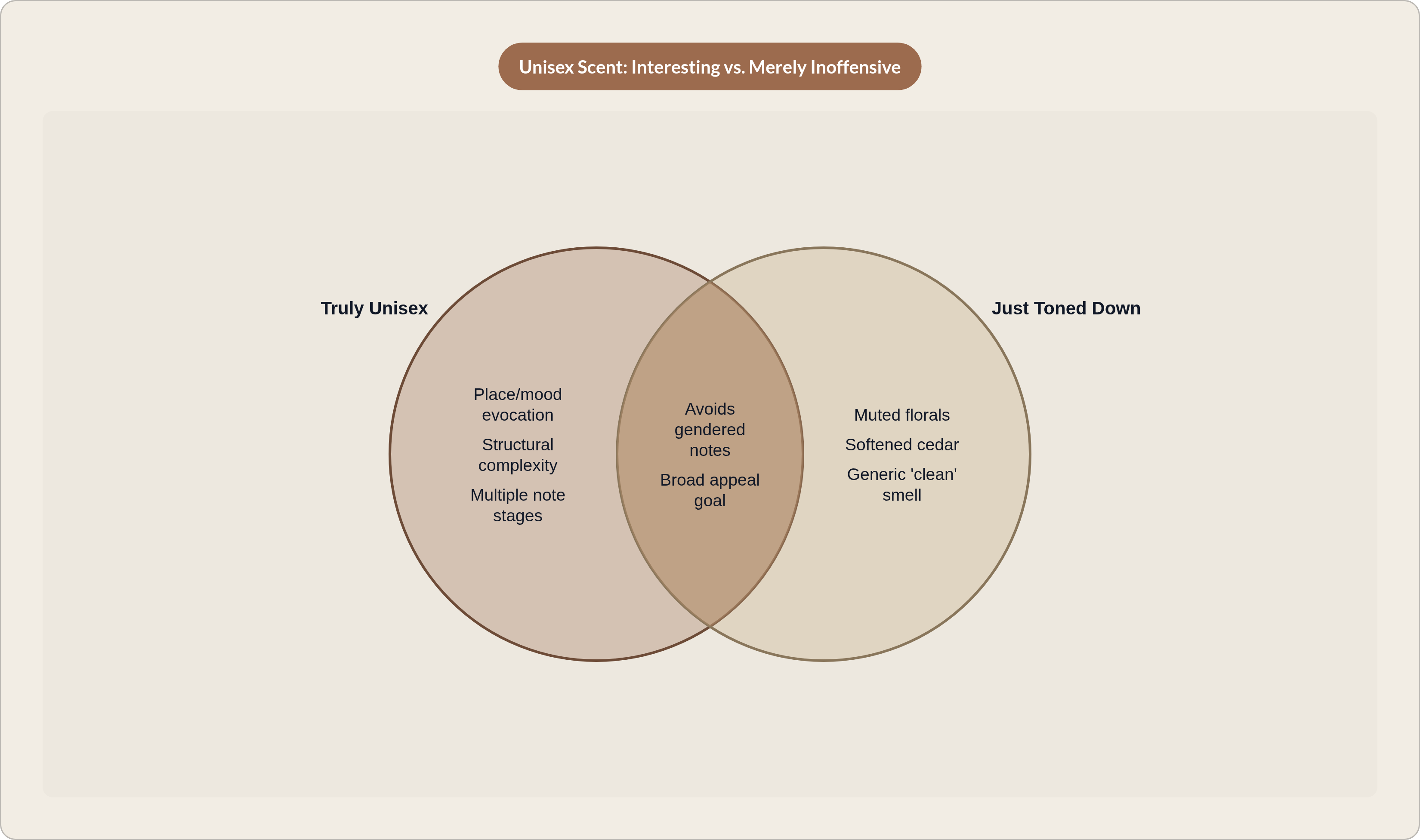
Complexity over blandness separates truly unisex fragrances from merely inoffensive ones.

Start with what unisex isn't.
Heavy leather, sharp barbershop, thick tobacco carry masculine coding so deeply baked in that even a beautifully made fragrance gets read through that lens first. Powdery rose, sweet gourmand, heady white florals present the same problem in the opposite direction. Neither category is bad. But in a shared home, both can feel like someone quietly claiming the space.
Here's something I noticed after spending years in this category: most so-called unisex fragrances aren't actually constructed to be neutral. They're just toned down. The florals get muted. The cedar gets softened. What's left is something that doesn't offend anyone and fails to interest anyone, either.
That's not broad appeal. It's just conflict avoidance.
Scents that actually hold up across different preferences tend to share one structural quality. They evoke a place or a mood rather than a person. Sea salt and driftwood don't suggest a demographic. Neither does bergamot over sandalwood, or fig over clean woods. Nobody walks in feeling like they stepped into someone else's aesthetic.
The note families that reliably read as gender-neutral in home diffusion:
- Fresh citrus. Bergamot, grapefruit, yuzu. Light, energizing, and hard to argue with.
- Clean aquatics. Sea salt, rain, driftwood. Open and spacious. Think of a cracked window, not a candle.
- Warm woods. Sandalwood, cedarwood, vetiver. This category gets miscategorized as masculine constantly, but at moderate intensity, warm woods sit close enough to neutral that most people don't even clock the association.
- Green botanicals. Fig, basil, cut grass. They evoke places, not people.
- Soft ambers and resins. More useful as base notes than leads. They add warmth without tipping into heavy, syrupy territory.
Modern genderless blends often feature ambroxan, neroli, and green tea. These read as contemporary without pulling in either gendered direction.
But what actually separates interesting unisex fragrance from the merely inoffensive kind? A flat, linear scent that smells generically "clean" gives nobody anything to hold onto. A vetiver-citrus blend, or a coastal profile with a warm wood dry-down, creates multiple entry points across the top, heart, and base. Different noses catch different things. That's what builds real, durable appeal rather than polite tolerance.
Complexity is the mechanism, and the "unisex" label is just the marketing.
How Shared Living Spaces Shape Which Unisex Profiles Actually Work
A scent that works brilliantly in a living room can feel completely wrong in a home office. Same nose, different context. Most fragrance content glosses right past this.
Room function changes what you need:
- Entryways and common areas. Fresh citrus and green botanicals create a welcome without making a statement.
- Living rooms. Warm woods and soft ambers layer well with furnishings and hold up over long stretches without becoming exhausting.
- Home offices. Clean aquatics and light botanicals. Research consistently links these profiles to alertness rather than sedation, which matters when you're trying to think.
- Shared bedrooms. The hardest room to get right. Anything loud, synthetic, or too closely associated with one person's taste creates low-grade friction that's hard to name but easy to feel. Soft woods, vetiver, and lightly warm florals are the safer starting points.
- Bathrooms. Citrus and aquatics feel intuitive. Wood notes, counterintuitively, can also work well in small enclosed spaces.
Household composition shifts the calculation further. Pets, young children, and anyone managing respiratory sensitivities aren't edge cases for a lot of households. A fragrance that's gender-neutral is only useful if it's also safe to diffuse continuously in shared air. The ingredient question is coming up in a minute and it's worth not skipping.
Season matters too. A citrus-forward blend that feels exactly right in June can feel thin and slightly cold in January. A warmer wood or amber base earns its place in a fall and winter rotation in a way it simply doesn't in summer. Which is another argument for building a small rotation rather than committing to one bottle, but more on that later.
Why Diffusion Method Changes How a Unisex Scent Reads in a Room
Same fragrance oil, different diffuser, noticeably different experience. This is one of the most undersold variables in home fragrance, and in my experience it matters as much as the scent itself. Sometimes more.
Heat-based methods, including wax melts and heated diffusers, volatilize top notes quickly. The bergamot and grapefruit disappear first. What remains is the heavier base, sitting without its context. A sandalwood-citrus blend that should feel balanced ends up reading as flat or musky. The structural complexity you bought evaporates before it reaches the room.
Water-based ultrasonic diffusers dilute the oil, which flattens that same complexity. Limited room coverage, frequent cleaning, and standing water that creates real conditions for mold and bacterial growth make these less than ideal for households with allergy concerns.
Cold-air diffusion works differently. It uses air pressure to atomize undiluted fragrance oil into fine particles. No heat, no water. The molecular structure of the scent is preserved from bottle to room. Top, heart, and base notes arrive in the relationship they were designed to have.
For shared spaces, the practical advantages stack up:
- Even dispersion across larger rooms without multiple units
- Programmable intervals that prevent olfactory fatigue, so the scent stays perceptible rather than disappearing into the background within twenty minutes
- No added humidity, relevant for households managing sensitivities
- No residue on surfaces or textiles
Aera's plug-in diffusers use what the brand calls Microdroplet Technology to disperse particles smaller than traditional aerosol.
The point isn't to rank these against each other. The point is that delivery method is a real variable, not a footnote. If you invest in a carefully balanced fragrance oil, the diffuser either honors that balance or quietly dismantles it.
The Ingredient Question: What's Actually in a Fragrance Oil Matters as Much as How It Smells
Phthalates first, because they're the most commonly cited and the most commonly dismissed.
These are plasticizers used as fixatives in conventional fragrance formulations. Research cited by Vine Vida found detectable phthalate levels in the urine of more than three in four adults. Some evidence connects them to reproductive disruption. Other ingredients that show up in conventional home fragrance include formaldehyde, benzene, toluene, and xylene, each carrying documented respiratory or neurological concerns at sustained exposure.
Here's the structural problem that makes this genuinely hard to navigate. Conventional fragrance products can legally list hundreds of synthetic chemicals under the single word "fragrance" on a label. It's a proprietary protection mechanism, but it's also a complete transparency gap. You have no visibility into what you're actually diffusing into shared household air.
But "clean" needs unpacking, because the word is doing a lot of unregulated work right now.
"Non-toxic" is a marketing term, not a government-certified standard. It signals a formulation philosophy. "Natural" doesn't automatically mean safe. Some essential oils cause sensitization or phototoxicity at certain concentrations. And some synthetic ingredients are actually safer than natural equivalents precisely because they've been more rigorously tested.
So what markers actually mean something? Specific ones: phthalate-free, paraben-free, formaldehyde-free. Full ingredient transparency rather than "fragrance" as a catch-all. Third-party standards give you a real benchmark. Sephora Clean, for instance, prohibits more than fifty suspect ingredients across certified products.
For households with children, pets, or anyone managing sensitivities, this isn't a premium consideration. It's the floor.
Unisex Fragrance Oils Worth Considering, and What Makes Each Work
Rather than a ranked list, here's a profile-first approach. The goal is matching note family to space and use case, not winning an argument about which scent is objectively best.
Fresh Citrus and Green Profiles
Best for: entryways, kitchens, common areas, daytime.
Look for bergamot or grapefruit as the lead note, a green botanical or light floral in the heart, and a clean woody dry-down rather than a musky base. These are the most broadly accessible profiles in unisex home fragrance. They don't demand anything from anyone, which sounds like faint praise but is actually the whole point.
Anchoring a scent to a place rather than a persona sidesteps gendered associations more naturally than building around abstract "freshness," and it gives household members something neutral to agree they like.
Clean Aquatic and Coastal Profiles
Best for: bathrooms, home offices, open-plan spaces, year-round.
Sea salt, driftwood, rain-type notes. These tend to work well in households where scent preferences diverge most sharply, precisely because there's very little to push back against. They feel open without asserting a strong aesthetic identity, which is a harder trick to pull off than it sounds.
Warm Wood and Amber Profiles
Best for: living rooms, bedrooms, evenings, fall and winter.
Sandalwood, cedarwood, vetiver at moderate intensity. Grounding without defaulting to masculine. A soft amber base adds warmth without sweetness. This is the register that rewards a good diffuser most directly, because the complexity of the dry-down is exactly what heat-based methods tend to kill first.
A spa lobby, a mountain lodge. Evocative of a specific sensory experience rather than a demographic. That framing is doing real work.
One practical note for cold-air diffuser owners: verify that any fragrance oil you buy is formulated for nebulizing diffusion. Viscosity and carrier content affect atomization.
Building a Small Unisex Fragrance Collection Rather Than Committing to a Single Scent
The strongest home fragrance setups I've encountered rotate. Not because variety is inherently better, but because different contexts call for different registers. Think of it the way you'd think about a wardrobe. One coat doesn't cover every season, and you wouldn't expect it to.
A minimal starting collection:
- One fresh or citrus profile. Daytime use, shared spaces, entryways.
- One warm wood or amber profile. Evenings, bedrooms, colder months.
- One clean aquatic. Year-round utility, bathrooms, home offices, and anyone in the household who consistently wants something lighter.
Three bottles covers a lot of ground without overwhelming anyone's tolerance. It's also a low-stakes way to build genuine buy-in across different preferences, which matters more than it sounds when you're sharing air with other people.
Cold-air diffusers with programmable scheduling make rotation practical without the manual effort. Morning versus evening scents without swapping bottles by hand. Dual-vial smart diffusers extend this further.
There's a layering principle worth keeping in mind too. Unisex oils diffused at low intensity in adjacent rooms can create a through-line rather than a collision. A citrus note in the entryway transitioning into a warm wood in the living room reads as cohesive. People notice it without knowing what they're noticing, which is honestly the goal.
Start with one room. Identify its primary function and the time of day it gets the most use. Match that to a note family. One bottle, one diffuser. See how the household actually responds before you buy anything else. The answer to "what unisex scent works for us" is almost never something you reason your way into. It's something you smell your way into over a few weeks.