Luxury Home Fragrance Without Synthetic Chemicals
Hidden chemicals in "fragrance" labels accumulate in your home and body over time.

Let me start with an admission: I spent years around the home fragrance industry before I understood what was actually in the products I was recommending to people. The science was there. I just wasn't looking for it.
The global home fragrance market is worth billions of dollars today and is on pace to double by 2033. That growth isn't being driven by the same synthetic formulas that dominated shelves for decades. It's being driven by people who want their homes to smell incredible and also want to stop unknowingly marinating in chemicals for eight hours a day. That's a fair request.
What I want to do here is walk you through what I've learned. Not to alarm you, and not to sell you on a total overhaul. Just to give you a clearer map of what clean fragrance actually means, how delivery technology fits in, and how to build a scent practice that serves your home and your health. You can decide what to do with it.
"Fragrance" Is a Legal Loophole, Not an Ingredient
Here's the part that surprised me when I first came across it.
When you see the word "fragrance" on an ingredient label, you're not reading an ingredient. You're reading a category. In the United States, "fragrance" is classified as a trade secret, which means a manufacturer can list it as a single term while concealing hundreds of individual compounds underneath. According to the Environmental Working Group, thousands of distinct chemicals can legally hide behind that one word.
That's worth sitting with for a second.
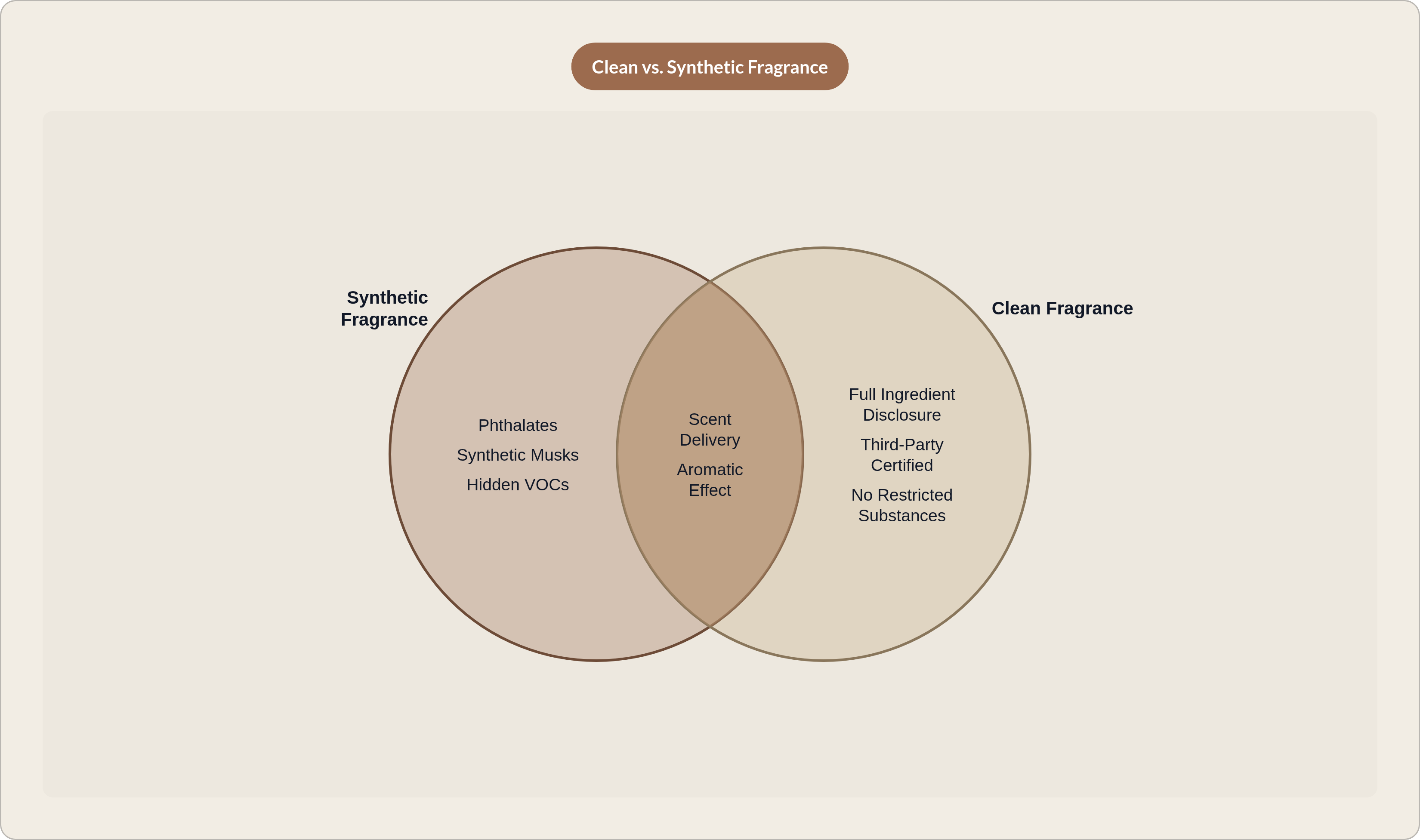
Some of the most common compounds found in synthetic fragrance blends include phthalates, which are used to make scent last longer on surfaces and in the air, and are linked to endocrine disruption. Synthetic musks, which give that clean, lingering base note to a lot of mass-market products, accumulate in body tissue over time. Volatile organic compounds (VOCs) release into indoor air and are associated with respiratory irritation. Parabens, a preservative class, have hormone-mimicking properties.
None of these are necessarily labeled. Some of them are banned in the EU and still legal in the U.S.
Research by Dr. Anne Steinemann found that 34% of the population reported health problems from exposure to fragranced products, with migraines being the most commonly reported symptom. Around 30% of people experience some form of sensitivity to synthetic fragrance.
A candle or a diffuser runs for hours in an enclosed space. The exposure isn't a single sniff. It accumulates. That's the real concern.
So when you read "fragrance" on a home product label, the straightforward response isn't satisfaction. It's a follow-up question.
"Clean Fragrance" Is a Market Category, Not a Legal Term. Here's What That Means.
One might argue that "clean fragrance" is just marketing with better aesthetics. And that argument has some merit. There's no regulatory definition. No federal standard. The term is defined entirely by what a brand chooses to exclude, not by any certification body that has legal authority over the space.
So does that make "clean fragrance" meaningless? Not quite. But it does mean you have to look past the label.
Here's what clean formulation broadly means in practice: no phthalates, no parabens, no synthetic musks, no heavy metals, no known carcinogens, and no VOC-generating compounds without disclosure. That's the baseline most credible clean fragrance brands work from.
What actually gives it teeth are third-party standards. A few worth knowing:
- Sephora Clean requires brands to meet a defined restricted substances list. It's one of the more rigorous retail clean standards in the U.S. market, and it requires verification, not just self-reporting.
- IFRA (International Fragrance Association) compliance sets concentration limits on known sensitizers. It's not perfect, but it's a recognized industry benchmark.
- EWG Verified and MADE SAFE certifications address ingredient safety with independent review.
- Vegan and cruelty-free certifications speak to ethical sourcing, which often (though not in every case) correlates with cleaner formulation practices.
The clearest signal of all? Full ingredient transparency. Brands that list individual fragrance components, rather than sheltering behind "fragrance" as a catch-all, are doing something most of the industry still won't do. That matters.
It's also worth considering the household context. A single adult choosing fragrance for their apartment is making a personal decision. A household with young children or animals is dealing with heightened, continuous exposure for family members who have less ability to advocate for themselves. Clean formulation stakes aren't equal across households.
Over 65% of new premium fragrance launches now highlight natural ingredients. Around 48% of global beauty brands have incorporated natural fragrance profiles. The industry is responding. The question is whether the standards are keeping pace with the claims.
The Ingredient List Is Only Half the Story
This is the part people most often miss. And it's one I overlooked for longer than I'd like to admit.
You can have a fragrance oil with a completely clean ingredient list. And if you're delivering it the wrong way, you're still creating a problem.
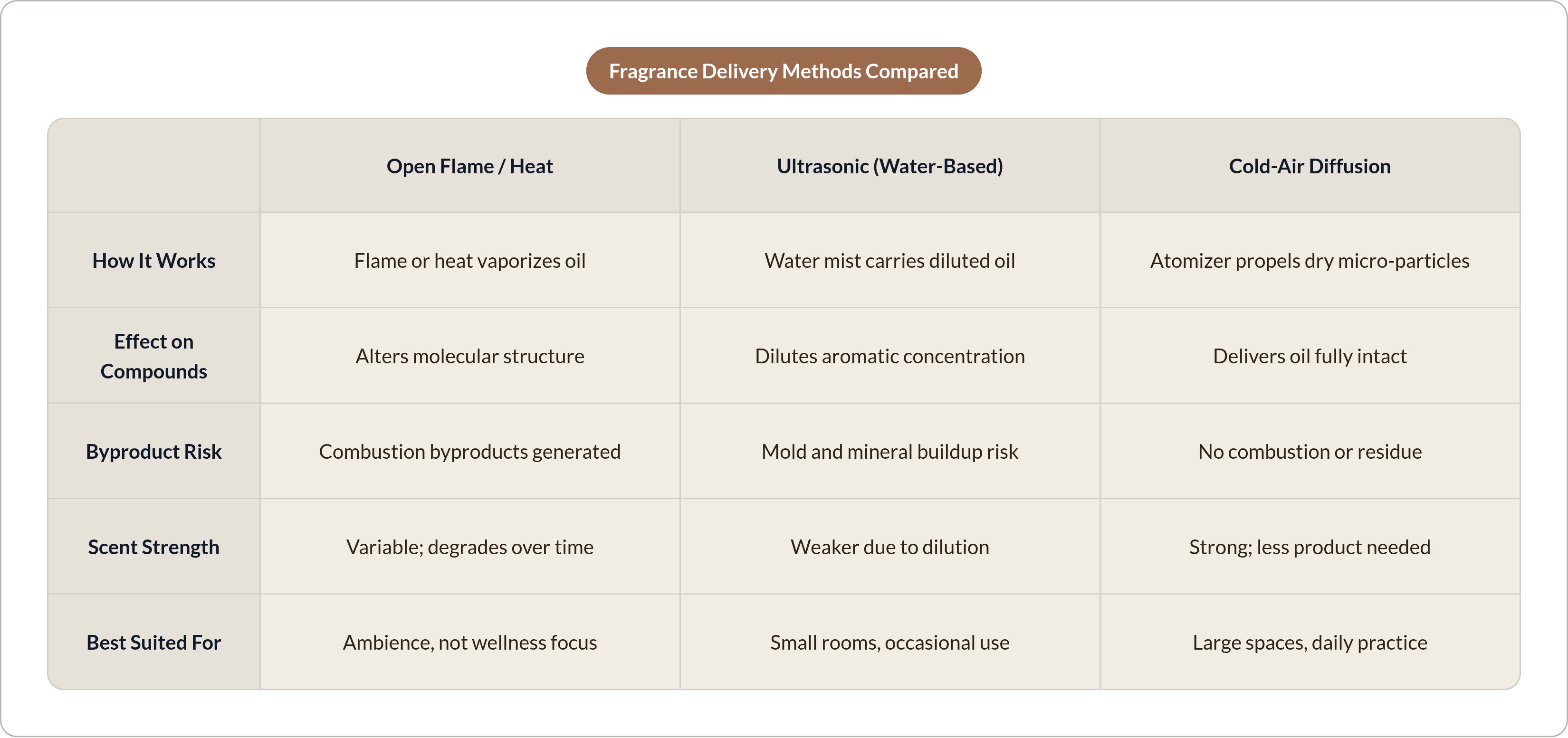
Heat changes things. Candles, wax melts, and traditional oil burners work by applying flame or direct heat to fragrance compounds. Heat alters and can destroy the molecular structure of aromatic compounds. That changes the scent profile, and it can generate combustion byproducts that weren't in the original formulation. The oil you purchased may be clean. What comes off a burning wick is a different question.
Ultrasonic (water-based) diffusers are better than open-flame methods, but they come with their own issues. They dilute the oil, reducing scent concentration. They create conditions, especially in humid environments, where mold or mineral residue can build up over time. They work. They just don't work as cleanly or as effectively as the marketing suggests.
Cold-air diffusion is the delivery method that's changed the equation. Here's how it works: a specialized atomizer breaks fragrance oil into microscopic particles, which are propelled into the room by a stream of cool, filtered air. No heat. No water. No alcohol. The aromatic compounds arrive intact, exactly as formulated. No combustion byproducts are generated. And because the oil isn't being diluted, you get a stronger scent result from less product.
Cold-air diffusion systems can effectively scent very large spaces. That's a meaningful gap compared to candles, reed diffusers, or plug-ins. Homeowners are moving away from single-room fragrance toward systems that create a consistent atmosphere across larger areas. Cold-air technology is what makes that viable.
Your Brain on Scent (and Why Clean Matters Here, Too)
Scent is the only sense that bypasses cognitive filtering on the way to your emotional brain.
Every other sense — vision, sound, touch, taste — passes through a processing relay (the thalamus) before reaching the areas of your brain associated with emotion and memory. Scent doesn't. Inhaled molecules bind to olfactory receptors that send signals directly to the amygdala and hippocampus. That's why a specific smell can pull up a memory or shift your mood before you've consciously registered what you're smelling.
The research here is specific, not just theoretical.
A randomized controlled trial found that lavender essential oil reduced anxiety symptoms by 32% in patients awaiting minor surgery. A 2025 study found that diffusing rosemary and peppermint in office environments improved memory recall and alertness by 18-20%. A Japanese clinical trial found that daily bergamot and ylang-ylang aromatherapy produced a 26% reduction in depressive symptoms, alongside improvements in sleep and social engagement in elderly patients.
That's a real physiological mechanism, not aromatherapy folklore.
These benefits are documented for pure essential oils and clean aromatic compounds. Synthetic fragrance chemicals that generate respiratory irritation or neurological symptoms work directly against the mood effects the research describes. A synthetic fragrance blend that triggers a headache in one-third of the population is not delivering a wellness benefit, regardless of how good it smells in the first ten seconds.
Consumer data shows that a large majority of the population reported appreciating scent more in 2024 than in 2020. People are using scent intentionally now. The question is whether the products they're reaching for are actually delivering on the wellness end of that promise.
A Room-by-Room Approach to Building a Scent Practice
The principle here is simple: different spaces serve different psychological functions. Fragrance can reinforce those functions when it's chosen with that in mind. Or it can work against them when it isn't.
Here's a useful starting framework:
Living room and entertaining spaces. This is your first-impression scent. Warm woods, soft spices, complex florals. Something welcoming and layered. The goal is ambient, not intrusive.
Bedroom. Lavender, chamomile, sandalwood. This is wind-down territory. The scent you use here should signal something to your nervous system, not just smell nice. If you've used the same blend consistently over time, that association gets stronger. Habit stacking works with scent the same way it works with behavior.
Home office and work areas. Peppermint, rosemary, citrus. The 2025 study showing an 18-20% improvement in alertness and memory recall is directly applicable here. Energizing without being aggressive.
Bathroom. Lighter formulations. Citrus, marine, eucalyptus. The bathroom doesn't need complexity. It needs freshness.
One thing that's shifted in consumer behavior recently is the "scent for mood" approach. People aren't picking a fragrance for a room anymore. They're picking a fragrance for a state of mind and letting the room follow. Morning diffuser routines, midday focus blends, evening wind-down sequences. That's a more sophisticated relationship with scent, and it maps directly onto the neuroscience.
For building a collection: start with two or three scents tied to specific rituals or times of day rather than buying broadly. Choose oils with full ingredient disclosure. And match the delivery method to the room size. Cold-air diffusion for larger shared spaces. Smaller formats for intimate rooms where you want something gentler.
Buying Clean Luxury Fragrance Without Getting Played
The clean fragrance market was valued at $13.64 billion in 2025 and is projected to reach $33.40 billion by 2035. That's a fast-growing space. And in fast-growing spaces, "clean" claims proliferate faster than the standards that back them up.
So here's the practical filter.
Green flags:
- Individual fragrance components are listed, not hidden behind the single word "fragrance"
- Third-party or retail certification: Sephora Clean, MADE SAFE, EWG Verified
- An explicit exclusion list: no phthalates, no parabens, no synthetic musks, no undisclosed VOCs
- Vegan and cruelty-free status, which often (not in every case) signals cleaner sourcing practices
- Cold-air or nebulizing delivery for at-home use. No heat. No water dilution.
Red flags:
- "Fragrance" or "parfum" as a single unlisted ingredient. Full stop.
- No mention of restricted substances or safety testing anywhere on the product or brand site
- Heat-based delivery as the only option, combined with zero ingredient transparency
One other thing worth naming: clean home fragrance — especially a diffuser system paired with curated oils — is well-suited as a gift, precisely because it creates a daily ritual rather than a single-use gesture. The person receiving it builds a practice with it. That's a different category of gift than a candle that burns down in two weeks.
Luxury complexity in home fragrance no longer requires synthetic chemistry. The formulation science has caught up. The delivery technology has caught up. The clinical evidence has been building for years. Clean and sophisticated are not in tension anymore.
They just require you to read the label more carefully than the industry has historically wanted you to.