Are Diffusers Bad for Your Lungs
Diffusers release potentially hazardous chemicals that pose real risks for certain lungs.
A diffuser aerosolizes fragrance compounds and sends VOCs, volatile organic compounds, into whatever air you happen to be breathing at the time. Chemically it's kin to popping open a can of paint or spraying down a bathroom mirror; the difference is a diffuser is designed to keep doing it, on a loop, for however many hours you let it run.
A team cataloguing emissions from 24 essential oils found 595 distinct VOCs across them, representing 188 unique compounds. Alpha-pinene, limonene, linalool, camphene: the regulars, names you've probably squinted at on the back of a "pure" lavender bottle without knowing what you were looking at. Of those 595, researchers flagged 124 (33 distinct compounds) as potentially hazardous, acetaldehyde and acetone and ethanol among them. Toluene, the paint-thinner compound, showed up in roughly half the oils tested.
Here's the detail that actually stopped me mid-sentence when I first read the study: there was no meaningful difference in hazardous VOC output between oils marketed "natural" and oils sold as plain "regular." Same chemical footprint, different marketing copy. The word natural did some work on the label, but it did nothing to the air.
There's a second wrinkle almost nobody talks about: indoor ozone chemistry. Limonene, the compound giving citrus oils their snap, reacts with ordinary ambient ozone indoors to form formaldehyde, a well-documented respiratory irritant. The risk isn't only what's printed on the bottle; it's also what that oil turns into once it collides with your actual living room air, a reaction most of us never signed up to think about when we bought a diffuser.
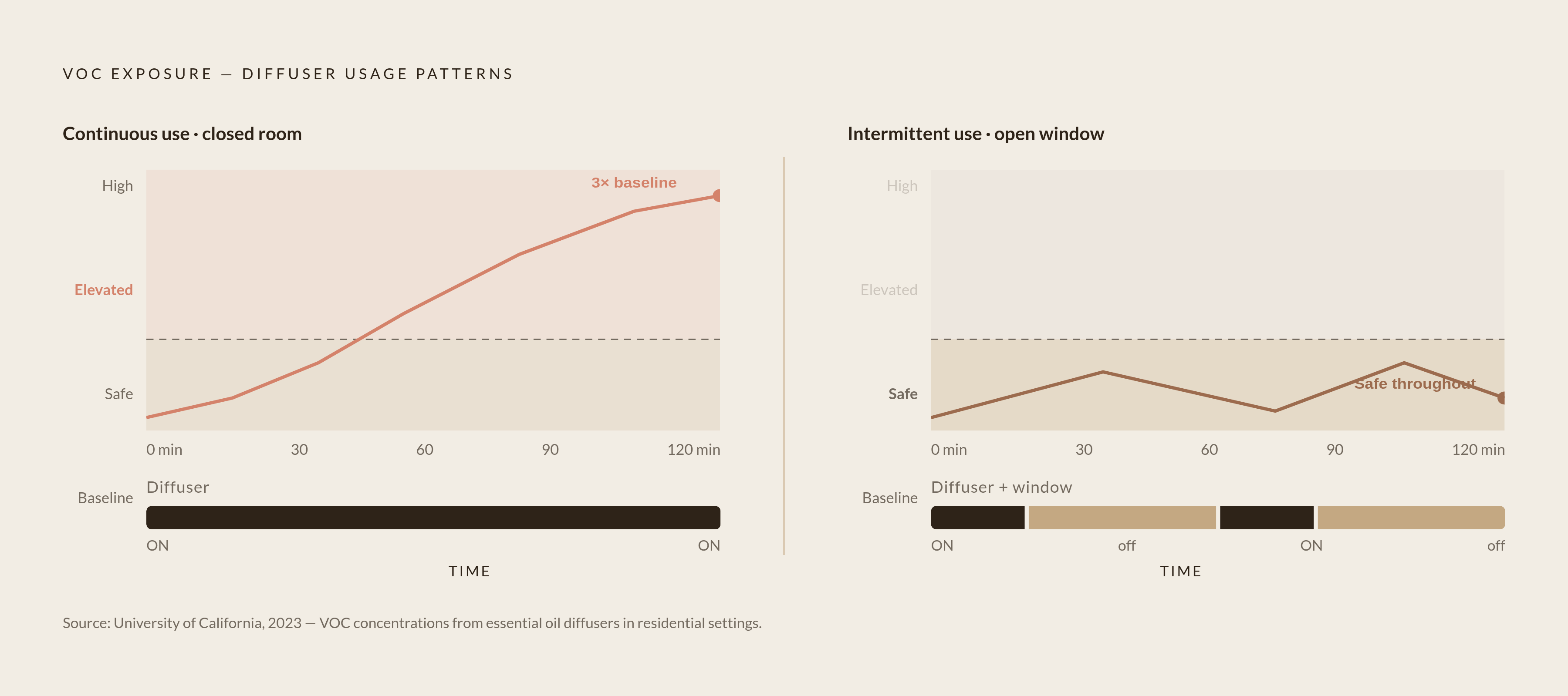
Numbers help here. A 2023 University of California study found continuous nebulizing diffuser use over two hours raised indoor VOC levels substantially above baseline in poorly ventilated rooms, and sit with that for a second. The same study found intermittent use paired with an open window kept VOC levels in a safe range the entire time. Chemistry sets the ceiling. Your habits decide how close you get to it.
Who actually faces respiratory risk from diffuser use
Not every set of lungs reacts to the same air the same way, and the at-risk group here is fairly well mapped out.
People with asthma or COPD sit at the top. Research in Allergy, Asthma & Clinical Immunology found children exposed to essential oil diffusers showed higher rates of wheezing, coughing, and shortness of breath than kids who weren't exposed. Dr. Neha Solanki, a pulmonologist at the Cleveland Clinic Asthma Center, has pointed out that diffused eucalyptus and lavender release terpenes, toluene, and benzene, compounds with documented respiratory effects. Fragrance itself sits on the CDC's list of common asthma triggers.
Now the part that took me an embarrassingly long time to accept: eucalyptus and peppermint make you feel like you're breathing better. That cool, opened-sinus sensation is real, and it's also a little misleading, because both act as airway irritants in anyone prone to inflammation. Your nose is reporting a friendlier story than your bronchial tubes are actually living. A 2022 study of 200 people found a negative association between essential oil use and cardiopulmonary health. That finding is contested, and I'm not pretending it's settled science, but pretending it doesn't exist would be worse.
Healthy adults without underlying respiratory issues carry lower risk under normal, moderate use, and that distinction is worth holding onto. Still, even healthy people rack up headaches, nausea, and airway irritation from all-day continuous diffusion, which is a fine reminder that safe and unlimited aren't synonyms. Infants, kids with airways still under construction, older adults, and pets round out the higher-caution group, and pets get their own real estate further down, since cats in particular warrant closer attention.
How diffuser tech shapes the risk: cold-air, ultrasonic, and heat compared
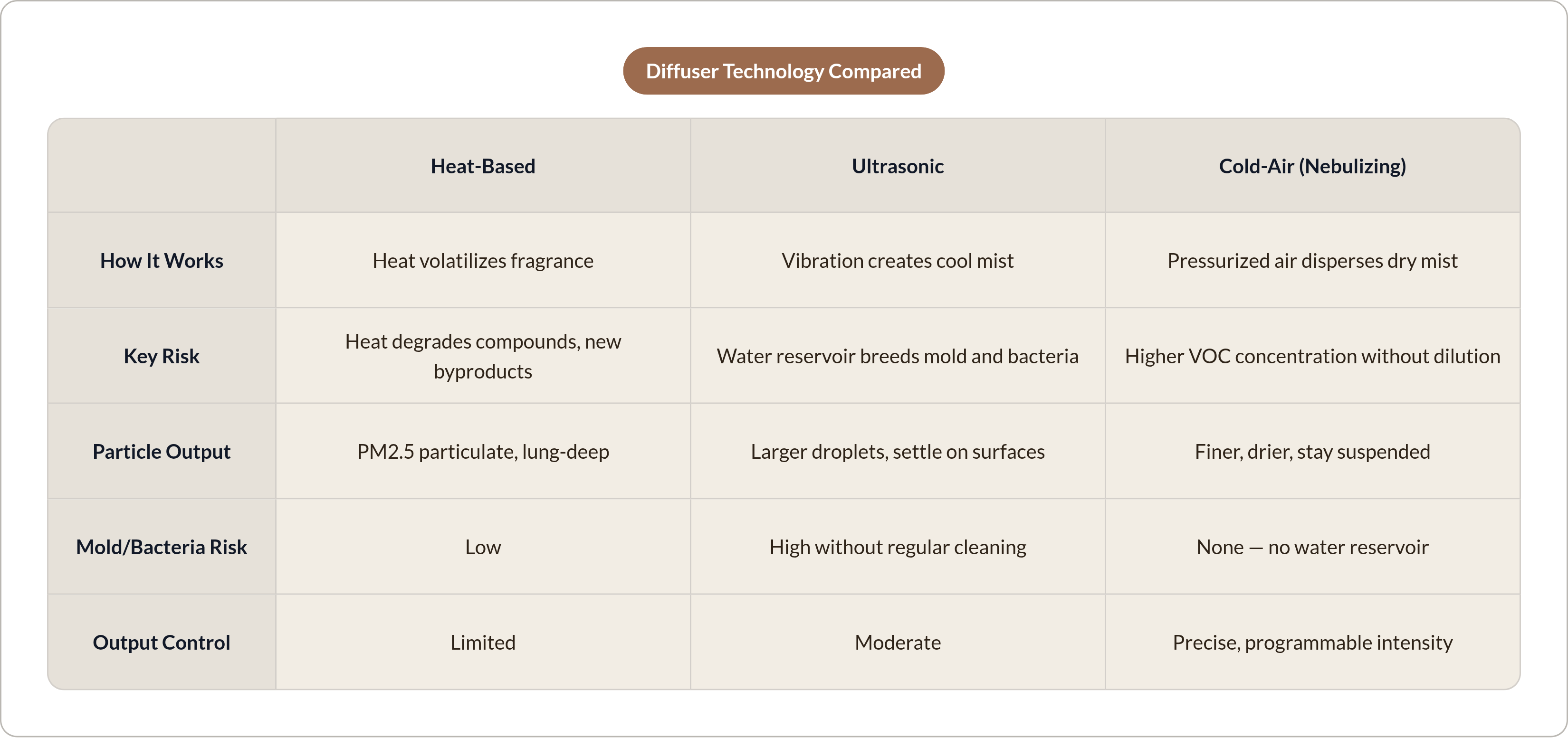
Three technologies dominate the home diffuser shelf, and they behave differently once you stop reading the packaging and start reading the chemistry.
Heat-based diffusers, candle warmers, plug-ins, use heat to push fragrance into the air, and heat changes chemistry on contact. Warming a compound degrades it, sometimes generating byproducts that were never in the original formula to begin with. Candles specifically throw off PM2.5 particulate matter, particles small enough to slide past your nose and throat and land straight in the alveoli, the tiny sacs where oxygen exchange happens. Testing shows candle emissions running well above ultrasonic diffusers on PM2.5, regardless of how good the candle smells.
Ultrasonic diffusers work on a different principle: water plus high-frequency vibration produces a cool mist carrying oil droplets along for the ride. The water reservoir, though, turns into a mold-and-bacteria situation fast if you're not cleaning it on a real schedule, and these units tend to produce larger droplets, the kind that get inhaled more deeply or settle onto your couch cushions. A 2021 study measured PM1 emission rates from lemon oil in ultrasonic diffusers at roughly 2 milligrams per hour, fine particles capable of triggering inflammatory responses in anyone already sensitive.
Cold-air, or nebulizing, diffusers work differently on both fronts. Pressurized filtered air disperses a dry mist of undiluted fragrance without heat and without a water tank, which removes the main breeding ground for mold and bacteria. Particles run finer and drier, so they stay suspended instead of clinging to fabric or settling into your airway. This is the same underlying tech behind luxury hotel scenting systems, the kind built to run all day in occupied lobbies. Aura House builds cold-air diffusers on this principle: waterless, heat-free, with no reservoir accumulating residue over time.
One caveat worth saying plainly: cold-air diffusers still release VOCs, and nobody's claiming otherwise. What changes is particle size, the absence of water-borne contaminants, and how tightly you can dial output up or down.
Beyond these three sits a category that needs a hard line drawn around it. Personal "aromatherapy vape pens" or diffuser sticks built for direct inhalation are a different category entirely. The American Lung Association groups these with electronic cigarettes, for good reason: they're inhalation devices meant for direct personal use, and treating one the same as a room diffuser sitting six feet away is a mistake worth not making.
What's in the oil matters as much as the device spraying it
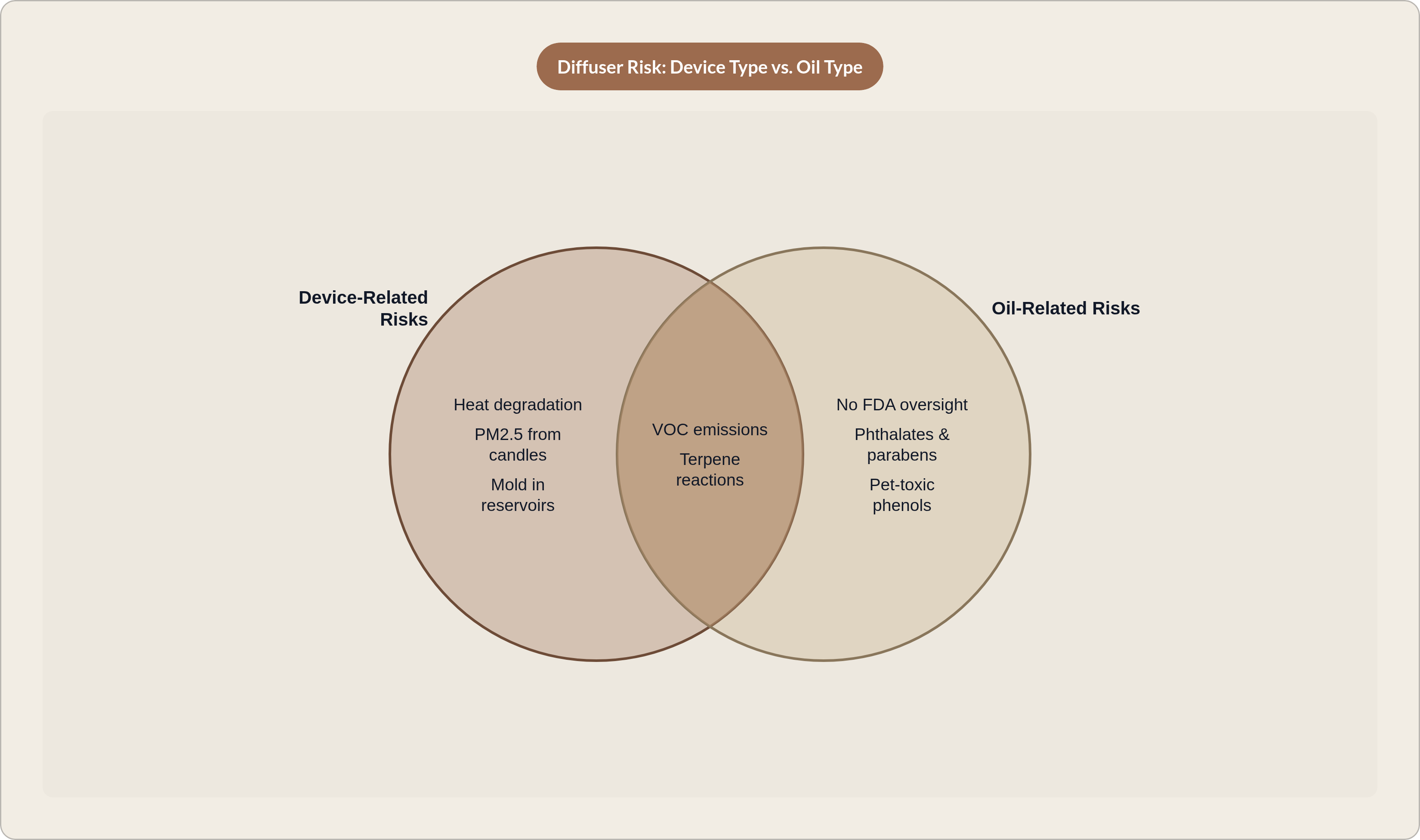
Remember that finding from earlier, the one where "natural" oils showed no real edge over "regular" oils on hazardous VOC output? That's the anchor for this whole section, because it means the word on the label is doing considerably less work than most people assume.
Essential oils, as an industry, operate with no FDA oversight. Nobody's checking what's inside a given bottle, at what concentration, or whether a trace contaminant snuck in somewhere along a supply chain that probably crosses three continents, so you're trusting a manufacturer's word in place of any independent check whatsoever.
The watch list runs through phthalates, parabens, and synthetic dyes, ingredients increasingly documented for downstream effects and slowly, unevenly, pushing the market toward cleaner formulas. Fragrance oils, distinct from essential oils, can carry extra synthetic compounds, and their safety hinges almost entirely on how transparent the maker chooses to be about what's actually in the bottle.
So what do you actually look for? Full ingredient disclosure comes first: brands publishing a real list instead of hiding behind the single word "fragrance" on the back label. Phthalate-free formulation matters too, since phthalates are plasticizers with documented endocrine effects, not something you want aerosolizing into your living room on a loop. Vegan and cruelty-free production isn't a lung-safety metric on its own, but it tends to correlate with brands paying closer attention to ingredients generally; a decent proxy, not a guarantee. Aura House formulates its fragrance oils with published ingredient lists and phthalate-free ingredients.
Regulation around VOCs in home fragrance is tightening, slowly nudging manufacturers toward exactly this kind of transparency. Even so, it's playing catch-up, so you can't fully outsource this judgment to a government agency yet. A "clean fragrance" claim backed by an actual, checkable ingredient list means something real. Without that backup, it's just a marketing claim.
How you run a diffuser changes its safety more than most people realize
Here's the genuinely good news: usage behavior is the one variable fully in your hands, starting today, with the diffuser already sitting on your shelf.
Session length matters more than people assume. Most experts land somewhere around 30 to 60 minutes of active diffusion followed by at least an hour off, and continuous all-day operation is exactly where overexposure symptoms (the headaches, the nausea, the low-grade irritation) start stacking up, even in people with perfectly healthy lungs. Ventilation might be the single most useful lever available to you: that same 2023 UC study that clocked a 60% VOC spike under continuous use also found intermittent diffusion paired with an open window kept levels in the safe zone the entire time. Open a window; it's not glamorous advice, but it's the one actually backed by numbers.
Room size matching is where people quietly sabotage themselves without noticing. Running a diffuser rated for a small den at full blast inside a sealed bedroom concentrates both the scent and the VOC load well past anything the device was built to handle. Matching a diffuser's rated coverage to your real square footage matters more than most people assume.
Oil volume follows the same logic, and this is where I think most people go wrong without realizing it. Manufacturers typically recommend somewhere between 3 and 6 drops per session, depending on diffuser size and oil strength, and doubling that doesn't double the pleasant smell in the room. It just doubles your exposure for zero upside, which is a bad trade by any measure. Timed on/off cycles built into a lot of modern diffusers solve the continuous-run problem automatically, one of the more genuinely useful features the industry's added in years, assuming you remember to turn the feature on in the first place.
Placement counts too. A diffuser in the middle of a well-ventilated room disperses evenly, while one shoved into a corner or crammed next to an air vent just concentrates output right where you're standing. Cleaning can't be an afterthought either: an uncleaned diffuser, ultrasonic units with water tanks especially, builds up oil residue, bacteria, and mold over time, degrading scent and air quality in the same breath.
Pets and kids in the room: where caution needs to tighten up
Kids' airways are still under construction, structurally and functionally, so a VOC concentration a healthy adult shrugs off can genuinely trigger a reaction in a small child, and that tracks straight back to the asthma research earlier in this piece.
Pets complicate things further, because they don't metabolize aromatic compounds anywhere close to how we do. Cats specifically lack certain liver enzymes needed to break down phenols, compounds found in popular oils like tea tree, eucalyptus, and clove; these oils are toxic to cats even at ordinary diffused concentrations, not just on direct contact. Dogs have a sense of smell that outclasses ours by orders of magnitude, so an oil reading as mild to a human nose can genuinely overwhelm a dog's sensory and respiratory system. The ASPCA keeps a running list of oils flagged as toxic to pets, and the simplest working rule is this: only diffuse in rooms your animals can leave freely, because if something feels wrong to them, they should be able to walk away from it.
For households juggling both kids and pets, the framework isn't complicated. Diffuse with doors open, so anyone or anything needing out can get out, and run shorter sessions at lower intensity than you'd otherwise pick. Lean toward oils with lower documented toxicity: lavender and frankincense generally land safer, while eucalyptus, tea tree, and peppermint sit higher on the risk list and earn extra caution. Waterless cold-air diffusers with programmable intensity give you the most precise control over all of this, since you can dial output down without losing the device's core function.
Even the cleanest, most transparently formulated fragrance oil, full disclosure, phthalate-free, no synthetic filler, lowers risk here without erasing the need for basic care. The oil still matters, no matter how good the machine spraying it happens to be.
A practical checklist for safe diffuser use at home
Start with the device. A cold-air, waterless diffuser is the safer baseline for your lungs, since it skips the mold-and-bacteria risk that comes bundled with any water reservoir and produces the finer, drier particles that don't linger where you don't want them. Match the diffuser's rated coverage to your actual room size instead of eyeballing it, and skip heat-based devices and personal aromatherapy vape products entirely, since different devices carry different risks.
Then look at the oil itself. Confirm full ingredient disclosure instead of trusting a "natural" or "essential" label to do that job for you, since the research says the label alone tells you almost nothing useful. Favor phthalate-free, paraben-free formulas with transparent sourcing, and if pets share your home, check any oil against ASPCA toxicity guidance before it goes in the diffuser, not after the room already smells like eucalyptus.
Operating habits round out the picture. Run 30 to 60 minute sessions with real breaks between them instead of letting the thing go all day uninterrupted, and crack a window or door during and after use. Default to the lowest intensity setting that actually does the job, bumping up only if the room genuinely calls for it. Use smart scheduling if your diffuser has it, since it removes the risk of just forgetting the thing is running, and clean the unit on the manufacturer's recommended schedule. Residue buildup quietly changes what the device puts into your air, even when the oil in the bottle never changes at all.
If you're managing asthma, COPD, or another respiratory condition, talk to a doctor before making diffusing a daily habit. Steer clear of terpene-heavy oils like eucalyptus and peppermint at first, and when you do experiment, run the shortest sessions and lowest concentration you can manage, just to see how your body actually responds before committing to anything longer.
Used with a decent device, a transparent oil, and habits that respect ventilation and moderation, a diffuser is a controlled way to shape how a room feels. The real risk lives in specific mismatches: wrong device for the space, an oil nobody bothered to disclose, a schedule that never shuts off. Get those three right, and the question stops being abstract. It becomes something you can actually answer for your own living room, your own lungs, your own pets.