Pet-Safe Plug-In Air Freshener Alternatives
Heat intensifies fragrance chemicals that accumulate dangerously in pets.
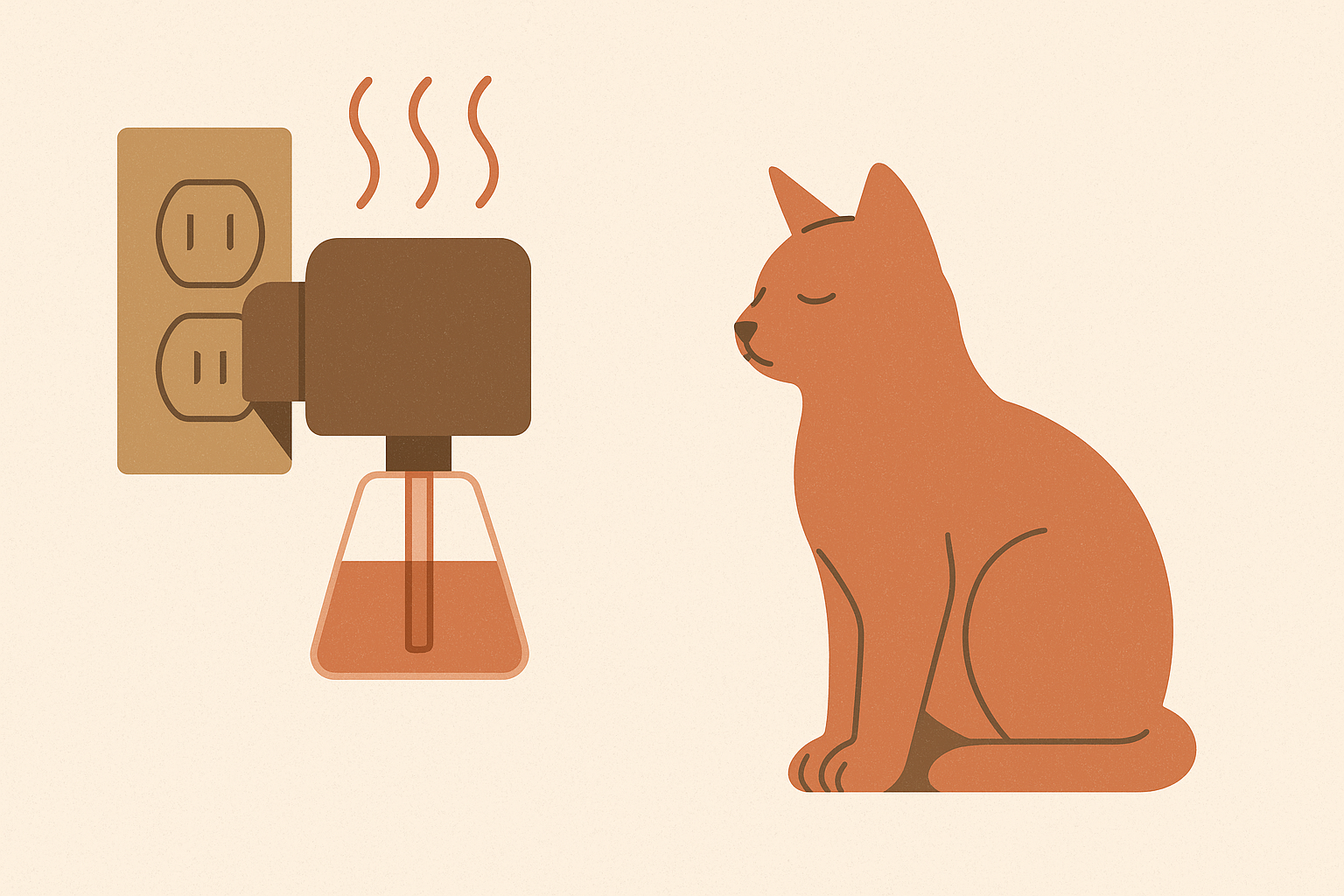
Plug-in air fresheners heat fragrance oil around the clock, and that constant low-grade heat is the actual problem for any house with a cat, dog, or bird in it. People usually frame this as a candle-versus-plug-in debate, but the more relevant factor is the heat itself, plus whatever's dissolved in the oil getting cooked by it. I've sat through enough vet conversations and squinted at enough toxicology tables to trust that combination over a nicer label. This piece walks through the mechanism, the specific ingredients that cause the trouble, and what an actual pet-safe alternative has to get right, on both counts.
What plug-ins actually release into the air
Here's a number that should bother you more than it probably does: less than 10% of air freshener ingredients ever get disclosed to the public. The word "fragrance" printed on a bottle is doing an enormous amount of legal work. It's a catch-all, legally speaking nobody has to break it down into its component chemicals, and a single product's "fragrance" can hide a few hundred of them without anyone being lied to on paper.
A study in Environmental Impact Assessment Review tested 25 air freshener products and found 133 different volatile organic compounds among them, averaging 17 VOCs per product. Twenty-four of those are classified as toxic or hazardous under U.S. federal law, and every product in the study emitted at least one. Worth sitting with: the study found no meaningful difference in VOC emissions between conventional and green-labeled products. The marketing changed, but the chemistry didn't move an inch.
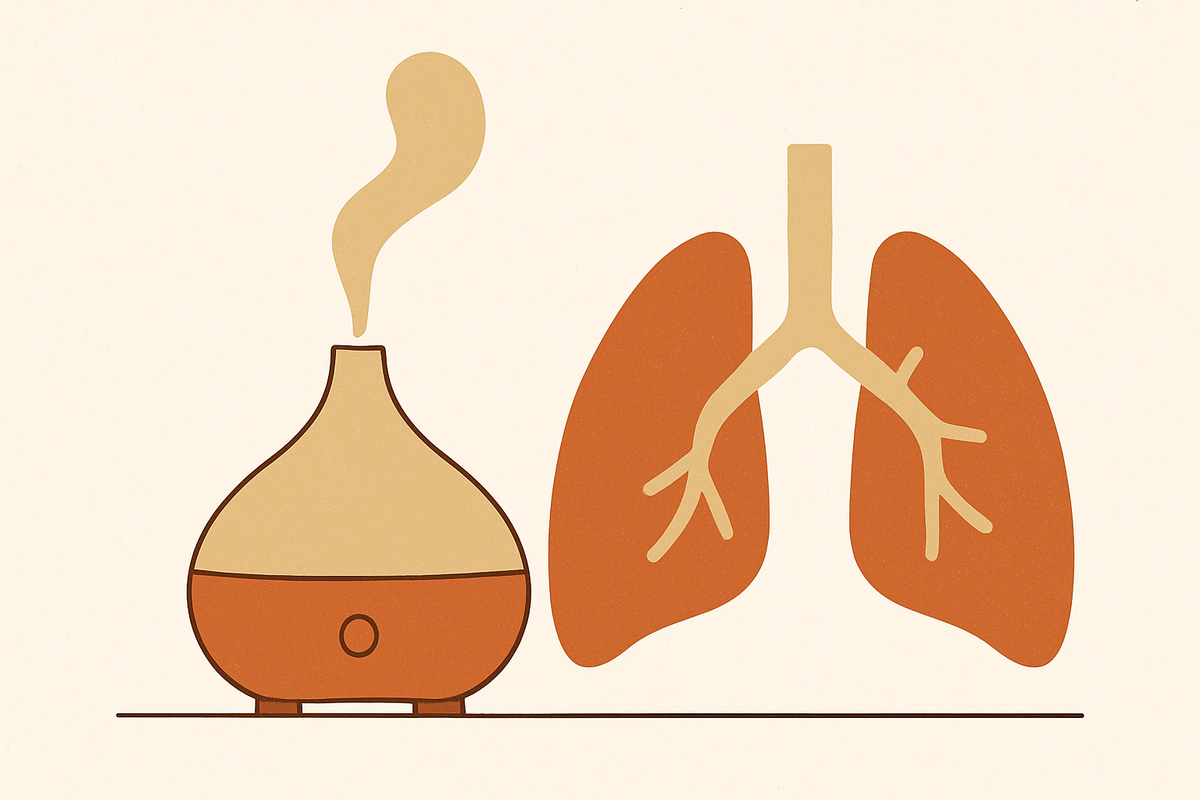
A few chemical families deserve naming outright. Phthalates carry and extend fragrance and get linked to hormonal disruption, while VOCs evaporate readily, irritate airways, and react with indoor ozone to form secondary pollutants like formaldehyde and ultrafine particles. Cyclic volatile methyl siloxanes, cVMS for short, are odorless, so there's no sensory tip-off that you're breathing them, and they bioaccumulate. Heat makes all three worse: higher VOC concentration, finer particles, deeper penetration into lung tissue.
So when a box says "pet-safe," what's actually backing it up? No agency certifies pet safety on a fragrance product, so the phrase functions as marketing copy standing in for a toxicology report it was never required to produce.
Why pets absorb these chemicals differently than humans do
Dogs detect around 100 million different odors, and cats detect roughly 200 million, with the scent-processing region of a dog's brain running about 40 times larger than ours does, proportionally, while cats smell somewhere near 14 times better than a human. A fragrance level you'd call subtle registers as anything but subtle to the animal asleep on your couch, and that's before anyone's talked about toxicity. This starts as a volume problem well before it becomes a poison problem.
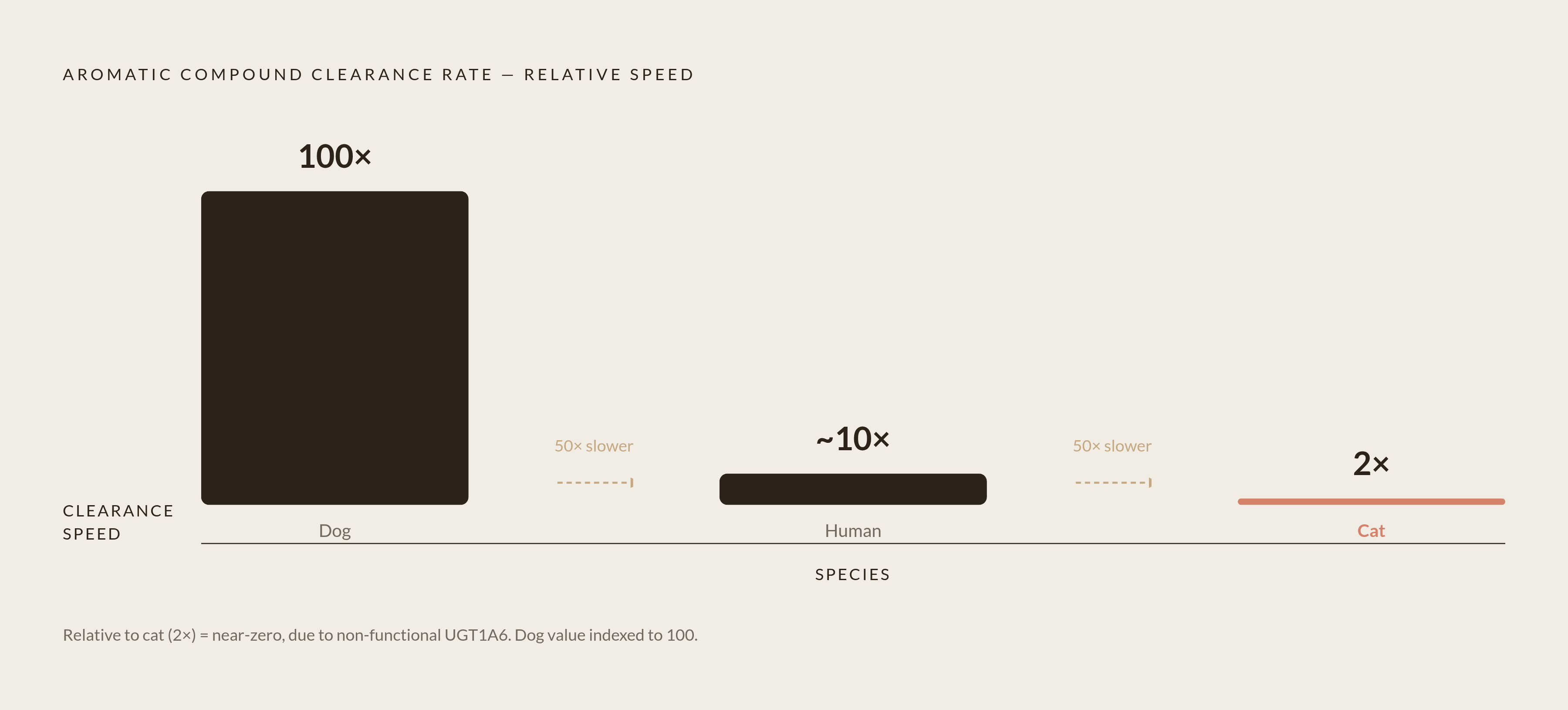
Then there's clearance, and cats draw the short straw here in a fairly specific way. Cats carry a non-functional UGT1A6 enzyme, and research from Court and Greenblatt (Pharmacogenetics, 2000) put their ability to clear aromatic compounds at roughly 50 times slower than a dog's. A dog in a room running a heated fragrance stream all day processes and eliminates some fraction of what it inhales as it goes, while a cat in that same room mostly just accumulates. One enzyme, doing measurably less damage control, at a fraction of the speed.
Birds don't need much nuance attached: even small amounts of airborne chemical exposure can kill one, and no plug-in or heated diffuser belongs anywhere near a room a bird lives in.
Size and age stack the odds further, too. Smaller and younger animals take on proportionally higher doses from identical air, and animals already dealing with liver or respiratory disease absorb disproportionate risk from exposure a healthy adult dog might not even notice.
Grooming changes the category of exposure entirely. Airborne fragrance particles settle onto fur and skin, and any pet that licks itself swallows those residues on the next pass. What started as something you inhale becomes something you also eat, both pathways running at once, stacked on top of each other rather than swapped out.
The ASPCA has tracked a 400% jump in calls to animal poison control centers tied to essential oils over the past decade. That's less proof the oils got more dangerous and more proof we underestimated this for years running. Dr. Sage De Rosa at the University of Pennsylvania School of Veterinary Medicine put it about as plainly as a vet ever puts anything: "I would say in general, it's good to avoid them." Dr. Audrey Weaver of Heart + Paw goes further, flagging that pets with existing lung conditions, asthma, cancer, or heart disease shouldn't be near air fresheners at all.
The specific ingredients and scents that are most dangerous to cats and dogs
Lumping every scent into one basket does readers a disservice, so let's name names instead of gesturing vaguely at "essential oils, bad."
Tea tree oil, melaleuca, turns up again and again in veterinary case reports as one of the more dangerous oils for both cats and dogs, while peppermint, eucalyptus, and wintergreen carry neurological risk. Cinnamon and clove irritate skin and mucous membranes, then turn hepatotoxic once concentration climbs. Citrus oils, lemon, orange, lime, are specifically toxic to cats, with dogs tolerating them somewhat better, and pine threatens both respiratory and liver function, landing hardest on cats again.
Lavender sits on the calmer end of the spectrum. It's generally considered safe for cats when it isn't ingested, and dogs handle it fine at normal diffusion concentrations. That qualifier, "at normal diffusion concentrations," is doing real work: inhaling a low, diffused amount is a different chemical event entirely from that same oil landing on skin or getting licked off fur.
Here's the practical snag underneath all of it. Most plug-in products won't say which specific oils, or which synthetic stand-ins, they're actually using, and a label that reads "eucalyptus scent" tells you nothing about concentration and nothing about whether you're getting the real compound or a lab-made analogue wearing its name. That gap between label and contents is most of the reason this piece exists.
Watch for the mild signs first: excessive sneezing, watery eyes, drooling, a pet that seems more tired than usual. Vomiting, labored breathing, tremors, or seizures mean an immediate call to the vet, with no waiting period to see if it passes. The goal is separating which ingredients are the actual problem from which format is amplifying them, so both get fixed, rather than scaring anyone into a permanently scent-free house.
Why the alternative matters: what a genuinely safer format looks like
People hear "plug-ins are bad" and go shopping for a substitute, which is the reasonable move. Trouble is, plenty of substitutes just relocate the same two problems to a different corner of the house.
Ultrasonic humidifier-style diffusers swap water for a heating coil, which sounds like an upgrade on paper. They're still dispersing essential oils into the air, though, and the oil stays exactly as hazardous no matter what pushed it airborne. Reed diffusers run passive and heat-free, genuinely, but a lot of them carry the same undisclosed synthetic fragrance blends as any plug-in; they dropped the electricity and kept the opacity. Wax melts bring the heat problem right back, VOC amplification included, just dressed up as candle wax instead of a wall socket.
So what actually separates safe from unsafe? Two things have to hold at once, not one or the other: does the delivery mechanism use heat and throw off ultrafine particles that reach deep lung tissue, and can you verify, ingredient by ingredient, what's actually being dispersed? A product that nails the mechanism but hides its ingredient list hasn't solved anything, and neither has one with a spotless ingredient list sitting inside a heating element.
Households mainly fighting pet odor, rather than trying to layer a nicer smell over it, might do better skipping fragrance for now. Enzymatic cleaners break down the source of urine and dander odor at the molecule level, and HEPA purifiers pull particulate straight out of the air. For a lot of households, that combination alone is the smarter first move, before any diffuser purchase enters the picture at all.
For households that do want fragrance in the mix, format and oil each need their own separate evaluation. No single word on a label, natural, plant-based, pet-safe, substitutes for a verified ingredient list. That word carries a lot of marketing weight and almost no actual chemistry.
How cold-air diffusion removes the heat problem
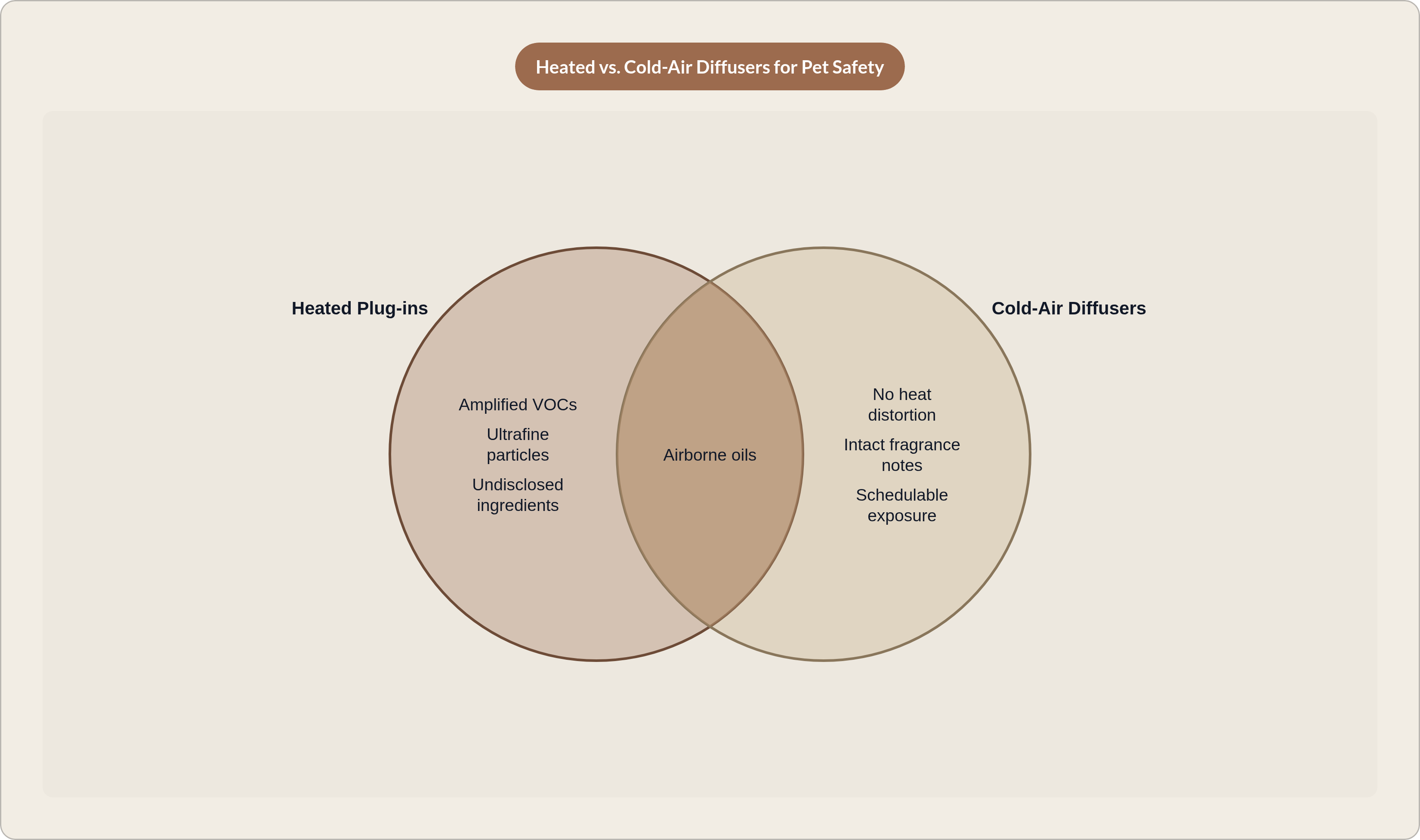
Cold-air diffusion, sometimes called nebulizing technology, disperses fragrance oil using a stream of cool compressed air pushed through an atomizer, with no heating element, no water, and no open flame anywhere in the process. The atomizer breaks the oil into microscopic dry particles and sends them into the room essentially unchanged from how they started.
Because there's no heat, VOC concentration doesn't get artificially amplified through vaporization the way it does in a heated plug-in, and the fragrance compounds stay chemically intact, so top notes, middle notes, and base notes arrive the way the perfumer actually built them, instead of arriving cooked and warped. The particle profile looks different too: no combustion byproducts, no secondary pollutants forming from VOCs reacting with indoor ozone.
There's a scent-quality upside almost nobody asks about but everybody notices the first time they smell it. Heat distorts fragrance pretty reliably: citrus notes turn bitter under sustained heat, florals flatten, base notes go muted and dull. Cold air skips that distortion entirely and delivers something a lot closer to the original formulation.
Some cold-air diffusers are built around this exact principle: waterless, heat-free, with intensity controls and scheduling built in, so an owner can run the device at a lower concentration and time it for windows when pets aren't even in the room. Scheduling and intensity are the actual levers for limiting cumulative exposure, which is the real variable driving risk here, more than any single ingredient choice. Cold-air diffusion handles the mechanism half of the problem, while the ingredient half still needs its own fix, separately, which is where the oil itself comes in.
What the fragrance oil inside the diffuser needs to satisfy
A cold-air diffuser running an undisclosed fragrance blend still functions, in any meaningful sense, as a black box wearing a nicer coat of paint. The format solves half the equation, and the oil has to solve the other half on its own merits, without hiding behind good hardware to get there.
Full ingredient transparency means a brand publishes every fragrance component, not just the carrier oil type printed on the front label, and it means phthalates, the synthetic carriers most tied to hormonal disruption, are confirmed absent rather than quietly left unmentioned. It means no synthetic musks and no formaldehyde-releasing preservatives sneaking in through the back door. And for pet owners who already think about animal welfare elsewhere, rescue adoption, cruelty-free food, vegan and cruelty-free formulation tends to matter here too, for the same underlying reason.
Revisit lavender for a second, because it makes the point cleanly. A clean lavender oil run through a cold-air diffuser at low intensity carries a genuinely different risk profile than a lavender-scented plug-in running an undisclosed carrier blend, even though the two share a scent family and a marketing word on the front.
Concentration still matters even once you've found a clean oil, since lower intensity settings mean less total volume of any aromatic compound moving through your living room, and that holds regardless of how clean the base formula is. Before buying any fragrance oil for pet-adjacent use, ask a few things: is the full ingredient list published somewhere you can actually find it, are phthalates confirmed absent rather than just omitted from the label, and does the brand formulate specifically for home diffuser use rather than repurpose something built for spa or topical application?
Practical steps for setting up a diffuser in a home with pets
Placement matters as much as any other part of the safety plan. Pets spend most of their day at floor level, exactly where particle concentration runs highest, so getting the unit up off the floor does real work by itself. Skip rooms where pets sleep or camp out for hours, a bedroom crate, the windowsill the cat colonizes every afternoon. If you can position it near an air return or somewhere with decent natural airflow, the particles don't just sit there and pool in one corner.
Intensity and scheduling are your two real levers, and they carry most of the weight in this whole plan. Start at the lowest setting and watch how your pet behaves before you touch the dial again, then use scheduling to run the diffuser while the dog's outside or the cat's shut in another room, limiting the long stretches when everyone's breathing the same air for eight straight hours overnight.
Know the warning signs going in. Excessive sneezing, watery eyes, or a pet pawing at its own face shortly after the diffuser switches on can mean trouble, same with lethargy or a pet suddenly avoiding a room it usually likes, and vomiting or any noticeable change in breathing means stop the diffuser and air the place out immediately, with no exceptions and no waiting to see if it passes on its own.
When you introduce a new scent, run it in a room your pet can freely leave, watch for ten or fifteen minutes, and never close a door on a pet during that first test. Give them the exit, and if they take it, that's worth paying attention to.
Birds and small mammals, rabbits, guinea pigs, need extra caution no matter the diffuser type; talk to a vet before any airborne fragrance goes anywhere near a room they live in.
If the actual goal was getting rid of pet odor, rather than layering a new smell over the old one, handle that at the source first: enzymatic cleaners for urine and dander, HEPA filtration for whatever's floating in the air, fragrance afterward as a complement rather than a cover story. A cold-air diffuser running clean, fully disclosed fragrance oil, set low, scheduled with some thought, placed with actual consideration for where your pet spends its day: that's the format and the ingredient list both doing their job, which is really the whole argument this piece has been making.