Smart Diffuser Scheduling and Automation Features
Cold-air diffusers preserve fragrance by scheduling scent only when a room needs it.
Most people run a diffuser like a candle: flip it on, walk away, forget it exists until the oil runs dry. That habit wastes both the oil and the point of scheduling in the first place, since the nose stops registering a smell after continuous exposure while the machine keeps burning through fragrance nobody's smelling anymore. This piece breaks down what scheduling and automation actually do inside a cold-air diffuser, and how to set them up so a room smells right without anyone hovering over a dial.
How cold-air diffusion makes scheduling worth doing in the first place
Cold-air diffusion pushes pressurized air through fragrance oil and shatters it into ultra-fine dry particles. No heat, no water, no dilution. That distinction matters more than it sounds like it should: output is immediate and concentrated the second the device turns on, and it stops just as fast when the device turns off.
Ultrasonic diffusers, by contrast, mix oil into a water reservoir and let output drift as the water level drops, so a schedule set on Monday behaves differently by Thursday once the tank's half empty. That drift is the whole problem with putting an ultrasonic machine on a schedule at all: the setting stays fixed while the actual output quietly wanders away from it. They make up roughly half to two-thirds of the broader diffuser market and they work fine as ambient background devices, since that's what they were built for. The point lay elsewhere entirely.
Waterless nebulizing tech doesn't have that drift problem, and the market has noticed. Cold-air, waterless diffusers led the smart scent segment in 2025, pulling in $349.39 million in revenue and claiming 59.7% of global smart scent diffuser share. That's most of the category voting with its wallet for a device where the on/off switch actually means something.
Particles also stay suspended in the air instead of settling onto surfaces, so there's no oily film on the coffee table and no extra humidity creeping into a room full of hardwood or electronics. Scheduling a candle is like trying to set a bedtime for a fire. Scheduling a cold-air diffuser is like setting a bedtime for a light switch, and only one of those jobs is realistic.
What smart scheduling features actually do, broken down
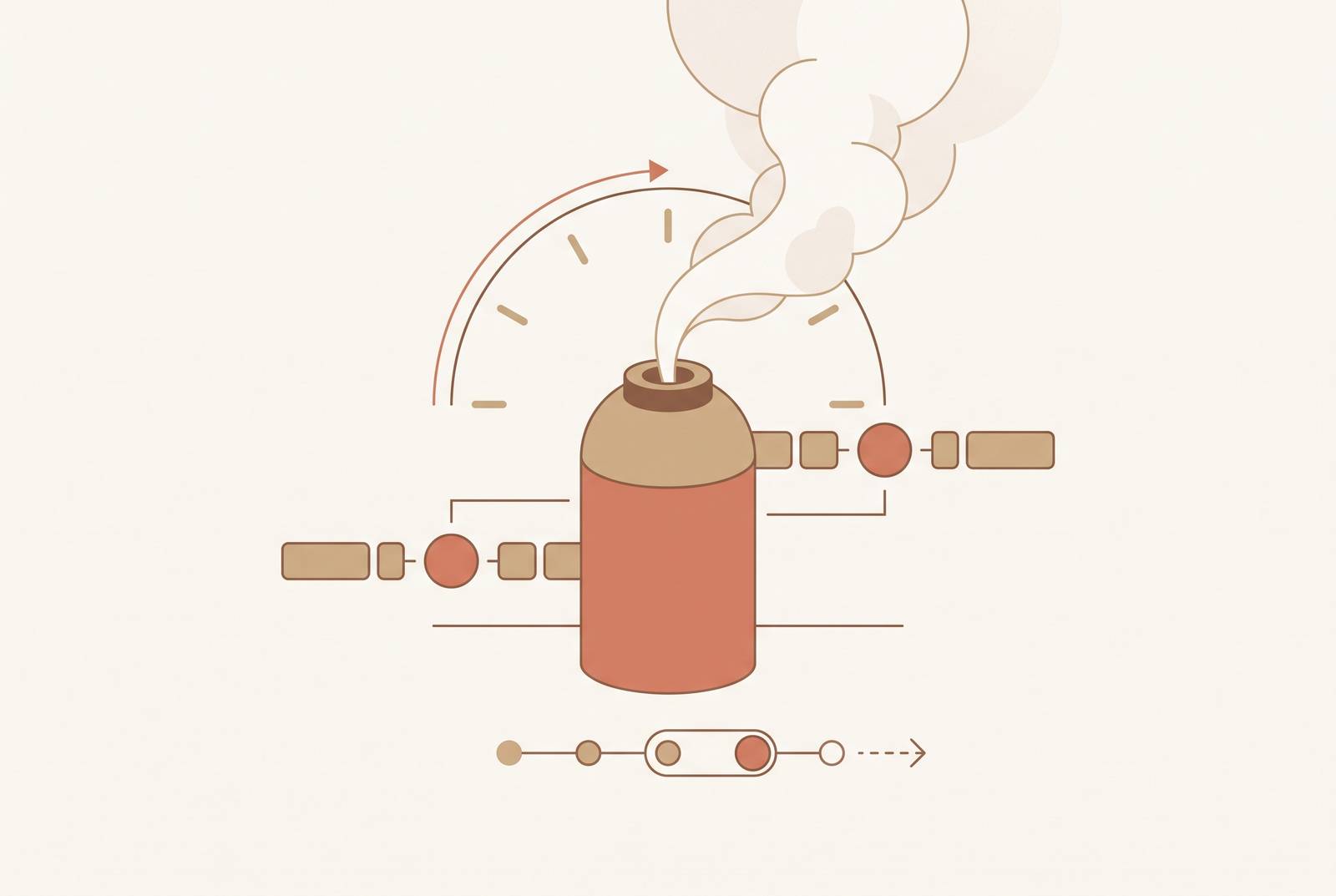
Timer and clock scheduling is the foundation. Set exact windows, morning, work hours, evening, bedtime, and the diffuser runs only when a room actually needs it. Higher-end systems built for HVAC integration, like The Magic Scent's TMS 1000, support up to three separate programs a day, each with its own intensity and duration: energizing in the morning, neutral through the afternoon, calming by evening, with nobody touching a dial. What that prevents matters more than what it enables, since continuous diffusion is the single biggest reason people go nose-blind and burn through oil for nothing.
Intensity control is the second lever, and it governs how much oil gets atomized per cycle, not just whether the machine runs. A studio bedroom and an open-plan living room don't share the same air volume, so they shouldn't share the same intensity setting. Cramming more fragrance into a small room doesn't read as luxurious. It reads as a headache with a nice smell.
Interval diffusion, sometimes called pulse mode, runs the device in short bursts, ten minutes on, twenty off, as one common pattern, instead of leaving it running continuously. That's the direct fix for nose-blindness: the olfactory system gets a break during the off cycle, resets, and picks the scent back up as new when the next pulse hits. It's the diffuser equivalent of knowing when to stop talking so people actually keep listening.
App quality decides whether any of this works, since the schedule lives inside the software, not the hardware. A great atomizer paired with a laggy app is still a laggy scheduling system, no matter what the box promises. Voice assistant integration through Amazon Alexa or Google Assistant covers the moments an app isn't practical: hands full of groceries, walking in the door, already half asleep. Voice assistants sit in an estimated 40%-plus of households in major markets at this point, which makes them a real control surface, not a feature bolted on for a press release.
How automation connects the diffuser to the rest of a smart home
A scheduled diffuser is useful sitting on its own. Wire it into the rest of a smart home and it starts doing something closer to anticipating a mood than managing an appliance.
A thermostat switches into "Morning" mode at 6:45 a.m., and the diffuser catches that same signal to start an energizing citrus blend at the same instant, no separate alarm required. A smart lock or presence sensor registers someone's arrival and can trigger a welcoming scent at the door, using occupancy signals instead of a fixed clock. Bedtime routines chain the same way, with the lights dimming, the thermostat dropping a couple of degrees, and the diffuser easing into a lavender schedule at reduced intensity, all off one trigger instead of three separate ones.
Apple HomeKit compatibility, on devices like the Meross Smart Essential Oil Diffuser, folds scent into existing iOS automation scenes instead of a system managed on its own. At the largest scale, whole-home cold-air systems wired into HVAC ductwork distribute scent across multiple rooms at once, and at that point it stops looking like a gadget and starts looking like infrastructure.
AI-driven personalization, systems that learn usage patterns and start suggesting fragrance rotations by time of day or occupancy, is still emerging rather than standard. Worth watching. Not yet worth basing a purchase on.
Strip away the specific triggers and the pattern underneath is simple: the diffuser stops being something a person has to remember, and turns into one more system the house runs without being asked.
Building a daily scent schedule that actually works room by room
Coverage has to match the room before any schedule gets built. A diffuser rated for 500 square feet underperforms in an open-plan great room no matter how aggressively it's scheduled, and a diffuser rated for 3,500 square feet overwhelms a bedroom at full intensity no matter how clever the timing is. Get that match right first, since scheduling only fine-tunes what the hardware already allows.
From there, the logic shifts room by room. Bedrooms want low intensity and a short pre-sleep window before bed, with the device off during actual sleep unless it's running a light interval mode. Calming, grounding profiles do the heavy lifting here. A home office wants scent scheduled around focus blocks instead of running all day: a light, clarity-oriented blend at moderate intensity, switched off entirely during calls so it doesn't become the mystery smell someone on a video call keeps asking about.
Living and entertaining spaces should track occupancy rather than running always-on, and can support higher intensity given the extra air volume, with room to shift character between a daytime blend and something different for evening. Entryways barely need scheduling in the traditional sense. A brief burst on arrival, triggered by geolocation or a fixed morning window, does the job. That's a first impression, not a sustained atmosphere, and treating it like one just burns oil on an empty room.
Rotating fragrances across the day, energizing in the morning, grounding by evening, works as a deliberate nose-blindness countermeasure, since the olfactory system responds to change far more than it responds to presence. The oil itself matters more than people expect here too: cleaner oil formulations hold up more predictably across a schedule, without odd off-notes developing as a room warms or residue building on nearby surfaces. That consistency matters even more in households where pets or kids are breathing the same air on repeat.
What to look at when choosing a smart diffuser for scheduling use
Scheduling depth is the first thing to check, and the hardest thing to judge from a product page. Does the app support multiple daily programs, interval modes, and per-window intensity control, or is it a glorified on/off timer wearing a nicer interface? That distinction decides whether the rest of this article even applies to a given device.
Diffusion technology matters just as much, and here's the part worth being blunt about: water-based ultrasonic models are the wrong choice for anyone building a real schedule. The output drifts with the water level, which means the same program produces a different result Monday versus Thursday, and no amount of app polish fixes a problem that lives in the hardware. Cold-air nebulizing gives scheduling actual leverage, since output stays immediate and concentrated regardless of how long the reservoir's been running, if there's even a reservoir at all.
Coverage claims deserve skepticism, and confirmed test results tell a more honest story than the square footage printed on the box. The AromaPro BT HVAC Scent Machine covers a confirmed 500 to 4,000 square feet, scored 9 out of 10 in testing, and runs $935, putting it in whole-home or commercial territory. A compact smart diffuser covering up to 500 square feet is fine for a single room, out of its depth anywhere bigger. The Aromadd Smart 3,500 Sq. Ft. Diffuser runs cold-air tech across that larger footprint and claims a 120-day runtime on one 600 ml bottle, which matters once the schedule has the device running unattended for months.
Smart home compatibility gets checked before the purchase, not after. Figure out whether the household already runs on Alexa, Google Assistant, or HomeKit, and confirm native support rather than trusting a workaround, since workarounds are exactly where automation reliability falls apart. Noise level deserves its own line item too, especially for anything running a 2 a.m. bedroom cycle. A diffuser that hums quietly in a showroom and buzzes at night gets unplugged out of frustration inside a week.
Last, oil compatibility. Closed cartridge systems lock a household into one company's scent library. Open systems allow a wider, often cleaner, selection of fragrance oils. That choice shapes both long-term cost and how much control anyone actually has over what's in the air.
Maintenance habits that keep a scheduled diffuser performing as configured
Nobody puts this tradeoff on the box: a scheduled diffuser runs more often than one people remember to switch on by hand, so it hits its maintenance intervals faster too. Residue builds up in the atomizer over time and quietly cuts output, so a device set to run at 70% intensity might be delivering less than that without anyone noticing, since it still turns on right on schedule, just weaker than it used to.
Cold-air nebulizing devices skip the water reservoir cleaning routine ultrasonic models require, but the atomizer and oil pathway still need periodic flushing, especially when switching between fragrance families. Mixing a leftover trace of cedarwood into a fresh citrus blend doesn't produce a new signature scent. It produces a muddy one.
A workable cadence: flush the atomizer any time the fragrance changes, run a full clean every few weeks on a daily schedule, check less often on a light interval schedule. Read runtime claims carefully too. That 120-day estimate on the Aromadd Smart is a claimed figure, and a heavier schedule burns through the bottle faster than the box suggests.
The scheduling app can close this loop on its own: a maintenance reminder set inside the same interface used for scent routines keeps upkeep from turning into an afterthought nobody remembers until the room smells like nothing at all. Cleaner oil formulations, with fewer synthetic additives, leave less residue behind, which cuts down on how often the deep clean is even needed.
Get all of it right, and a well-maintained, well-scheduled cold-air diffuser does the one thing a candle never could. It delivers the same room, the same scent, the same experience, day after day, with nobody needing to recalibrate a thing.