How Waterless Diffusers Work and Who They Are For
These devices skip water and heat to deliver fragrance at full strength and purity.

Home fragrance stopped being an occasional fix and turned into a daily habit, something people build into a morning routine the same way they treat a skincare step or a supplement. Grand View Research pegged the home fragrance market at $13.2 billion in 2025, with a run to $26.5 billion by 2033 at a 9.2% compound annual growth rate. That's a real shift in how people relate to the air in their own homes, well beyond a rounding error in a niche hobby category, and waterless cold-air diffusers sit at the sharp end of it.
North America already claims a 34.79% share of the global market as of 2025, according to Fortune Business Insights, and separate research cited by dsm-firmenich found 72% of consumers said they appreciated scent more in 2024 than they did back in 2020. Something happened in those four years that moved fragrance from background noise to something people actively choose and manage. This piece is about the specific technology behind that choice for a growing slice of buyers: how cold-air atomization works, how it stacks up against water, heat, and spray, and who actually benefits from paying more for it.
What cold-air atomization actually does inside the device
A waterless diffuser turns pure fragrance oil into a dry cloud of micro-particles without heat, water, or steam, and it does that through something called the Venturi effect, which sounds fancier than it is.
Here's the mechanical chain: a quiet internal pump pulls in ambient air and compresses it. That compressed air gets pushed through a narrow nozzle at high speed. The speed increase creates a pressure drop, a small vacuum, right at the nozzle opening, and that vacuum pulls fragrance oil up out of its reservoir. The fast-moving air then shears that oil into particles measured in microns, tiny enough to stay airborne but not vaporized. What comes out the other side is a dry scent cloud, distinct from mist, vapor, or steam.
Why does the missing heat matter so much? Fragrance molecules are volatile compounds by design, that's how they reach your nose in the first place, and heat breaks them down and rearranges the very structure a perfumer built. Cold-air atomization sidesteps that problem entirely because there's no heat source to degrade anything. And the missing water matters for a more basic reason: oil and water don't mix. Any process that dilutes fragrance oil in water before dispersing it changes the concentration and, with it, the character of the scent you actually smell.
The result is a fragrance that reaches the room close to the concentration and profile it was formulated at, avoiding the dilution or heat-altering that other methods introduce. Those dry micro-particles also hang in the air longer than a water-based mist would, so the scent spreads more evenly and lasts longer without fresh dosing. No residue lands on your furniture. No extra humidity gets dumped into the room, which matters more than people think, especially in spaces already prone to damp.
How waterless diffusers compare to ultrasonic, heat-based, and spray alternatives
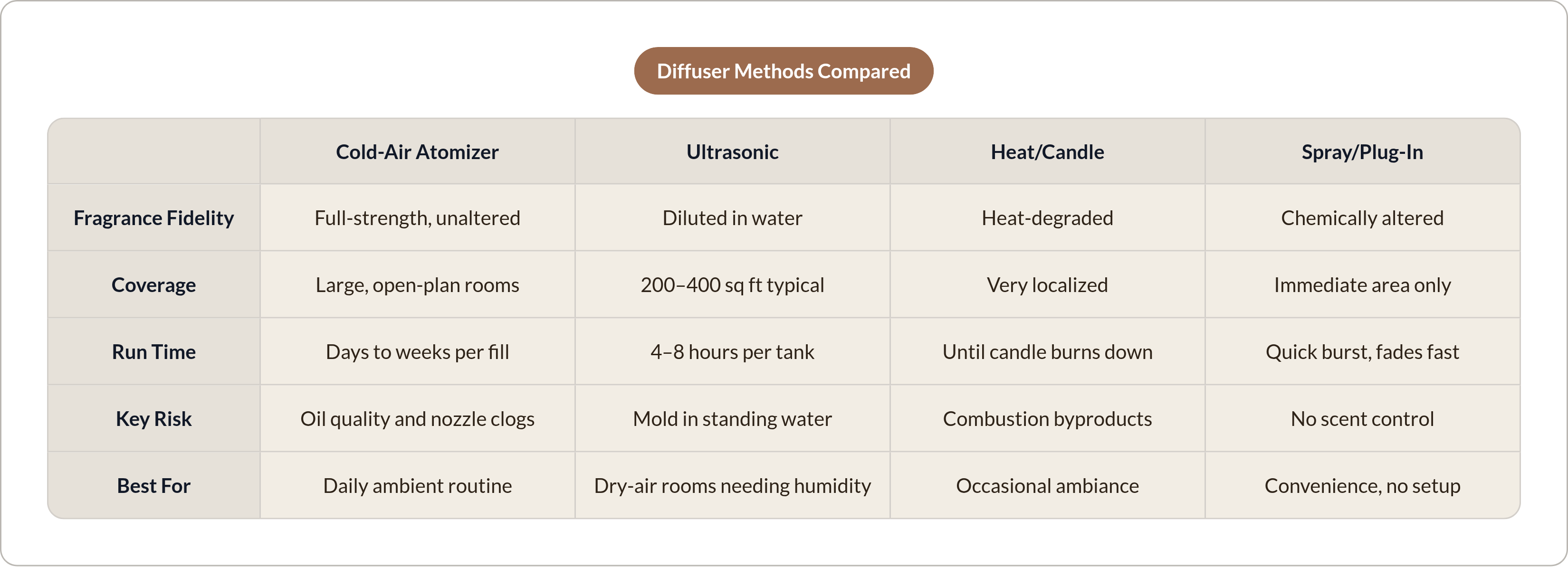
Ultrasonic diffusers, the most common home fragrance devices on the market, use water as the carrier. A typical setup runs 3 to 5 drops of oil per 100ml of water, which works out to roughly a 0.5% to 1% fragrance concentration in the air that actually reaches you. Waterless diffusers skip the water step and deliver oil at full strength. That gap in intensity and fidelity comes down to two fundamentally different mechanisms rather than one brand executing better than another.
Coverage follows the same logic. Ultrasonic units generally handle 200 to 400 square feet, and even premium models cap out around 1,000 square feet. Cold-air atomizers push undiluted scent further, which makes them a better fit for open-plan layouts or larger rooms where a diluted mist just doesn't carry.
Run time tells a similar story. An ultrasonic tank holding 200 to 300ml of water needs a refill every 4 to 8 hours. A waterless diffuser can run for days or weeks off a single oil fill, and most owners set them on interval timers rather than running them nonstop. That said, ultrasonic devices do add measurable humidity to a room, and in a dry winter house with the heat cranked, that's a genuine benefit, arguably the one scenario where water-based diffusion has the edge.
Heat-based and candle delivery methods run into a different problem entirely: combustion. Burning a candle degrades the fragrance molecules and introduces byproducts into the air, and no amount of clever wick engineering fixes that, because it's a chemistry issue, not a dosing issue. Sprays and plug-ins solve for convenience instead, giving you a quick burst that fades fast, with no real control over how strong it is, how long it lasts, or when it happens.
Line up all four methods and the waterless diffuser comes out as the cleanest delivery platform: no standing water means no mold risk, no flame means no combustion byproducts, no water carrier means no dilution. The Alliance of International Aromatherapists specifically endorses cold-air diffusion because it keeps the full chemical profile of essential oils intact rather than cutting it with water.
What goes into a waterless diffuser — and what damages it
The intended fuel is simple: pure, undiluted fragrance or essential oil, nothing else. Thicker oils, resins, absolutes, heavy blends, can be used, but they need thinning first. A workable ratio runs around 25% to 30% thick oil mixed with 70% to 75% thin essential oil. Skip that step and the atomizer struggles, the mist slows down, and the nozzle clogs.
Carrier oils are the real trap here. Jojoba, coconut, fractionated coconut, sweet almond, these are staples in massage and skincare but far too viscous for an atomizer built to shear microscopic droplets. Run one through a waterless diffuser and expect the internal chamber to gum up within weeks, a problem that doesn't resolve itself without taking the unit apart for a deep clean.
Oil quality matters beyond viscosity too. Impurities, synthetic extenders, and oils cut with cheap diluents can leave deposits on the atomizer head over time, the same way tap water leaves scale on a kettle. A routine wipe of the reservoir between oil changes keeps scent bleed and residue from building up, and the nozzle itself needs periodic deeper cleaning to keep particle output consistent. Neglect that nozzle long enough and the opening narrows, coverage drops, and the scent that does come out starts smelling subtly different than it should.
This is where oil sourcing and device longevity actually connect. Fragrance oils formulated with clean, disclosed ingredients are less likely to leave the kind of residue that shortens a diffuser's working life, so the choice of oil isn't just a scent decision, it's a maintenance decision too.
Why continuous, consistent scent delivery changes how a room feels
Smell takes a more direct route to the brain than sight or sound does; the olfactory system connects straight into the limbic system, which governs emotion and a chunk of the body's automatic responses. Heart rate, blood pressure, hormone release, these can shift before a person has consciously registered what they're smelling.
Consistency is the variable that determines whether that pathway works for you or against you. A scent that spikes and then fades gets noticed every single time it cycles back, which pulls attention rather than settling into the background. A steady, calibrated scent, delivered at the same low level hour after hour, tends to fold into the room's atmosphere without demanding anyone stop and register it.
The research backs this up in specific numbers. A randomized controlled trial published in Frontiers in Psychology found that lavender essential oil cut anxiety symptoms by 32% in patients waiting for surgery. Research published in the International Journal of Environmental Research and Public Health found that rosemary and peppermint diffused in office settings improved memory recall and alertness by 18% to 20%, with a corresponding drop in reported mental fatigue. Both studies used intact essential oils, preserved from the degradation that heat or water dilution would cause, which lines up with what cold-air atomization is built to preserve.
Think about the scent you notice walking into a well-run hotel lobby, the one that feels like the building's identity rather than an afterthought. That effect comes from steady, calibrated delivery, not a burst-and-fade cycle. Programmable scheduling on a waterless diffuser lets a household aim for that same effect: a stronger presence during morning routines, something lighter through the workday, a different mood for the evening, all without running the device more than it needs to.
What the clean fragrance question actually means for a waterless diffuser
Here's the catch worth sitting with: the delivery mechanism can be completely clean while the oil going into it is not. Those are two separate questions, and it's easy to assume solving one solves both.
U.S. fragrance labeling law allows a manufacturer to list a single word, "fragrance," on a label while leaving out the individual ingredients that make it up, protected as trade secrets under the Fair Packaging and Labeling Act. That one word can be standing in for volatile organic compounds, phthalates, or known allergens, none of which show up to a shopper reading the label at the point of sale.
Candles raise the stakes further. A 2015 South Korean study found that scented candles released volatile organic compounds, including benzene, toluene, formaldehyde, and acetaldehyde, both before and during burning. The National Candle Association disputes that these compounds cause harm at normal use levels, so both positions sit in the public record and neither side has fully settled the argument.
Waterless diffusion removes combustion byproducts and water dilution from the equation, which is a real advantage. But it's worth flagging a less obvious wrinkle: natural terpenes present in diffused oils can react with ozone already present indoors to form secondary nanoparticles, according to published indoor air quality research. Flame-free burns cleaner than combustion, genuinely, though that doesn't make it automatically risk-free in every indoor environment.
What this means practically: pairing a cold-air diffuser with oils that disclose their ingredients, that skip hidden synthetic extenders, that are vegan and cruelty-free, closes the gap that the delivery technology alone leaves open. For a household with kids, pets, or anyone with respiratory sensitivities, that ingredient transparency isn't a nice-to-have. It's the deciding factor. And on pets specifically: cold-air diffusion disperses oil as a dry particle cloud rather than a mist that settles on fur and surfaces, which helps, but certain essential oil compounds remain toxic to cats and dogs regardless of how gently they're dispersed. The delivery method changes exposure, not toxicity.
Matching a waterless diffuser to a specific room, household, and set of habits
Start with room size, because it filters out half the wrong choices immediately. A bedroom, home office, or bathroom calls for a compact unit running at low intensity; crank a high-output device in a small space and the result reads as overwhelming rather than ambient, which defeats the entire point. Open-plan living rooms and larger shared spaces need either a higher-output device or one with adjustable fan speed, something that can push scent evenly through a bigger volume of air. Some households skip the single-big-unit approach entirely and run one smaller device per zone; placement and airflow end up mattering more than raw horsepower.
Placement itself follows a few basic rules. Elevated spots, a shelf or console table, let natural air circulation carry scent downward and outward through the room. Positioning near an HVAC vent, though not directly in its path, lets the diffuser ride the home's existing air movement; sit it directly in the vent stream and it over-distributes, burning through oil faster than intended. Enclosed corners are the one placement to actively avoid, since scent pools there instead of spreading.
Household profile shapes the decision just as much as square footage. Homes with pets or young kids benefit from the no-residue, no-water output structurally, though that's exactly where oil ingredient transparency becomes non-negotiable rather than a nice detail. Renters and minimalists tend to like that there's no flame risk, no water to spill, no surface damage, and the unit itself doesn't have to look or function like a piece of furniture. People managing humidity sensitivity or a respiratory condition benefit from a device that adds zero moisture and creates no mold vector. And for anyone who travels often or just wants to set a routine and walk away, programmable scheduling does the daily thinking for them.
Certain habits point clearly toward waterless: daily ambient scenting as a built-in routine rather than an occasional fix, a preference for one consistent scent character over time instead of frequent switching, and a willingness to spend more on a smaller amount of quality oil rather than buying scent by volume. Other habits point elsewhere. Wanting extra humidity in a dry winter room is a job ultrasonic handles directly and well. Occasional single-room use with zero interest in scheduling or programming might not need the added cost or complexity at all; a simpler device does the job just fine.
The honest read is that a waterless cold-air diffuser is a considered purchase, not an impulse one. It rewards the buyer who understands what's happening inside the device, picks oils that won't gum up the nozzle, and keeps up with the light maintenance the thing actually needs. For that buyer, the category has little else that delivers scent quite the way this does.