Recreating Japanese Forest Bathing Scents at Home
Phytoncides, not scenery, are what makes forest bathing heal your body.
Most wellness topics live in a soft evidentiary haze where anecdote and clinical research blur together until you can't tell what's real. Forest bathing is not that, and the distinction matters, because it's what allows us to move from "forests feel good" to "forests do something specific, and here's the mechanism."
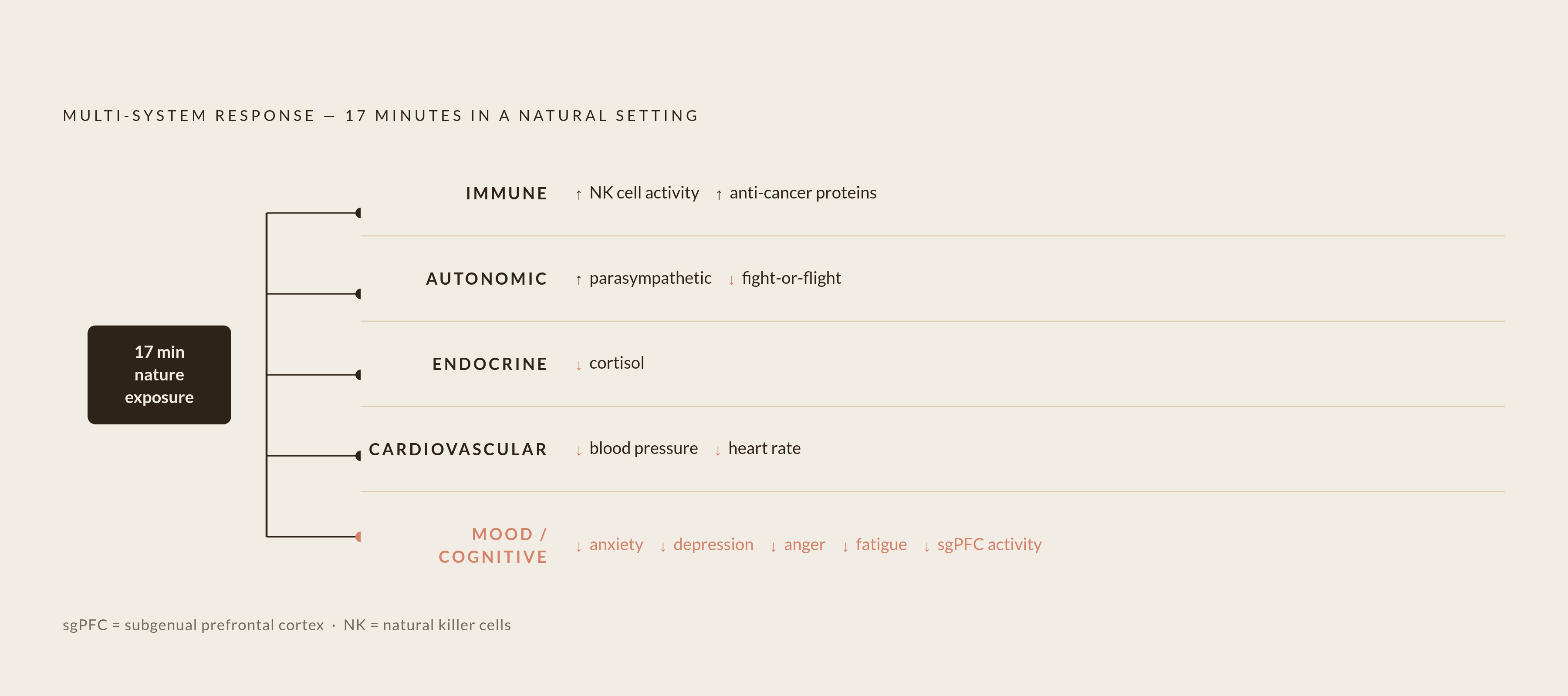
Researchers at Chiba University's Center for Environment, Health, and Field Sciences found measurably lower cortisol, blood pressure, and heart rate in participants spending time in forested settings compared to urban controls. Not self-report. Biomarkers.
The effects span several systems simultaneously. Immunologically, forest exposure increases natural killer cell activity and elevates anti-cancer proteins. Autonomically, it shifts the nervous system toward parasympathetic dominance, rest-and-digest, pulling it away from fight-or-flight. A 2022 study published through the National Library of Medicine documented reduced scores for anxiety, depression, anger, fatigue, and confusion on the Profile of Mood States assessment. Stanford researchers found that 90 minutes in a natural setting decreased activity in the subgenual prefrontal cortex, the region associated with the repetitive negative thinking that underlies depression. A 2024 systematic review in ScienceDirect confirmed the pattern across the literature: NK cell enhancement, reduced cortisol, modulated inflammatory cytokines, parasympathetic dominance, with tree-derived volatile compounds identified as meaningful contributors to those outcomes.
Here's the detail I keep coming back to: some findings suggest as little as 17 minutes a day in a natural setting improves reported well-being. Seventeen minutes is a walk to the corner and back. Which raises the question the rest of this piece tries to answer: what is actually producing the effect in those 17 minutes?
Why scent is the primary biological mechanism, not scenery or silence
The forest is multisensory. That's part of what makes it immersive. But when researchers begin disaggregating which inputs drive which outcomes, the chemical environment, what you are actually breathing, turns out to be central rather than incidental.
Phytoncides are volatile organic compounds trees release as a biological defense, protecting themselves from bacteria, fungi, and insects. The word combines the Greek phyton (plant) with the Latin caedere (to kill). Airborne, they travel through the atmosphere and enter the body through inhalation, moving into the bloodstream and reaching the brain with relatively little biological intermediary.
The most compelling evidence for scent as the operative mechanism comes from a controlled experiment by Dr. Qing Li. Twelve subjects were isolated in hotel rooms: no forest, no natural light, no exercise. One group's rooms were infused with vaporized hinoki cypress essential oil; the other received no scent alteration. The cypress group showed a 20 percent increase in NK cell activity and reported reduced fatigue. The control group showed almost none.
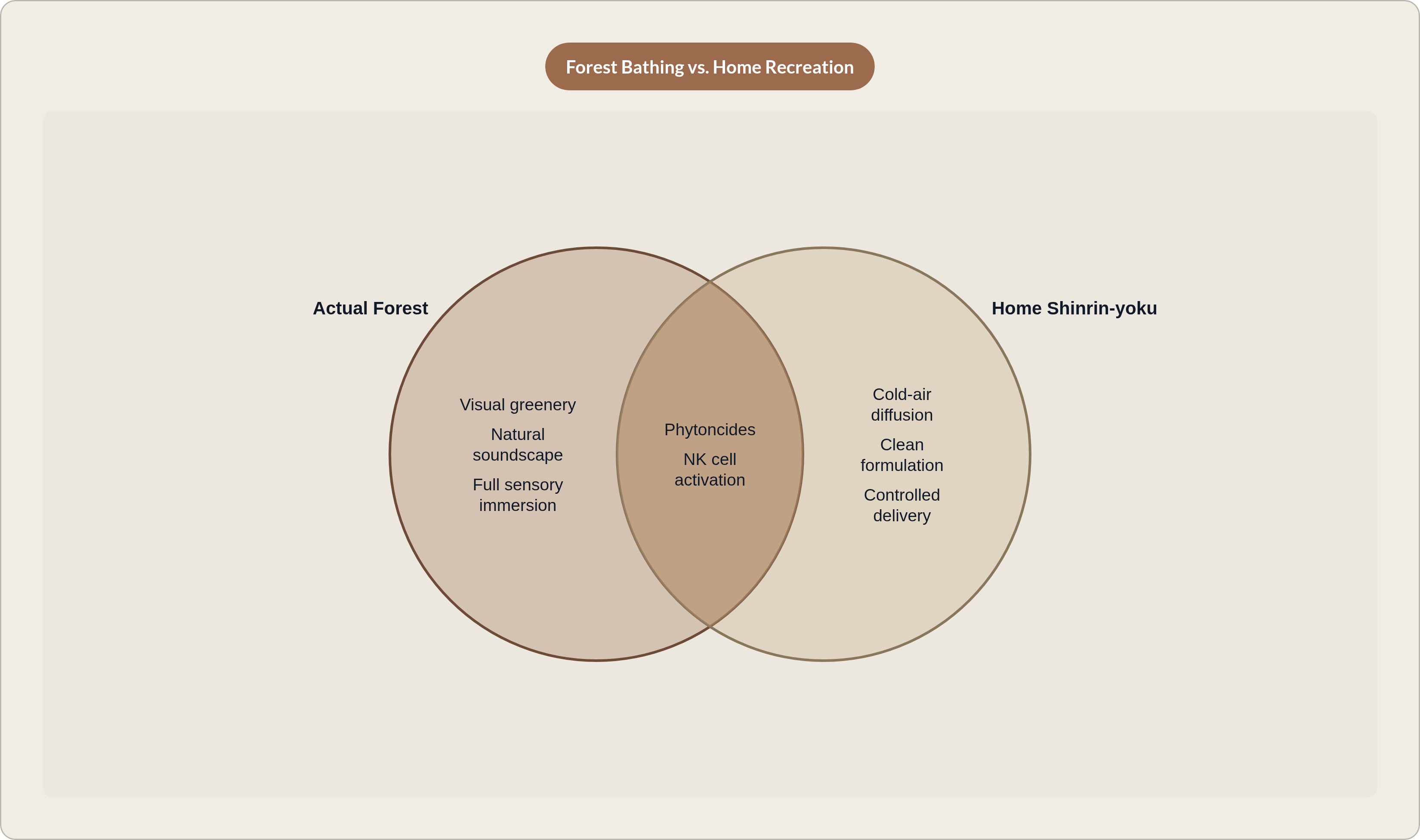
What that experiment isolates is significant. No trees were present. No soundscape. No visual field of green. Just the molecular signature of the forest, diffused into an ordinary room. And the immune effect followed the molecules, not the experience of standing among trees. A photograph of a cypress grove cannot enter your bloodstream. A nature sounds playlist cannot modulate your NK cells.
I want to be clear about what the evidence leaves unresolved here. The full forest experience, compounding chemical inputs with visual, auditory, and temporal dimensions, produces effects beyond what scent alone can replicate. Home recreation is a meaningful approximation, not a substitute. The argument isn't that you can recreate Akasawa in a living room. It's that the most physiologically active ingredient in the forest experience also happens to be the most portable one.
The specific aromatic compounds that carry the forest's therapeutic signature
Not all forest-adjacent scents carry the same biological freight. The compounds matter, and understanding which ones do the actual work gives you a more reliable evaluative framework than packaging aesthetics.
Alpha-pinene is the dominant phytoncide in coniferous trees, specifically identified in research as the compound in hinoki cypress responsible for replicating the calming effect associated with forest bathing. It's also what produces the characteristic sharpness in pine and fir needle oils.
Limonene appears abundantly in pines and firs, not just citrus fruits, which is why you detect a slightly bright, almost citrusy lift in cypress and fir needle oils. It carries antioxidant and anti-stress properties; it's part of why these forest oils smell more complex than simply "woody."
Beta-caryophyllene appears in coniferous trees, rosemary, and black pepper. Anti-inflammatory, with some evidence for pain-relieving properties, it adds a grounded, slightly spiced depth that keeps forest scents from reading as merely clean or green.
As a class, phytoncides have been shown to increase NK cell activity, reduce oxidative stress, lower cortisol, and enhance sleep quality. These outcomes map closely onto the forest bathing research, which is precisely why identifying these specific compounds gives you more signal than looking for a bottle dressed in green.
Cedar, cypress, and pine are among the most phytoncide-dense sources, making cedarwood, Scots pine, hinoki, and fir needle essential oils the strongest home-recreation candidates. The framework here is practical: if you know what you're looking for at the molecular level, evaluating products becomes less a matter of aesthetic preference and more a matter of what's actually in the bottle.
Hinoki cypress as the anchor scent for at-home shinrin-yoku
Hinoki, Chamaecyparis obtusa, is the wood of Japanese temples, shrines, and traditional bathhouses. That's not incidental. It was selected for those settings over centuries because of its natural antibacterial properties, the same phytoncide chemistry we've been tracing, before anyone had clinical language for the mechanism.
Describing the scent concretely: the base is dry cypress wood, settled and quiet. Above that, alpha-pinene and limonene lift it into something slightly citrusy and aerated, forest after rain rather than cologne's interpretation of forest or a cleaning product's version of fresh. It is both grounding and light simultaneously, which is a difficult register to achieve. Researchers have found that many components of hinoki wood essential oil correspond closely to compounds present in fresh forest air, which makes it the closest single-ingredient approximation of the Akasawa olfactory environment you can source outside Japan.
For those drawn to a darker, more primordial quality, the forests of Yakushima offer a different reference point. Ancient yakusugi cedar trees, some over many centuries old, on a UNESCO World Heritage island, create an atmosphere dominated by moss, mist, and cedar rather than hinoki's brightness. Earthier, deeper, mineral. Worth knowing as an alternative register, especially for anyone who finds hinoki's relative airiness too restrained for daily use.
Building a complete home palette around hinoki's chemistry has an internal logic. Ozone, eucalyptus, and white tea can serve as top notes, mimicking the fresh quality of forest air on first inhalation. Cypress and pine anchor the heart. Cedarwood, juniper, and amber ground the base. For ritual use, bergamot, frankincense, and lavender pair naturally without competing.
There is also the Sagano Bamboo Grove register: green, mineral, aquatic, forest without resin or wood as the dominant note. For anyone who finds coniferous heaviness too dense for sustained daily use, this is the lighter alternative within the same scent family.
Why diffusion method determines whether phytoncide chemistry survives into the room
You can source a thoughtfully formulated hinoki oil and still fail to deliver its active compounds into the air if the delivery method works against the chemistry. This part of the decision gets skipped more often than it should.
Heat is the central problem. It volatilizes top notes prematurely, degrades or alters the molecular structure of sensitive compounds, and leaves the aromatic profile unbalanced, base notes dominating in ways the formula wasn't designed for. Alpha-pinene and limonene, the compounds with the most documented therapeutic relevance, are the top and heart notes most vulnerable to heat exposure. A diffuser using a heating element is actively degrading the ingredient you're trying to introduce to your air before it reaches you.
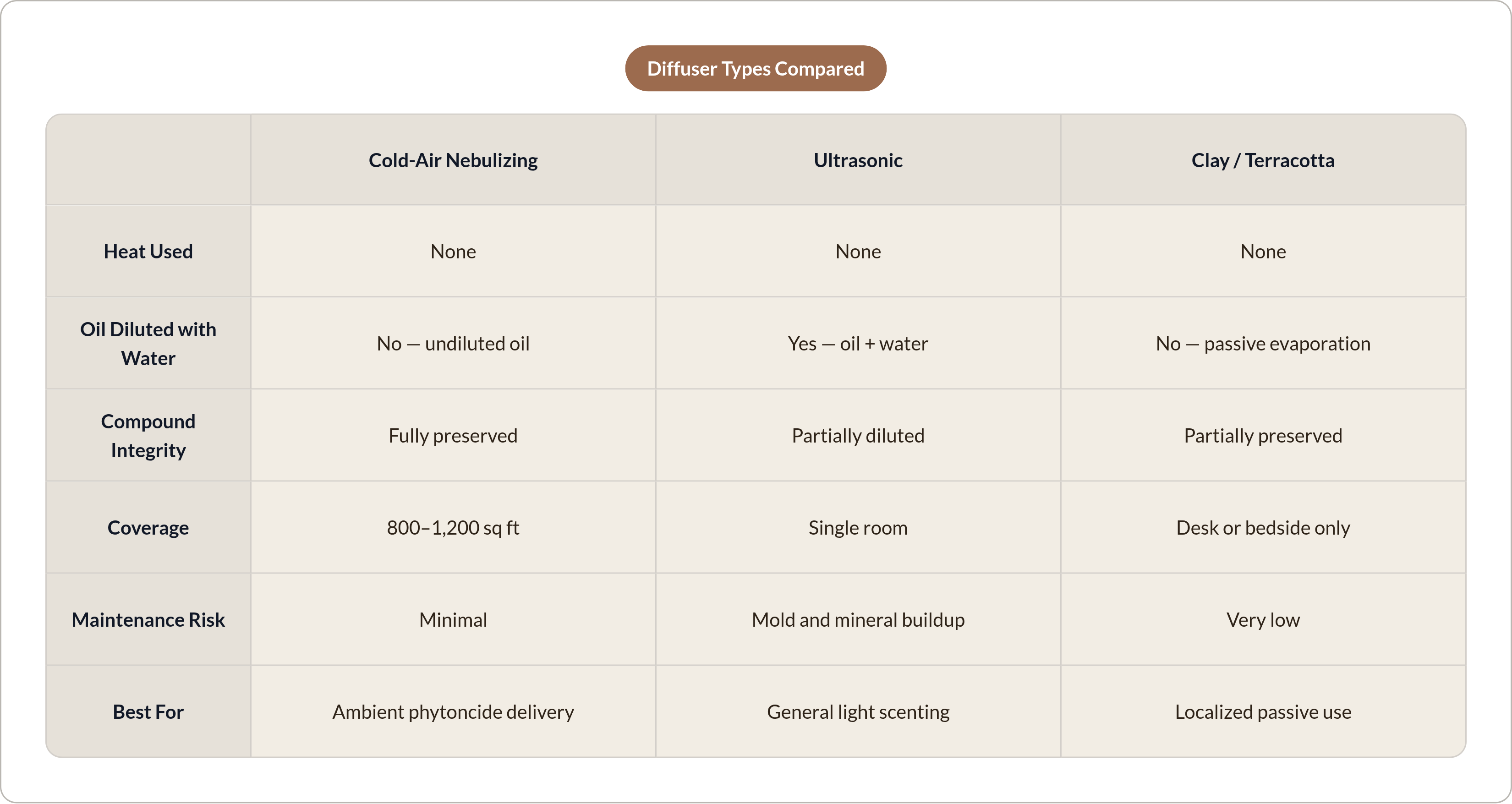
Cold-air diffusion works differently. Pressurized filtered air, no water, no heat, atomizes undiluted fragrance oil into a dry micro-mist. The molecular complexity of the oil is preserved as formulated. For forest recreation specifically, this isn't a minor technical preference; it's the difference between delivering phytoncide-mimicking compounds and delivering their degraded byproducts.
Coverage is also worth considering practically. A well-positioned cold-air diffuser services 800 to 1,200 square feet, enabling ambient immersion rather than a localized scent pocket in one corner. The forest analogy is instructive: the Akasawa experience works because you are surrounded, not because you are standing adjacent to a single fragrant tree.
The waterless mechanism also eliminates the mold, mineral deposit, and bacterial accumulation that develop in reservoir-based diffusers over time. For anyone using forest oils with health intentions, introducing airborne irritants through a neglected reservoir is the kind of irony worth avoiding.
For comparison: ultrasonic diffusers dilute oil with water, limit meaningful coverage to a single room, and require regular cleaning to prevent contamination. Clay and terracotta diffusers require no heat, water, or electricity, making them the most passive option, but scent radius and intensity are low, suitable for a desk or bedside rather than a room. Cold-air nebulizing diffusers deliver undiluted oil without heat across a wider area, and that format most closely replicates the ambient, enveloping quality of actual forest air.
What clean formulation means in practice for forest-inspired home scenting
There is a specific irony embedded in conventional scented products: the attempt to introduce a calming, nature-derived experience simultaneously introduces chemical compounds that work against that purpose.
Conventional scented products can contain VOCs, phthalates, and formaldehyde. The mechanism to understand is the fragrance loophole: under current U.S. labeling conventions, the single word "fragrance" or "parfum" on an ingredient list can legally conceal a significant number of undisclosed synthetic chemicals, including phthalates linked to endocrine disruption. There is no requirement to enumerate what's inside.
The household dimension of this matters particularly for families. Phthalate-containing diffused particles settle lower in the air; children and pets, who spend more time at floor level, receive disproportionately higher exposure. The same population for whom a daily forest bathing analog is most appealing is also the population most exposed to whatever compromises the formula contains.
Some would argue that trace synthetic compounds in a fragrance formula are too minor to matter. But clean formulation and therapeutic intent are not separate considerations here. They are the same consideration. If the goal is to introduce phytoncide-mimicking botanical compounds into your home air, the baseline requirement is that nothing else in the formula works against that effect. A formula containing synthetic endocrine disruptors is not a vehicle for the forest; it is noise layered on top of it.
What to look for practically: fully disclosed ingredient lists rather than the aggregate "fragrance" designation; phthalate-free formulation; no synthetic masking compounds. Sephora Clean certification provides one reliable independent reference point.
The decision to build a home shinrin-yoku practice is, in the end, several decisions layered together. The compounds themselves matter. The delivery method determines whether they survive into the air intact. The formulation determines whether you've created the conditions for a beneficial effect or undermined them before you've started.
The government workers sent into the Akasawa forest in the 1980s didn't need to understand alpha-pinene to experience the benefit. But replicating that chemistry at home requires knowing what you're working with, because the forest does not require your understanding to function. A product does.