Evening Wind-Down Scents for Better Sleep
Scent signals your nervous system before conscious thought kicks in.

Smell breaks the rules your other senses follow. Sight and sound get routed through a kind of interpretive checkpoint before they're allowed to touch your emotions; smell doesn't. Harvard Medical School's research on olfaction explains why: the olfactory bulb wires directly into the limbic system, the brain's emotional and memory center, with no detour through conscious processing first. You react to a smell before you've named it. That's not a metaphor, it's wiring, and it's why a scent can slow your heart rate before you've even figured out what you're smelling.
That shortcut is exactly why scent matters for sleep. Certain compounds in fragrance oils bind to receptors tied to the autonomic nervous system, the machinery running your heart rate, your blood pressure, that low background hum of alertness that keeps half your brain on watch even when you're trying to unwind. A study on bergamot and ylang-ylang in elderly patients recorded a 26% drop in a measured symptom score, along with real reductions in heart rate and blood pressure. Nobody just asked these patients if they felt calmer and wrote it down. The body backed up the claim on its own.
Here's the part most people skip: consistency. Pair the same scent with the same wind-down routine, night after night, and your brain starts treating it as a cue rather than just a pleasant smell. Run the same lavender diffuser every night around 10:15 and eventually your body starts downshifting before you've climbed into bed at all. That's classical conditioning, the same mechanism behind Pavlov's dog. It only works if the exposure holds steady, which is exactly why the next section on delivery methods matters more than people assume.
One distinction worth drawing early: inhaling a diffused scent and rubbing oil on your wrist are two completely different experiments, and marketing loves to blur the line between them. For sleep, what matters is ambient diffusion during the wind-down window, not skin contact. The science supports intentional scent choice. It does not support every claim printed on a bottle label, and an honest look at this topic keeps those two things separate instead of pretending the whole industry runs on the same rigor.
The scents most supported by evidence for sleep and evening calm
Lavender wins, and it isn't close. A 2025 review in Frontiers in Pharmacology documents its anxiolytic, antidepressant, and sleep-promoting effects, while a meta-analysis published in a peer-reviewed gerontology journal combed through dozens of articles and narrowed the field to clinical trials testing lavender specifically for sleep disorders in older adults. A randomized controlled trial even pitted lavender against virtual reality for sleep quality in people with type 2 diabetes, with lavender showing favorable results. One detail buried in that research is worth remembering before you get creative: for insomnia specifically, single-note lavender outperformed mixed blends, so resist the urge to drown it in five other notes if sleep is the actual goal.
Chamomile pairs naturally with it. Both carry sedative properties that ease the transition into sleep, according to aromatherapy guidance from soapandpaperfactory.com. Sandalwood shows up constantly in wind-down protocols too, a grounding base note that slows a room down instead of lifting it up.
Jasmine is the odd one out. It doesn't smell like what people expect "calming" to smell like: it's floral, a little heady, nothing like the soft green scent most people picture when someone says relaxation. And yet a 2025 Sleep Research Society study using a smart diffuser found jasmine improved sleep efficiency and cut nighttime wakefulness by 25%. Rosa Damascena, the Damask rose, has newer backing as well; a 2025 systematic review in Frontiers in Public Health pulled trials from six major databases and found preliminary positive effects on anxiety, depression, stress, and sleep quality.
Bergamot and ylang-ylang, beyond the heart-rate effects mentioned earlier, are established anxiety reducers in clinical settings, and bergamot in particular does good work on mood before bed. Blue tansy and ho wood get name-checked in 2025 coverage of the sensescaping trend, though the research trail behind them is thin next to lavender's. Whether they're working on their own merits or simply riding lavender's coattails into relevance is still an open question.
If you're building a protocol from scratch, build it around lavender, jasmine, and chamomile. Those three carry the actual clinical weight. Everything else is a supporting note, and there's nothing wrong with a supporting note, so long as you're not mistaking a pleasant smell for a proven one.
Why delivery method determines whether these scents actually work
You can buy the exact right oil and still get nothing out of it. Sleep places demands that most fragrance formats simply can't meet: it needs to run all night unattended, hold a steady output instead of spiking and fading, and introduce zero heat, flame, or humidity into a room where someone's unconscious for eight hours. It also can't click, hum, or buzz in a way that yanks a person out of light sleep at 3 a.m.
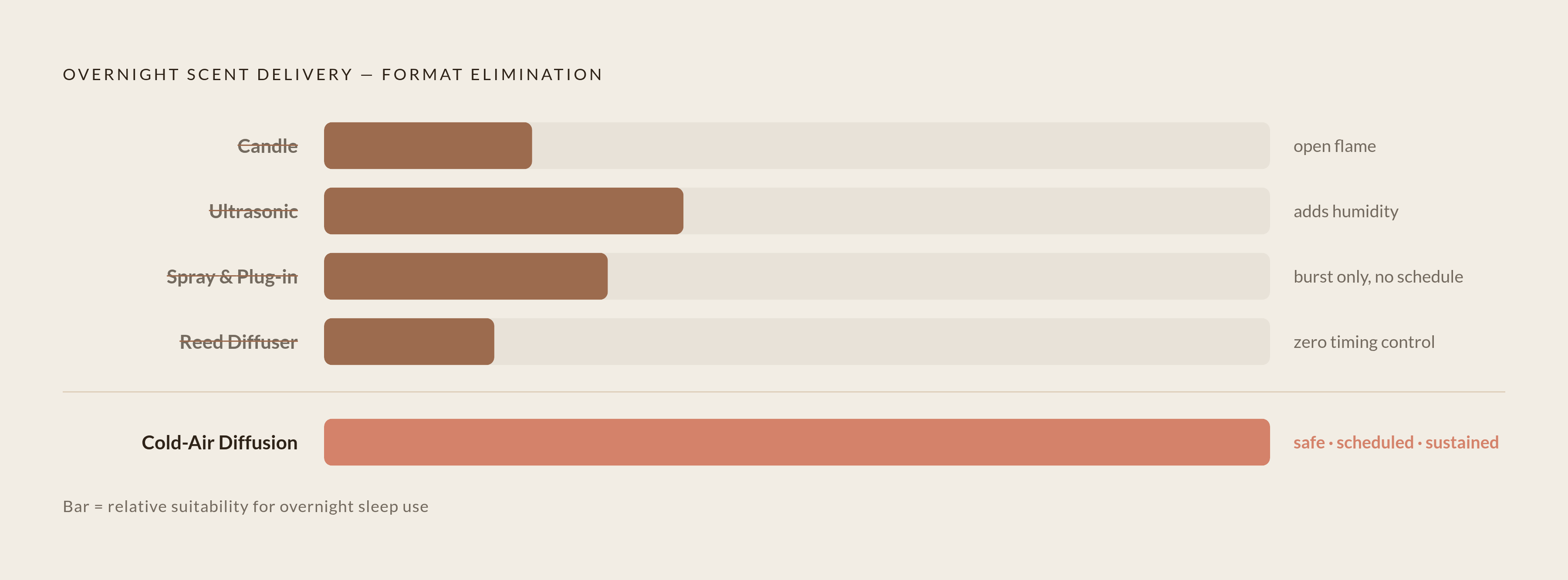
Candles fail on the first requirement. Open flame, real heat, and the hard rule that you blow them out before closing your eyes; fine for the first twenty minutes of a wind-down ritual, useless for the actual sleep window. The one thing you need running while you sleep happens to be the one thing you cannot leave burning while you sleep.
Ultrasonic diffusers mix oil with water, which adds humidity to the room and dilutes the oil; practitioners in the aromatherapy space argue this significantly weakens the oil's actual therapeutic properties, not just how strong it smells. Some practitioners in the aromatherapy space argue this dilution weakens the oil's actual chemistry, not just how strong it smells; that distinction matters if you're diffusing lavender for its effect on your nervous system and not just its vibe.
Sprays and plug-ins fire in bursts, not sustained streams, with no scheduling and no way to taper intensity as the night wears on. Reed diffusers go the opposite direction: passive to a fault, releasing scent at whatever rate they feel like with zero control over timing.
None of these formats share one dramatic flaw. Each fails for its own particular reason. But the thread running through all of them is the same: none let you shape delivery to the actual arc of a sleep cycle, stronger during the ritual, quieter or off once you're actually under.
What cold-air diffusion does differently for sleep environments
Cold-air diffusion works on a different mechanism entirely. It uses pressurized air to break pure fragrance oil into an ultra-fine, dry mist: no heat, no water, no flame, no residue. The particle size suspends well in the air and gets absorbed steadily through the respiratory system, so you get a consistent scent level instead of the spike-then-crash pattern a spray gives you.
No water means no added humidity, which means no risk to hardwood floors, electronics, or anything hanging on a nearby wall, and no extra moisture for anyone with respiratory sensitivity. It also means the oil's fragrance profile survives the trip intact, since heat is what breaks down fragrance compounds and cold air simply leaves them alone. What you smell matches what's actually in the bottle, therapeutic compounds included, rather than some heat-degraded approximation of it.
Coverage matters too. Cold-air diffusers are generally rated for broader coverage than candles, reed diffusers, plug-ins, or ultrasonic units, which counts for a lot if your bedroom opens into a hallway or bathroom instead of sitting sealed off like a hotel room.
The safety case for overnight use is short and unremarkable in the best way: no flame, no heat source, no water reservoir demanding attention. Set it up correctly and it runs fine through a full night's sleep, which is more than you can say for a candle you forgot to blow out.
Scheduling is the feature that actually earns this method a spot in a bedtime routine. Set intensity higher for the 30 to 60 minutes before bed, when scent-priming does the most work, then let it taper or shut off once you're likely asleep. That keeps the room from getting oversaturated and stops you from burning through oil during the seven hours nobody's awake to enjoy it.
Choosing the right diffuser for a bedroom — coverage, placement, and intensity
Start with square footage. It's the spec everyone skips reading on the box, right above the price. A diffuser's coverage rating needs to match or beat your room's size; an undersized unit works overtime and still underdelivers, while an oversized one floods a small bedroom if the output isn't scheduled properly. A studio nook usually does fine on a compact unit at low intensity. A primary bedroom with an open layout or an attached bath needs broader coverage and some thought about how air actually moves through the space. If your bedroom bleeds into a living area with no real wall dividing them, you're probably shopping in whole-home or high-coverage territory instead.
Placement matters more than people assume, and most people assume it doesn't matter at all. You want mist riding the room's natural air movement, not blasting straight at the bed where it pools way past comfortable, and not stuffed behind furniture where it just sits there going nowhere. Elevated placement, a shelf, a nightstand, the top of a dresser, gives the dry mist room to spread evenly before it settles. Distance from the sleeper counts too: park a strong diffuser too close to your face and you get an alerting effect instead of a calming one, which undoes the entire point in one stroke.
During the wind-down window, moderate is usually plenty; taper it down or schedule it off once you're actually in bed, since you're priming the room, not fumigating it. Noise deserves a mention here too. A diffuser that seems silent in a bright showroom might hum just loud enough to disturb light sleep once your bedroom goes dead quiet at 2 a.m., and that gap between showroom-quiet and midnight-quiet is real. Worth checking before you buy, not after you're lying awake counting the hum.
Fragrance oil quality matters more at night during waking hours
Your body runs at a lower gear while you sleep, with less bandwidth to shrug off irritants than it has during a normal waking hour. A quick daytime whiff of something synthetic is one problem. Eight straight hours of exposure while unconscious is an entirely different math problem, and it's not one most people run before grabbing a diffuser oil off a shelf. Studies indicate that 30% of the population experiences some form of sensitivity to synthetic fragrance, ranging from mild irritation to a genuine allergic reaction, and at nighttime diffusion levels, even the mild end of that range can chip away at sleep quality without anyone tracing it back to the diffuser humming quietly in the corner.
Watch for phthalates, the synthetic fixatives tied to endocrine disruption and respiratory irritation. Watch for parabens too, preservatives with known sensitization potential, and for VOCs, the volatile organic compounds found in cheaper synthetic fragrance bases that irritate the respiratory tract under sustained exposure.
The clean fragrance market is growing fast for exactly this reason, moving from roughly $12.47 billion in 2024 toward a projected $33.40 billion by 2035. Around 65% of new premium fragrance launches now highlight natural ingredients, according to Fortune Business Insights. That's the market catching up to what a lot of people already figured out on their own, years earlier, by reading labels at midnight and wondering why their throat felt scratchy at 3 a.m.
So what do you actually look for in an oil meant to run all night? Full ingredient disclosure, not a vague "fragrance" line hiding whatever was cheapest to source that quarter. Vegan and cruelty-free formulation, if that's part of how you think about wellness generally. And compatibility with your specific diffuser, since not every oil is built for nebulizing diffusion; a thick or impure oil can clog a nozzle and quietly wreck the device over months.
Using scent around pets at night: what's safe and what isn't
Plenty of households run a bedroom diffuser overnight with a dog sprawled on the floor or a cat perched on the dresser. A pet's respiratory and olfactory systems are far more sensitive than a person's, though, so a concentration that reads as pleasantly ambient to you can land much harder on an animal sleeping four feet away in the same room.
Some oils carry genuine risk even at diffused, ambient levels, and they have no business running in a shared sleeping space. Tea tree, also called melaleuca, is toxic to both dogs and cats. Eucalyptus irritates the respiratory tract in both. Peppermint is especially rough on cats specifically, and cinnamon, clove, and citrus oils are linked to GI and skin irritation from ambient exposure alone, no direct contact required.
On the safer side, lavender is widely cited as one of the better options around dogs, provided it's running at low intensity in a well-ventilated room. Chamomile sits in similar territory, generally considered lower-risk for dogs at a proper dose.
None of that is a license to skip common sense. Watch how your pet behaves the first few nights with anything new in the air. And if your cat starts acting off, don't wait around for a peer-reviewed study to confirm what's already obvious from across the room.