Diffuser Tank Size and Mist Output Ratings for a 300 Square Foot Bedroom
A 500–700 ml diffuser with adequate output covers the room better than coverage claims suggest.
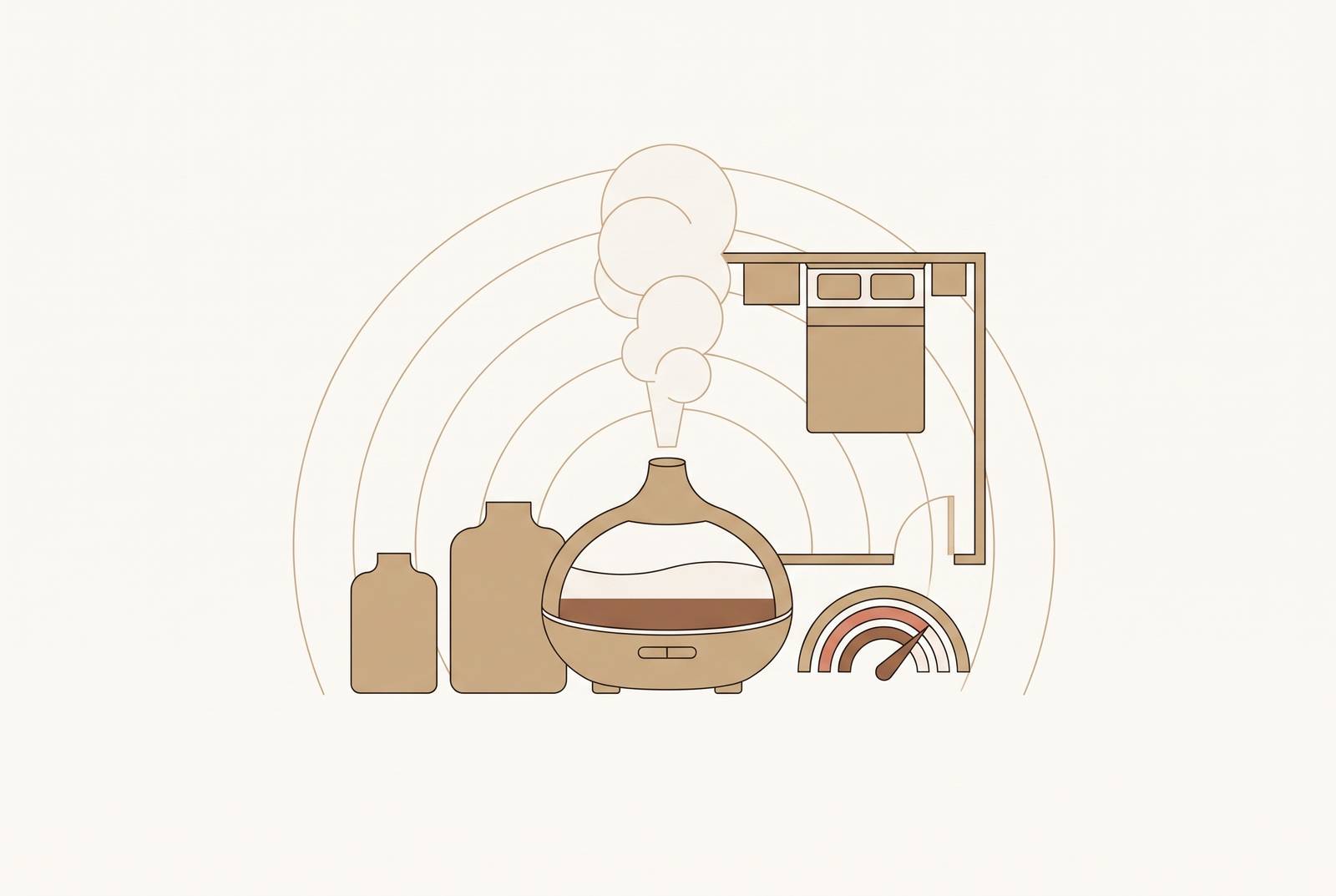
For a 300 square foot bedroom, a 500–700 ml ultrasonic diffuser is the practical starting range, with rated coverage meaningfully above 300 square feet. Mist output determines reach, while tank capacity determines runtime. Choosing the right diffuser means matching both to the room’s air volume and overnight schedule.
Why the coverage number on the box is not the coverage you will get
A diffuser labeled for 300 square feet may fall short in a bedroom of exactly that size. The printed figure is an upper limit. Real-world effective coverage can run at roughly 60–70% of the stated figure. A model advertised for a larger room may be the appropriate match.
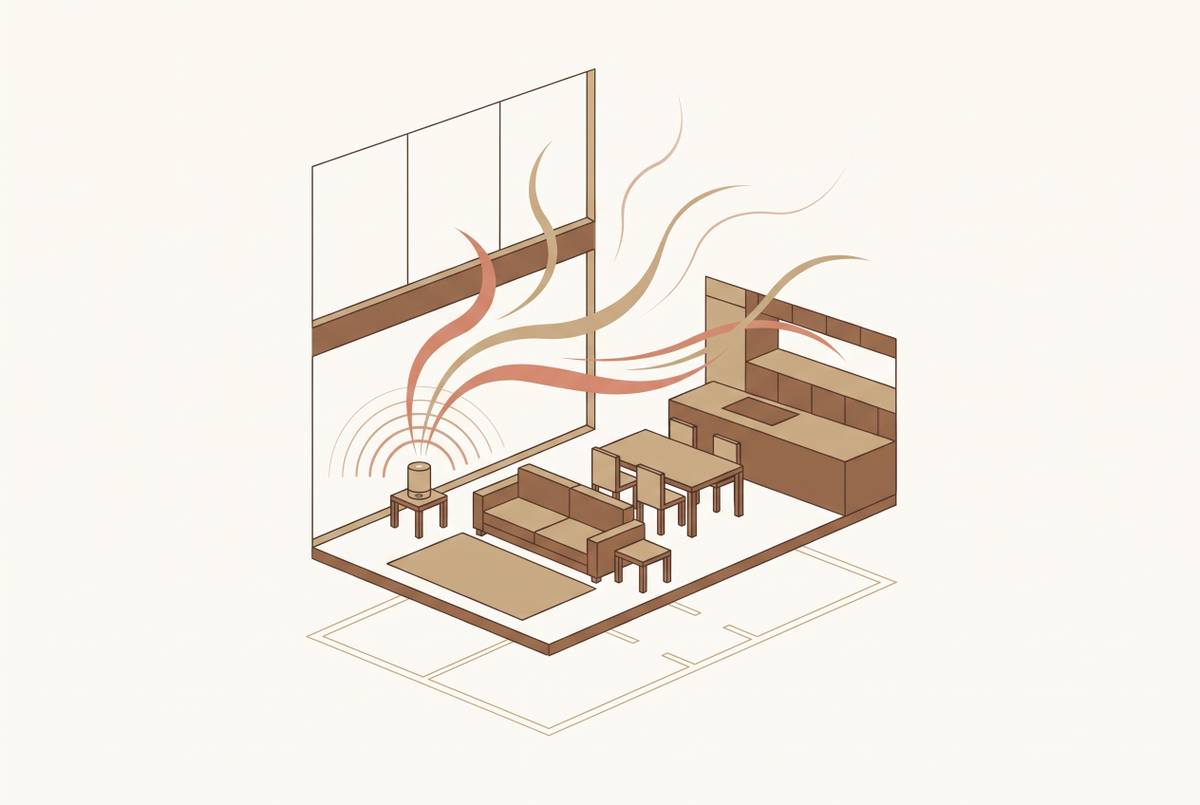
A bedroom that opens into an en-suite or has a vaulted ceiling makes the coverage shortfall clearer. Fragrance does not recognize the boundary on a floor plan, and extra air volume still needs scenting. The nominal area therefore understates the job the diffuser must do. Coverage claims are useful for comparison, but they need a correction before they become a sizing recommendation.
What actually determines coverage — output rate and tank capacity as separate variables
Mist output is the reach. Tank capacity is the endurance. Output rate, measured in ml/hour, describes how quickly an ultrasonic diffuser releases mist. Higher output distributes scent farther and scents the room’s air volume faster, which becomes important when height or airflow reduces effective coverage. Tank capacity answers a different question entirely. It determines how long that output can continue before a refill.
This distinction prevents a common buying mistake. A large reservoir paired with a low output rate can keep an inadequately scented room inadequately scented for longer. A smaller reservoir with stronger output may spread scent through the room but need a refill sooner.
But surely a bigger tank means a more powerful diffuser? Not necessarily. Two units with identical output rates but different tank capacities can cover the same area, while the larger one runs longer. Compare output rates at similar settings first, then tank capacity. A generously sized water supply is not a substitute for sufficient mist production.
What size diffuser do you need for a standard 300 square foot bedroom?
For a standard, closed 300 square foot bedroom, a 500 ml ultrasonic model rated at or above 300 square feet is the minimum candidate. It is not the most defensible final choice. A unit rated exactly at the room’s area has no allowance for inflated coverage claims or less favorable conditions. The stronger target is the next coverage band up, with enough output to serve the room and a low or intermittent setting for maintenance.
A 700 ml model rated for a larger area combines that coverage allowance with longer runtime. Both specifications must support the choice. The extra water provides more endurance once the output requirement is met. Low or intermittent operation then allows that larger-rated unit to maintain scent without running at full intensity throughout the night.
ASAKUKI’s official product pages say the ROCK 500 ml has coverage up to 350 square feet and a 16-hour runtime. This illustrates the lower end of the specification range. Its runtime also needs to be read in the context of its operating mode. For a bedroom with added air volume or active HVAC, the 700 ml tier or higher is the starting point, still subject to an adequate output rating.
How bedroom geometry and airflow change the sizing calculation
Coverage ratings assume a standard ceiling height, but a vaulted or cathedral ceiling means there is much more air to scent. A 300 square foot room with that extra volume should therefore be treated as a larger space. The floor plan is only half the drawing. Size the diffuser for the amount of air it must serve where the scent will be experienced.
Now consider that same bedroom with an open en-suite. Fragrance can migrate through the doorway, reducing its concentration in the sleeping area. Closing interior doors is the simplest sizing correction where practical. If the doors stay open, the unit needs to cover the combined effective area, which is larger than the bedroom alone.
Airflow adds another adjustment to this example. Some movement helps distribution, but a strong heating or air-conditioning stream can disperse mist before scent builds evenly, and a ceiling fan can accelerate dilution. Placement away from direct airflow mitigates the problem without removing it. For a bedroom with any of these conditions, the practical rule is to move up one coverage band rather than rely on a model rated exactly at 300 square feet.
Intermittent versus continuous mode and what runtime numbers actually mean for overnight use
A runtime claim needs to say which operating mode it uses. Continuous operation maximizes mist delivery but drains the reservoir much faster, making it useful for initial room scenting. Intermittent mode cycles output on and off. For bedroom use, its runtime is the more useful figure because it describes the setting intended to sustain scent while someone sleeps.
A 500 ml tank on intermittent mode can deliver roughly 18 hours of runtime, while continuous operation lasts substantially fewer hours. That runtime provides a useful benchmark, though actual performance varies by model. A 700 ml tank can run longer still, allowing longer sessions or a later shutoff. Product pages that advertise only a headline runtime leave an important question unanswered unless they identify the mode behind it.
A diffuser programmed to run, pause and resume can maintain scent presence while using oil more efficiently. For a bedroom, beginning a short time before sleep and shutting off automatically avoids manual restarting during the night. The goal is not simply to keep the device running longest, but to deliver fragrance when it is wanted.
Cold-air diffusion versus ultrasonic — which technology is more appropriate for a bedroom?
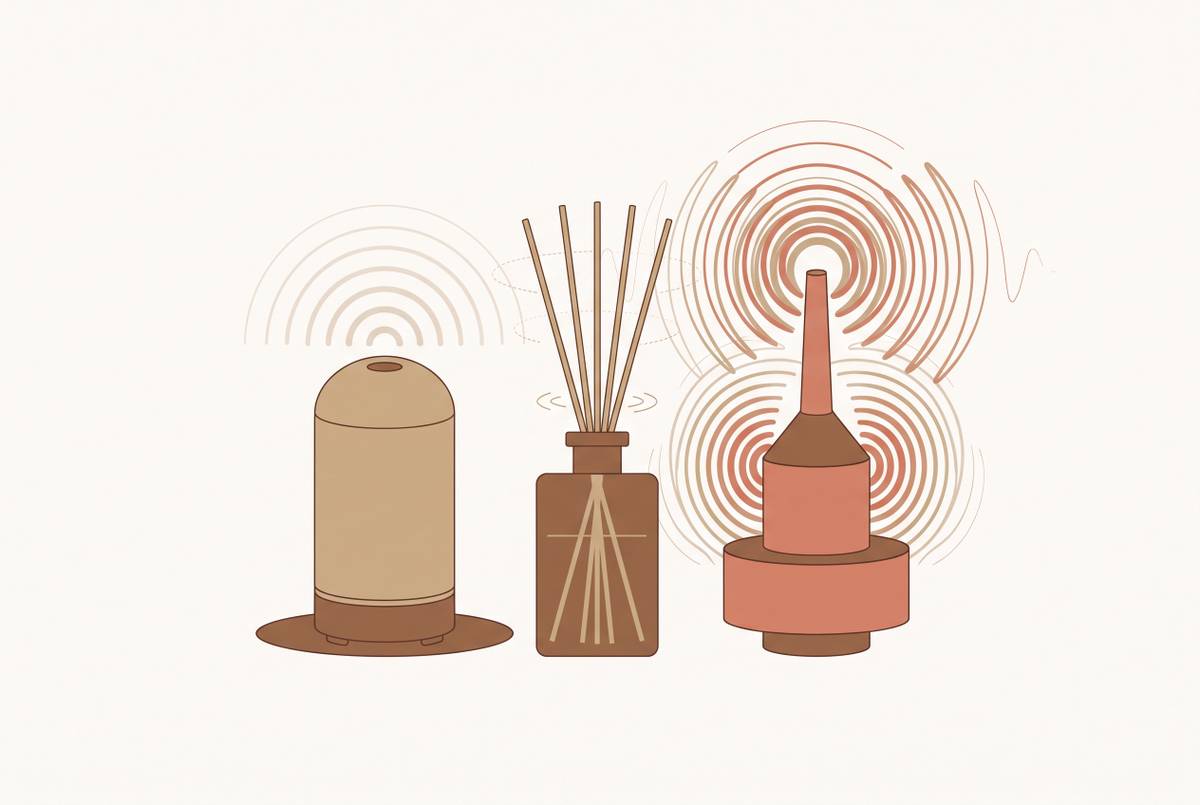
The tank recommendations so far apply to ultrasonic diffusers, which dilute oil in water. Cold-air, or nebulizing, diffusion uses pressurized filtered air to disperse a dry mist of undiluted fragrance. There is no water reservoir to size in the same way. A buyer comparing the two technologies therefore cannot treat their liquid capacities as equivalent measures of overnight endurance.
Air Aroma says cold-air systems are a common way to spread hotel signature scents. They keep a steady scent in the air, with intensity set by how long the output runs and how it is scheduled. A smart-scheduled cold-air unit can use oil more efficiently than an ultrasonic model running continuously to maintain scent. That comparison depends on operation, however, rather than proving that every cold-air unit always consumes less oil.
Cold-air systems cost more upfront, while many quality ultrasonic units operate under 23 dB. Budget ultrasonic models can reach 30–40 dB, and cold-air noise varies, so neither technology name establishes whether a unit is quiet enough for sleep. Both avoid heat, but their trade-offs differ. The 500–700 ml ultrasonic range is a familiar, lower-cost choice for a bedroom, while cold-air uses undiluted scent without water to handle or a pool of diluted oil that children or pets can reach.
Fragrance oil selection and intensity control in a 300 square foot bedroom
In an ultrasonic diffuser, the ratio of oil drops to water governs concentration, so too little oil in a large tank may produce negligible scent. Too much can overwhelm a closed bedroom. Cold-air units instead use undiluted oil, with intensity adjusted through output duration and scheduling.
For either approach, low or intermittent operation is the appropriate bedroom baseline. High continuous output can over-scent a sealed 300 square foot space even when the unit is correctly sized. More fragrance is not the objective here. The aim is a balanced ambient presence, with concentration and timing adjusted together.
The fragrance itself also changes the experience. Lavender, sandalwood and related calming notes suit a bedtime routine, while sensory anchoring explains why consistency can be useful. Repeating the same scent at the same time helps establish an association with rest. Heavy, base-note-dominant oils also spread differently from lighter top-note oils because heavier molecules settle faster, so the same hardware settings may give a different sense of how far the scent reaches.
BPA-free, food-grade PP is the baseline tank specification, particularly because citrus oils contain d-limonene, a solvent that can erode unsuitable plastics. Clean formulations free of phthalates and synthetic additives are the intended standard for overnight use. Those labels do not, by themselves, establish suitability for every occupant. A fragrance that suits the device still needs to suit the people and animals sharing the room.
Pet and family safety considerations specific to bedroom diffuser use
A closed bedroom creates a more concentrated exposure setting than an open-plan room. The relevant variables are the oil, the duration of use, ventilation and whether a pet can leave. These conditions need to be checked before the diffuser runs overnight. Closing a door may improve scent retention, but that same retention changes the safety assessment for occupants who cannot choose their exposure.
Cats present a particular concern because they lack the enzyme needed to metabolize many essential oil compounds. Pet Poison Helpline identifies oils known to cause poisoning in cats, including wintergreen, citrus oil, peppermint, eucalyptus and tea tree. These examples are not an exhaustive list. Oil selection for a cat-occupied bedroom therefore needs more scrutiny than a preference for a calming fragrance or a “non-toxic” formulation label.
Cold-air diffusion removes the hazard of a reservoir of diluted oil that someone can reach. It does not make an unsuitable oil suitable for a cat, infant or person with a respiratory condition. A schedule that limits runtime cuts the total exposure, but the choice of oil and ventilation still need care. Briefly opening a door or window before sleep can reduce the concentration after scenting. The aim is controlled exposure.
Reading a diffuser spec sheet for a 300 square foot bedroom — a practical checklist
Start with rated coverage meaningfully above 300 square feet. Account for an open en-suite, high ceiling or active HVAC before deciding that the rating is sufficient. Then find the output rate in ml/hour. For an ultrasonic unit, this is the specification that addresses reach, whereas reservoir size addresses endurance. A large tank with low output does not pass the coverage test merely because it runs longer.
Next, look for a clearly identified intermittent-mode runtime, with at least 18 hours as the shopping target for ample overnight margin. A 500 ml tank at standard output levels can run that long, while 700 ml lets it run longer. Do not substitute an unlabeled runtime claim for it. Check the noise figure separately, using under 30 dB as the quiet-bedroom target rather than relying on descriptions such as “whisper quiet.”
An ultrasonic tank should use food-grade PP free of potentially harmful chemical additives, and the intended oil must be compatible with the unit rather than assumed suitable because it is an essential oil. Undiluted use needs explicit compatibility. Timer or smart scheduling should support the intended pre-sleep start, pauses and automatic shutoff, so the chosen oil can be delivered at a suitable intensity without manual management through the night.