Why Ultrasonic Diffusers Lose Scent Strength Before It Reaches the Far Side of a Room
Water dilutes fragrance at the source while heavy droplets settle before traveling far.
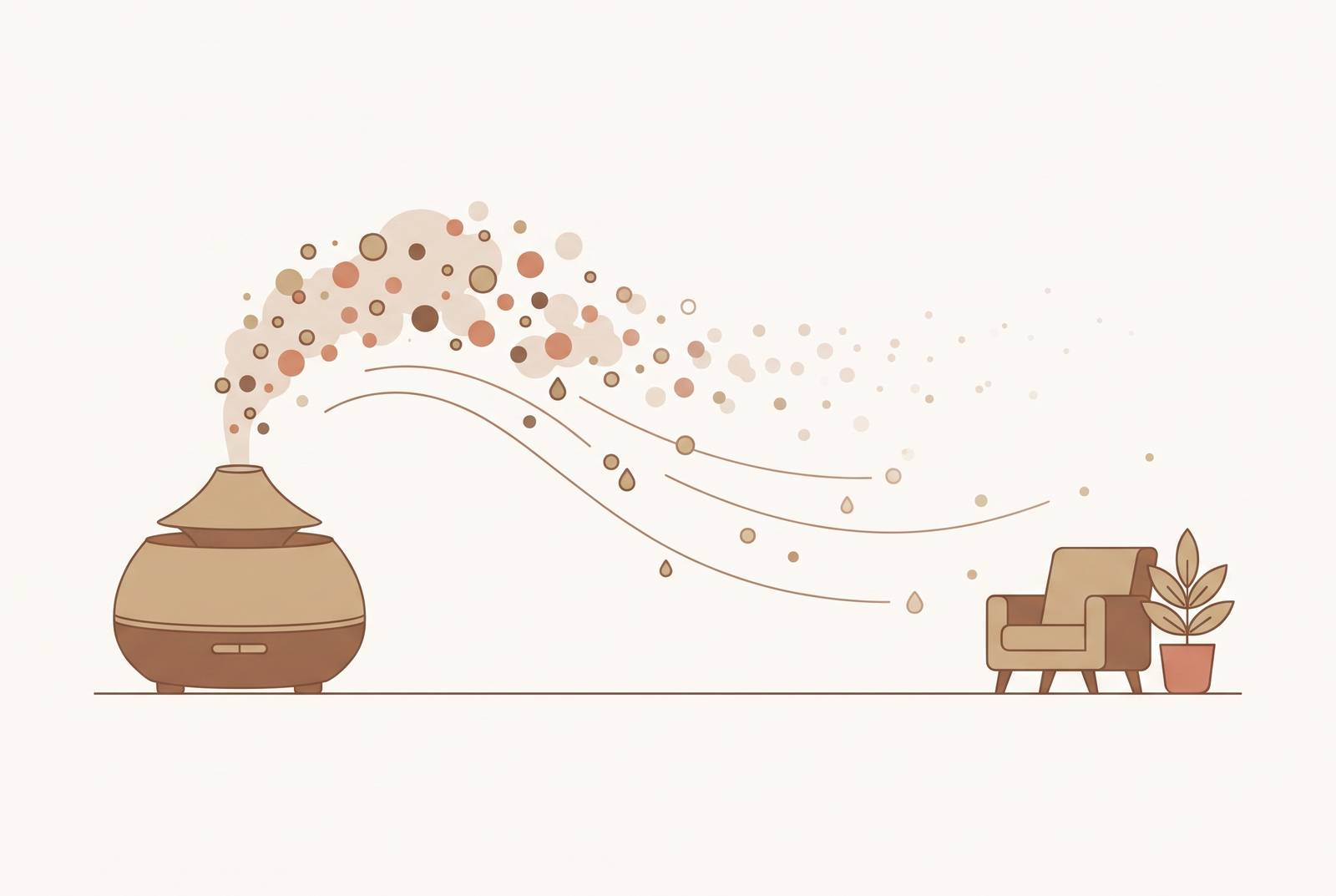
Ultrasonic diffusers lose scent strength across a room because water dilutes the fragrance at the source, while water-laden droplets settle before they can travel far. For home use, ultrasonic diffusion works well in small, closed rooms where a light scent and added humidity are welcome. Cold-air diffusion uses undiluted oil and smaller, lighter particles, so it is better at keeping fragrance even across large or open-plan living spaces.
How an ultrasonic diffuser actually works, and what it releases into the air
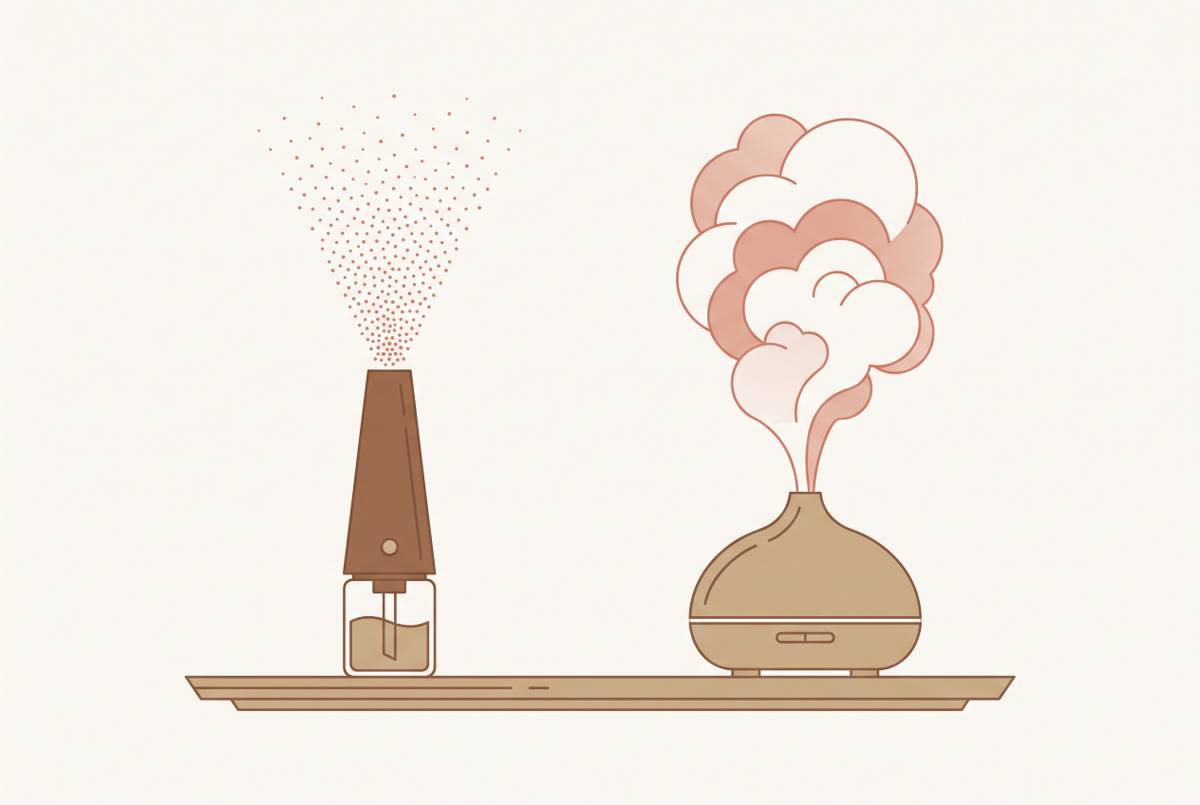
Inside an ultrasonic diffuser, a ceramic disc vibrates at ultrasonic frequency beneath the surface of a water reservoir. That vibration breaks the surface into a fine, cool mist, without heat, a pump or pressure. The visible plume is a water-and-oil mixture whose composition determines both how much fragrance it delivers and how that fragrance moves through the room.
The oil enters the reservoir as drops and sits as a thin film on the water’s surface. As the device produces mist, a small amount of oil leaves with a much larger amount of water. Although the droplets are fine, the aromatic payload in each is small relative to its total mass. A plume that looks big can therefore carry only a little fragrance.
That distinction also explains why the water cannot simply be treated as an unnecessary ingredient. It gives ultrasonic mist its cool, humidifying feel, which is part of the technology’s appeal. The device does two jobs at once, adding moisture as it releases scent. Any comparison with a waterless system needs to account for that design choice before treating differences in strength as differences in quality.
Why water dilution weakens fragrance concentration at the source
A few drops of oil are spread across a large volume of water, so the outgoing droplets contain only a small proportion of aromatic material. This is dilution at the source. Water does not need to alter the oil chemically to reduce the amount of fragrance present in a given quantity of mist.
What does that mean for the person sitting nearby? The scent feels lighter and thinner than the oil itself. Even a fuller oil reaches the air as a small component of the mist. The distinction is between what the oil smells like and how much of it the delivery system makes available to the nose.
Distance then puts that already limited aromatic signal under further strain. There is less fragrance available at the outset to sustain a noticeable presence away from the device. More visible mist does not remove that constraint. Even on high, an ultrasonic diffuser releases a water-and-oil mixture, so more mist does not mean a higher fragrance concentration or pure oil.
Oil and water left in the reservoir can leave stale residue that affects the next fill. In that case, the scent entering the room may not faithfully represent the fresh oil that was just added. A thinner or changed scent need not be the fault of the fragrance in the bottle.
Why water-laden droplets fall before they can travel
Concentration is only half of the problem, because fragrance also needs time in the air to reach a distant part of the room. Suspension depends on particle size and density. Smaller, lighter particles stay in the air longer, while larger, heavier droplets settle sooner. The water in ultrasonic mist contributes to droplet mass without contributing to its aromatic payload, leaving the device with more material to disperse for relatively little fragrance.
The relevant comparison is with the smaller dry-oil micro-particles produced by a nebulizing system, rather than with drops large enough to see individually. Nebulizing particles are roughly one to three microns and can remain suspended for several minutes. Without the added water load, they have more opportunity to migrate through a space before settling. Ultrasonic droplets lose altitude sooner, shortening their useful journey.
Picture an open-plan living room with a seating area connected to a kitchen and dining zone. An ultrasonic diffuser on the coffee table may produce a pleasant scent for someone on the sofa. The kitchen is a different proposition. By the time the mist would need to cross into that zone, settling has reduced the amount of fragrance still available to travel. The far dining corner can remain faintly scented or effectively outside the device’s reach, even while the plume looks busy.
Air movement makes that journey less predictable. HVAC airflow and open doorways can disperse the mist downward and outward before it establishes a consistent presence across the room. Dilution has already reduced the fragrance available in the output, and early settling limits how far that output travels. These are compounding constraints, so increasing the setting may improve the immediate area while scent remains faint at the far wall.
Is an ultrasonic diffuser enough for your living room?
An ultrasonic diffuser can be a good fit for a living room if the space is small, enclosed and relatively quiet in airflow terms. The occupied part of the room needs to fall within the device’s effective reach. A compact seating area asks much less of the mist than a living room that opens into a kitchen, hall and dining space.
Published coverage figures need to be read with those conditions in mind. They are coverage estimates, with fragrance intensity varying within a stated area. Room height also changes the space being scented. Open doorways and active HVAC can further reduce the effective radius, so the number on the box cannot describe every room with the same floor area. Layout and airflow belong in the decision with square footage.
Within a suitable room, ultrasonic diffusion offers genuine advantages, including low noise, added humidity, modest oil consumption and long run times. A persistent background note can be the goal. Someone who wants a light scent in the bedroom overnight may well prefer a slow, steady release to a stronger system made to reach across a larger space. That preference is not a failure to appreciate performance, but a different definition of it.
Long-running output is useful when the room is small and closed enough for that output to serve the intended area. It does not give individual droplets more time aloft. In an open living space, the diffuser can keep the area near the sofa scented while the scent on the far side stays faint. The technology works best when the desired fragrance zone is modest, rather than when a modest plume is expected to serve an expansive room.
How cold-air diffusion solves both problems the physics creates
Cold-air diffusion changes the material entering the air and the way it is broken into particles. Pressurized air flows through a narrow tube and creates a pressure drop that draws pure oil up. The oil is then fragmented into micro-particles. This Venturi process uses no water or heat, so water neither dilutes the oil at the source nor adds to the mass of the particles it releases.
The two changes answer the ultrasonic constraints directly. Undiluted output provides a fuller aromatic signal, while the small particles remain suspended long enough to move through a larger area. Strength and reach improve for different reasons.
Nebulizing units commonly cover 400 to 900 sq ft, a range relevant to open-plan living rooms, large primary bedrooms and connected kitchen-dining spaces. Those figures still require attention to room conditions. Even so, this method is better at spreading scent across a wide area than a water-heavy mist. Commercial spaces use cold-air nebulizing technology for the same reason, as in hotel lobbies where the scent is meant to stay even from entrance to elevator. Devices made for the home work the same way in smaller spaces.
That performance comes with a real trade-off. Cold-air units cost more upfront and consume more oil per session than ultrasonic devices. Interval timers can manage oil use, but they do not make the difference in consumption disappear. For a small bedroom that needs only a gentle background note, more reach may not be worth the extra cost. For a connected living space, the extra cost buys a way of spreading scent that better fits the area it needs to reach.
How placement and room conditions affect whichever diffuser you use
To put that comparison into practice, placement should be treated as part of the system. Even a cold-air unit can produce fading fragrance if it sits where the output is dispersed before it can spread through the intended area. Avoid positions directly beside HVAC vents or in high-traffic corridors. Strong local air movement can scatter the output downward and outward, undermining the advantage of longer suspension.
For ultrasonic units, place the diffuser near the seating area in a small, closed room. That puts its strongest output where it is wanted. A position at mid-room height, rather than on a floor-level surface, gives droplets more vertical space before they settle. Corners or other areas with little cross-draft can also allow particles to remain suspended. The aim is to support a defined scent zone.
A cold-air unit can sit centrally or near the dominant airflow path so its light mist distributes naturally through the connected space. This is different from placing it directly beside a vent. The useful distinction is between working with the room’s general air movement and exposing the output to a strong local disturbance. Where cross-drafts are disruptive, a calmer position can give the particles more opportunity to spread.
Oil quality deserves attention after placement, because the delivery system cannot compensate for a thin or poorly formulated fragrance. The oil supplies the aromatic signal the device distributes. For cold-air diffusion, a well-formulated oil with consistent viscosity also gives the atomizer a consistent material to work with. Clean, vegan, phthalate-free formulations can be selection criteria, but performance still depends on how well the oil is formulated for the delivery system. Technology and fragrance need to be considered together.
Matching diffusion technology to the room you actually have
Begin with the room’s square footage and whether its boundaries are closed doors or open connections to other rooms when choosing a diffuser, giving these conditions priority over its strongest setting. Then compare rated coverage with those conditions. A device made for one closed room has a different job when the same floor area opens into a hall or adjoining kitchen.
For a small, closed primary bedroom, home office or bathroom, ultrasonic diffusion is a natural fit. Its limited reach can match the intended zone, while its humidity and long run time may be welcome. Subtle output can be an advantage here. A large primary bedroom, however, needs to be judged as a larger space before ultrasonic diffusion is chosen for it. The room’s size and layout determine the requirement.
For a large living room, entrance hall or combined dining and sitting area, cold-air diffusion is better at keeping the scent even throughout. A home with more than one room can use a different technology in each space. An ultrasonic unit can provide subtle overnight fragrance in the bedroom, while a cold-air diffuser serves the open living area. Each then performs the task its output is suited to.
Maintenance completes the choice because reliable output depends on the condition of the device. Ultrasonic reservoirs need regular cleaning to prevent biofilm and stale residue from affecting the next fill. Waterless units remove that reservoir task, although their atomizer nozzles still benefit from periodic cleaning. Before buying, match the coverage estimate to the actual room, allowing for open doorways, airflow and optimistic published figures. The aim is not the biggest plume, but fragrance that reaches the places where it is wanted.