Diffuser Coverage Area by Room Size and Ceiling Height
Calculate cubic footage, not just square footage, to size diffusers correctly.
Diffuser coverage ratings measure floor area. Scent doesn't fill a floor plan, though, it fills a volume of air, and that gap between square footage and cubic footage is why a diffuser "rated" for a room sometimes just doesn't cut it. This piece walks through how to size a diffuser properly, using length, width, and the number most buyers forget to write down: ceiling height.
What manufacturer coverage ratings actually measure, and what they leave out
Coverage numbers come from a lab, and they assume still air, a standard 8-foot ceiling, the unit sitting dead center in the room, continuous running with nothing blocking it. That's a clean test. Nobody lives in a clean test.
Furniture breaks up airflow and creates dead zones where scent pools in one corner and never reaches the other. HVAC systems drag fragrance-laden air across the room and dilute it before it settles anywhere. Open-plan layouts ignore the boundary the rating assumes entirely, so coverage bleeds into the next room and gets thin doing it. Ceiling height is the variable nobody accounts for. It can run 8 feet in a standard build or climb well beyond that in a converted loft or great room, and that swing changes the math completely even though the square footage on paper stays identical.
Airflow alone can gut a rating before the diffuser even gets going. A ceiling fan on medium in a 150-square-foot bedroom can cut effective scent concentration by 30 to 40% against the still-air baseline the lab used to generate the number in the first place. Crack a window, run a fan, leave a vent open nearby: each one is a small tax on coverage, and they stack. None of this makes the rating wrong. It makes the rating a floor, not a ceiling, and the irony is that actual ceiling height is the one variable it never asked about.
How to calculate the air volume your diffuser actually needs to fill
The fix is one extra multiplication, and it takes about ten seconds. Multiply floor length by width to get square footage, the way everyone already does it, then multiply that number by ceiling height to get cubic footage. That's the figure that describes the actual job in front of the diffuser, not the one printed on the box.
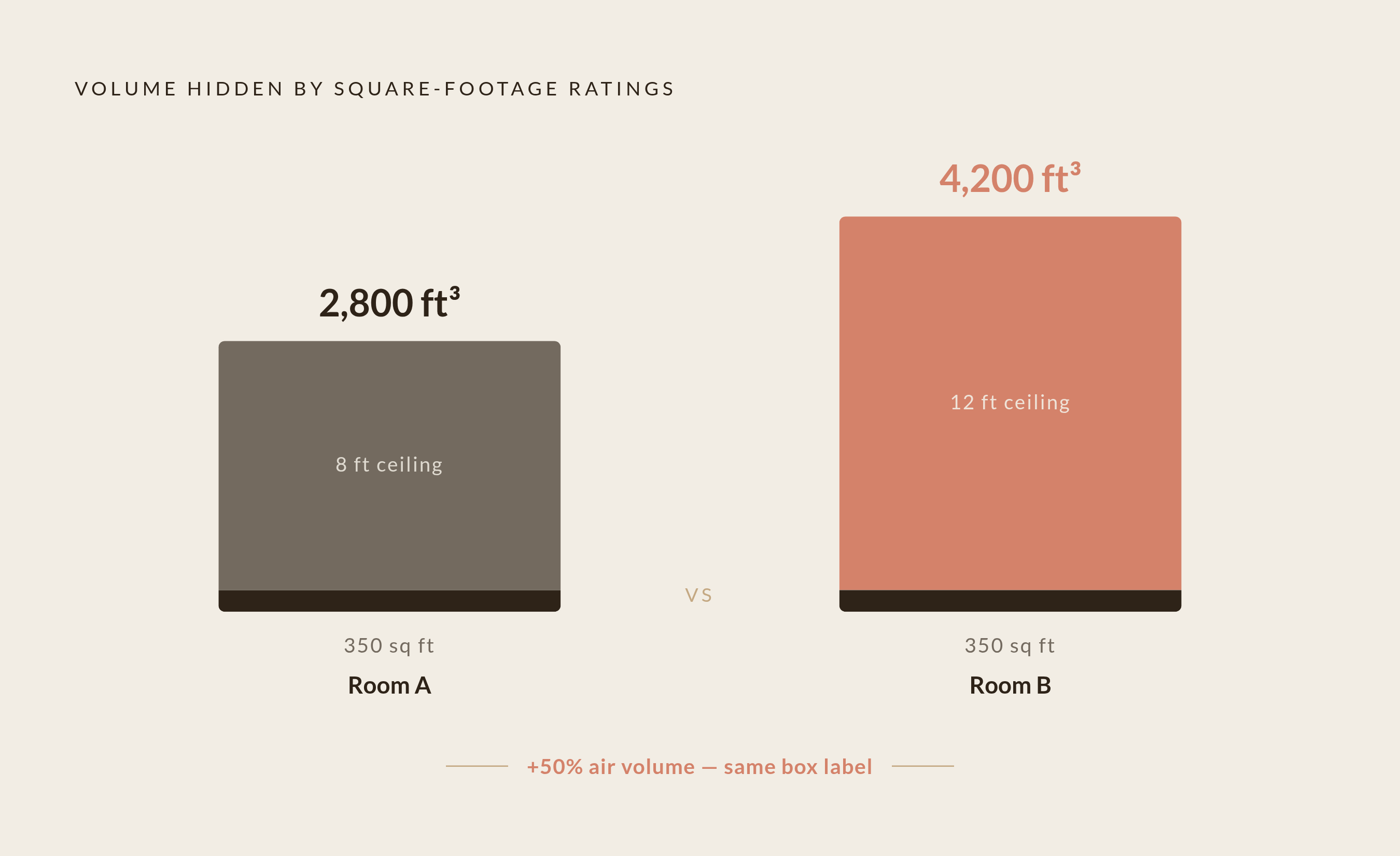
Set that next to a flat square-footage rating and the problem shows itself fast. A room rated at 350 square feet with a standard 8-foot ceiling holds 2,800 cubic feet of air. Give that same 350-square-foot footprint a 12-foot ceiling instead, the kind found in a converted warehouse unit or a great room with exposed beams, and it now holds 4,200 cubic feet. Same floor plan, same square-footage sticker on the box, 50% more air to actually scent. A unit rated for 350 square feet under lab conditions is being asked to do a job one and a half times its size, and it has no idea.
This is where most buyers get the decision backwards: shopping by square footage is the wrong method, full stop, because that's the number on the label, and it's how someone ends up wondering why the great room with vaulted ceilings smells like nothing by the time they reach the far couch. The fix requires rethinking the setup entirely, not just swapping in a stronger diffuser or a different scent. It's the cubic footage math, done once, before the purchase instead of after the disappointment.
Room-by-room sizing: matching diffuser output to the spaces in a typical home
A standard bedroom, 12 by 12 feet with an 8-foot ceiling, works out to 1,152 cubic feet. Small, boxy, low ceiling: this is close to the best-case scenario a manufacturer's lab test resembles, so the printed rating tends to hold up here better than almost anywhere else in the house.
Living rooms are where the trouble starts. A mid-size living room at 9 feet of ceiling height already holds a substantially larger air volume than a standard bedroom, and that's before anyone accounts for the open doorway to the kitchen or the ceiling fan running all summer. Great rooms with vaulted or cathedral ceilings are the real outlier: a 20-by-20 footprint at 16 feet averages out to 6,400 cubic feet, more than twice what the same floor plan would hold at a standard 8-foot ceiling. Buy for square footage on a room like that, and the diffuser is short by a factor of five before it's even out of the box.
Bathrooms flip the problem. Small, often under 100 square feet, but ventilation fans move air fast enough to strip scent out of the room in minutes. The limiting factor isn't volume, it's air exchange rate. A diffuser sized correctly for a 60-cubic-foot bathroom can still lose to a high-capacity exhaust fan, because the fan is cycling air out of the room at a rate that outpaces the diffuser's output. No amount of cubic-footage math saves a diffuser from a ventilation system that's winning on speed rather than size.
Why cold-air diffusion handles volume more effectively than water-based or heat-based alternatives
Not every diffusion method scales the same way with cubic footage, and heat-based diffusers are the weakest of the three for anything beyond a small room, no matter what the box claims. They work by warming oil until it evaporates, and heat breaks down the lighter aromatic compounds in essential oils first. That means the scent thins out and changes character well before it's traveled far enough to fill a large volume of air. That's a chemistry problem, not a power problem: turning up the heat doesn't fix it, it accelerates the breakdown.
Water-based ultrasonic diffusers use a plate vibrating at ultrasonic frequency to break oil and water into a fine mist, and they hold up fine in small, enclosed rooms. But the mist is diluted by design, carrying oil suspended in water vapor rather than oil alone, and it depends on evaporation to actually disperse. In a large great room, that mist runs out of momentum long before it runs out of room.
Cold-air, or nebulizing, diffusion skips the water and skips the heat. It uses pressurized air to atomize pure essential oil directly into a fine suspension, so the oil's chemical structure stays intact and the particle concentration per cubic foot of output stays far higher than either alternative manages. That's the mechanical reason nebulizing diffusers get rated for larger spaces than ultrasonic units of similar size, and it's why they're the more reliable choice for larger or more open spaces. Pick an ultrasonic or heat-based unit for a great room with significant volume, and the fight is already lost before the diffuser finishes its first cycle.
Where to place the diffuser once you have the right size
Cubic footage gets the size right. Placement decides whether that size ever gets used.
Center of the room beats a corner, every time, for the same reason a speaker sounds better in the middle of a room than crammed against a wall: airflow can move in every direction instead of only the ones that aren't blocked. A diffuser pushed into a corner is fighting two walls before the scent's gone anywhere.
Elevation matters more than most buyers expect. Placing a diffuser on a shelf or table roughly 3 to 4 feet off the floor lets it work with the room's natural air currents, since warm air rises and pulls scent up and out rather than letting it pool along the baseboards where nobody's nose happens to be. Keep it clear of direct airflow from vents or windows, since that airflow is exactly what was cutting effective coverage by 30 to 40% in the bedroom example earlier. In a great room or open-plan layout, placing the diffuser closer to the center of the whole connected space, rather than centered on one zone of furniture, accounts for the fact that the "room" it has to fill isn't bounded by walls that aren't actually there.
A practical checklist for choosing and placing the right diffuser in any room
Measure length, width, and height, then multiply all three. That's the cubic footage number that matters, not the square footage on the box.
Compare that cubic footage against the diffuser's rated capacity, and pad the number if the room has a ceiling fan, an HVAC vent nearby, or an open floor plan bleeding into another space. For anything past a standard bedroom, especially a great room or a vaulted living space, cold-air nebulizing diffusion is the more reliable pick over ultrasonic or heat-based units, and treating it as an equal option among three is how most of these purchases go sideways. Place the unit centered in the room and roughly 3 to 4 feet off the ground, away from direct airflow, and treat open-plan spaces as one combined volume rather than a collection of separate rooms.
Skip any of these steps, and the square-footage rating on the box goes back to being the only number in the room, which is exactly the number that started this whole problem.