Large Room Scent Coverage Test Waterless Diffuser Against Ultrasonic
Waterless diffusers cover large rooms better than ultrasonic models.
For home use, cold-air waterless diffusers are the stronger choice for large rooms because they release undiluted fragrance as a fine mist that stays airborne and spreads farther. Ultrasonic diffusers disperse oil in water, making them better suited to a softer scent in a small room. The difference in reach, consistency, and intensity starts with the mechanism, but room layout, controls, maintenance, and oil choice determine the result.
What’s the difference between a cold-air and an ultrasonic diffuser for a living room?
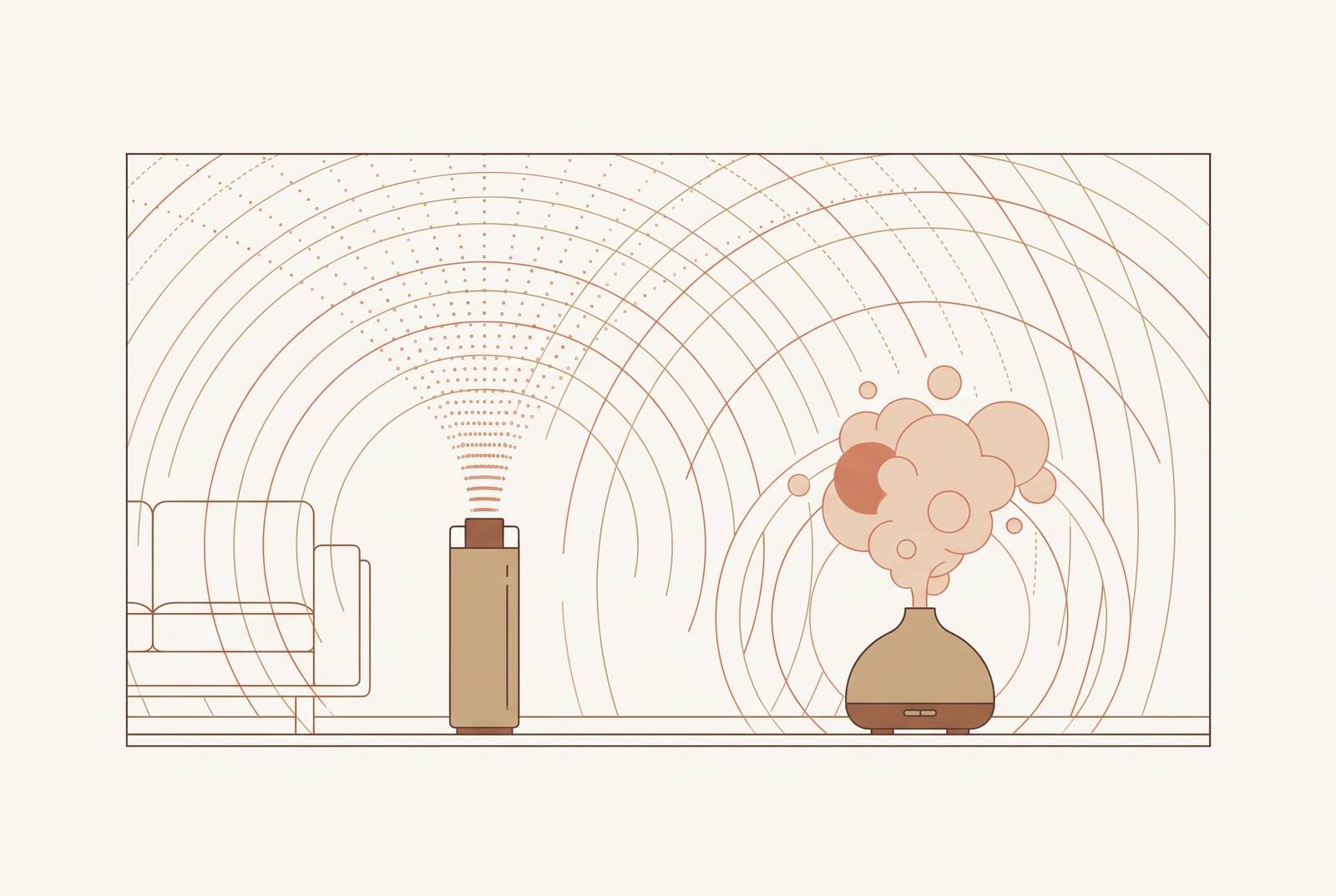
Cold-air and ultrasonic diffusers use different mechanisms. A cold-air diffuser has a pump that pushes pressurized air across a narrow tube. The resulting vacuum draws fragrance oil upward, where the airstream breaks it into fine particles. No water enters the process, and no heat is applied.
An ultrasonic diffuser starts with a different mixture. A ceramic plate at the bottom of its reservoir vibrates at ultrasonic frequencies, breaking water and a small dose of oil into a cool, visible mist. Most of that mist is water, with fragrance dispersed through it. Visibility is not a measure of scent strength.
Both methods release fragrance without heating it, but only the cold-air method avoids the water reservoir and its dilution. That distinction affects both the concentration leaving the device and how the particles behave afterward. Cold-air diffusion gives off a fine, dry oil mist that can stay in the air for a long time. Water weighs down ultrasonic droplets, which tend to settle near the device, so gravity starts to pull them down almost as soon as they leave it.
What fragrance dilution actually does to scent reach in a large room
Dilution gives an ultrasonic diffuser less fragrance to distribute through the surrounding air. As that output spreads into a large room, the scent can become faint before it reaches the far side. The oil is still diluted when the mist setting is turned up. This explains why an ultrasonic diffuser may look busy on high while barely scenting the whole room. The visible output and the perceived fragrance are different things.
Cold-air diffusion starts with undiluted oil and particles that stay airborne longer, so room air has more time to spread the scent. A suitably sized unit can fragrance an open-plan kitchen-living room combination where a comparable ultrasonic model might scent only a corner. Results still vary by model, oil dose, airflow, and placement.
A gentler smell is not, by itself, a safety assessment, just as it is not evidence of adequate coverage. In a large room, gentle can become effectively absent away from the device. Dilution can also change how the top, heart, and base notes smell in relation to each other, as well as make the whole fragrance weaker. Cold-air intensity controls let the user turn down a concentrated fragrance.
How room size and layout determine which technology is adequate
A bedroom or home office asks less of a diffuser than an open-plan living area. Ultrasonic devices are usually designed around that single-room task, where a soft, local scent may be exactly what is wanted. Open-plan rooms change the requirement. Without walls containing the mist, fragrance disperses into a larger volume of air, and the limits of water-diluted output become more apparent.
Cold-air devices also need matching to the space. Small plug-in units work well in small to mid-sized rooms, while standalone tower-style models are a better fit for open-plan living areas. HVAC-connected systems can spread the scent through several rooms or the whole home. These are distinct scales of use. A small waterless device can use the same basic mechanism as a larger system without being able to scent the whole home.
Floor area alone cannot describe the job. A room with tall ceilings contains more air than a standard-height room with the same footprint, so its coverage requirement is greater. Furniture, closed doors, and normal ventilation also separate a lived-in home from ideal conditions. An “up to” coverage claim generally describes maximum intensity under favorable airflow. Buyers should therefore choose a device rated for more than the floor area it needs to scent.
Why placement and intensity settings shape real-world performance as much as technology type
To turn that capacity into useful coverage, place a standalone diffuser in an elevated, central position. This gives the fine mist a better starting point for distribution by room air currents. A perimeter position makes the diffuser work from one edge of the space. Good technology cannot cancel out poor placement. For multi-room coverage, a system connected to central heating, ventilation, and air conditioning spreads scent more evenly than a standalone unit that has to reach from one room into others.
Start at low intensity and schedule operation around the hours the space is occupied. Continuous full output can consume oil unnecessarily while producing scent fatigue, in which the nose stops registering the fragrance. More output is not always more perceived freshness. Interval scheduling in 30–60 minute cycles can maintain that sense of freshness while reducing oil use, rather than keeping the device at full power throughout the day.
Multiple intensity levels make those adjustments practical. A setting that suits an empty room in the morning may feel excessive when guests occupy it in the evening, while timer controls and app-based adjustment reduce daily intervention. The aim is dependable background fragrance. Getting placement and scheduling right can separate a diffuser that transforms a space from one that sits unused after two weeks.
Maintenance differences between the two types and what each means for ongoing performance
Maintenance affects coverage because residue can change what a diffuser releases. In an ultrasonic model, standing water, organic compounds, and warmth can support microbial growth if the tank remains dirty or damp between uses. That does not make the technology unmanageable. Emptying, drying, and cleaning the reservoir according to its manual addresses the system’s particular needs. A universal weekly cleaning rule is less useful than the instructions for the actual device.
Cold-air systems have no water reservoir to clean. They avoid its mineral buildup and damp-tank problems, and they do not add water mist near furniture, books, or electronics. They are not maintenance-free, however. The nozzle and fragrance-contact parts still need periodic cleaning because oil residue can interfere with output. Where the device’s care instructions permit it, periodic cleaning with isopropyl alcohol can help keep the nozzle clear.
Oil compatibility also shapes the maintenance burden. Thick oils such as vetiver, patchouli, and sandalwood can build up in the atomizing chamber, while carrier oils including jojoba, coconut, and almond can clog the mechanism. Oils made for cold-air nebulization avoid these problems with buildup and clogging. Cleaning also protects scent character, since residue from a previous fragrance can alter the next one. Ultrasonic care is manageable when consistent, while cold-air care is simpler by design. Neither system delivers sustained performance through neglect.
What oil quality and formulation do to coverage and safety
Undiluted output makes the oil itself a central performance and safety variable. Cold-air atomization avoids heat-induced degradation and combustion byproducts, but preserving a formulation is only an advantage when that formulation is suitable. The mechanism does not make an unsuitable oil safe. Whatever the hardware, ingredients, concentration, and room ventilation still need care, especially in homes with children or pets.
For purchasing, look for phthalate-free fragrance oils that comply with established fragrance safety standards and explicit compatibility with cold-air nebulization. IFRA compliance refers to established fragrance safety standards, while phthalate-free labeling addresses that ingredient category. Neither label is a blanket assurance for every household. Reed-diffuser oils, alcohol-based perfumes, and water-based blends are not interchangeable with nebulizing oils and can clog the device or damage its seals. The correct formulation protects both the mechanism and the quality of its output.
Pet households require particular caution. Cats lack a key liver enzyme and metabolize concentrated essential oils poorly. The Merck Veterinary Manual identifies multiple oils as especially dangerous, and the high-risk choices described in the safety guidance include tea tree, wintergreen, pennyroyal, cinnamon bark, peppermint, eucalyptus, clove, sweet birch, and citrus. Lavender, Roman chamomile, and frankincense appear as lower-risk choices in guidance and still require caution. A “hotel-style” fragrance description is likewise not proof of pet suitability. Use blends identified as appropriate for the household, keep the room ventilated, control concentration, and always allow the animal to leave.
How the hotel scent experience maps directly onto cold-air technology — and how to replicate it at home
The appeal of hotel fragrance is its continuity. Rather than encountering a strong pocket beside a machine and little scent elsewhere, the visitor experiences fragrance as part of the space. Cold-air diffusion at the right scale provides the physical basis for that effect. Pure oil dispersed as a fine, dry mist can create an enveloping background without depending on a visible plume.
To reproduce that effect at home, match a cold-air unit to the living area and use adjustable intensity with interval scheduling. An open-plan room does not require a commercial system to benefit from the same fundamental approach. Fragrance choice then defines the atmosphere. Hotel-style compositions are built around an environment rather than a single note, and cold-air diffusion preserves the intended relationship between their top, heart, and base notes. The base notes help those compositions last and fill the room.
A signature fragrance adds another layer of continuity. Used consistently in the main living space, it can become associated with the home over time. A small fragrance wardrobe can still have fresh scents for kitchen and bath, warmer or woody scents for living areas, and floral or herbaceous scents for bedrooms. Changing scents with the seasons can keep that choice thoughtful without the need for a large collection.
How to choose between cold-air and ultrasonic before buying, and what to check on the device itself
Measure the floor area and check for open doorways, ceilings that are taller than standard, and sources of strong ventilation. Tall rooms require coverage beyond their footprint, while open-plan spaces need a coverage margin. For a large living room, cold-air is the more suitable starting point. For multiple rooms, the decision also concerns distribution.
Then examine the controls on the specific device. Several intensity levels and a usable timer let output follow occupancy and time of day, while app connectivity offers remote adjustment if wanted. A single-setting machine leaves little room for calibration. Check which oils the device allows and how to clean it at the same time, since these show what it will take to keep it running. Open compatibility with oils formulated for cold-air diffusion offers more choice and can lower ongoing costs compared with a proprietary cartridge system.
Check warranty coverage and after-sale support just as closely. Well-built cold-air models with metal components can last for years, making durability relevant to the upfront premium. That premium is not necessary for every use, however. Ultrasonic is still a good choice for a soft scent in one small room, visible mist, mild humidification in dry winter air, or the lowest possible cost to buy. It can make sense to use both technologies in different spaces. The decisive purchase is not the strongest diffuser available, but the one whose mechanism, capacity, and controls fit the room it must actually scent.