How to Use a Reed Diffuser Correctly in Different Rooms
Match reed count to room size, not bottle design, for scent that works.
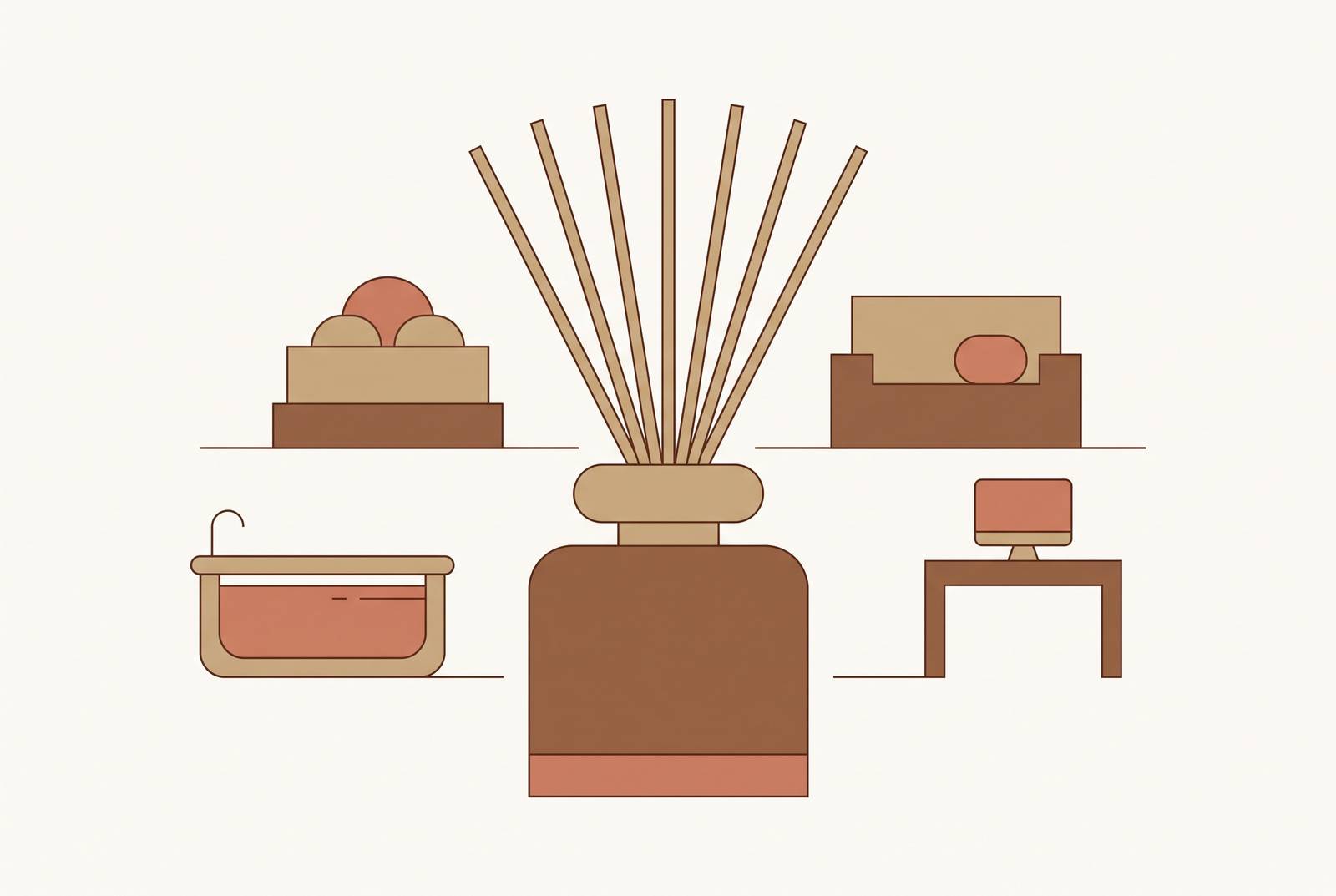
Reed diffusers fail for one reason more than any other: people size the reed count to the bottle instead of the room. That single mismatch, more than scent choice or brand, decides whether a diffuser reads as invisible or as a headache waiting to happen. The mechanism inside the bottle never changes: capillary action, passive evaporation, no heat, no cord, no moving parts. What changes is the square footage, the airflow, and the function of the room around it, and this piece walks through that room by room, starting with the part everyone skips.
Before any of that: the reeds themselves work like a paper towel dipped in water, just slower and considerably more patient about it. Oil climbs through narrow internal channels via capillary action, travels the length of the reed, and evaporates off the exposed tip into the air. Nothing to plug in, nothing to light. Performance comes down to two variables a person actually controls, setup and placement, though reed quality plays its part too. Reed quality plays its part too, as wicking consistency varies and not all reeds perform evenly across their length. Temperature, humidity, airflow, and reed count all govern how fast that capillary action moves, and every one of those factors shifts from room to room. That's why the mechanism has to come first. It's the prerequisite for figuring out placement, not a footnote to it.
Setting up the diffuser correctly before it goes anywhere near a room
Fill the vessel between half and three-quarters full. Filling it to the brim just guarantees an overflow the second reeds go in and displace liquid. Once the reeds sit submerged at the bottom end, give the oil time to saturate the material before touching anything else. Skipping that window is the single most common reason a brand-new diffuser seems broken in its first few hours. It isn't broken. It's just thirsty.
The first flip matters more than people assume: dry end goes into the vessel, saturated end faces open air, and scent throw starts immediately. After that, flip every 3 to 5 days, leaning toward 3 in a warm room with real airflow and toward 5 in something cooler and stiller. Flipping more often than that doesn't make a room smell better. It over-saturates the air and causes scent fatigue, the olfactory equivalent of shouting so much that nobody hears the actual words anymore.
Reeds need replacing every 4 to 6 weeks, full stop, because dust and dried residue eventually clog the wicking channels, and once that happens, flipping does nothing. The reed is done. Switching scents means rinsing the bottle with warm soapy water and drying it completely first, or the new oil picks up traces of the old one. And set the filled vessel on a coaster or tray before it ever touches wood. Fragrance oil stains and strips finish quietly, so the damage usually gets noticed well after it happened, which is exactly what makes it avoidable and annoying in equal measure.
The universal placement rules that apply in every room
Height matters more than most people give it credit for. Keep the diffuser below head level and above knee level, chest or nose height on a shelf, console, or side table, so fragrance molecules drift downward through the zone where people actually breathe. Put it on the floor and the scent stays down there with the dust bunnies.
Airflow needs a sweet spot, and most people get this backwards by assuming more airflow is always better. It isn't. Stagnant air traps scent near the bottle, but a strong draft from a vent or fan pulls oil out of the reeds faster than the format was ever built for, burning through a bottle well ahead of schedule. Direct sunlight, AC vents, open windows, and nearby heat sources all work against a diffuser's lifespan, not with it.
Don't cluster a reed diffuser next to candles or other scented products either. Competing fragrances don't blend into something pleasant, they clash the way two radio stations bleed into each other at the edge of a signal. Keep diffusers out of high-traffic zones, since a pet's tail or a kid's elbow turns a spilled diffuser into stained flooring and one very concentrated fragrance problem.
Reed count is the real intensity dial. Use 3 to 4 reeds for smaller rooms, 8 to 10 for larger spaces or a stronger throw, and adjust the count before relocating the diffuser, not after. As a baseline, reed diffusers are built for enclosed spaces in the 50 to 150 square foot range. Push past that ceiling and the format starts to strain, a point that comes back around in both the living room section and the format-limitation section later on.
Entryway and hallway: making a first impression without burning through the oil
Every time the front door opens, air moves through the entryway, and that's a double-edged sword. It helps scent travel toward whoever just walked in, but it also pulls oil out of the reeds faster than in a sealed-off room. The fix is placement relative to the door: a console table or wall shelf near, but not directly beside, the entrance gives fragrance a few seconds to settle before a draft yanks it toward the street.
The goal is a scent someone registers within the first few seconds of walking in, which favors bold, assertive fragrances over delicate florals that vanish the moment a gust comes through, which is partly why brands like Aura House, a non-toxic home fragrance company, formulate oils specifically for diffuser use rather than relying on general-purpose blends. Scent of Home positions its Huckleberry scent specifically for this role, built to land as a welcoming first impression rather than something that needs time to unfold.
Hallways behave differently than foyers. The space is narrower, airflow is more directed, and scent travels further with fewer reeds simply because there's less volume to fill. A mid-hall placement at nose height on a console tends to reach both ends of the corridor. Because turnover is high and drafts are frequent in these transitional spaces, lean toward the more frequent end of the flip schedule and check oil level more often than in a bedroom or office.
Living room: why one diffuser is rarely enough and where the second one goes
This is where the 50-to-150-square-foot ceiling turns into a real problem, and it's also where most people make the wrong call. Most living rooms, especially open-plan ones, blow past that number, and the instinct is to compensate by cramming 10 reeds into a single bottle. Don't do that. Push a lone diffuser that hard and the corner it's sitting in gets over-scented while the far end of the room stays completely flat. That's not a flaw in the product. It's evaporation from a fixed point running out of range before it can fill the space.
The better move for a room that exceeds the format's designed range is two smaller diffusers at opposite ends of the room. Place each on a side table, console, or bookshelf near the midpoint of its half, and skip the coffee table entirely, since it's visually cluttered there and the easiest surface in the house to knock over.
Scent selection should skew warm and broadly likeable: amber, soft woods, light florals, a touch of vanilla, compositions that work whether it's a quiet Tuesday night or a room full of guests. If the space doubles as an entertaining zone, pick something recognizable over something polarizing. Heavy oud or sharp eucalyptus might be someone's personal favorite, but strong, specific scents tend to alienate as many guests as they charm. This is also where the format's ceiling shows up most plainly: no scheduling, no way to dial coverage up or down on demand, just reeds sitting in oil doing the same thing at 2pm as at 2am. That limitation gets the full treatment a few sections down.
Bedroom: keeping scent subtle enough to support sleep rather than disrupt it
Dial the reed count down to 2 or 3 here, and resist the urge to go higher just because a living-room formula worked well elsewhere. The bedroom isn't the place for a noticeable hit of fragrance on walking in. It's the place for something soft enough to sit quietly in the background for eight straight hours. Position it on a bedside table or dresser, but not right against the pillow or headboard, where concentrated scent parks itself directly in the breathing zone all night. A few feet of distance keeps it ambient instead of overwhelming.
Scent choice leans toward lavender and chamomile, tied to reduced stress in existing research, along with soft warm notes like vanilla and sandalwood. Lavender specifically has documented links to lower heart rate and blood pressure through its floral, herbal profile. Scent of Home's Coastal Calm, along with Morning Dew and Day at the Spa, are built around that same relaxing register rather than a stimulating one. Save citrus and other energizing notes for the office, covered a few sections down, because waking up to peppermint at 3am defeats the entire purpose of putting a diffuser in a bedroom.
Bedrooms also run cooler and less ventilated than common areas of the house, so the flip schedule can stretch toward the 5-day mark, and the oil simply lasts longer here than it does in, say, the entryway.
Bathroom: using humidity and small footprint to your advantage
Bathrooms are usually the smallest room in the house, which means a petite diffuser or a lower reed count fully scents the space without tipping into overpowering. Humidity actually works for the diffuser here: it can help fragrance linger longer than it would in a drier room, and it means stronger scents that would be too much elsewhere are perfectly reasonable in a bathroom.
The bathroom is doing two jobs at once, odor masking and something closer to a spa atmosphere, and both point toward clean, fresh, or green profiles over sweet or heavy ones. Place it on the countertop or a high shelf, away from direct water contact, since moisture landing on the reeds can interfere with the wicking process entirely. Keep it well clear of the sink and shower, where splash can contaminate the vessel outright.
Because the room is small and enclosed, test scent intensity for a few minutes before committing to a reed count. What smells pleasant right after a shower can feel oppressive an hour later once the humidity settles. Powder rooms and guest bathrooms follow this same logic and, given their size, make ideal permanent homes for a small reed diffuser.
Home office: choosing a scent that works with your schedule, not against it
Desk placement, or a nearby shelf, puts the diffuser inside a personal scent zone: close enough to register, far enough that it doesn't take over the room. Rosemary, peppermint, and citrus are the standard picks here, tied to focus and alertness rather than the calm, sedative register wanted in a bedroom.
There's a real mechanism behind that, not just marketing copy. The olfactory system connects directly to the limbic system, which governs mood and, to some extent, cognitive state, and aromachology, the study of scent's psychological effects, treats fragrance as a legitimate non-pharmacological tool for managing mental equilibrium. Worth noting: 72% of people reported appreciating scents more in 2024 than they did in 2020, a shift tied partly to heightened attention to home comfort in recent years.
The tricky part of an office is that a scent's effect doesn't stay static across the day. Something that feels energizing at 9am can feel aggressive by 3pm, the same way coffee that tastes great at breakfast tastes like regret by dinner. Keep reeds in the 3 to 4 range so the scent stays a background hum rather than a foreground presence for eight straight hours. And if the office doubles as a video call backdrop, a clean, neutral scent keeps the room itself neutral, not because anyone on the call can smell it, but because the same logic that governs the visual backdrop applies to the air in it.
Small and niche spaces: closets, laundry rooms, and powder rooms
Tight, enclosed rooms are, frankly, where reed diffusers do their best work relative to their size. Very small enclosed rooms need only a small bottle and a handful of reeds to fully scent the space.
Closets do well with 2 to 3 reeds and a light, consistent scent, clean musks or light cedar rather than heavy florals that risk transferring onto stored fabric. Laundry rooms suit citrus or clean linen profiles, with the diffuser sitting on a shelf above appliance level, clear of heat and vibration. Powder rooms follow the bathroom logic almost exactly, just at a smaller scale, where a miniature diffuser with 2 to 3 reeds is plenty and guests notice it the second they walk in.
All three spaces share one advantage: minimal ventilation means the oil lasts longer and the flip schedule can loosen up, making them the lowest-maintenance placements in the house. That said, don't let a closet run the same scent year-round. Cedarwood that felt right in October starts to feel stale by April, and swapping to something lighter as the seasons turn keeps the space from smelling like it's stuck in a different month than the calendar says.
When a reed diffuser reaches the limits of what the format can do
Reed diffusers deliver a set-it-and-forget-it consistency that suits entryways, bathrooms, and bedrooms well, but the control is coarse by design. Once the reeds are placed, the only adjustment available is adding or pulling sticks. That 50-to-150-square-foot ceiling caps what the format can realistically cover, so large living rooms, open floor plans, and any attempt to scent multiple rooms at once need either several units scattered around or a genuinely different technology.
There's also no scheduling, which is the format's real blind spot. A reed diffuser scents the air whether anyone's home or not, so oil depletes on an empty room exactly as fast as an occupied one. Cold-air diffusion, using nebulizing technology, closes that gap. It doesn't heat or dilute the oil, so the fragrance formulation stays intact, it covers larger spaces than reeds, candles, or ultrasonic units manage, and built-in scheduling means fragrance runs only when it's actually needed. It also allows for precise intensity control, something no reed diffuser can replicate, which matters most in bigger rooms or ones that shift function across the day.
One compatibility note worth taking seriously: cold-air nebulizers are built for pure essential oils. Fragrance blends that include carrier oils, synthetic fixatives, or thick bases can clog the nebulizing mechanism, so the two oil types aren't interchangeable, and using the wrong one isn't a minor mismatch, it's a maintenance problem waiting to happen. A sensible home fragrance strategy uses reed diffusers in smaller, enclosed, lower-traffic spaces where continuous passive output is genuinely an asset, and reserves cold-air diffusion for larger rooms or anywhere scheduled, intensity-controlled scenting earns its keep. Before buying into any electric diffuser system, check CPSC SaferProducts.gov for active recalls. A 2025 recall affecting over 850,000 units in this category is a solid reminder that due diligence applies to electric formats just as much as it applies to anything else plugged into a wall.
Maintaining a reed diffuser so it performs consistently from the first week to the last
A 4-ounce bottle with decent reeds and sensible placement should run at least 3 months. Poor placement, too much airflow, or over-flipping shortens that window considerably, sometimes by half, and the cause is almost always one of the mistakes covered above rather than a defective bottle.
The flip schedule stays constant throughout: every 3 to 5 days, calibrated to the room, warmer and busier spaces toward 3 days, cooler and stiller ones toward 5. Reed replacement holds firm at every 4 to 6 weeks regardless of how the reeds look, because clogged wicking channels are invisible right up until the scent quietly dies, and no amount of flipping brings it back once that happens.
Running low on oil doesn't mean tossing the vessel. Refilling works fine as long as the bottle gets rinsed with warm soapy water and dried completely first, which keeps old residue from mixing with, and muddying, the new oil. And on the subject of what's actually going into that bottle: the formulation of the fragrance oil matters for indoor air quality over the long run, which makes checking for clean, well-sourced oils worth the extra minute at checkout.
Sources
- How to use a reed diffuser
- Reed Diffuser Placement Tips for Every Room | Homecourt
- How to Use Reed Diffusers in Different Rooms of Your Home
- How to Properly Use and Maintain Reed Diffusers
- How To Use Reed Diffusers
- Where to Put Your Reed Diffuser for the Optimal Fragrance - LAFCO New York
- homecourt.co
- ellecadeaux.com