Reed Diffuser vs Electric Diffuser for an Apartment
Electric diffusers offer scheduling and intensity control that reed diffusers simply can't match.

Choosing between a reed diffuser and an electric diffuser for an apartment comes down to room size, how consistent you need the smell to be, how much control you want over intensity, and what's actually safe to run in a small space with thin walls and shared ductwork. I've lived with both, replaced more reed bottles than I'd like to admit, and killed one ultrasonic unit by ignoring the tank for a month. So let's get into it.
Apartments come with constraints houses just don't have. Most leases ban open flames outright, which knocks candles out of contention before you've even opened a browser tab. Layouts get weird too: galley kitchens, studios where the bedroom and living room are the same 300 square feet, combined spaces that don't map onto "room" the way diffuser packaging assumes they will. Shared ventilation and thin walls mean your fragrance choice becomes, in some small way, your neighbor's problem as well. And since you can't install anything permanent, whatever you buy needs to survive your next move in a cardboard box.
This has become a bigger deal than it used to be. Home fragrance went from an afterthought to something people actually plan around; research cited by ellecadeaux.com found that 72% of the population in 2024 appreciated scent more than they did in 2020, which tracks as a fairly obvious post-pandemic shift toward treating how your home smells as part of its design, rather than an accident of what you ordered for dinner. The diffuser sub-category alone reached $1.5 billion globally in 2024. That's a household staple now, sitting somewhere between a lamp and a houseplant in terms of how routine it's become.
For renters, the realistic choices narrow to two formats: reed and electric. Everything else runs into either a lease clause or the simple fact that you don't own the ductwork. What follows is a room-by-room, dollar-by-dollar comparison of the two, and by the end you should have a decent read on which one fits your particular apartment.
How reed diffusers actually work and what that means day to day
A reed diffuser is about as low-tech as home fragrance gets, and I mean that as a compliment. Fragrance oil sits in a glass vessel, and rattan or fiber reeds pull it upward through capillary action, the same process that lets a paper towel wick up spilled coffee, then release it passively into the air. No heat, no electricity, no switch to flip. The second you drop the reeds in, diffusion starts, and it doesn't stop until the oil's gone.
That always-on quality is basically the whole personality of the format. The scent stays constant, but it's quiet, more background presence than room-filling event. You can't schedule it, can't crank it up before guests show, can't pause it at night when you're trying to sleep. Your only real levers are adding or pulling reeds, or flipping them every week or two to refresh the exposed surface. Control here is a blunt instrument, not a dial, and that's just something you accept going in.
What you get in return is genuine convenience. No cord means it sits anywhere flat, and it doubles as a small piece of decor rather than a device hiding behind a lampshade. Keep it away from strong air currents, an AC vent, a drafty window, since that just speeds up evaporation and shortens how long a bottle actually lasts you.
Maintenance is close to nonexistent. Flip the reeds, replace the oil when it's empty, wipe the glass occasionally. No water tank, no filter, no gunk to scrub out on a Sunday you'd rather spend doing something else. If low-effort is your top priority, this is genuinely hard to beat.
How electric diffusers work and where the formats diverge
"Electric diffuser" actually covers two pretty different machines, and lumping them together is where most buying confusion starts.
Ultrasonic diffusers are the ones most people picture: a ceramic disc vibrates at ultrasonic frequency, breaking a water-and-oil mix into a visible mist that drifts up out of the top. They need a water tank, which needs refilling and, more importantly, needs actual cleaning, since standing water plus oil residue is exactly the environment mold enjoys. They hum faintly, they add humidity to the room (worth knowing if you've got hardwood floors, instruments, or electronics nearby that don't tolerate moisture well), and most come with adjustable intensity and a timer. They also need an outlet, so your placement options are wherever the nearest socket happens to live.
Cold-air nebulizing diffusers use air pressure, not water or heat, to break fragrance oil into an extremely fine, dry mist. No dilution means what comes out is closer to the true, undiluted formulation, so you typically use less oil to get a comparable effect. No water tank means no mold risk from standing liquid, though undiluted residue can still build up on internal parts and needs the occasional wipe-down. Operation is close to silent, most models support scheduling, and coverage tends to beat both reed and ultrasonic, which matters if you're trying to fill an open-plan apartment with one machine. The tradeoff is price: cold-air units cost more upfront than either alternative, though better oil efficiency claws some of that back over time.
What ties the two electric formats together, versus reed, is the outlet dependency and the fact that both ask something of you beyond occasionally flipping a stick. Whether that something is emptying a tank or swapping a cartridge, it's more hands-on than a jar of oil just sitting there working on its own.
Room size and coverage: where each format reaches its ceiling
Here's where the math starts to matter, because a diffuser that's perfect for a 120-square-foot bathroom can be nearly useless in a 600-square-foot open-plan living room.
Reed diffusers are built for small, contained rooms: bedrooms, bathrooms, entryways, hallways, places where air isn't moving much and scent can accumulate in a confined volume. Ask a reed diffuser to scent a combined living-dining-kitchen area and you're asking capillary action to do a job it was never designed for. The passive release rate just isn't strong enough to fill that much air.
Ultrasonic diffusers step up meaningfully, with some models rated for coverage up to several hundred square feet or more, enough for most studio or one-bedroom open layouts. Cold-air nebulizing diffusers go further still; current waterless models can cover significantly more area on a single oil cartridge over roughly a month of use. If you've got one big combined space and want a single device to handle all of it, cold-air is the format built for exactly that.
Rough rule of thumb: reach for reed when the individual room is under 400 to 500 square feet and you want always-on background scent. Reach for electric, ultrasonic or cold-air, when you're dealing with an open floor plan or need one unit covering the whole apartment.
Plenty of apartment dwellers just split the difference anyway: reed in the bathroom, electric in the main room. The two formats complement each other once you stop thinking apartment-by-apartment and start thinking room-by-room.
Scent consistency and intensity control across the day
Consistency and control sound like the same idea, but this is exactly where reed and electric diffusers stop agreeing with each other.
A reed diffuser is consistent in that it never stops, but that's also its limitation: it puts out the same level of scent whether you're home, asleep, or out running errands for six hours straight. In a small apartment, that constancy backfires two ways. Either you stop noticing the scent entirely, the way most people stop smelling their own perfume after ten minutes, or you come back from a long weekend and the whole apartment hits you at once, over-saturated from three days of unsupervised diffusion.
Electric diffusers hand you a schedule instead of a fixed setting. Run it for thirty minutes before your alarm, or two hours in the evening, instead of continuously; the timer handles the discipline you'd otherwise have to remember yourself. That scheduling stretches the oil further too, since the device isn't burning through fragrance while you're at your desk eight miles away. Cold-air units with programmable output take this the furthest, matching intensity to actual room occupancy instead of running one fixed level around the clock, whether or not anyone's around to enjoy it.
This matters more in an apartment than a house, partly because of pets or kids on nap schedules who benefit from an actual pause button, and partly because of that shared-ventilation issue from the intro. Running a diffuser at full blast all day is a different kind of neighborly than running it on a moderate schedule. A device calibrated to the room and run with some restraint tends to land better than the same unit cranked to max around the clock.
Safety, ingredients, and what actually goes into the air
The real safety question centers on what's actually in the bottle.
Synthetic fragrance oils can contain benzene, toluene, and formaldehyde, all known irritants, some with carcinogen classifications attached. Phthalates, commonly added to make scent last longer, are endocrine disruptors that have been linked to asthma and other health issues. Plenty of conventional commercial oils also carry isopropyl alcohol at fairly high concentrations. None of that changes based on whether the oil sits in a reed vessel or a cold-air cartridge. A reed diffuser filled with a badly formulated oil carries its own risk regardless of the missing cord, and a well-built electric diffuser running a clean oil carries a comparably low risk despite plugging into a wall.
A cleaner formulation skips phthalates, parabens, formaldehyde, and synthetic dyes, and leans on plant-based or transparently sourced fragrance compounds instead. VOC compliance matters too; some brands skip dipropylene glycol (DPG) as a base entirely. Vegan and cruelty-free certification won't tell you everything, but it's at least a reasonable proxy for a company willing to say what's actually in the bottle.
Where format does introduce its own wrinkle: reed diffusers keep oil in an open vessel, so spillage and access around pets or toddlers is the actual hazard, separate from the diffusion itself. Ultrasonic diffusers add humidity and standing water, which becomes a mold risk the moment you skip a cleaning cycle, and the water-dispersed droplets carry whatever's in the oil more broadly through the room. Cold-air diffusers skip both water and heat, so the dry mist is just the oil itself, undiluted, which, paired with a clean formulation, makes it arguably the most controlled delivery method of the three. Housing material matters too; BPA-free plastic or ceramic components mean the device isn't adding its own chemical baggage on top of whatever's already in the oil.
Apartments raise the stakes slightly on all of this, simply because they're sealed spaces with limited airflow. Whatever goes into a 600-square-foot unit with one small window sticks around longer than it would in a bigger house with cross-ventilation. A transparent, clean-formulated oil probably matters more per square foot in an apartment than it does somewhere with more air to dilute things.
Maintenance and running cost over a year of apartment use
Money and effort, tallied over a full year, break down pretty differently across these three formats.
Reed diffusers are cheap to buy and cheap to run: low-to-mid upfront cost, zero electricity draw, and the only recurring expense is replacement oil and the occasional fresh set of reeds. Predictable, a little boring, easy to budget for. The catch is that since the oil diffuses around the clock, including the eight hours you're asleep and not smelling anything, you can burn through a bottle faster than an electric device that only runs on a schedule.
Ultrasonic diffusers sit in the middle: modest electricity cost, oil use tied to how long you run it, and a tank that needs regular cleaning or you're trading fragrance for mold spores. Diluting oil with water also means you need more of it per session to hit a comparable intensity, and that adds up over a year of daily use.
Cold-air nebulizing diffusers cost the most upfront but tend to run the most efficiently, since undiluted oil goes further per session and there's no tank demanding weekly attention. Add scheduling that only runs the device when you actually want scent in the room, and the oil savings start clawing back that higher purchase price over the course of a year.
If footprint matters to you on top of dollars, reed diffusers use no electricity and generate very little plastic waste, which makes them the cleanest format on that one specific measure. Cold-air beats ultrasonic on oil efficiency, but neither touches the zero-energy simplicity of a glass jar and some sticks.
Which type of apartment and lifestyle each format actually suits
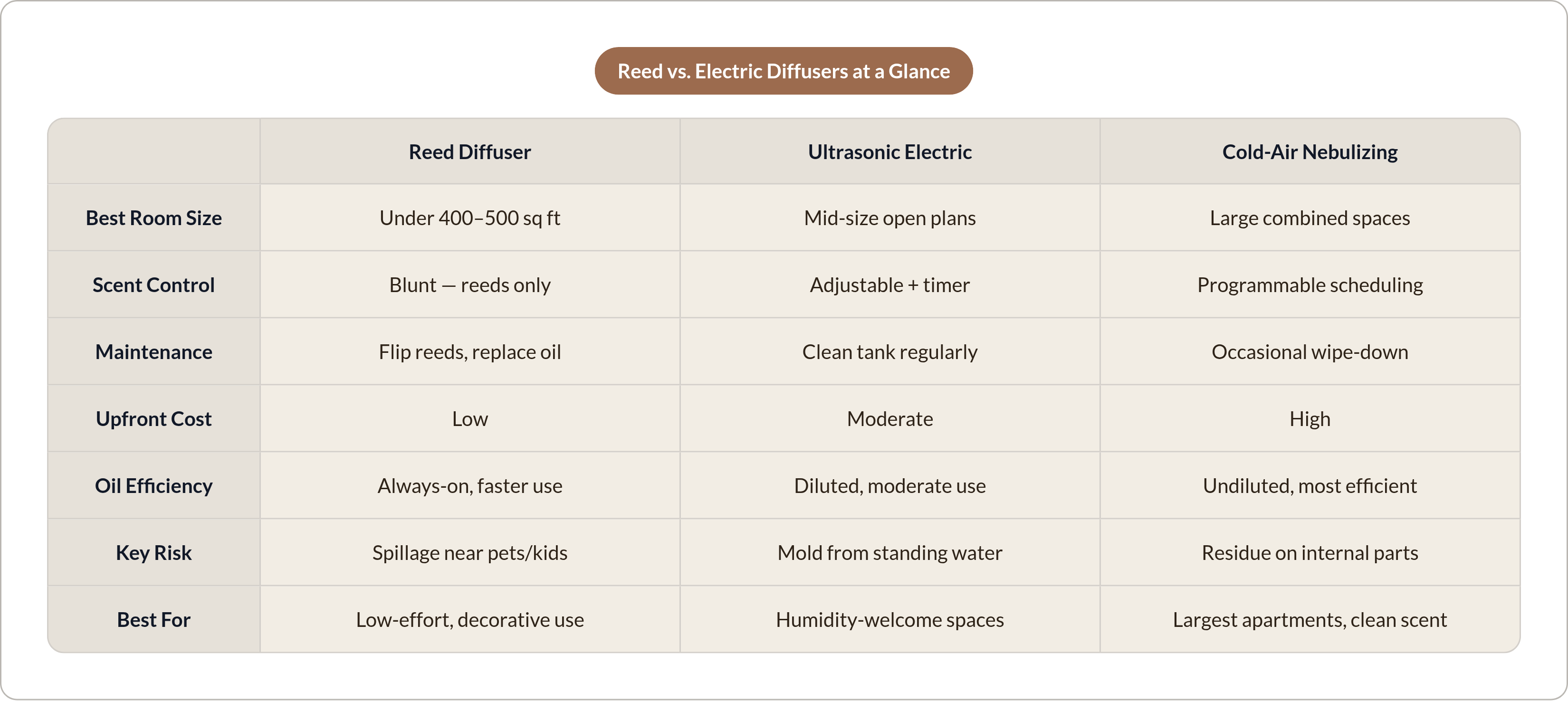
So who actually buys which one? Less a matter of taste than a matter of the shape of your apartment and how much attention you're willing to give a small appliance.
A reed diffuser fits best in a small, contained room, a bathroom, bedroom, entryway, or home office, where you want constant scent and zero management: no app, no timer, no charging cable to lose behind the nightstand. It's the right call if budget is your main constraint, if you like the diffuser doubling as a decorative object instead of a gadget, or if you travel a lot and don't love the idea of a plugged-in device running unsupervised while you're away. You can just leave it alone. That's the whole appeal.
An ultrasonic diffuser makes more sense once your apartment has a mid-size, open-plan layout that reed can't realistically cover, and you want adjustable intensity and timer control without paying the premium a cold-air unit demands. It's also the better pick if a little extra humidity is welcome, a dry climate, winter heating season, and you're genuinely willing to clean the tank on a schedule instead of letting it slide for two months like I did that one time.
A cold-air nebulizing diffuser is the format for the largest apartments here, the ones where a single unit needs to cover a full combined living space, and for anyone who wants granular scheduling paired with the truest, least-diluted version of a scent. It costs more on day one, but across a year of use, the oil efficiency and near-total absence of maintenance start looking like a fair trade for that upfront number, especially if you're the type who forgets water tanks exist.
Each format has its own strengths, built for different rooms, different routines, different appetites for maintenance. Room size tells you the ceiling, consistency and control tell you what daily life with the thing actually feels like, and the ingredient list tells you what you're breathing while you enjoy any of it.