Scent Profiles of Iconic Desert and Southwest Landscapes
Desert plants release their scents strategically, creating a layered olfactory palette.
Building a signature scent that feels like a five-star hotel lobby at home comes down to two decisions: which fragrance profile to use and how you diffuse it. The American Southwest offers one of the most sophisticated palettes available, and it is far more layered than most people assume. Cold-air diffusion is the method that preserves that layering faithfully, because it introduces no heat and no water into the chemistry.
Why the American Southwest has a more complex scent identity than most people expect
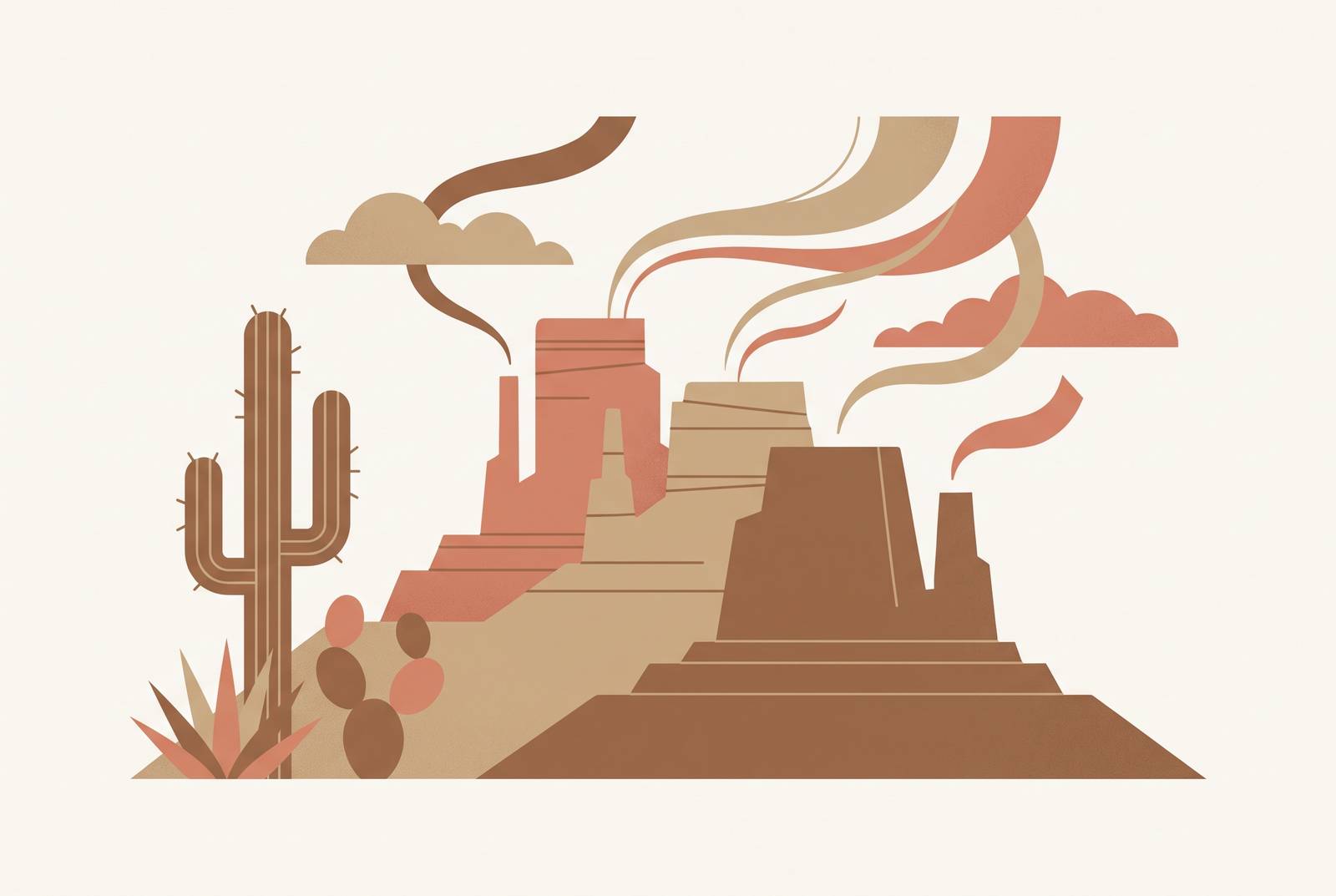
The common mental image of desert fragrance is reductive: dusty, a little musky, maybe a faint green note if you are feeling generous. The reality inverts that expectation. The American Southwest gets its olfactory character from at least three distinct mechanisms: heat-activated plant compounds, rain-triggered releases, and the bloom cycles of arid-adapted flora. None of those is a single dominant note.
Arid-land plants do not broadcast their aromatics continuously the way a temperate flower bed might. They hold volatile oils in their foliage as a survival strategy, and release them only under specific conditions. That is why desert fragrance reads as concentrated rather than absent. The landscape is, in fact, often more fragrant and more varied than temperate forest environments that enjoy a reputation for scent richness. A conifer forest gives you pine, damp earth, maybe decaying needles. A New Mexico scrubland in late spring gives you chocolate in the morning, oregano when you brush the foliage, and resinous creosote the moment a storm arrives.
The plant-by-plant breakdown of what the Southwest actually smells like
What makes the Southwest smellscape unusual is that it is built from nameable plants, each with a distinct aromatic signature that already maps onto fragrance vocabulary. This is not an abstract terroir claim. It is a reference list.
Creosote bush, Larrea tridentata, sits at the center of the palette. Its leaves carry a sharp, resinous, herbal pungency that activates after rain. For many Southwest residents this is the defining smell of monsoon season, and the chemistry explains why the association is so emotional. Rain triggers aromatic organic compounds including phenolics such as cresols and nordihydroguaiaretic acid, known as NDGA. The scent arrives with moisture, and in an arid climate that means the scent arrives with relief.
Bee bush, or Aloysia wrightii, reads as oregano when crushed, strong and herbaceous, which makes sense given its close relationship to lemon verbena. In Mexico it carries the name oreganillo and is used in cooking. Chocolate daisy blooms from late spring through fall in New Mexico scrubland, emitting a morning sweetness that genuinely registers as chocolate, an unexpected gourmand note produced natively by the landscape. Cleveland sage, Salvia clevelandii, provides the strong, musky sage character, with spikes of purplish-blue flowers, and it is the plant that the broad desert sage accord in fragrance typically approximates.
Damianita, or Chrysactinia mexicana, is a low groundcover shrub with an earthy, mildly pungent scent and golden daisy-like flowers in spring and fall. Midnight cereus opens after sundown in June or July and reaches full blossom by midnight, an exotic, sensuous aroma specific to nighttime desert air. Purple sage gives a floral fragrance with a woody undertone, and early Southwest settlers recognized it as an unusual and distinctive scent. Yucca, the state flower of New Mexico, blooms in early summer with a fresh, clean aroma. Cactus flower, specifically prickly pear, produces yellow blooms with a mildly spicy, soft scent. Piñon pine offers a rich, smooth, earthy aroma used for centuries on cool desert nights, with a tang that mellows into a lingering sensation and a character distinct from temperate pines. Desert jasmine grows in arid canyons, reminiscent of French jasmine but distinctly different in character. Desert mistletoe, with small yellow-green flowers on vines growing in cottonwood and mesquite trees, carries a sweet, romantic essence. Understanding these individual plant aromatics, from creosote's rain-triggered release to piñon's earthy richness and desert sage's musky character, is the first step toward selecting fragrance oils that authentically capture the landscape. Some brands have begun curating formulations built around botanically rooted accords that allow homeowners to layer these Southwest notes into a coherent scent story.
How the landscape shifts by time of day, season, and elevation, and why that produces multiple distinct scent profiles, not one
The Southwest does not have one smell. It rotates through several recognizably different profiles depending on time of day, season, and elevation zone. That temporal and spatial variability is precisely what makes the palette so useful as a fragrance reference. You are not selecting a static desert accord. You are selecting a register from a working system.
Time of day produces the most immediate shift. Mornings bring a crisp, mineral freshness as cool air settles before heat activates the resinous compounds. Midday pushes warming soil, sun-baked sand, and heat-activated plant oils to the foreground, amber, warm sand, resinous sage. Evenings and nights arrive with a sharp temperature drop under clear desert skies, letting richer, heavier notes develop without heat distortion: piñon smoke, midnight cereus blossom, dry oud-like woods.
Season then layers on top of that diurnal cycle. Late spring introduces the chocolate daisy's gourmand sweetness. Early summer brings yucca and cactus flower blooms, fresh, clean, and mildly spicy. Late June through July is creosote monsoon release at peak, alongside the midnight cereus. And from November through February, Mount Lemmon marigold bloom season arrives with a sweet, musky character. The calendar is a schedule of distinct olfactive events, not a slow blend.
Elevation adds a third dimension. The low desert floor gives warm sand and amber, creosote, cactus flower, prickly pear, the classic palette most people picture. Mid-elevation washes and canyon floors shift herbal, pungent, and green, with desert lavender, bee bush, and desert jasmine. Higher scrub and the forest edge bring piñon, ponderosa pine, and juniper, resinous, woody, and cool. The same region, on the same day, smells like three different landscapes depending on where you stand. Because this identity shifts so dramatically across morning, midday, evening, and season, capturing it at home requires a diffuser system that offers precise control and scheduling, allowing the scent to evolve intentionally rather than remain static.
How fragrance makers and perfumers have translated these landscapes into scent compositions
The good news is that this variability translates cleanly. The Southwest's scent profile maps onto recognizable fragrance note families that perfumers and formulators already work with, which means the landscape can be rendered in home fragrance with specificity rather than approximation. The core note families the landscape produces, confirmed by fragrance formulators working in the Southwest tradition, include warm sand and amber, cactus flower and musk, earthy musky sage, frankincense and incense, cedar, sandalwood, fruity musky prickly pear, desert lavender, mineral freshness, and piñon resinous woods.
The coherence of this system shows up even in commercial descriptions. Wholesale Supplies Plus describes the Southwest palette in terms of blue bonnet flowers, warm desert sand, cactus flower, prickly pear, and a tequila-heavy margarita as the way to unwind in the Southwest. That may read as a joke. It is also a functional acknowledgment that these notes operate as a regional system. No single element defines the palette. The gestalt does.
Fine fragrance has sampled this territory repeatedly, but the landscape's real value for home scent is structural. It provides a full pyramid, from bright mineral and herbaceous tops through musky and floral hearts to resinous and woody bases. Most importantly, the transitions are dictated by environmental logic. Heat releases the top notes. Cooling reveals the base. A well-built Southwest fragrance already knows how to unfold. It just needs a delivery method that does not interfere.
Why desert and Southwest notes are particularly hard to reproduce faithfully without the right diffusion method
Here the argument gets technical, because the note families that define Southwest landscapes, mineral, arid, sage, frankincense, resinous pine, are among the most volatile and chemically sensitive in fragrance. Delivery method is not a secondary consideration for these profiles. It is part of the composition.
Desert climate physics translate directly into home fragrance physics. In dry air, fragrance top notes evaporate extremely quickly, the drydown arrives sooner, and without the right delivery mechanism the heart and base, where sandalwood, cedar, and amber live, may never fully develop in the room. Heat distorts these notes specifically. Warmth accelerates evaporation of the mineral and herbal top registers and can make resinous base notes cloying rather than grounding, which produces the opposite of the clean, dimensional character of the actual landscape. Water dilution flattens the palette. The arid, mineral quality of desert fragrance depends on oil purity. Blending with water reduces potency and muddles the precise character of notes like creosote, sage, and piñon that are already subtle.
The delivery formats most people default to each introduce a distorting variable. Candles add heat. Water-based diffusers add dilution. Reed diffusers offer passive evaporation without control. Each of those works against the dry, layered specificity the Southwest palette requires. The layering, triggered by rain, heat, elevation, and bloom cycles, mirrors what luxury hotel lobbies aim to achieve: a signature scent that feels complex and intentional, grounded in place, and impossible to pin down to a single note.
How to fill large rooms like hotel lobbies do, and why cold-air diffusion preserves the full fragrance pyramid these landscapes produce
Ask how hotel lobbies fill a large space with consistent scent, and the answer is usually a cold-air system, not a candle or a reed diffuser. Cold-air diffusion atomizes fragrance oil into a dry micro-mist without heat or water, dispersing it as micro-sized particles, typically 1 to 5 microns, that maintain the original chemical structure of the oil throughout the diffusion process. That is the entire argument, compressed. The oil arrives as it was formulated.
For a desert fragrance composition specifically, the consequences are precise. The full pyramid, top, heart, and base, reaches the room as the formulator intended. Mineral top notes are not burned off before they can register. Sage, frankincense, and cedar heart notes are not diluted into a flattened approximation. Sandalwood and amber base notes develop at their natural rate, not accelerated into heaviness by heat.
The scheduling point is worth dwelling on because it is the most elegant parallel available. Smart diffusion runs on programmable intervals, cycling between active diffusion and dormancy. That prevents olfactory adaptation without overwhelming the room. And it is the correct analogue for how the desert itself releases fragrance: in concentrated bursts tied to environmental triggers, not as a constant blanket. The desert does not smell at full intensity all day. It pulses. A smart diffuser that mimics that pulse is making a compositional statement, not merely distributing scent.
Aura House cold-air diffusers bring this delivery fidelity to residential scale. They are designed to work across the room footprints where these fragrance experiences are built, and they pair with clean, vegan, cruelty-free oil formulations that match the transparency the Southwest palette requires. Translating that landscape experience into the home requires fragrance oils of genuine quality and a diffusion method that preserves their botanical nuance without heat or water degradation.
Choosing a Southwest-inspired fragrance oil and matching it to how you actually want your space to feel
Once the botanical layers are understood, choosing a fragrance becomes a deliberate act. You can select which register of the landscape belongs in a specific room, morning mineral crispness, midday earthy warmth, or evening resinous depth, rather than defaulting to a generic desert label. A morning or workspace register pairs mineral freshness, citrus, desert lavender, and sage, notes that support alertness and clear thinking, suited to home offices and kitchens at the start of the day. A midday or living-space register draws on warm sand and amber, cactus flower, and prickly pear musk, the full-heat desert palette for main living areas where presence is the goal. An evening or bedroom register moves to piñon, sandalwood, cedar, and frankincense, the cool-night resinous depth that grounds and winds down.
Intensity matters more with this palette than with most. The Southwest landscape releases fragrance in concentrated, conditional bursts, not as a persistent heavy atmosphere. A diffuser set to lower intensity with timed intervals replicates this more accurately than continuous high output. More fragrance is not more desert. The mineral and herbal notes that make the palette distinctive are the first to become unpleasant when overdosed. Placement is similarly consequential. HVAC and air circulation patterns in dry climates mean fragrance distributes differently than in humid rooms, so the diffuser should sit away from direct airflow vents to prevent top notes from being carried away before they register. Finally, oil transparency determines the result. The plants that define the Southwest palette, sage, lavender, piñon, frankincense, have well-documented aromatic profiles. Choosing oils with clean, transparent formulations ensures the botanical character is what diffuses, not a masking compound. Understanding the landscape is what makes the fragrance choice intentional rather than accidental. The reader who has followed the argument knows what they are trying to recreate, and can evaluate any oil or product against that knowledge.