Essential Oils for Sleep Diffusion at Night
Match your oil choice to your specific sleep problem, not just to general relaxation.
Lavender is the obvious starting point, and for once the obvious answer holds up. A 2015 systematic review by Hwang in the Journal of Alternative and Complementary Medicine identified multiple randomized controlled trials showing improved sleep quality with lavender aromatherapy. If you are new to this, lavender is a reasonable default. Start there.
But "sleep" is not one problem. Are you struggling to fall asleep, staying asleep, or calming a mind that refuses to stop composing tomorrow's argument? The answer should drive the oil selection, and most people never ask the question.
Bergamot earns less attention than it deserves. Research, including a 2015 study by Rombolà et al. in Evidence-Based Complementary and Alternative Medicine, points to anxiolytic properties, which makes it well-suited to anxiety-driven insomnia specifically: the kind where worry is the barrier, not physical restlessness. Vetiver is a heavy base note with considerable staying power; it lingers far longer than any floral oil, which means it punishes overuse. Fewer drops than you think, typically.
Cedarwood appears in blends targeting sleep fragmentation, the pattern of waking repeatedly through the night rather than struggling at onset. Roman chamomile contains apigenin, a compound studied for its interaction with GABA receptors, and it softens woody blends without competing with them. Frankincense and marjoram both have roles in tension-driven disruption, though you would not know it from popular discussion.
The structural logic of a functional sleep blend is unlike building a piece of music: floral or herbaceous top notes — lavender or chamomile or clary sage — paired with grounding base notes like vetiver, cedarwood, or sandalwood serve as the rhythm section underneath. Too much brightness reads as energizing. Too much earthiness tips oppressive. The olfactory system is processing contrast between arousal cues and rest cues, and a well-proportioned blend lands on the right side of that divide, or it does not.
Blend Ratios That Practitioners Actually Use
There is a persistent temptation to treat essential oil blending as an art form. It is largely a matter of chemistry, and the mysticism around it serves the market more than the sleeper.
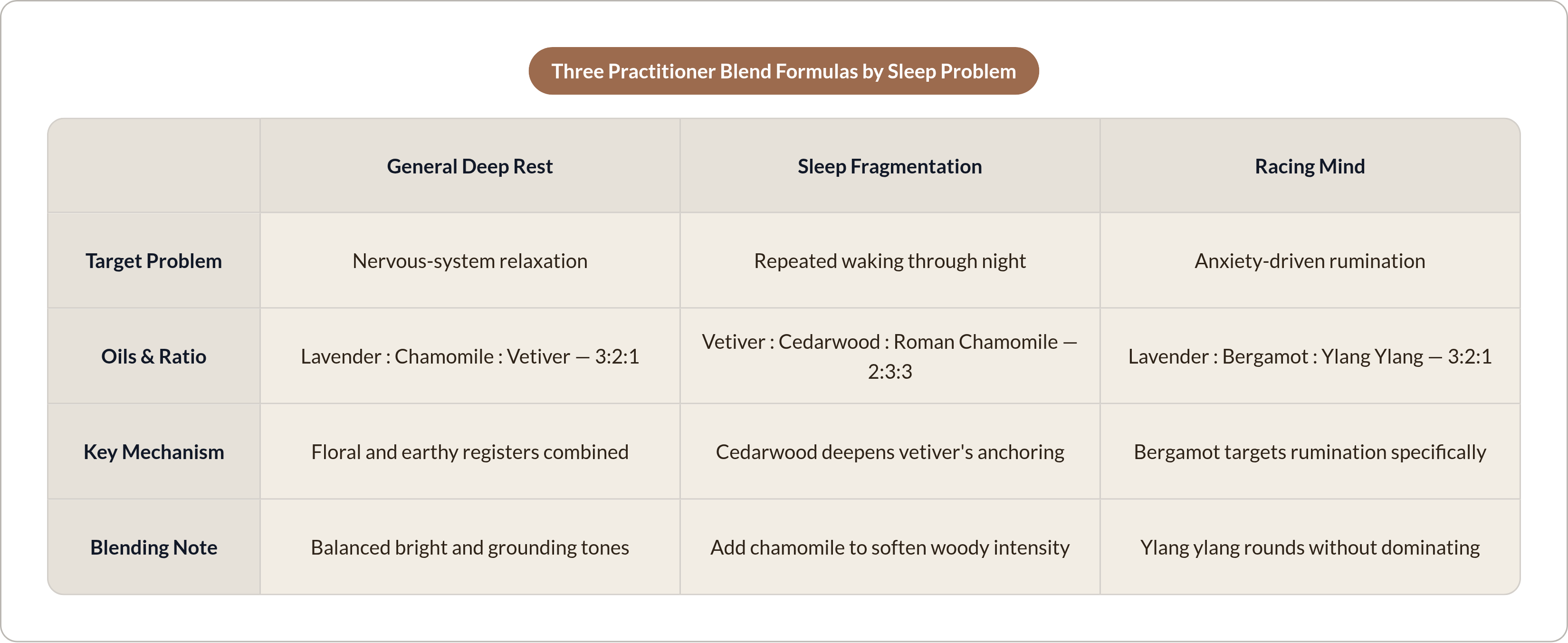
Three formulas appear consistently in clinical aromatherapy contexts.
For general deep rest: lavender, chamomile, and vetiver at 3:2:1. This targets nervous-system relaxation across both floral and earthy registers.
For sleep fragmentation: two drops vetiver, three drops cedarwood, three drops Roman chamomile. Cedarwood deepens vetiver's anchoring quality; chamomile prevents the woody intensity from becoming unpleasant.
For nights when the obstacle is a mind that will not stop: three drops lavender, two drops bergamot, one drop ylang ylang. Bergamot is associated with reduced rumination in the research literature. Lavender has shown measurable heart rate effects in some trials. Ylang ylang rounds the blend's edges without taking it anywhere unexpected.
One practical note: base notes like vetiver and sandalwood persist significantly longer than florals, so start below the formula's implied proportion on first use and adjust upward. Three to five drops total is a reasonable starting range for a bedroom-sized space. These ratios are calibrated starting points. Individual olfactory response varies in ways no standardized formula can fully anticipate, so treat them accordingly.
Why How You Diffuse Matters as Much as What Oil You Choose
This is where most people lose the thread, and where the evidence-to-practice gap is widest. The oil selection gets obsessive attention. The delivery method gets none.
Clinical protocols standardize diffusion duration at thirty to sixty minutes pre-bedtime, with oil concentration held within a specific volumetric range. Real-world diffusion matches neither. But there is a more fundamental problem than duration or concentration: thermal degradation.
Heat changes the chemistry of essential oils before the molecules reach the air. The terpenoids, esters, and phenols associated with sleep effects are volatile and sensitive to thermal breakdown. Research on essential oil chemistry, including work published in the Journal of Chromatography, documents that heat alters volatile compound profiles. What leaves a heat-based diffuser differs meaningfully from what the research actually tested.
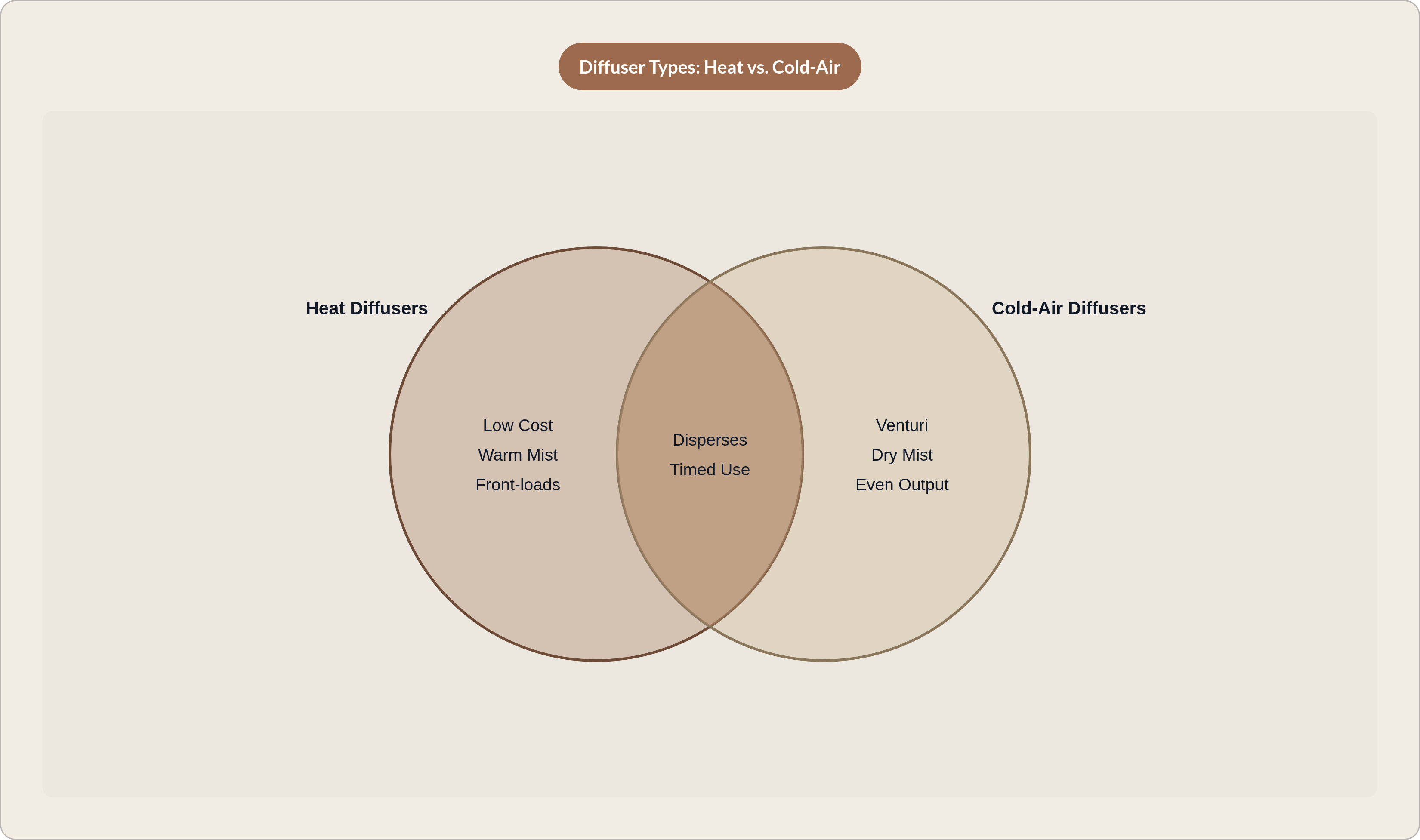
Water-based ultrasonic diffusers improve on heat, dispersing oil as an aerosolized mist without thermal energy. The scent profile is better preserved, though diluted by water. In humid climates or warmer months, the added ambient humidity can impair sleep comfort in ways that are genuinely annoying to trace back to the diffuser.
Cold-air diffusion uses the Venturi principle: compressed room-temperature air atomizes oil into ultra-fine dry particles without water, heat, or alcohol. The full compound spectrum reaches the air closer to as formulated, and scent intensity stays more consistent across the diffusion period rather than front-loading as a warm reservoir does. Ultrasonic diffusers produce adequate results for many users, and cold-air diffusion is an incremental upgrade at a premium price. It is worth considering, though, how often "adequate results" and "no perceptible effect after two weeks" describe the same experience, and how rarely the diffusion method gets examined as the variable.
Timing Your Diffuser to Work with Your Sleep Cycle, Not Against It
Running a diffuser all night is one of the most common mistakes in sleep aromatherapy, and it is a mistake that feels like diligence.
The olfactory system habituates to constant stimulation, a well-documented phenomenon called olfactory adaptation. A continuous aromatic signal becomes ambient background, not a meaningful cue — like trying to hear a whisper in a room where someone has been whispering for hours. Beyond habituation, continuous exposure to top-note-heavy blends can feel stimulating or outright unpleasant at three in the morning, when the diffuser is still running and the room context has shifted entirely.
Clinical studies use a thirty-to-sixty-minute pre-bedtime diffusion window. Start the diffuser thirty to sixty minutes before your intended sleep time and set a shutoff timer for sixty to ninety minutes maximum. Many diffusers run two to three hours by default; verify the unit's built-in shutoff actually aligns with this window, because many do not.
The consistency effect matters here too. Research on conditioned olfactory responses and olfactory-limbic conditioning suggests that repeated pairing of a scent with a behavior strengthens the associative response over time. Someone who diffuses four nights out of seven and declares the approach ineffective is drawing conclusions from an inconsistent experiment. Timing regularity matters as much as oil selection. Possibly more.
Where You Place the Diffuser in a Bedroom and Why It Changes the Result
Room coverage is not uniform, and placement is something most people overlook — a shame, because it is the cheapest variable to adjust.
A diffuser placed in a corner behind furniture distributes entirely differently than one positioned in open airflow. Cold-air diffusion particles follow natural air currents, which means placement relative to ceiling fans and HVAC returns affects how evenly scent distributes. Placing the diffuser near, but not directly in front of, an air return creates broader distribution than simply setting it on the nightstand.
Too close to the sleeper amplifies intensity in a way that disrupts rather than supports sleep. Three to six feet from the bed, at nightstand height or slightly above, allows the mist to disperse before concentrating at nose level. The target experience is ambient presence: perceptible after a minute in the room, not detectable on the first breath through the door.
Room size is a variable that diffuser marketing handles poorly. A unit calibrated for large open spaces will barely register in an enclosed 150-square-foot bedroom. The same unit, sized correctly for that room but run at full intensity with the door closed, will over-saturate it. Cold-air diffusers with adjustable output need to be deliberately matched to the actual room. This is tedious to calibrate and worth doing once, correctly, rather than indefinitely wrong.
What to Check Before Putting Any Oil in a Bedroom Diffuser
Adulteration is a documented problem in the commercial essential oil market. A study in the Journal of AOAC International found that lavender, among the most popular sleep oils, is also among the most frequently adulterated, with commercial samples containing synthetic linalool, diluent carriers, or petroleum-derived compounds. Adulterated oil will produce no therapeutic effect documented in clinical research. It will also irritate airways across hours of nightly exposure, which is a bad trade.
What clean oil labeling looks like: the botanical Latin name, extraction method, country of origin, and batch number. Third-party certifications for phthalate-free, paraben-free, and formaldehyde-free status represent the minimum standard for anything going into a bedroom diffuser.
One consideration that most sleep aromatherapy content buries as a footnote: pets. Cats lack certain liver enzymes needed to metabolize many terpenes, a fact documented in veterinary toxicology literature, meaning compounds that calm humans accumulate to toxic levels in feline physiology. Dogs have a far more sensitive olfactory system, making concentration and duration in a shared space especially consequential. The ASPCA flags several common oils, including tea tree and eucalyptus, as toxic to pets; even lavender requires careful dosing and room ventilation in pet-occupied spaces. In homes with animals: lowest effective intensity, ensured ventilation, and a conversation with a vet before establishing any nightly routine.
Synthetic fragrance products, plug-ins, sprays, and conventional "sleep" scent products often obscure chemical composition behind proprietary fragrance formulations. What the label omits is frequently what is being inhaled for eight hours. Transparency in formulation is baseline due diligence, not a premium feature.
Building a Nightly Diffuser Routine That Holds Up Over Time
The conditioning principle is central to why this works at all. The olfactory-limbic pathway, which connects scent processing to emotional and physiological response, is well-supported by research in Pavlovian conditioning and sleep behavior. Night twenty-eight should work better than night one, assuming the setup remains consistent. That means the routine needs to be simple enough to maintain without effort, because at some point you will stop thinking about it, and the routine either survives that or it does not.
A workable structure: choose one blend and hold it for at least two weeks before evaluating. Changing oils nightly breaks the associative conditioning that makes the approach accumulate over time. Set a smart schedule so the diffuser starts automatically thirty minutes before your typical sleep time and shuts off ninety minutes later. Begin at the lowest intensity appropriate for the room size and increase only if the scent is barely perceptible after fifteen minutes. Clean the diffuser regularly; residual oil buildup alters the scent profile of subsequent blends and degrades output consistency in ways that are easy to misattribute to the oil itself.
Signs the setup is working: easier sleep onset in the first week, reduced mid-night waking by week two, the scent becoming a reliable physiological cue. When the brain treats vetiver and lavender as a signal that sleep is imminent — the scent becomes a lullaby the nose already knows — the system is actually doing what it is supposed to do.
Signs to adjust: scent that feels overwhelming on waking suggests the diffuser ran too long. No perceptible effect after two weeks usually points to intensity too low, a room too large for the unit's output, or an oil quality problem. A morning headache warrants both reducing intensity and scrutinizing the formulation.
But what if the routine works for three weeks and then stops? The most common cause is a break in consistency: a few nights traveling, a blend change, a diffuser that ran dry unnoticed. The conditioning does not disappear immediately, but it requires reinforcement. Restart the same routine; re-establishment tends to occur faster than the initial conditioning period, consistent with what is known about reacquisition in conditioned responses.
Most people who try aromatherapy for sleep fail because they treat the whole thing as passive: put oil in diffuser, achieve sleep, report results. The delivery method, the timing, the placement, the oil quality, and the conditioning consistency are each doing real work. Get three of the five wrong and you have run a different experiment than you think. That, more than any choice of lavender over bergamot, is usually what separates someone who finds this useful from someone who has an expensive piece of hardware sitting on their nightstand collecting dust.