What a Diffuser Actually Does Beyond Making a Room Smell Good
Scent delivers measurable shifts in stress and mood by reaching your brain before conscious thought.

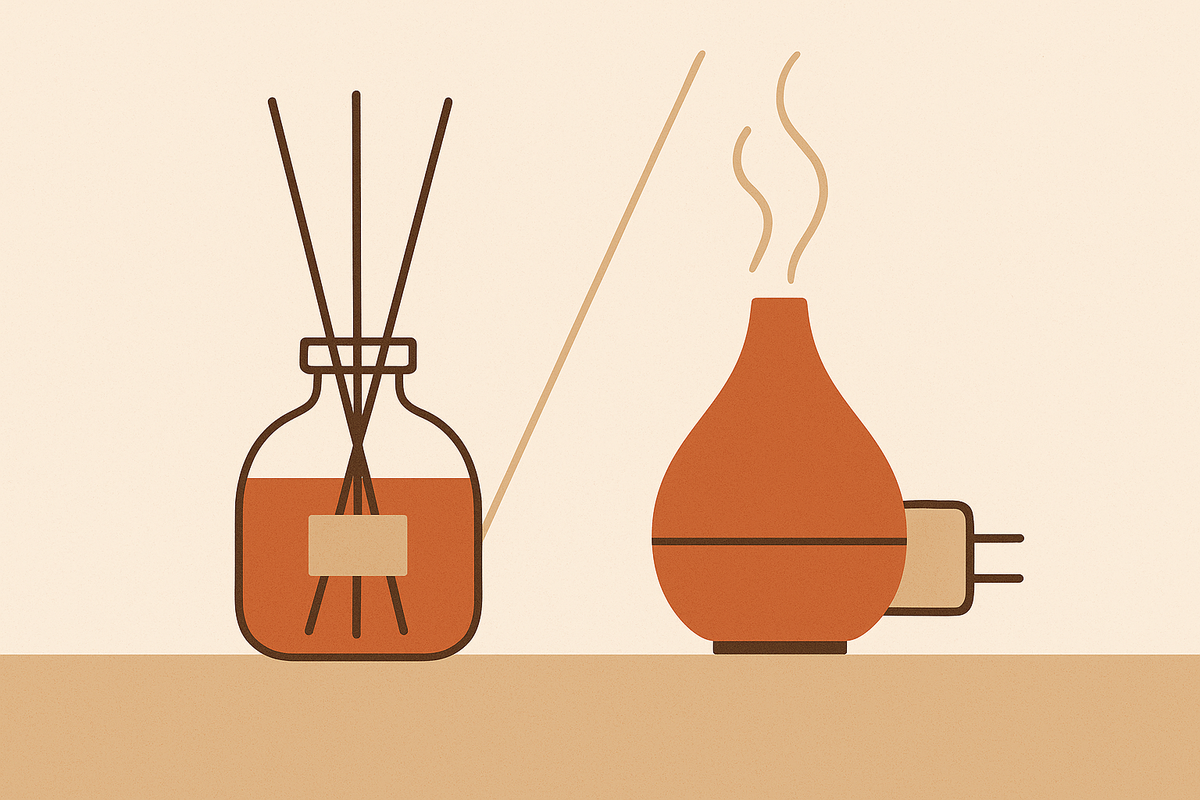
Somewhere in the last decade, a diffuser stopped being an accessory and started being infrastructure. It shapes mood, air quality, focus, even how a room gets remembered, which is a strange amount of responsibility for something that used to just cover up last night's dinner smell. Diffusers are among the most dynamic segments in home fragrance right now, with reed, electric, and crystal diffusers growing at 11.3% a year between 2023 and 2026, while candle growth ran at 8% year-over-year in 2025. That contrast is the whole piece in miniature: something is happening here that goes past "nicer smell," and the sections below trace what that something actually is.
How cold air diffusion works and why the mechanism matters
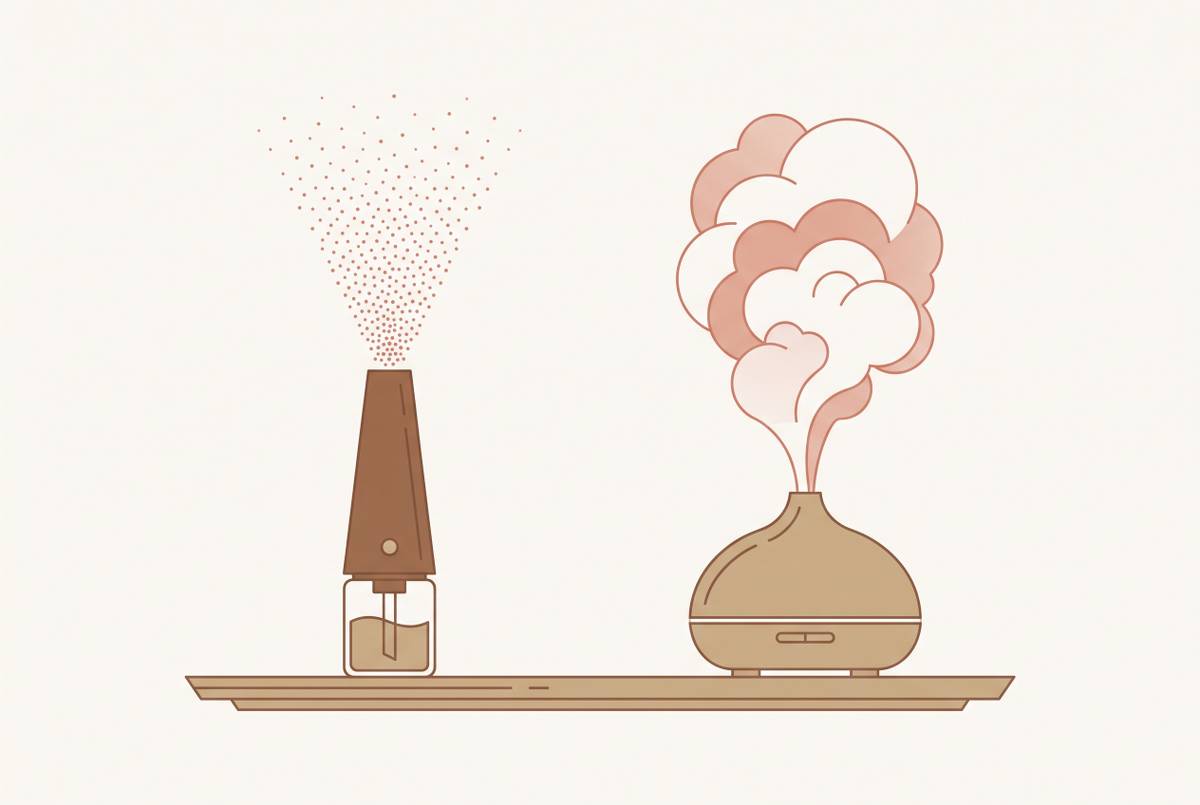
Start with the plumbing. Cold air diffusion uses pressurized air to break fragrance oil into a fine mist of microscopic particles and push them into a room, with no heat and no water involved. That sounds like a technical footnote until it's compared to the alternatives, and the comparison is where the real case gets made. Heat-based diffusers vaporize oil, and heat changes delicate aromatic compounds on the way out; the smell that reaches the room is not quite the smell that was blended in the bottle. Ultrasonic diffusers need water to create their mist, which dilutes concentration and adds humidity, a minor detail until the unit is running in a small, closed bedroom for eight hours a night.
Cold air diffusion sidesteps both problems, and this is worth being blunt about: it holds up as the stronger mechanism for anything beyond casual scenting. Minimal thermal degradation means the fragrance profile arrives close to how it was formulated, layered instead of flattened. Minimal added moisture matters too, since enclosed rooms with elevated humidity are exactly where mold gets a foothold. Cold air units also tend to cover more square footage than candles, reed diffusers, plug-ins, and ultrasonic devices, less because the fragrance is stronger and more because the distribution is even across a bigger volume of air.
Why dwell on mechanism at all? Because everything the rest of this piece describes, the mood effects, the air quality tradeoffs, the daily rituals, depends on the molecule actually showing up intact and reaching the room consistently. A diffuser that degrades its own oil, or can't cover the space it's placed in, is unreliable at the one job every other benefit sits on top of.
What scent actually does once it enters the air you breathe
Here's the part that makes fragrance different from every other sense being used to read this sentence. Smell has a direct line to the limbic system, the part of the brain handling emotion and memory, before the signal even reaches conscious thought. Sight and sound get routed through the thalamus first, a kind of switchboard that filters and organizes input. Smell skips that step entirely, which is why a scent can trigger a feeling half a second before anyone's figured out what they're even smelling.
The olfactory system also talks to the endocrine and autonomic nervous systems, meaning specific scents can shift cortisol, the main stress hormone, and serotonin, which stabilizes mood. Research on olfaction has put it more bluntly than most academic writing usually allows: smell and emotion are, functionally, the same system, closely intertwined at a neurological level.
That's the premise behind aromachology, a field worth separating from aromatherapy rather than lumping in with it. Aromatherapy is largely therapeutic: oils applied with a treatment goal in mind. Aromachology studies how scent affects mood and behavior in ordinary environments, offices, homes, waiting rooms, with no therapeutic framing attached. The distinction matters because a diffuser running in a living room is dispensing input, the same category of input as light or temperature, and the nervous system responds whether or not anyone in the room is paying attention.
The measurable effects on mood, focus, and stress that research has documented
The clearest data point in this whole conversation comes from research tracking patients waiting for minor surgery, which found a 32% reduction in anxiety symptoms among those exposed to lavender, measured physiologically rather than through a mood survey.
Broader reviews of the aromatherapy literature have found the anxiety-reducing effect appearing across different populations and study designs, which matters more than any single study because it argues against the idea that any one result is a fluke, or worse, a placebo dressed up in citrus notes. The effect shows up across different populations and different scents. That consistency is the actual finding here, more than any individual percentage.
Where does that leave a reader? Two things are worth holding onto. First, the effect runs more specific than the vague, ambient thing "aromatherapy" sometimes gets marketed as; specific molecules at consistent concentrations are producing specific, measurable physiological changes. Second, consistency of delivery is doing real work: a diffuser holding a stable concentration across a room behaves differently from a candle whose scent throw rises and falls depending on how close someone's sitting to it. What the research doesn't yet nail down is optimal duration or dose, and individual sensitivity to scent clearly varies. Nobody's handing out a prescription pad for peppermint, and nobody should pretend otherwise.
How intentional fragrance scheduling turns a diffuser into a daily rhythm tool
If scent shifts brain chemistry reliably, the obvious next move is scheduling it, and that's where a diffuser starts acting like a rhythm tool rather than background decor. Pair the same scent with the same part of the day, repeatedly, and the brain starts treating the smell as a cue for what comes next: the same associative learning that makes a specific song summon a specific memory before the lyrics even kick in.
Peppermint and rosemary belong in the morning, tied to alertness and recall. Lavender and vetiver belong in the evening, tied to the anxiolytic effects documented above. Sandalwood and cedarwood suit anything meditative, a pairing with a long history in contemplative practice and growing support in mood research. None of this is arbitrary matching; it's the same chemistry from the last two sections, just applied on a clock.
None of it requires a household member standing by the diffuser with a stopwatch, either. App control, programmable on and off cycles, and adjustable intensity turn scheduling into something that runs itself, with a quieter secondary benefit: a diffuser only running when needed burns through oil more slowly than one running continuously. At that point the device manages how a room feels at 7 a.m. versus 10 p.m., a role that goes beyond simply how it smells.
The indoor air quality dimension that most fragrance conversations skip
Here's the part fragrance marketing tends to leave out of the brochure. Synthetic fragrance compounds are volatile organic compounds, VOCs, and peer-reviewed research has linked repeated indoor exposure to synthetic fragrance VOCs with headaches, respiratory trouble, and potential endocrine disruption. That's a case for paying attention to what's actually being diffused, and how often, rather than treating "smells nice" as the only relevant metric.
The cumulative load problem compounds this. A candle here, a scented cleaner there, laundry detergent, a body spray: none of them individually overwhelming, but background exposure stacks across all of them at once. Even natural terpenes, the aromatic compounds found in plant oils, can react with indoor ozone and form secondary nanoparticle pollution, which is the detail that trips up anyone assuming "natural" automatically means "no risk." The risk profile is different, and smaller, but present.
Labeling adds a layer of confusion most people never bother to peel back. Terms like "natural fragrance," "aroma," "parfum," and "luxury scenting" can all describe synthetic compounds sitting behind vague packaging. The only label that actually guarantees plant-derived origin is "100% essential oil," stated plainly, nothing else. For diffuser selection, that means two separate variables are in play, the delivery method and the oil itself, and conflating them is how people end up trusting a product for the wrong reason. Cold air diffusion without heat reduces one risk factor by avoiding combustion byproducts and thermal breakdown. Clean, transparently labeled oil addresses the other. A diffuser that's BPA-free and unheated closes off plastic off-gassing too, a smaller detail with an outsized effect in a small, closed room.
Why pet and family safety belongs in the diffuser decision, not as an afterthought
Pets and small children live closer to the floor than the rest of the household, literally, and that changes their exposure to anything a diffuser puts into the air. A concentrated oil droplet settling near a baseboard is a non-event for an adult standing across the room. For a cat walking past it or a toddler crawling through it, it's direct contact.
Species differences make this sharper, and this is where "safe for humans" quietly stops meaning "safe for the household." Cats lack certain liver enzymes needed to metabolize aromatic compounds that are harmless to people. Dogs carry an olfactory system dramatically more sensitive than a human's, so a room concentration that reads as pleasant to a person can be overwhelming to a dog. Cold air diffusion, without heat and without water pooling in a reservoir, lowers the odds of direct contact with undiluted oil sitting somewhere a pet can reach it.
The practical requirement underneath all of this is transparency: knowing the actual compounds in a formulation, not the marketing category stamped on the label. Safety is already a primary purchase driver in this category — the majority of diffuser buyers cite the absence of an open flame as their main reason for choosing diffusers over candles — and pet and family safety is just that same logic extended one room further, into the parts of the house where the smallest and most sensitive members of the household actually spend their time.
How a diffuser defines the sensory identity of a space over time
Scent memory sticks around longer than most other kinds of memory, and it attaches to places with a stubbornness visual design can't match. Repaint a room and people notice the color's different. Change the scent that's been running in that same room for two years, and people notice something's off before they can say what it is.
Luxury hotels figured this out a long time ago: a consistent signature scent running through a lobby becomes something guests associate with the brand itself, a sensory shorthand that outlasts the visit. The same mechanism scales down to a house, just with a much smaller guest list. Run the same diffuser in the same spot in an entryway for months, and that scent becomes the first impression, registering before a single piece of furniture does. In a bedroom, the effect compounds. Pair a scent with sleep every single night, and the scent turns into a cue for sleep itself, the way a particular sound might.
None of this works if the diffuser isn't sized right for the room, and this is where a lot of otherwise careful buyers get it wrong. Oversized fragrance in an undersized space turns overwhelming fast, and a diffuser rated for a small bedroom pushed into an open-plan living area underperforms at every function described so far. Placement matters just as much: a unit sitting next to an air return, or wedged into a corner with poor airflow, delivers a different experience than the room actually needs. Get the sizing and placement right, though, and every session run over months adds another layer to a sensory signature that's genuinely building something more than a pleasant smell: the smell of home.
What to actually look for when choosing a diffuser for these purposes
Everything above points toward a short, specific checklist, and it starts with coverage matched to room size, arguably the single most consequential spec on the whole list. A diffuser built for a 200-square-foot room will simply fail at its job in a 600-square-foot open-plan space, no matter how good the oil inside it is; no amount of formulation quality fixes a coverage mismatch.
From there: a cold air, waterless mechanism, for the reasons laid out earlier, oil integrity preserved, minimal added humidity, minimal combustion byproducts drifting into the air. Intensity control and scheduling aren't optional extras for anyone trying to use scent intentionally; running a different profile in the morning than at night is the entire mechanism the ritual depends on. Oil transparency matters just as much as the hardware. Look for a formulation that discloses what's actually in it, since "fragrance oil" with no further detail tells a buyer close to nothing, particularly in a household weighing pet safety or air quality.
Two smaller specs get overlooked constantly and shouldn't. Noise level matters enormously if the diffuser runs through sleep, focused work, or meditation; an audibly intrusive unit undermines the entire point of running it in those settings. And maintenance design, how easy the thing is to actually clean, determines whether oil residue builds up over time and degrades both scent purity and the unit's lifespan. None of this is complicated engineering. The difference comes down to a diffuser that quietly does its job versus one that becomes another appliance nobody wants to deal with by month three.