Nordic and Scandinavian Scent Aesthetics for Minimalist Homes
Nordic scent design uses psychology and landscape to build comfort without drama.

Denmark placed second in the University of Oxford's 2025 World Happiness Report. It placed second for a country where December sunsets arrive before four in the afternoon.
I used to file that away as interesting trivia and move on. Notes, blends, what was selling that quarter: those felt like the real work. The happiness paradox could wait. Then February in Copenhagen disabused me of that rather quickly, not through anything dramatic, just the experience of being inside a place that had clearly thought harder about warmth than anywhere I'd lived.
The Nordic response to prolonged darkness is not grit. It is something more deliberate, almost architectural. Hygge gets reduced to candle photography in most English-language coverage, which is a shame, because it misses what the concept actually does. Call it a survival mechanism. Call it what a culture builds when it collectively decides that comfort is not a luxury but an obligation, and then constructs daily rituals accordingly.
Scent is one of the sharpest tools in that construction. The olfactory system connects directly to the limbic region, bypassing the cortical processing that filters most other sensory input, which is why a fragrance can shift emotional register faster than almost anything else you can deliberately introduce into a room. Nordic home fragrance is built on calming, grounding notes rather than attention-seeking ones for a reason that has nothing to do with aesthetics. The function is psychological. It is regulatory, even. Not decoration.
That reorientation changes how you evaluate nearly every fragrance decision downstream.
The Nordic scent palette and where its notes come from
The palette is sourced directly from the Nordic landscape, and that is not incidental. It is the premise.
Forest and green notes: pine, spruce, fir needle, birch. These reference the boreal forest that covers enormous swaths of Scandinavia, the actual visual horizon for most people raised there. Air and water notes, sea air, cold water, saline, capture the particular quality of a coastline or open fjord on a cold morning, a sharpness that reads immediately as clarity. Warm and grounding notes, cedarwood, sandalwood, amber, smoked musks, evoke the interior of a cabin rather than the exterior landscape. Then the hygge-adjacent notes: vanilla, fresh coffee, clean linen, wildberry.
Skandinavisk, the Danish fragrance house, describes their process as deconstructing hygge into component sensory parts: minor everyday things associated with feeling good. Their SKOG fragrance is instructive. Morning mist over spruce and pine needles, woodland lily of the valley, aged leather. That is the Swedish boreal forest rendered in olfactory language, every note referencing materials a person has actually encountered rather than abstract constructions assembled to impress a buyer in a department store.
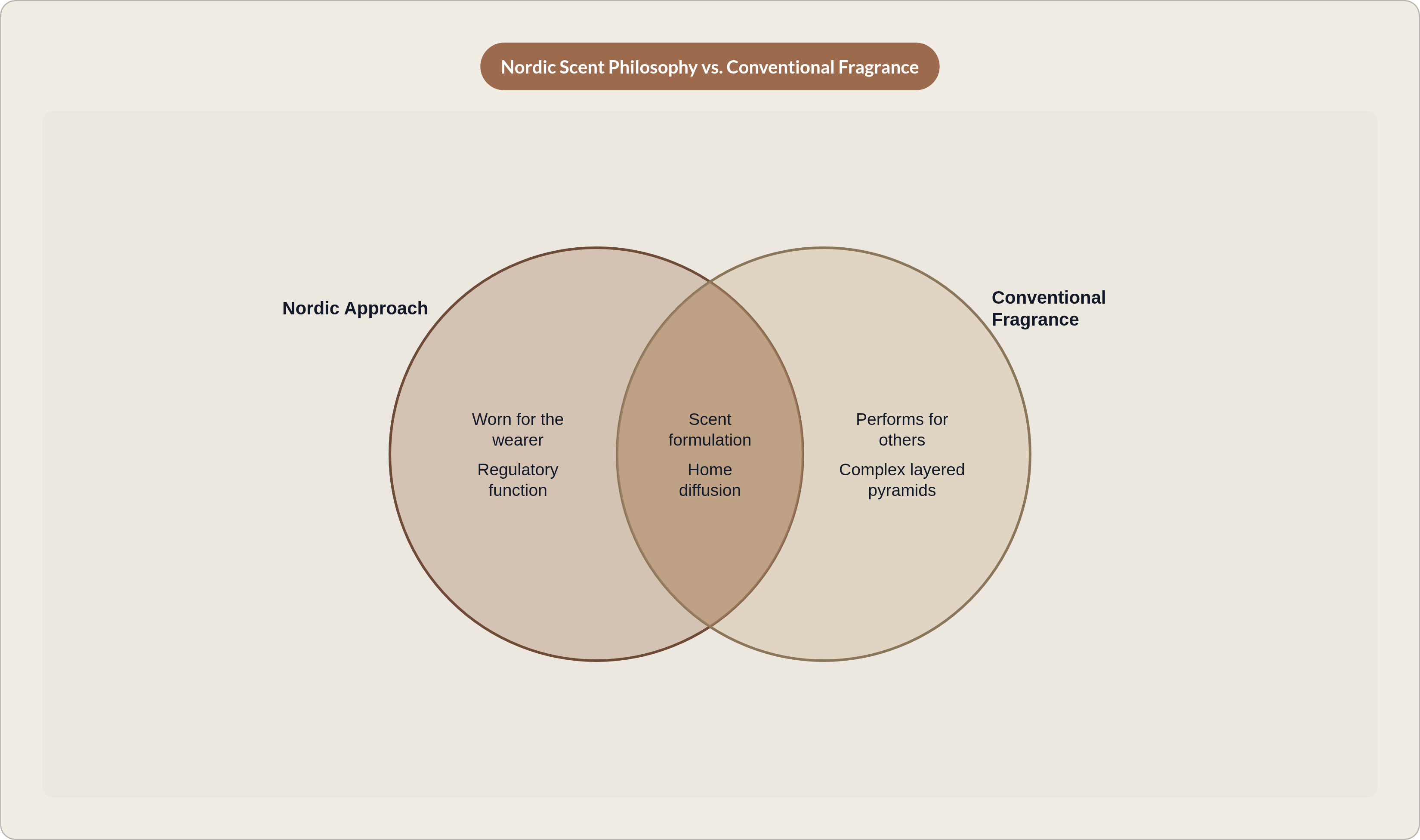
What unifies the palette is restraint. Nordic blends favor two or three dominant notes rather than elaborate layered pyramids. Legibility is itself a design value here. Stina Bibbi of Bibbi Parfums put it plainly: "Scandinavian scents are more clean and deeply rooted in nature. They're sophisticated and scaled down but high quality." Isabelle Lewenhaupt of Björk and Berries draws the line even more sharply: "These are the scents that don't perform for others. They're worn for the wearer, designed to evoke rather than impress."
Worn for the wearer. I kept returning to that phrase because most of the fragrance industry I had worked in was organized around precisely the opposite assumption.
How minimalist design principles carry over into scent choices
Scandinavian design starts from a premise that every element should serve a function. Ornamentation without purpose is noise. You see this in furniture, ceramics, architecture, the whole sensory vocabulary of the region. The aesthetic emerges from the constraint.
Applied to fragrance, the logic is fairly immediate. A scent that announces itself from across the room violates the same principle as a cluttered surface. It is doing more than its job requires.
Working with clients on interior sensory environments, I noticed the same gap repeatedly. They would spend months selecting upholstery and then grab a room spray off a pharmacy shelf without a second thought. Brands like Aura House, a diffuser-focused home fragrance company whose oils are formulated without toxins, are built around closing exactly that gap. Lighting, material, texture: all considered carefully. Scent: left to chance. That inconsistency is not arbitrary; it reflects a widespread assumption that fragrance is decoration rather than function. Nordic design philosophy does not share that assumption. One or two signature scents for the whole home, formulations whose ingredients are as transparent as exposed wood or undyed linen, scent chosen with the same deliberateness as any other material in the space.
There is also the Japandi dimension worth noting. The fusion of Scandinavian and Japanese minimalism shares a core conviction: that restraint is a form of sophistication, not deprivation. When that lens is applied to fragrance, scent recedes into the background, becoming ambient rather than declarative. Part of the room rather than a comment on it. The analogy extends all the way through: just as Scandinavian furniture chooses natural materials over synthetic ones, Nordic fragrance chooses ingredient transparency over chemical complexity.
What clean formulation looks like when applied to Nordic-style home fragrance
The word "fragrance" on a product label is a legal loophole, and it took me longer to fully reckon with that than I would like to admit, even working inside this industry. A single ingredient designation can conceal dozens of undisclosed compounds, including phthalates, classified as known endocrine disruptors, and certain synthetic musks linked to hormone disruption and respiratory irritation.
Sephora's Clean standard prohibits more than fifty suspect ingredients. That benchmark exists because the default is considerably lower.
One distinction worth being precise about: "natural" and "non-toxic" are not synonyms. Certain essential oils cause sensitization or phototoxicity at elevated concentrations. Some synthetics, by contrast, pass exhaustive toxicological review and are demonstrably safer than their botanical counterparts. The meaningful standard is transparency and third-party accountability, not the word "natural" appearing on a label.
Certifications that carry actual weight include IFRA compliance, meaning ingredients have met International Fragrance Association safety standards, and NPA certification for natural products. As of January 1, 2025, all fragrance oils are required to ship with a Safety Data Sheet and Unique Formula Identifier code, raising the baseline for formulation disclosure across the industry.
Several Nordic brands take this seriously in practice. Son Venin uses no artificial colors or additives and holds cruelty-free and certified vegan credentials. Andrea Maack formulates with 88 to 89 percent natural ingredients, builds on a base of 100 percent organic Icelandic alcohol and water, and holds vegan, gluten-free, and cruelty-free certifications. Skandinavisk maintains vegan and cruelty-free standards with responsible sourcing throughout.
For these brands, clean formulation is not marketing. It is the natural consequence of a philosophy that values transparency in materials, the same transparency present in the furniture, the architecture, and the daily rituals.
Why diffusion method matters as much as the formula inside the bottle
You can make considered choices about a fragrance oil and then undermine all of them in how you put it into a room.
Heat-based diffusion, wax warmers, heated ceramic diffusers, alters fragrance molecules during the process. The volatile compounds carrying the top notes are especially vulnerable. What reaches the air after heat processing is a diminished version of what the perfumer formulated; the most delicate parts of the composition have been burned off before anyone inhales them. It is a bit like commissioning a careful piece of furniture and then sanding off the finish.
Cold-air diffusion atomizes fragrance without heat, preserving the full molecular profile of the oil. The note structure arrives intact.
For minimalist interiors, diffusion method is also a design consideration, not just a chemistry one. Cold-air diffusers produce no combustion, no soot, no wax residue. They are consistent with clean-surface, low-maintenance logic in a way that a wax warmer is not. Output is controllable, often programmable, which matters practically: the fragrance serves the space on the inhabitant's terms rather than diffusing continuously at full intensity whether or not anyone is home.
Some cold-air diffusers are designed with exactly this in mind, pairing with Sephora Clean-certified fragrance oils and transparent ingredient disclosure, sidestepping the "fragrance" loophole and allowing users to verify what they are diffusing into their homes. The device becomes a considered object in a considered space, subject to the same decision-making framework as everything else in the room.
Translating Nordic scent philosophy into a home fragrance practice
The Nordic approach is less about acquiring specific products and more about committing to a decision framework before you acquire anything. A framework like this outlasts whatever is trending; a product list does not.
The practical starting point is choosing fewer scents with greater intentionality. One or two signature notes anchored in a landscape or personal reference with actual meaning, not whatever is prominent in retail this season. Scent treated as part of a daily ritual with a defined context: morning as a transition into the day, evening as a deliberate shift toward rest.
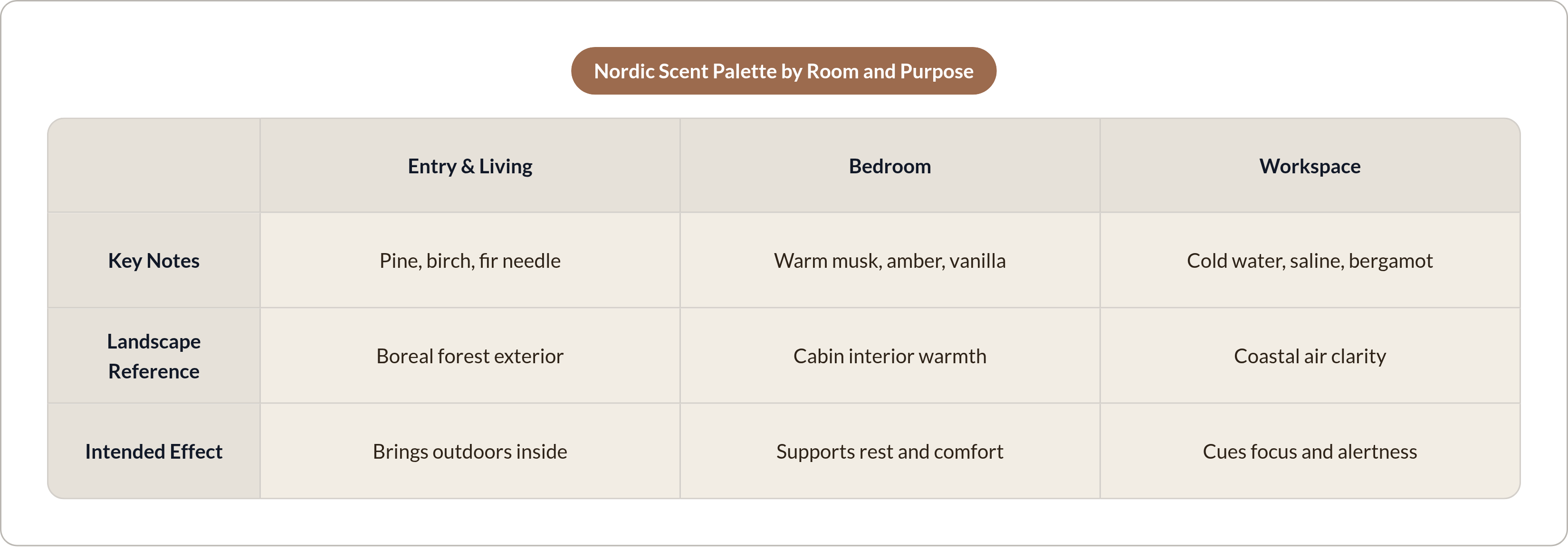
Room-by-room application maps naturally onto the Nordic palette. Entry and living spaces respond well to forest and green notes, pine, birch, fir, bringing the outdoors inside in a way that registers immediately. Bedrooms call for warm musks, amber, vanilla, the hygge-adjacent comfort that supports rest rather than alertness. Workspaces benefit from cold water, saline, bergamot, the clarity of coastal air as a cue for focus.
Roughly two-thirds of consumers globally now prefer home fragrance products that smell as natural as possible, and close to half favor natural household fresheners over synthetic alternatives. But market movement and philosophy are two different things, and conflating them is easy. The Nordic approach asks you to determine what scent is actually for before you decide what scent to choose. That sequencing matters.
Scent in a minimalist home is not minimized. It is curated with the same care given to every other material element. Lagom, the Swedish concept of just the right amount, means exactly what the space requires, no more. That is considerably harder to achieve than abundance, because abundance requires no decisions. You just keep adding.