Seasonal Fragrance Rotation for Mood Regulation
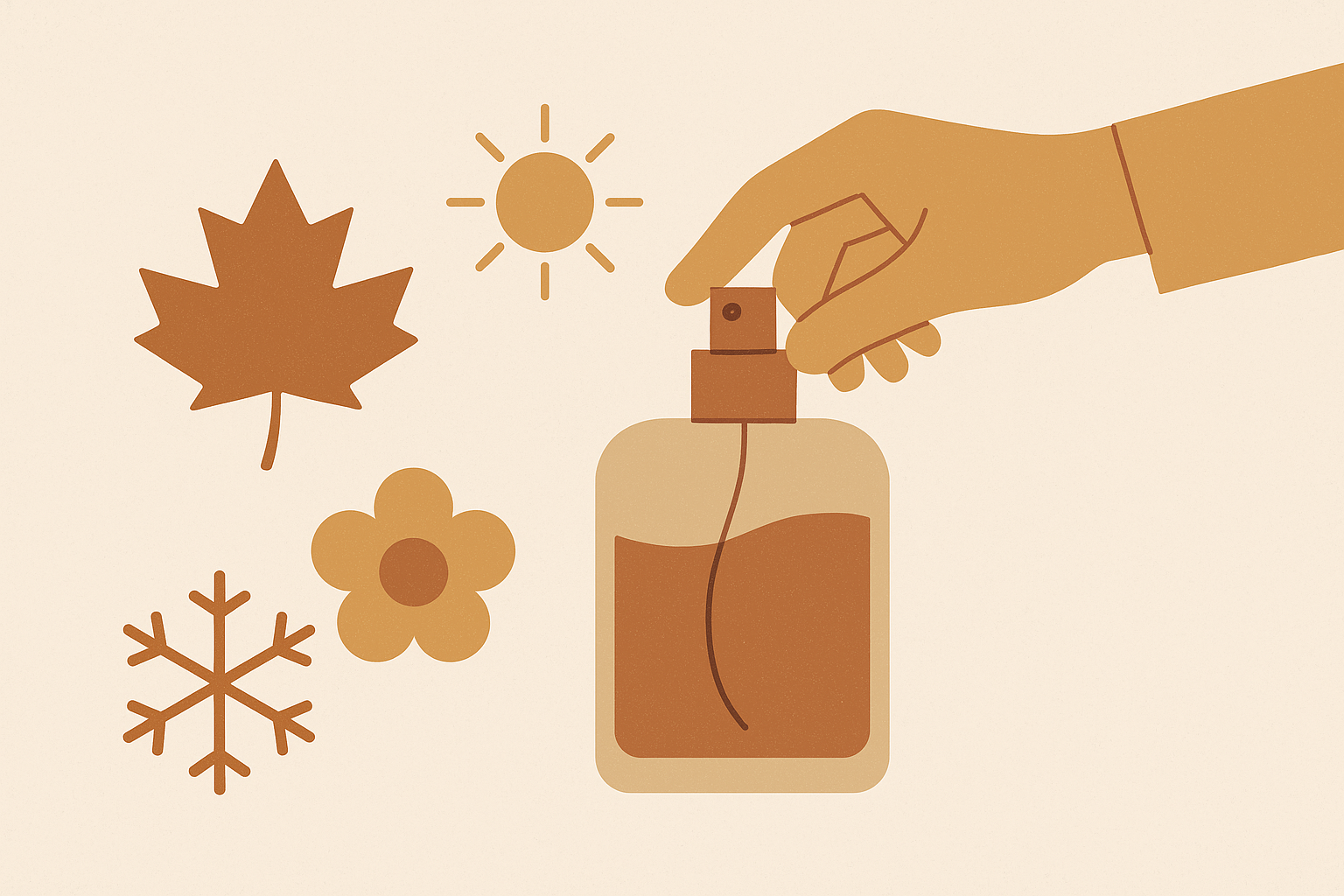
Rotating fragrance oils through the seasons is a mood-regulation habit backed by real neuroscience. Functional fragrance, meaning scents marketed for sleep, focus, stress relief, or energy, grew 23% year-over-year across North America and Western Europe in 2025, and research cited by Statista found 80% of fragrance users now consider scent essential to mood management. That's the whole premise of this piece: if scent reliably shapes how you feel, then rotating it on purpose, season by season, turns a home diffuser from background furniture into an actual tool. Most people already do a version of this instinctively; they just never treat it as a practice worth refining.
How scent reaches the brain faster than almost any other input
Here's the part that gets skipped in most fragrance marketing: smell doesn't take the scenic route through your brain the way sight and language do. Odor molecules travel through the olfactory bulb straight into the amygdala and piriform cortex, which sit in the brain's emotional core. Visual and verbal information get routed through more analytical regions first and get interpreted before they get felt. Smell skips the interpretation step almost entirely.
Rachel Herz, a neuroscientist at Brown University, has described how smell can trigger an emotional response and a memory at the same moment, and odor-evoked memories have been linked to positive physiological responses. Research has found that positive emotions triggered by specific fragrances can lower stress levels and improve overall mental outlook in participants. More recently, a 2024 study published in JAMA Network Open found that odor-linked memories were especially useful for people with depression, a group that tends to recall past events in vague, flattened terms. Scent-triggered recall, by comparison, came back sharper and more positive than non-scent-cued memories.
A fragrance oil doesn't fix a mood on contact. Smell primes and anchors; it doesn't guarantee an outcome, and treating it like a light switch misses how the effect actually works. That caveat is the foundation of the argument for seasonal rotation. Rotation works because you build personal associations over time between a scent and a season, a room, a routine. The effect isn't universal. It's earned.
What specific fragrance families actually do to mood and alertness
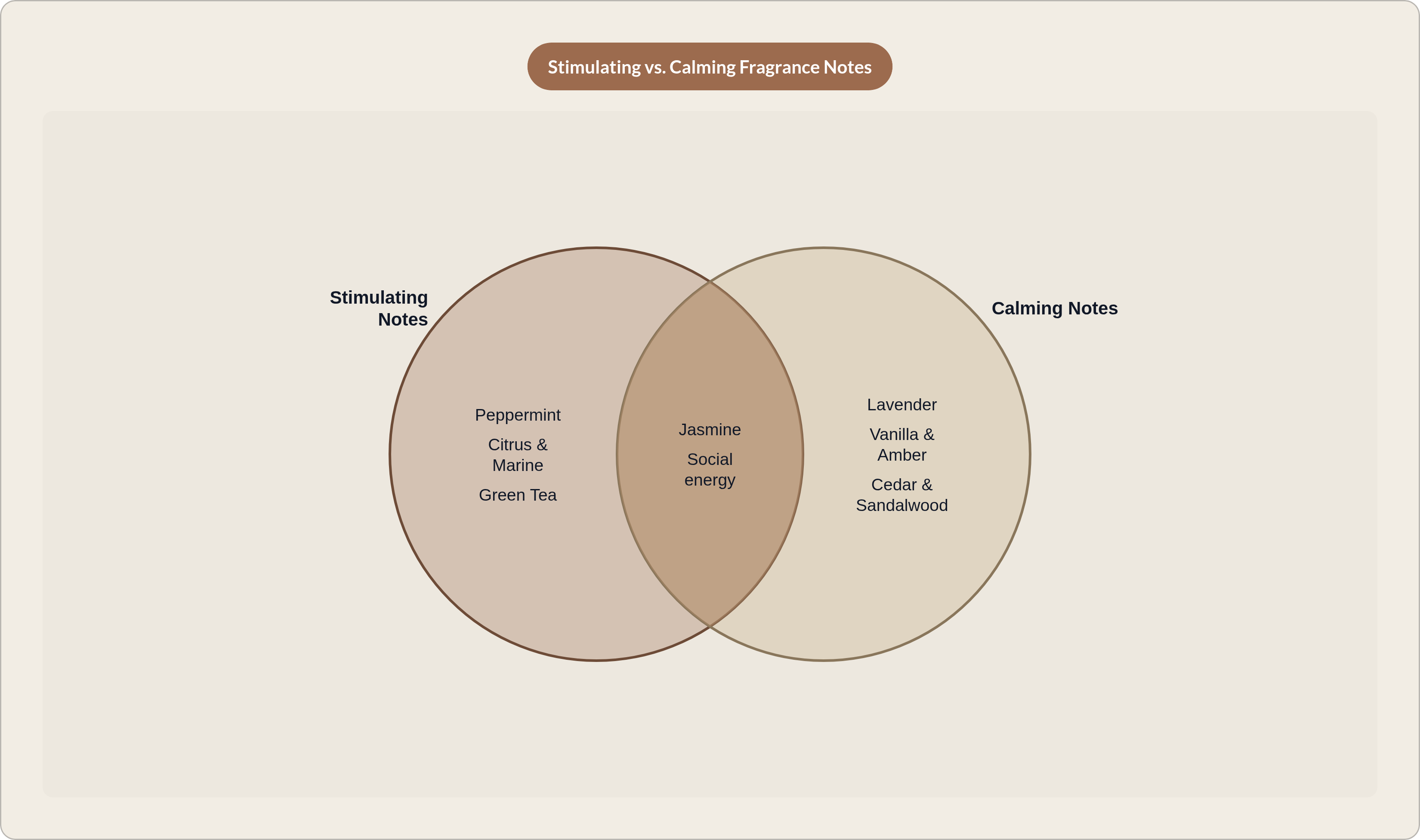
Peppermint has some of the cleanest data behind it. In a study of 144 participants exposed to peppermint, ylang-ylang, or no scent at all, peppermint improved memory performance and raised alertness scores compared to the other two conditions. That's about as close as aromatherapy research gets to a clean cognitive win.
Lavender and vanilla sit at the opposite end. Across several studies, both are linked to calmness and lower anxiety; in one, participants exposed to a pleasant odor reported feeling calm and positive, while those exposed to an unpleasant odor reported mild anxiety. Jasmine lands somewhere else entirely: participants exposed to it reported feeling energized and upbeat rather than sedated. Jasmine reads as a social-energy note, the kind that lifts a room rather than settling it, distinct from a calming note like lavender.
Line these up and a pattern falls out. Sharp, stimulating notes (mint, citrus, green tea) activate. Warm, sweet, or floral notes (vanilla, lavender, jasmine) soothe or elevate, depending on the specific compound. That maps cleanly onto both time of day and time of year: activating notes fit mornings and spring or summer, settling notes fit evenings and fall or winter. One further data point worth sitting with: a biometric personalization study matched custom scent blends to individual cortisol and heart rate patterns and found a 19% improvement in emotional balance among participants, the strongest quantified result in this entire body of research. A single note doesn't work the same way for everyone; personalization multiplies whatever baseline effect the note already has.
Why seasonal change is a legitimate trigger for shifting your scent environment
Seasons change more than the thermostat setting. Light levels shift, indoor-outdoor behavior flips, and the whole psychological texture of a day changes with it: the walk to the mailbox at 7pm in June is a different experience than the same walk in December, dark for two hours already. A home doesn't just look different across seasons; it feels different, and scent is one of the fastest, cheapest ways to acknowledge that shift.
Observed consumer behavior suggests people are moving away from rigid seasonal scent rules, carrying favorite profiles across seasons rather than switching on a fixed calendar schedule. The driver isn't calendar convention anymore. It's emotional fit. Which raises the real question behind this whole section: if the old rulebook (florals for spring, spice for fall, full stop) is loosening, what's actually guiding the rotation?
The psychological register of the season is. Spring signals renewal and clearing, so scent should feel light and forward-moving. Summer runs high-energy and social, often outdoors, so scent should feel clean and alive rather than heavy. Autumn pulls people back indoors as days shorten, so scent should feel grounding and warm. Winter is the deepest anchor point of the four, the season where scent should feel genuinely cozy and familiar, almost like a known quantity in a stretch of the year that can otherwise feel static. A diffuser with scheduling built in makes this rotation automatic rather than another thing to remember: set the seasonal profile once, and the atmosphere shifts on its own from there.
A practical seasonal scent map by note family and room
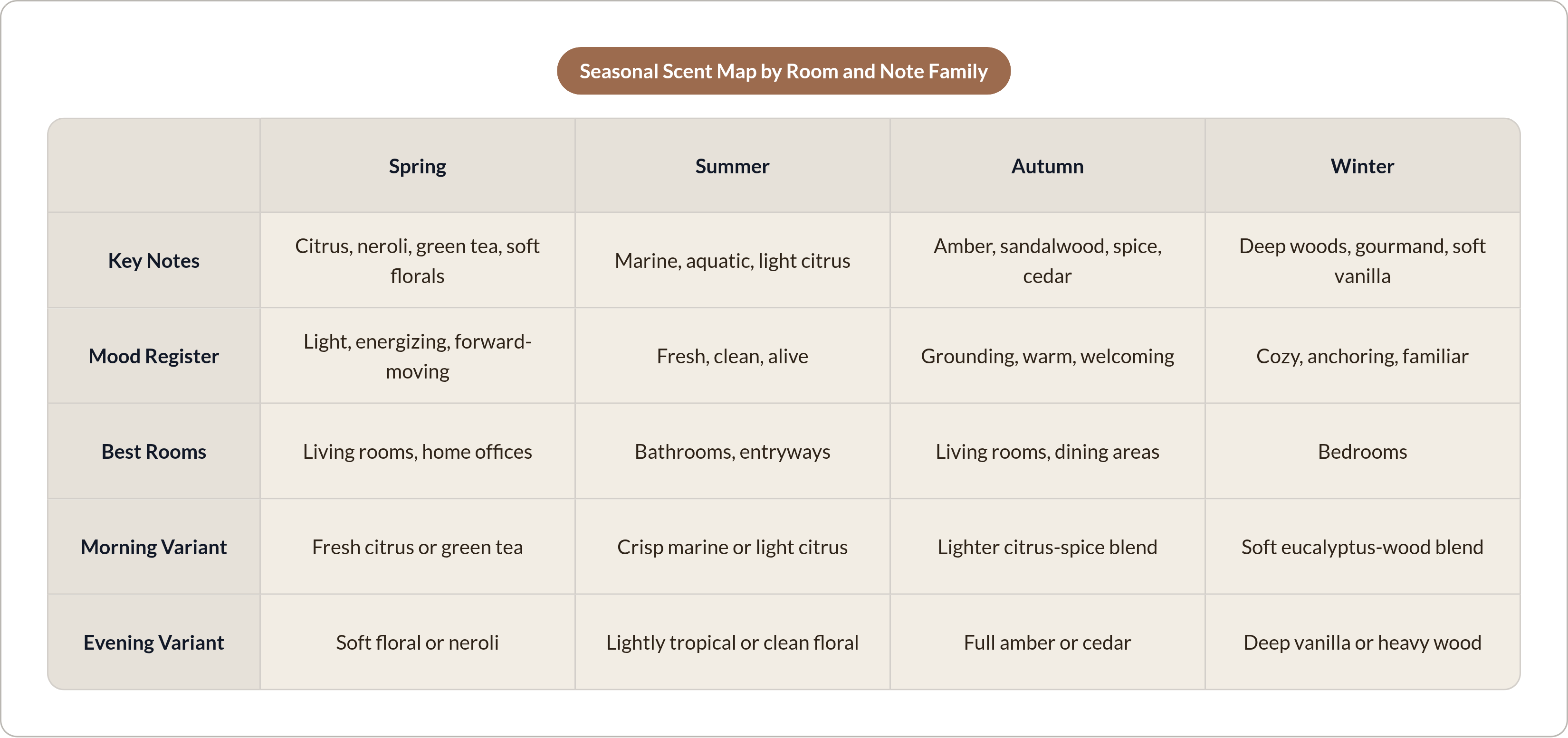
Spring calls for fresh tea, citrus, neroli, soft florals, and green notes, the kind of scent profile that reads like an open window. Living rooms and home offices get the most out of this register; it's light enough to energize without overwhelming a space where people are trying to think.
Summer wants airy, clean, lightly aquatic or tropical notes: marine accords, citrus, nothing sweet or heavy. Bathrooms and entryways are natural fits here, since the goal is freshness, not richness.
Autumn shifts toward amber, sandalwood, spice, cedar, and vanilla; living rooms and dining areas carry these well, especially once the sun starts setting at 5:30pm and entertaining season kicks in. Winter goes deeper still: heavier woods, cozy gourmand blends, soft hotel-lobby-style profiles that fill a room rather than just touching it. Bedrooms benefit most here, run at low intensity, since the goal is signaling rest, not saturating the air.
Layer time of day into each seasonal palette rather than treating the season as a single fixed note. In autumn, mornings might call for a lighter citrus-spice blend, saving the full amber for evening. In winter, mornings might lean on a soft eucalyptus-wood combination, with deep vanilla reserved for the hours before bed. The season sets the tone; the time of day adjusts the volume.
Room by room, the logic holds steady: living rooms stay welcoming and versatile, rotating fully with the season. Bedrooms stay calming and intimate, so keep the intensity low and stick to the softer end of whatever the season's palette offers. Home offices need to energize without distracting, so mint, green tea, and jasmine work best, adjusted seasonally but always kept crisp rather than sweet. Bathrooms stay fresh and clean year-round, built on a citrus or marine base with light seasonal accents layered on top. This doesn't require an overhauled oil cabinet each quarter. Two or three key oils rotated per season is enough to shift how a home actually feels.
Why cold air diffusion is the right delivery method for a rotation practice
A rotation practice only works if the scent stays consistent between uses. If the fragrance profile shifts every time humidity or temperature changes, the whole mood-anchoring effect gets muddled, and the ritual stops meaning anything.
Cold air diffusion atomizes fragrance oil into a fine, dry mist without heat or water involved, so the oil's chemical structure stays intact. What comes out of the diffuser matches what went into the bottle, every single time. Heat-based diffusers alter the fragrance molecules as they warm, and ultrasonic, water-based diffusers dilute the oil and pump extra humidity into the room; both introduce variability that works against everything a rotation practice depends on. Waterless diffusion also sidesteps mold risk, water residue, and mineral buildup, so the device stays stable across seasonal transitions instead of needing a deep clean every time you swap oils.
Scheduling matters just as much as the delivery method. Program morning and evening diffusion windows that match the time-of-day logic from the section above, and calibrate intensity to the actual size of the room rather than running the device at full output by default; more fragrance isn't more effective, it's just more. Swapping oils is also simpler on a cold air device, since there's no water residue or heated buildup to clean out before starting the next profile. Aura House cold air diffusers are built and calibrated around this exact idea, sized for specific room coverage so the seasonal scent map above actually lands in the space instead of dissipating in a room too large for it or overwhelming one too small.
What clean fragrance oil formulation means for a year-round practice
Indoor VOC levels can run up to 10 times higher than outdoor air, and a fair amount of that comes from fragrance products releasing synthetic compounds into a closed space, where they linger far longer than they would outdoors. Some conventional fragrance products contain phthalates, compounds linked to hormone disruption and respiratory issues, hidden behind the single word "fragrance" on an ingredient label. Manufacturers aren't required to disclose individual fragrance components, and trade secret protections let them leave the full ingredient list off the package entirely. Assessing a product's safety from its label alone is genuinely difficult when the label isn't required to disclose much.
That gap matters more in a rotation practice than in occasional use. A diffuser running daily, year-round, across four different oil profiles, is a different exposure pattern than lighting a candle twice a month. Vegan, cruelty-free, phthalate-free formulations remove the chronic exposure risk that builds up with daily use, and pet-safe, child-safe formulations matter even more once a rotation spans an entire house rather than one room. The whole rotation idea only holds up if the oils cycling through it are safe every day, not just pleasant on the days you notice them.
When evaluating any oil for a rotation collection, look for a disclosed ingredient list, the absence of a vague catch-all "fragrance" entry, and confirmed freedom from phthalates and synthetic VOC carriers. A brand's willingness to say what's in the bottle is the clearest signal available.
Building a four-season diffuser collection without overcomplicating it
Eight oils covers a full year without turning this into a hobby that needs its own spreadsheet: one primary oil per season, plus one transitional or time-of-day variant for each. That's it. Nobody needs a shelf of forty bottles to run a mood-regulation practice.
Transition periods, late winter sliding into spring, late summer easing into fall, are natural points to blend the outgoing season's oil with the incoming one rather than making a hard cutover on some arbitrary date. The blending itself becomes part of the ritual, not a chore before it. Store the oils you're not using somewhere cool and dark, away from heat sources; cold air diffusion protects oil quality inside the device, but the bottles sitting in a cabinet still need decent storage conditions to hold up.
Lean on the diffuser's scheduling function to set seasonal windows once, at the start of each season, rather than adjusting settings daily. The goal is a steady atmospheric anchor, not a project you're managing. And here's the actual test of whether the practice is working: does the house smell meaningfully different in February than it does in July, and do those differences feel right for how each season actually feels to live in? Tuned, rather than staged like a seasonal display at a store. A seasonal oil collection paired with a diffuser also makes a solid gift for exactly this reason: it hands someone a complete starting point, a device with a clear sense of what to run through it and oil with a clear purpose behind it.