Scent Anchoring for Anxiety and Stress Relief at Home
Scent anchoring is a conditioning trick: you pair a specific smell with a calm state on purpose, over and over, until the smell alone can call that state back up without you doing anything else. This piece gets into why the trick works on your nervous system rather than your willpower, what the research actually measures versus what it just implies, and how a cold air diffuser, used with some discipline, turns a nice-smelling room into an actual tool instead of a candle you light when guests are coming over.
Smell gets to skip the line other senses have to wait in, and that's wiring, not mysticism. Sight and sound both route through the thalamus first, a relay station that sorts sensory input before handing it off to the parts of the brain that decide what it means. Smell skips that step entirely. Olfactory receptors in the nose catch airborne molecules and fire straight into the olfactory bulb, which sits right next to, and wires directly into, the amygdala and hippocampus, your brain's emotion and memory centers. No layover. No filtering. That's the reason a smell can drop your stomach or unclench your shoulders before you've even figured out what you're smelling. A 2025 paper in ScienceDirect calls this "a rapid and relatively effortless path to emotion regulation," and flags it as promising for people who struggle with effortful coping strategies, anxiety and depression included. I keep circling back to that phrase, mostly because "effortless emotion regulation" isn't language this field throws around casually. Everything below is built on that one anatomical shortcut.
What scent anchoring actually is and where the concept comes from
Anchoring, in the conditioning sense, is what happens when you pair a stimulus with a targeted emotional or physiological state repeatedly, until the stimulus alone can trigger the state. It's not a metaphor lifted from a self-help book. It's classical conditioning, the same basic wiring behind Pavlov's dogs, except a scent stands in for the bell, and a learned sense of calm stands in for the drool.
There's a registered clinical trial at University Hospital Strasbourg (NCT07444255, estimated completion May 2029) studying olfactory anchoring specifically for anxiety relief. The protocol pairs a scent with a relaxation state induced through hypnosis, so the scent alone can later re-trigger that relaxed response without the hypnosis session attached. The investigators point out something hypnotherapists have leaned on for years: smell is unusually good at stimulating the imagination when someone's building a "safe place," which is the backbone of a lot of anxiety work in that field.
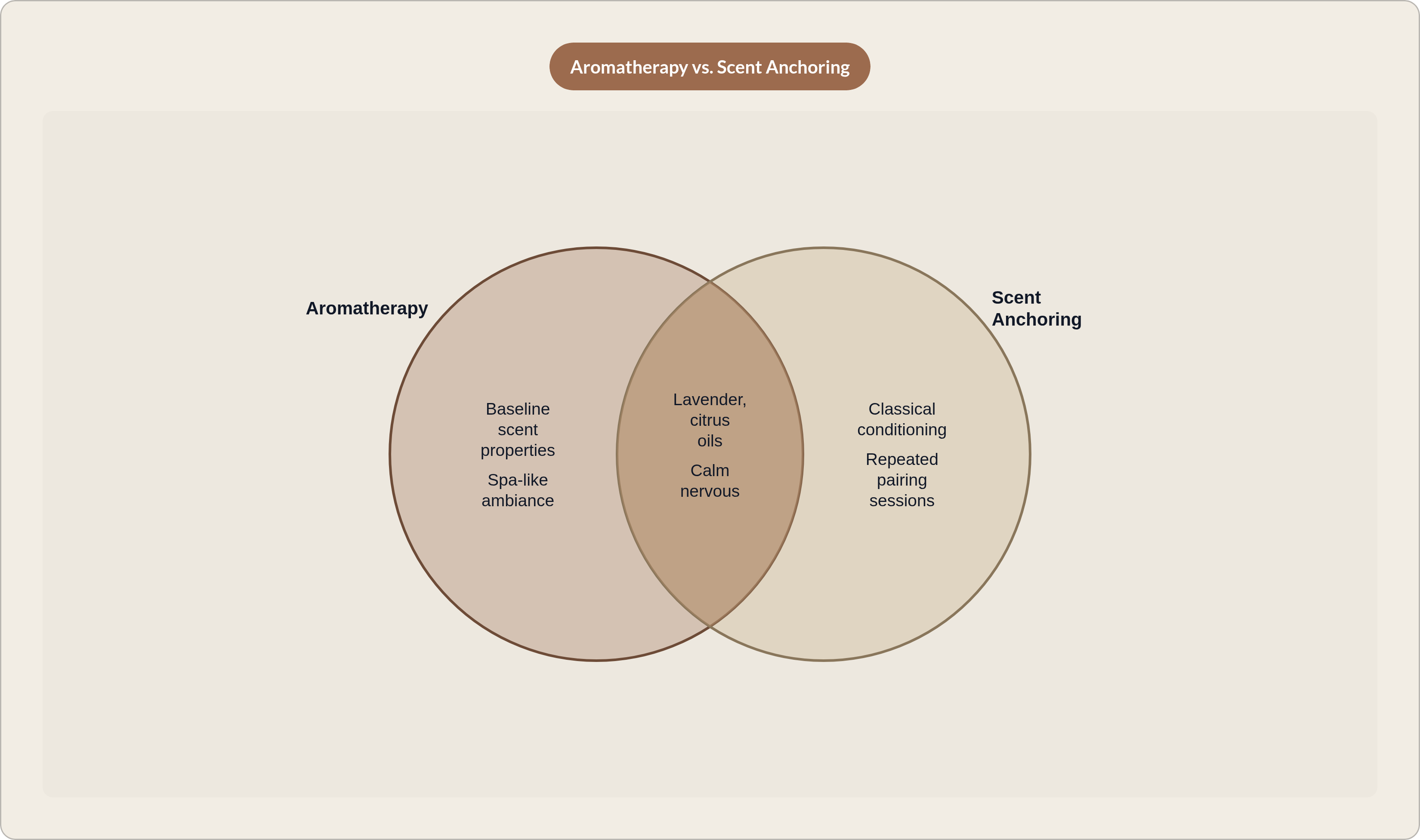
Here's where it splits from ordinary aromatherapy. Aromatherapy leans on a scent's baseline properties: lavender calms you because lavender is, on some pharmacological or psychological level, calming, full stop. Anchoring stacks a second layer on top, a conditioned association you build deliberately, pairing by pairing, and that layer compounds. Each repetition tightens the link, until the scent works in a stressful moment that has nothing to do with the calm context where you built it in the first place. You're training a response, not just burning something that smells like a spa lobby and crossing your fingers.
What the research says about specific scents and measurable anxiety outcomes
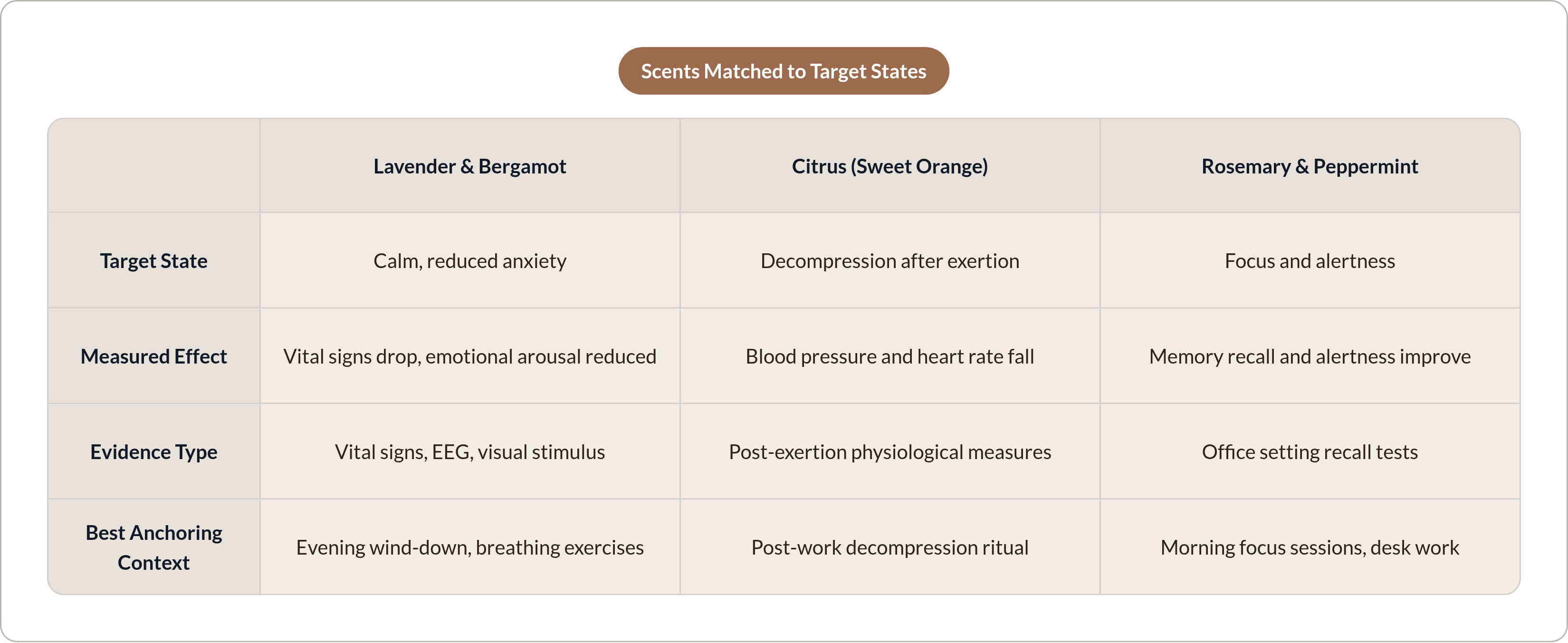
Start with the number that gets cited most, because it's a good one. A study referenced in Frontiers in Psychology found lavender oil produced a 32% reduction in anxiety among patients waiting for minor surgical procedures, along with measurable drops in heart rate and blood pressure. That's not a mood scale filled out after a nice whiff of something. Those are vital signs moving.
A 2025 pilot study in Frontiers in Behavioral Neuroscience used EEG to track brain wave activity and found certain scents increased alpha and theta activity, both tied to relaxed states, while cutting beta activity, which tracks with alertness or anxiety. Brain-wave data, not a questionnaire. A separate 2025 ScienceDirect study found lavender specifically reduced emotional arousal in response to high-intensity visual stimuli, which suggests it's doing something to reactive anxiety, the sudden-stressor kind, not just the low hum of background stress.
Citrus scents, sweet orange especially, showed up in a 2025 Frontiers in Psychology study with measurable drops in blood pressure, heart rate, and heart rate variability after mental exertion. Useful if you're the type who needs a decompression ritual after closing the laptop at 6pm.
A 2026 narrative review in MDPI, covering 47 studies on essential oils for anxiety, depression, and stress in women, found the strongest evidence clustering around lavender, bergamot, rose, chamomile, clary sage, and ylang-ylang, with inhalation as one of the most studied delivery methods in that body of work. Rosemary and peppermint sit in a different bucket entirely. A 2025 study in the International Journal of Environmental Research and Public Health measured an 18 to 20% jump in memory recall and alertness in office settings. That's a focus effect, not a calming one, and it's worth knowing the difference if what you actually want from your diffuser is sharper attention rather than a slower pulse.
So where does that leave you? Match the scent to the target state. Lavender and bergamot for calm, citrus for decompression, rosemary or peppermint if you're anchoring focus instead of relaxation. What the research doesn't cover yet is the long game, and that gap is worth sitting with instead of glossing over. Most of these studies measure a single session, a single EEG reading, not what happens after eight weeks of deliberate daily pairing. The conditioning effect this whole piece is built around sits on top of those baseline findings; it's additive, and mostly unmeasured on its own terms so far.
Why the delivery method determines whether the anchor holds
Conditioning runs on consistency. Change the cue's shape every time you present it, whether that's intensity, molecular profile, or a scent that just smells subtly off from last week, and the brain has a harder time locking in the association. The anchor builds slower, or it doesn't build at all.
This is where a lot of home fragrance quietly falls apart. Heat-based delivery, wax melts, scented candles, plug-in warmers, all change fragrance chemistry as they run. Top notes, the citrus and light florals that hit your nose first, tend to turn bitter or flat under sustained heat. Base notes like musk and amber go muted. What reaches your nose isn't the oil as formulated; it's a thermally altered version of it, and that version shifts depending on how long the wax has been melting or how hot the warmer runs that day.
Water-based ultrasonic diffusers have their own inconsistency problem. They dilute the oil before dispersing it, and the resulting intensity and composition shift with the water-to-oil ratio, the fill level, even the mineral content of the water. Fill it a little differently one morning and the cue is a little different too.
Cold air diffusion works on a different mechanism. Air pressure atomizes the oil into microscopic particles, no heat, no water. The full molecular structure of the fragrance reaches the air mostly intact, so what your nose gets on session ten looks like what it got on session one, assuming same oil, same device. For anchoring, that reproducibility is the whole mechanism. The brain needs a stable, identifiable cue to condition against; a moving target doesn't build a reliable association, it just builds vague good vibes, and vague good vibes don't hold up under stress.
Cold air units also tend to cover more square footage than candles, plug-ins, or ultrasonic diffusers, which matters if you want the cue filling the room instead of just the six inches around the device. And with no added humidity in the process, there's nothing interacting with ambient moisture to shift how the scent disperses, which matters more than people assume in climates where indoor humidity swings hard by season.
How to choose a scent that is safe and stable enough to anchor with
An anchor scent has to hold its identity across bottles and across months, which makes formulation transparency less of a nice-to-have and more of a prerequisite. If you don't know what's actually in the bottle, you can't be sure the thing you're conditioning yourself against today is the same thing you'll be smelling in April.
Here's the regulatory gap that trips people up: the word "fragrance" or "parfum" on a label can legally stand in for hundreds of undisclosed compounds, none required to be individually tested or listed. Phthalates, often used to make scent last longer, are one of the most common things hiding behind that blanket term. They're endocrine disruptors, and diffusing them means inhaling them, a different exposure route than a lotion just sitting on skin.
What to actually look for: full ingredient disclosure instead of a vague catch-all term, a phthalate-free formulation, compliance with IFRA (International Fragrance Association) safety standards, and, if it matters to you, a cruelty-free certification like Leaping Bunny. Worth separating "natural" from "safe" here too, because people treat those words as synonyms and they aren't. Some essential oils irritate airways or cause phototoxic reactions at diffusion concentrations, while certain well-vetted synthetic compounds are demonstrably safer in that same context. Natural doesn't automatically win that argument, whatever the label implies.
If there's a cat or dog in the house, this section stops being optional. Lavender, eucalyptus, and tea tree, all calming for humans, carry real risk for cats and dogs. A brand publishing a pet-safe oil list with full ingredient disclosure isn't a bonus feature. It's the baseline worth checking before you buy anything.
Aura House fragrance oils fit this brief: phthalate-free, vegan, cruelty-free, with full formulation transparency, built to hold a consistent scent profile across uses in a cold air diffuser, which is exactly the property anchoring depends on. If you don't want to overthink this part, pick one oil that meets the criteria above, confirm it's phthalate-free and pet-safe if that applies to your household, and don't let it drift into other uses until the anchor is actually established.
How to build a scent anchor step by step using a cold air diffuser
Step one: pick a single dedicated scent and don't use it for anything else yet. It shouldn't be the smell you already associate with cleaning the kitchen, or the candle your sister gave you for your birthday two years back. Novelty speeds up conditioning. A scent with no baggage attached is a blank slate, and blank slates condition faster than ones already crowded with other memories.
Step two: fix a consistent time and place. Context stability matters here almost as much as the scent itself, so pick the same room, the same time of day, and pair it with the same activity, meditation, a breathing exercise, reading, whatever your wind-down actually looks like. Evenings work well as an entry point, mostly because the nervous system is already leaning toward downregulating anyway.
Step three: start the diffuser before the calm state begins, not partway through, not after the fact. The association forms while the scent is present as you're entering calm, so timing this backward defeats the whole point. If the diffuser has a scheduling function, use it. Automating this step removes the chance you'll forget, which, let's be honest, you will, at least twice, maybe more if it's been a long week.
Step four: control the intensity on purpose. More isn't better here. An overwhelming concentration reads as sensory overload, not calm, and that works against the entire premise. A cold air diffuser's adjustable output lets you dial to something present but not dominant, a background note rather than a wall of scent, and that fine control is one of the clearer advantages it has over a candle or plug-in, where your only real setting is "on."
Step five: repeat, consistently, for several weeks, before testing the anchor under actual stress. Two or three sessions don't make an anchor. Conditioning builds through repetition, and daily or near-daily pairing during a calm activity is the realistic bar before you can expect the cue to do anything on its own.
Step six: activate it when stress actually shows up. Run the diffuser during a tense evening, before a hard phone call, in the middle of a rough work-from-home stretch. If the conditioning took, the nervous system recognizes the cue and starts drifting toward the associated state, the same way it was trained to during all those calm sessions weeks earlier.
Placement matters more than people expect: nose height, away from HVAC vents that scatter or dilute the scent, in the same room where the actual anchoring sessions happen. Check that the diffuser's coverage rating matches your real square footage too; an underpowered unit in a big room delivers an inconsistent cue, which undercuts the whole project before it starts. Diffusers with programmable scheduling and adjustable intensity map pretty directly onto the consistency this entire technique runs on.
Keeping the anchor reliable over time
The anchor is only as stable as the scent underneath it. Change the scent, even slightly, and the cue weakens. Fragrance oils oxidize over time, and that process speeds up in warm or sunlit storage, so keep the bottle somewhere cool and dark, and it's not a bad habit to jot down roughly when you opened it.
Diffuser maintenance affects this more than most people assume. Residue from previous oils builds up inside the atomizer and can contaminate whatever you're diffusing now, so a dirty diffuser is quietly handing your nervous system a slightly different cue than the one it was originally conditioned against. Cleaning it on the schedule the manufacturer recommends isn't just general upkeep; for anchoring specifically, it's what protects the signal.
Guard the scent's exclusivity too. The moment that same oil starts freshening up the guest bathroom, or covering last night's dinner smell, it picks up competing associations and loses some of its specificity as a stress-relief cue. If life throws a curveball, a move, a stretch of bad stress, a long gap where the diffuser sat forgotten in a closet, the anchor doesn't need rebuilding from scratch. A short re-conditioning stretch, one to two weeks of repeating the original pairing routine, tends to bring it back.
Once it's solid, it doesn't need daily activation forever. Occasional use during calm states is usually enough to keep the link functional long-term, which is good news for anyone who pictured themselves diffusing lavender every single night for the rest of their natural life.