Fragrance as Part of a Meditation or Breathwork Practice
Fragrance changes what your body does during meditation. It's measurable physiology, and the catch is that it only works if you deliver the scent the exact same way every single time. Smell takes a more direct path to the brain than other senses do, which means pairing one scent with one practice, over and over, wires an actual shortcut into your nervous system. Most delivery methods people already use, candles, incense, sprays, wreck that consistency without anyone noticing until the shortcut just stops firing.
How specific fragrances affect the body during breathwork and meditation
Smell takes a shorter path to the amygdala and hippocampus than your other senses do. Sound and touch and sight all route through the thalamus first, like mail getting sorted before it lands on your desk; smell skips the line entirely. That's a structural fact about the olfactory bulb, and it explains why a scent can shift your mood before you've consciously clocked what you're even smelling.
Rachel Herz, a neuroscientist at Brown University, found that scents tied to personal memory produce slower, deeper breathing than generic pleasant odors do. Your body runs this without asking your conscious mind for permission. Calming scents nudge brain activity toward alpha and theta patterns, the frequencies tied to meditative states, and stacking intentional breathing on top flips the nervous system into parasympathetic dominance faster than breathing alone gets you there. Heart rate drops. Cortisol follows it down.
"Calming scent" gets thrown around as a catchall so often it's basically lost meaning, so let's get specific. Frankincense has been burned in temples for for thousands of years, and modern research at least partially backs the folk wisdom: mild sedative properties, no drowsiness, measurable activity in brain regions tied to emotional regulation. Lavender works a different lever entirely, slowing sympathetic nervous system activity. Certain scents, including jasmine and clary sage, show documented effects on heart rate fast enough to matter within a single sit.
Woody profiles, cedarwood, sandalwood, vetiver, oud, ground you rather than sedate you. Oud shows up across a striking range of spiritual traditions specifically tied to meditative depth, which is a strange amount of cultural consensus for a tree resin to earn on its own. Heavier, resinous scents slow a room down, while rosemary and peppermint sharpen alertness and invite a completely different kind of focus. A restorative body scan and a box-breathing session built for concentration are oriented toward different states, so the scent that helps one won't necessarily help the other.
Personal scent memory bends all of this more than research papers like to admit. Someone's calming lavender is someone else's grandmother's closet, and untangling that particular knot is a job for a therapist, not a diffuser. Matching fragrance profile to practice type is still a real, measurable lever though, and it's one almost nobody thinks to pull.
The scent anchor: how repeated pairing trains the brain over time
Repetition is where the actual payoff shows up. Pair one scent with one meditative state often enough and the brain builds a shortcut between the two, something researchers call neural entrainment. Eventually one inhale does part of the work that used to take five minutes of settling in. The scent stops accompanying the practice and starts triggering it outright.
The protocol is straightforward. Pick one fragrance and reserve it only for meditation, not laundry, not the car, not a "nice smell" drifting through the living room on some random Tuesday afternoon. Every time that scent shows up somewhere else, you dilute the association you're trying to build. Cross-contamination is the quiet part that ruins this, the part nobody warns you about because it doesn't look like a mistake while it's happening. Give it two to four weeks of consistent use and the scent alone starts triggering the physiological shift before you've sat down on the cushion.
Luxury wellness properties build entire ambient strategies on the same logic. The WELL Bay Harbor Islands diffuses a signature blend of bergamot, ylang-ylang, cedarwood, and frankincense through its common areas specifically to anchor guests in the present moment, in their own words. A nervous system cued the same way enough times just stops needing convincing.
The anchor only holds if the delivery holds: same fragrance, same intensity, same timing, sit after sit. Which raises the actual question worth sitting with. How is that scent getting into the air, and can the method you're using hold still long enough to build the association in the first place?
Why most common delivery methods introduce variables that undermine a scent anchor
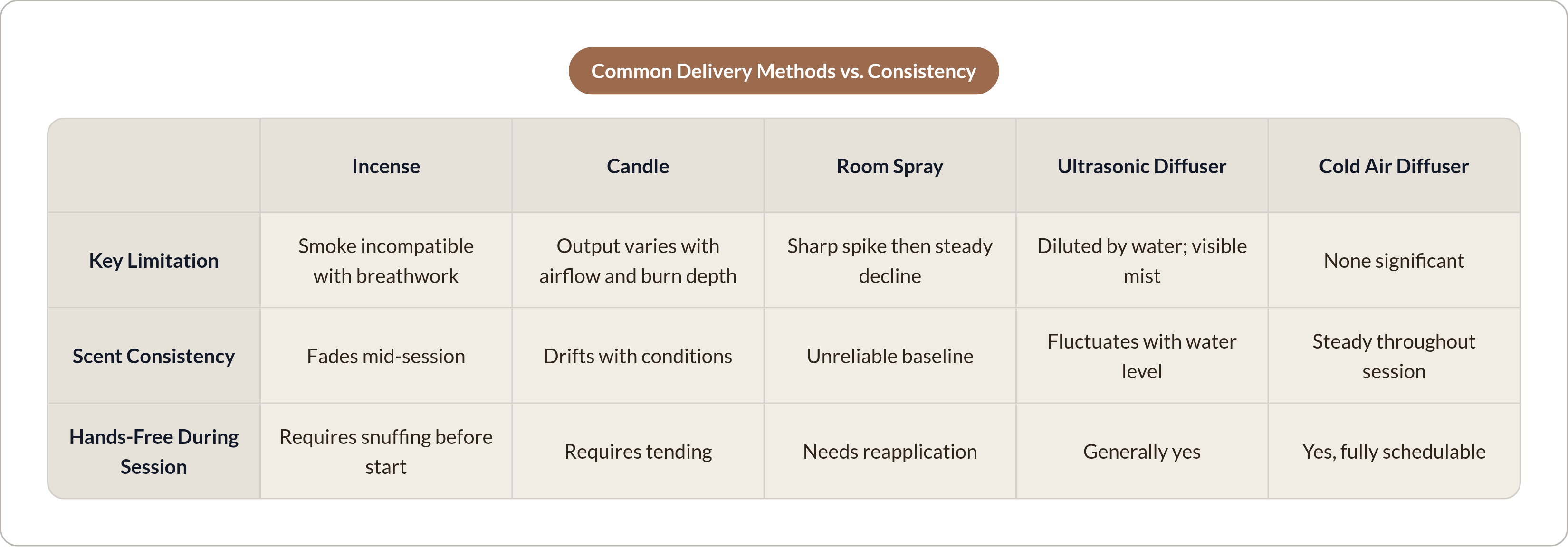
Nobody thinks this part through, mostly because it doesn't seem like it should matter this much. It does.
Incense has serious pedigree, showing up across Buddhist, Hindu, Ayurvedic, and countless indigenous ritual traditions as a strong signal that a practice is beginning. The trouble is smoke and deep nasal breathing don't mix well, so plenty of practitioners light it, then snuff it out right before the breathing exercises start. That's a workaround, not a fix. The scent shows up at the beginning of the sit and is gone by the middle of it, which defeats the point of an anchor that's supposed to hold for the whole thirty minutes.
Candles have their own charm; the flame gives your eyes something to rest on before you close them. But scent throw drifts with airflow, room temperature, and how far the wax has burned down, and it demands tending: light it, watch it, blow it out, repeat tomorrow. Topical application, a dab on the wrist, feels intimate and works fine for one deliberate inhale, but it fades within minutes and needs reapplying, which means moving during a practice built entirely around not moving. Room sprays spike hard and vanish, giving you a burst followed by a steady decline instead of anything resembling a level baseline. Water-based ultrasonic diffusers dilute fragrance with vapor and fluctuate as the water level drops, and the visible mist can feel like an intrusion in a room where the whole goal is sitting still.
Heat-based diffusers have a flaw that's easy to miss. Heat-based diffusers apply thermal energy to fragrance oil before it reaches your nose, which can change what you're actually smelling relative to what was in the bottle. Every method here trades consistency for convenience somewhere, and most people don't clock the trade until the ritual starts feeling unreliable for reasons they can't quite name.
What a cold air diffuser does differently inside a breathwork session
Cold air diffusion sidesteps the trade-off by refusing both heat and water. The device nebulizes fragrance oil into fine particles, so the oil's chemical makeup reaches the air essentially intact, no thermal breakdown, no dilution in between.
No water in the system means no humidity swings and no visible mist to catch your eye mid-breath. Output holds steady for the entire session because nothing is burning down and nothing is evaporating unevenly. The diffuser runs at whatever level you set before starting, and it keeps running there until you stop it. Minute one smells like minute thirty. The anchor holds because the input holds, plain as that.
Scheduling adds something that matters more than it sounds like it should. A diffuser set to start before the session and stop automatically after means nothing to touch mid-practice, nothing to light or watch or blow out between breaths. Skipping an open flame also skips smoke and combustion byproducts drifting into a room where someone's doing pranayama, which isn't a small detail when the entire point of the exercise is pulling more air, more deliberately, into the lungs. Aura House makes cold air diffusers designed to stay unobtrusive during a session. What's left is the scent itself, delivered with the same steady consistency that professional scenting systems build into hotel lobbies and spa corridors, just shrunk down to fit a bedroom.
Why what is in the fragrance oil matters as much as how it is delivered
Delivery is only half the equation. Here's the part that gets a little less pleasant to talk about, and the part most diffuser marketing conveniently skips over.
Deep nasal breathing during pranayama pulls air more fully into the lungs than ordinary breathing does, so whatever's actually in that air matters more here, not less. This is where fragrance labeling gets genuinely murky. The word "fragrance" on a label can legally stand in for a blend of up to 3,500 individual chemicals, and manufacturers aren't required to list a single one of them. Terms like "natural fragrance," "aroma," or "parfum" sound reassuring, but they're umbrella terms that can still carry synthetic compounds, including phthalates, volatile organic compounds, and substances flagged as potential endocrine disruptors.
Natural doesn't automatically mean non-toxic, and this trips up a lot of well-meaning people. Some essential oils carry their own risk of skin sensitization or phototoxicity at higher concentrations, so slapping "natural" on a label isn't the reassurance it's marketed as. What actually matters is whether a fragrance oil discloses its ingredients, skips synthetic fillers and hormone-disrupting compounds, and has been tested for indoor inhalation safety. Anyone sharing a home with pets or kids, who breathe the same diffused air whether they signed up for the meditation practice or not, stops treating this as a nice-to-have pretty fast.
That matters precisely because a cold air diffuser preserves the oil's chemistry so faithfully; the faithfulness only pays off if what's being preserved was worth breathing in the first place. Otherwise the consistency just delivers something you'd rather not inhale.
How to set up a home scent ritual that actually holds across sessions
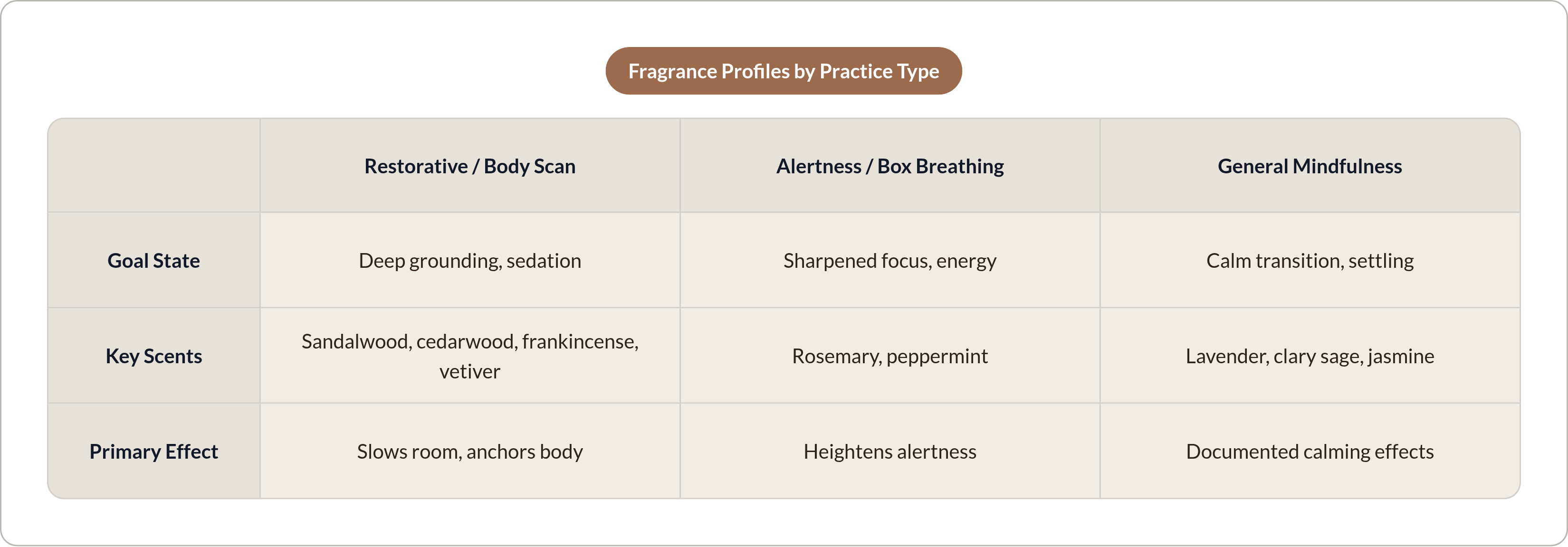
None of this needs a complicated setup.
Pick one fragrance and reserve it strictly for this practice, never as a general room scent, never the candle burning while you make dinner. Exclusivity is what keeps the anchor sharp. From there, match the profile to what the session is actually for. Restorative work or a body scan wants something dense and grounding: sandalwood, cedarwood, frankincense, vetiver. Breathwork built around alertness, box breathing or an energizing pranayama sequence, responds better to rosemary, peppermint, or similarly sharp, clarifying profiles. General mindfulness or a transition ritual between tasks suits lavender, clary sage, or jasmine, all of which show documented calming effects.
Placement matters more than people expect. Put the diffuser where airflow carries scent across your breathing zone and across the room, not six inches from your face. Run it ahead of your session so the space reaches a stable baseline before your first breath, and keep the intensity low; more concentration doesn't mean more benefit when your nose has thirty or sixty minutes of work ahead of it. If the diffuser supports scheduling, use it. Program it to start before you sit and stop when the window ends, so there's nothing left to touch once the session begins.
Give it two to four weeks of consistent use with the same scent, and the ritual starts reinforcing itself without extra effort on your end. The smell alone begins cueing the state before you've done anything else, and at that point the setup runs itself: diffuser on, scent steady, session starts. There's no candle-babysitting, no incense-snuffing, no spray-bottle-hunting, just one variable that, for once, isn't asking anything of you.